
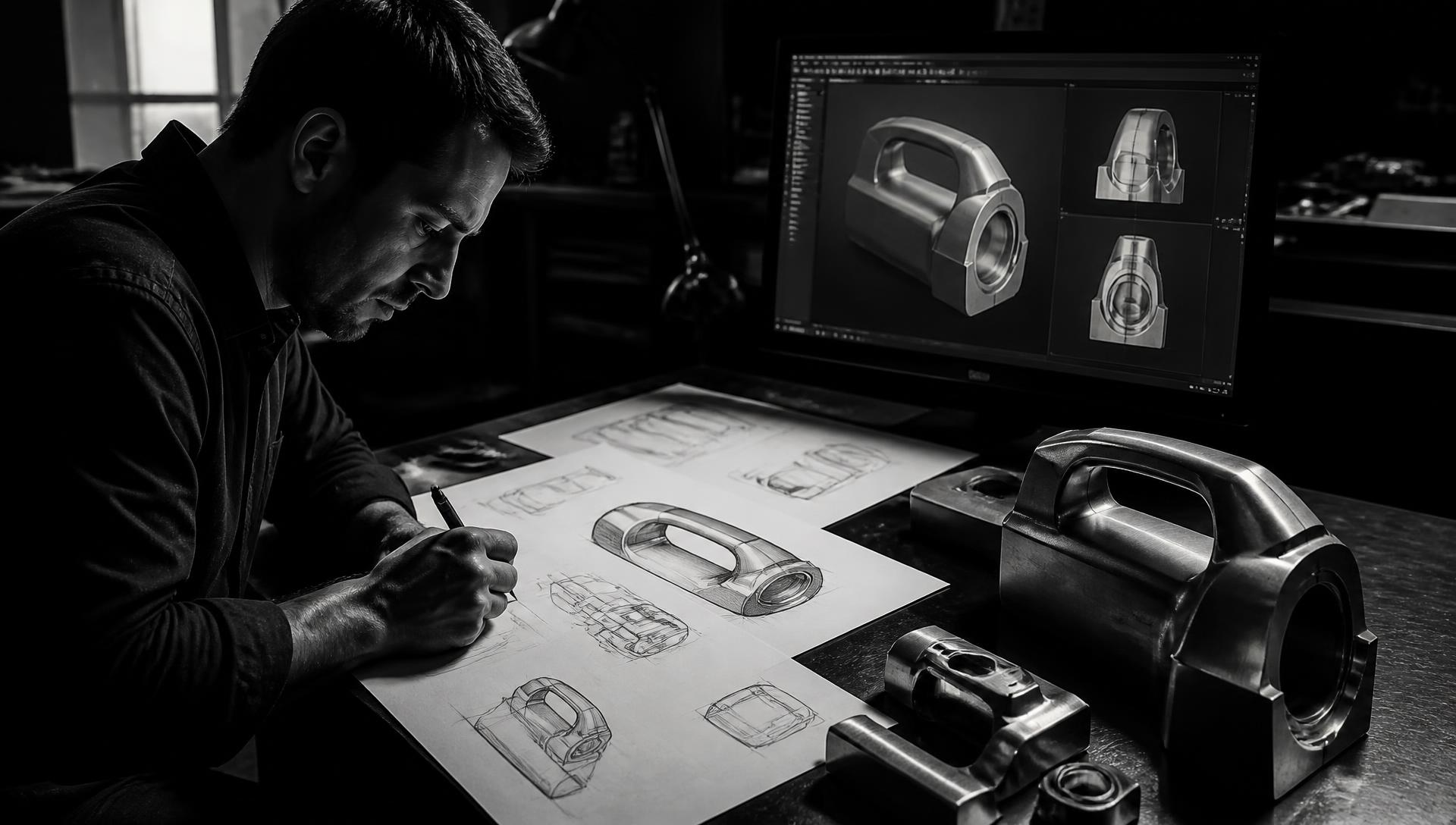
Concept design
Concept Sketches vs CAD vs Prototype: Which Do You Need?
A decision guide for founders deciding where to spend first
Sketches, CAD models and prototypes answer different questions, and buying them in the wrong order is the most common way a first-time inventor burns a budget.
This page compares what each one proves, what it costs, and the question you should be asking before you commission it.
Side by side
| Sketches | Concept CAD | Prototype | |
|---|---|---|---|
| Answers | What could it look like and how might it work? | Will it actually fit together and can it be made? | Does it work and feel right in the hand? |
| Typical cost | $500 – $3,000 | $3,000 – $15,000 | $1,000 – $20,000+ |
| Typical time | 3 – 10 days | 2 – 6 weeks | 1 – 4 weeks after CAD |
| Good for | Exploring directions, early IP conversations | Manufacturing quotes, engineering handoff, patent drawings | User testing, investor demos, retail meetings, certification prep |
| Not good for | Getting a factory quote | Proving ergonomics or durability | Exploring directions — it locks one in |
Answers
- Sketches
- What could it look like and how might it work?
- Concept CAD
- Will it actually fit together and can it be made?
- Prototype
- Does it work and feel right in the hand?
Typical cost
- Sketches
- $500 – $3,000
- Concept CAD
- $3,000 – $15,000
- Prototype
- $1,000 – $20,000+
Typical time
- Sketches
- 3 – 10 days
- Concept CAD
- 2 – 6 weeks
- Prototype
- 1 – 4 weeks after CAD
Good for
- Sketches
- Exploring directions, early IP conversations
- Concept CAD
- Manufacturing quotes, engineering handoff, patent drawings
- Prototype
- User testing, investor demos, retail meetings, certification prep
Not good for
- Sketches
- Getting a factory quote
- Concept CAD
- Proving ergonomics or durability
- Prototype
- Exploring directions — it locks one in
The order that wastes the least money
Sketch until the direction stops changing. Model in CAD until the internals fit and the parts can be made. Prototype once, well, to test the things only a physical object can answer.
Skipping straight to a prototype is tempting and occasionally right — if the product is a single simple part and you already know its shape. For anything with a mechanism or a circuit board, it usually produces an expensive object that teaches you what a $2,000 CAD review would have.
Three common situations
Investor meeting in six weeks
Concept CAD plus renders, and a printed appearance model if the shape matters. Renders carry a deck; a model carries a room.
You need a manufacturing quote
Concept CAD with a rough bill of materials. Factories cannot price a sketch, and quotes from sketches are meaningless.
You are unsure the mechanism works
A crude functional prototype of just the mechanism, before any styling. Cheap, ugly, and it answers the only question that matters.
Where to go from here
- Concept designThe full guide to turning an idea into sketches, CAD and renders.
- Rapid prototypingHow we build working prototypes and what they cost.
- Product development portfolioProducts we designed, engineered and manufactured.
Questions
Frequently asked questions
Can I skip CAD and go straight to a prototype?
Only for a simple single part whose shape you already know. Anything with a mechanism, an enclosure or electronics needs CAD first, because the prototype has to be made from something.
Are renders the same as a prototype?
No. Renders are images generated from a CAD model. They prove appearance, not fit, strength or usability.
Which one do patents need?
Patent drawings are usually produced from CAD or from formal line drawings, not from concept sketches.
Where to go next
- Concept designThe full guide to turning an idea into sketches, CAD and renders.
- Industrial design servicesForm, ergonomics, CMF and surfaced CAD — what it includes and what it costs.
- Rapid prototypingHow we build working prototypes and what they cost.
- Product development portfolioProducts we designed, engineered and manufactured.
- All development servicesResearch, design, engineering, prototyping and short-run production.