
Smart Product Development: Stages, Costs and Timelines
A practical walkthrough of electronic product development: what each stage produces, where connected and IoT projects lose time, and what the work costs.
February 7, 20225 min read

Written by Ashok Chintagunta, MS Computer Science, Louisiana Tech University
CTO & Software Engineer, AI and Automation
Published February 7, 2022Updated August 19, 2026
Electronic Product Development: Stages, Costs and Timelines
Electronic product development is a hardware schedule with a software schedule bolted to it. Most connected products slip not because the circuit is hard, but because firmware, enclosure, certification and supply chain were sequenced as if they were independent. This guide lays out the stages, what each one owes the next, and the budgets teams should plan for.
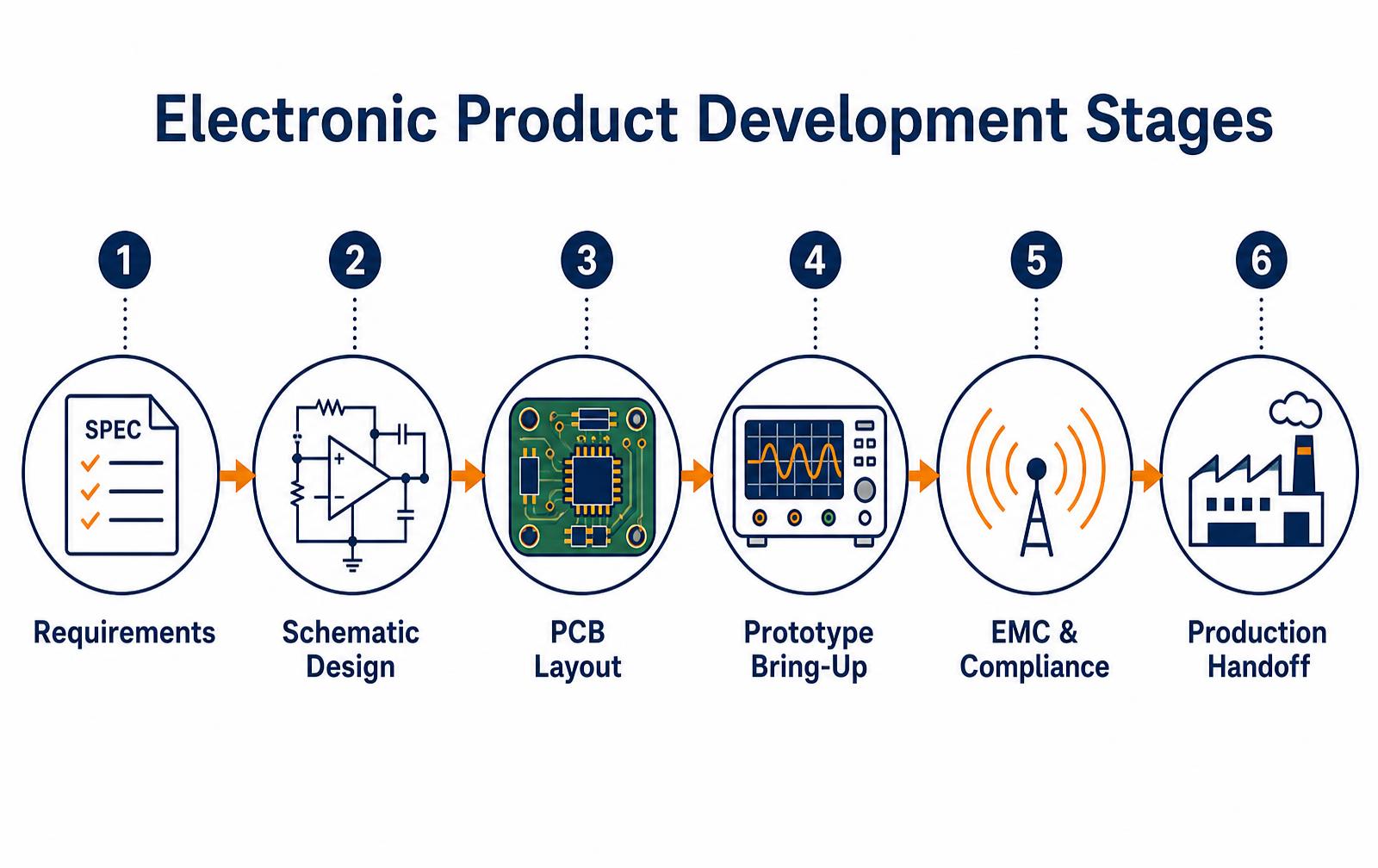
Stages, deliverables and budget
Stage | Deliverable | Duration | Typical cost |
|---|---|---|---|
Requirements and architecture | Block diagram, power budget, connectivity choice, BOM target | 2-4 weeks | $10k-$30k |
Schematic design | Reviewed schematic, part selection with second sources | 3-6 weeks | $15k-$45k |
PCB layout | Stackup, routed board, fabrication and assembly package | 3-6 weeks | $12k-$40k |
Prototype bring-up | Working boards, firmware bring-up, measured power and thermals | 4-8 weeks | $25k-$80k |
Compliance | EMC pre-scan, FCC/CE testing, radio module certification | 4-10 weeks | $15k-$60k |
Production handoff | DFM release, test fixtures, pilot run, yield data | 6-12 weeks | $25k-$100k |
Decisions that set the whole budget
- Pre-certified radio module vs. chip-down design. A module adds a few dollars per unit and removes tens of thousands in intentional-radiator testing and re-spins.
- Battery or mains. A battery target forces duty-cycling, low-power silicon and an early power budget; retrofitting it after layout rarely works.
- Connectivity choice. BLE, Wi-Fi, LTE-M and LoRa differ in certification burden, cloud cost per device and antenna tuning effort.
- Enclosure timing. Tooling needs a frozen board outline and connector positions, so mechanical and electrical release dates must be planned together.
- Test strategy. A functional test fixture designed during layout costs far less than a hand-test procedure invented at the contract manufacturer.
Where connected products actually slip
Two failure modes dominate. The first is component availability: a design locked around a single-sourced part becomes unbuildable when lead times move, so every critical line item needs an approved alternate captured in the schematic.
The second is certification discovered late. An EMC pre-scan on the first working prototype costs a fraction of a failed formal test and usually catches the same clock harmonics and cable radiation problems while there is still room to fix them.
Related reading: our electronic design services and the guide to design for manufacturability.
Electronics development budget by stage
Stage | Engineering spend | Build cost | Duration |
|---|---|---|---|
Architecture and part selection | $8k-$25k | - | 2-4 weeks |
Schematic and PCB layout | $15k-$60k | $1.5k-$6k for boards | 4-8 weeks |
Firmware bring-up | $20k-$80k | - | 6-12 weeks |
Enclosure and mechanical integration | $12k-$45k | $3k-$15k prototypes | 4-8 weeks |
Pre-compliance and certification | $6k-$20k | $8k-$40k lab fees | 6-12 weeks |
Production test fixtures | $8k-$30k | $5k-$20k | 4-6 weeks |
Mistakes that add a spin
- No design for test. Without test points and a fixture plan, factory yield checks become manual and slow.
- Antenna placed last. RF performance is set by board and enclosure layout; retrofitting costs a full spin.
- Single-sourced critical parts. Approve a second source during design, not during a shortage.
- Skipping pre-compliance. A failed formal EMC test costs a board spin plus relab fees.
- Power budget estimated, never measured. Battery life claims collapse at DVT when real duty cycles arrive.
What each electronics stage actually costs
Electronic product development is priced in phases, not as a lump sum, because each phase retires a different risk.
Architecture work decides the microcontroller, radio, power topology and certification path. Schematic capture and layout convert those decisions into a manufacturable board. Bring-up proves the board boots, enumerates and draws the current the budget assumed.
Teams that skip architecture usually pay for it twice: a re-spin costs the full board fabrication and assembly again, plus two to four weeks of schedule. Budget at least two board revisions for any product with a radio, and three when the product combines a radio with motor drive or high-current charging.
Phase | Typical duration | Typical cost | What it produces |
|---|---|---|---|
Architecture and part selection | 2-4 weeks | $6,000-$18,000 | Block diagram, BOM skeleton, power budget |
Schematic and PCB layout | 3-6 weeks | $12,000-$40,000 | Fabrication package, assembly drawings |
Prototype build and bring-up | 3-5 weeks | $8,000-$25,000 | Working boards, test report |
Firmware to functional demo | 4-10 weeks | $20,000-$70,000 | Demo-ready firmware, debug tooling |
EMC pre-scan and certification | 4-8 weeks | $9,000-$30,000 | FCC/CE test reports |
Pre-layout checklist that prevents re-spins
- Lock the power budget in a spreadsheet before layout: worst-case current per rail, not typical.
- Confirm every critical part has a second source with the same footprint.
- Reserve test points on power rails, reset, boot-select and the debug interface.
- Give the radio a keep-out and a matched antenna reference design; do not improvise the ground plane.
- Run a DFM review with the actual assembler before releasing Gerbers.
- Write the bring-up test sequence while the board is still editable.

Connectivity, power and the hidden recurring costs
A connected product carries costs that never appear on the bill of materials.
Cellular modules need a data plan and a carrier certification; Wi-Fi products need a provisioning flow that non-technical users can survive; BLE products need a phone app that must be maintained across two mobile operating systems for the life of the product.
Cloud costs scale with fleet size and telemetry rate, and a firmware update pipeline is a product in its own right. Founders who model only unit economics are usually surprised by the second-year operating line.
Decide the connectivity stack against the use case, not against novelty. A device that reports twice per day does not need a cellular modem if the customer already has Wi-Fi; a device installed in a field or a truck almost certainly does. Battery products live or die on duty cycle: the radio is usually the largest consumer, so measure real transmit current with a power profiler before committing to a cell size.
Recurring item | Typical annual cost | Scales with |
|---|---|---|
Cellular data plan | $12-$60 per device | Fleet size, telemetry rate |
Cloud ingest and storage | $1-$8 per device | Message volume, retention |
Mobile app maintenance | $15,000-$60,000 | OS releases, feature scope |
Firmware OTA infrastructure | $5,000-$25,000 | Fleet size, update frequency |
Certification renewals and re-tests | $3,000-$15,000 | Hardware changes |
Electronic product development team, tools and what each role costs
Electronic product development is rarely one engineer. Even a modest connected device needs schematic and layout capability, embedded firmware, RF or compliance support, and someone who owns test. Understanding the roles helps you decide what to hire, what to contract, and what to leave with a partner.
Role | Owns | Typical engagement | Blended rate |
|---|---|---|---|
Systems / architect | Requirements, block diagram, budgets | 20–40% of program | $150–$220/hr |
Schematic engineer | Circuit design, part selection | Front half | $120–$180/hr |
PCB layout | Stackup, routing, DFM | 4–8 weeks | $100–$160/hr |
Embedded firmware | Drivers, application, OTA | Continuous | $120–$190/hr |
RF / compliance | Antenna tuning, pre-scan, lab liaison | Bursty | $160–$250/hr |
Test engineer | Fixtures, station software, yield | Back half | $110–$170/hr |
Documentation that has to exist before production release
- Released schematic and layout with a revision history that matches the boards you tested.
- Bill of materials with manufacturer part numbers, approved alternates and lifecycle status.
- Assembly drawing, stackup and impedance targets for the fabricator.
- Test plan with station coverage, limits and pass criteria for each build stage.
- Firmware release notes, signing keys handling, and a documented update path.
- Certification reports and label artwork with the correct marks and statements.
- Change control process that names who can approve a component substitution.
Missing documents are the single most common cause of a smooth prototype turning into a chaotic production ramp. Our electronic design services deliver this package as part of the release, not as an afterthought.
Key takeaways
- Price electronics work by phase; architecture decisions set the cost of everything downstream.
- Budget two to three board revisions for any connected product.
- Reserve test points and a debug interface before layout is released.
- Certification is a scheduled phase, not a last-minute step.
We take electronics from block diagram to certified production hardware.
Request a quoteSmart product development costs founders underestimate
A connected product is two products: the hardware you ship once and the service you operate forever. Smart product development budgets fail when the second one is missing from the plan.
Certification for a radio module, cloud hosting, OTA update infrastructure, security patching for the life of the fleet, and customer support for connectivity issues all continue long after tooling is paid off.
Model those as a per-device annual cost and check the unit economics before choosing cellular over Wi-Fi or BLE.
Ongoing cost | Typical driver | How to control it |
|---|---|---|
Connectivity | Cellular data plan per device | Buffer and batch payloads; prefer BLE or Wi-Fi where the use case allows |
Cloud and storage | Message volume and retention | Downsample historic data; aggregate at the edge |
OTA updates | Fleet size and image size | Delta updates and staged rollouts |
Security maintenance | Support window commitment | Choose modules with long-term vendor support |
Support | Connectivity troubleshooting | Self-healing pairing flows and clear in-app diagnostics |
Work with LA NPDT: if you are moving from here to execution, start with our electronic design services or talk to us about IoT development.
Frequently asked questions
What are the stages of electronic product development?
Requirements and architecture, schematic design, PCB layout, prototype bring-up with firmware, EMC and regulatory compliance, then production handoff with test fixtures and a pilot run. Firmware and enclosure development run in parallel and must share the same release gates.
How much does it cost to develop an electronic product?
A simple sensor product typically runs $80,000 to $150,000 to production release. A connected consumer device with an app and cellular or Wi-Fi connectivity usually lands between $150,000 and $400,000, and regulated or high-reliability products exceed that. Compliance testing and tooling are the two costs most often left out of early estimates.
How long does electronic product development take?
Plan on nine to eighteen months from requirements to first production units. Two board revisions are normal, each adding four to six weeks, and certification adds one to three months depending on whether you use a pre-certified radio module.
Related articles
All articles
IoT Hardware Development: Stages, Costs and Timelines
IoT hardware development explained: architecture choices, module vs custom PCB, power budgets, firmware, connectivity and certification, with cost and timeline ranges.

New Product Introduction Process: Stages, Costs and Partners
Not all product development companies do the same work. Here is how the four types differ, what each engagement costs, and how to pick the right one for your stage.

Contract Manufacturing Process: Steps, Costs and Timelines
How the contract manufacturing process works step by step: RFQ package, supplier selection, tooling, first articles, pilot run and full production.
Services related to this guide
- Electronic design servicesSchematic, PCB layout, firmware and bring-up, through to production handoff.
- Rapid prototypingWorking prototypes in days, from 3D printing to vacuum casting.
- Product design servicesIndustrial design and CAD taken all the way to manufacturable files.
- Product development examplesReal projects we designed, prototyped and shipped.