
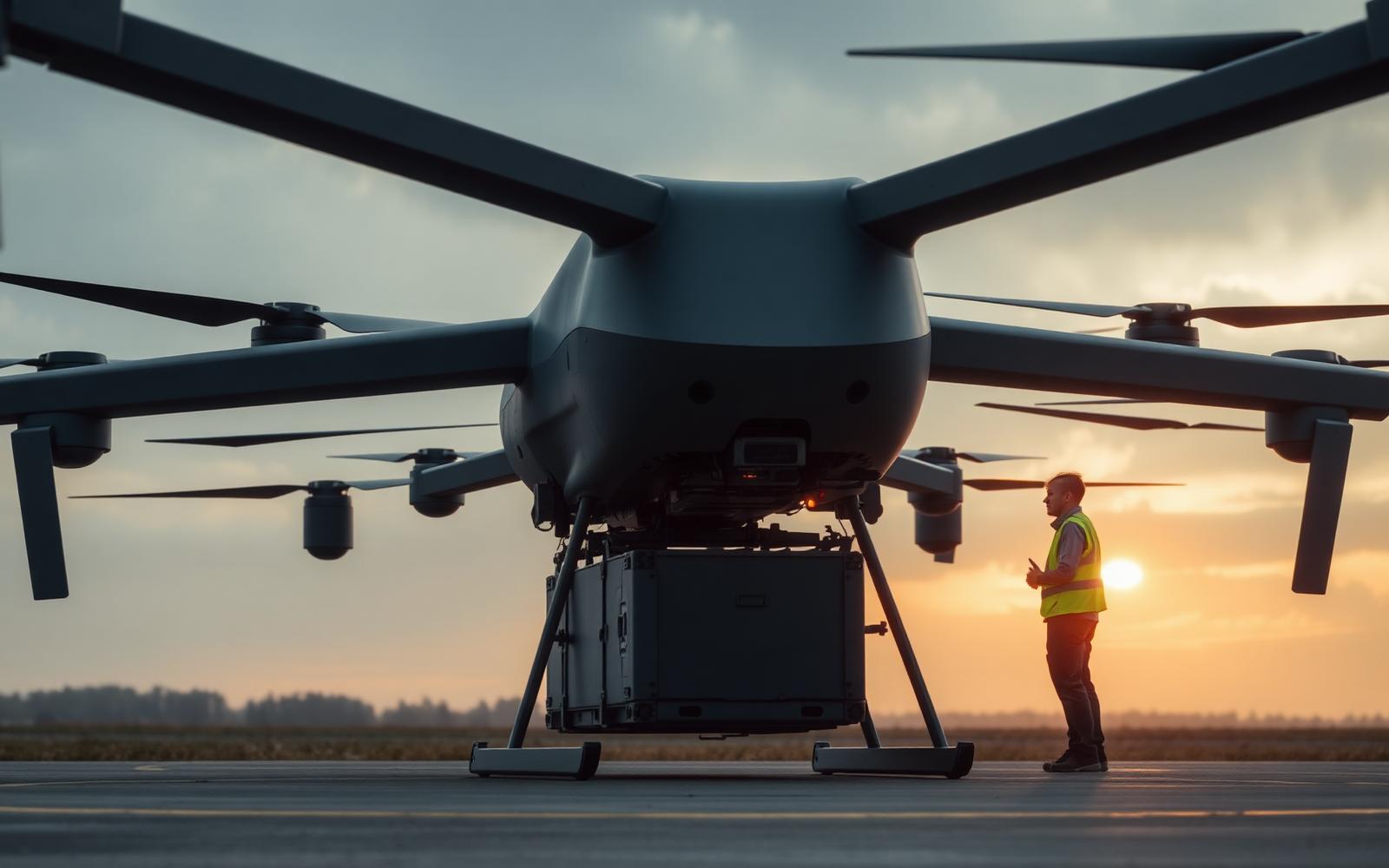
Cargo Drones: Payload Classes, Economics and What It Takes to Build One
Cargo drone delivery is an engineering and regulatory problem long before it is a logistics one. Here are the payload classes, the physics that limits them, and what building one really involves.
November 2, 20196 min read

Written by Konstantin Dolgan, Ph.D., NPDP
Founder & CEO, Product Development Engineer
Published November 2, 2019Updated August 19, 2026
A cargo drone is an uncrewed aircraft designed to carry freight rather than a camera, and the entire design is a negotiation between payload, endurance and certification. Small multirotors move a few pounds across a few miles. Hybrid VTOL aircraft move hundreds of pounds across hundreds.
Between those extremes sit almost all of the practical commercial applications: medical resupply, spare parts to remote sites, inspection kit delivery, and last-mile parcels in areas where roads are slow.
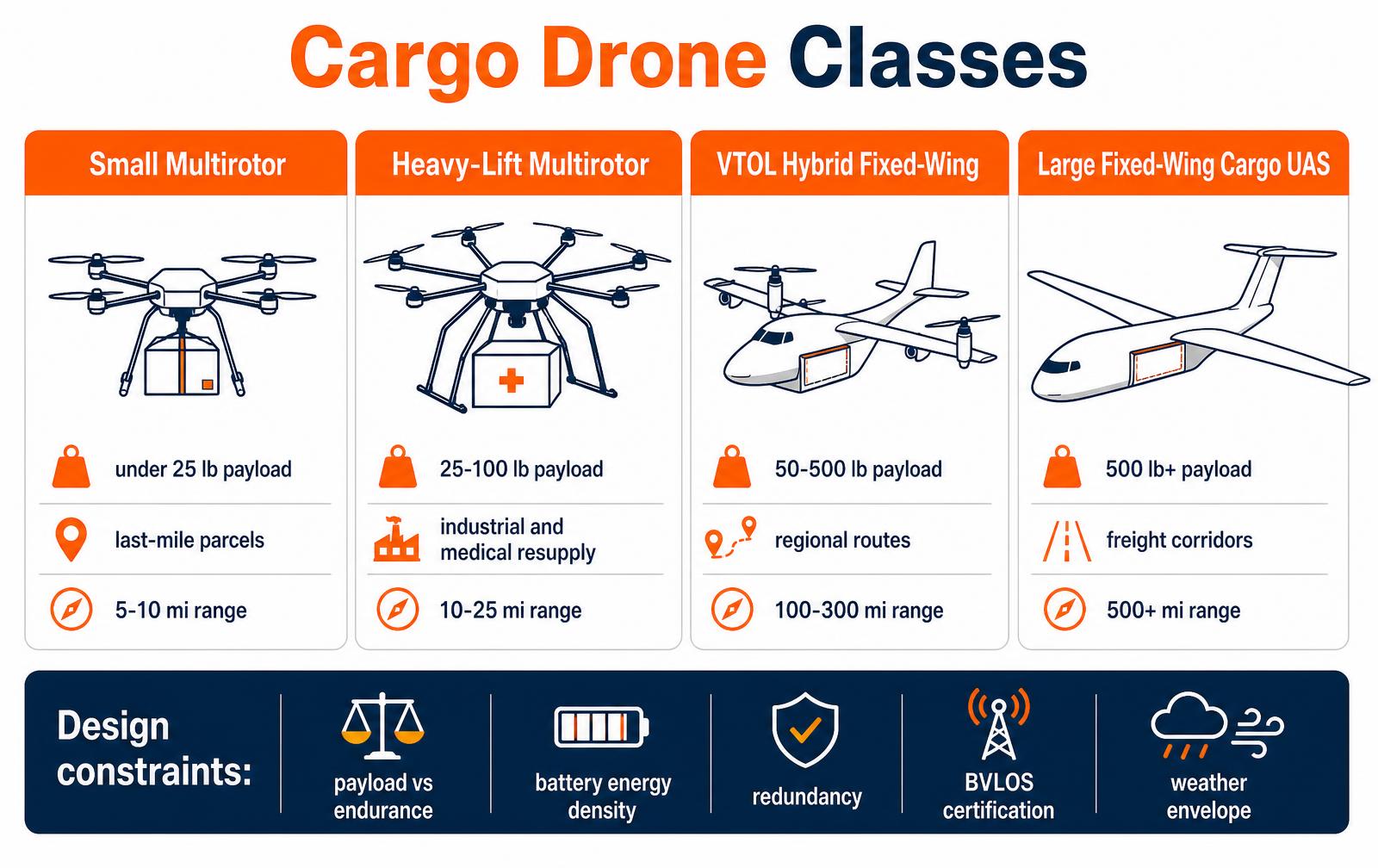
The four classes, and what each is good for
Class | Payload | Typical mission | Main limitation |
|---|---|---|---|
Small multirotor | Under 25 lb | Last-mile parcels, lab samples, food | Short endurance; energy goes into hovering |
Heavy-lift multirotor | 25-100 lb | Industrial resupply, medical logistics, utility work | Battery mass grows faster than useful lift |
VTOL hybrid fixed-wing | 50-500 lb | Regional routes without runways | Two flight modes to design, test and certify |
Large fixed-wing cargo UAS | 500 lb and up | Freight corridors, island and remote supply | Needs runway infrastructure and full certification |
The class is chosen by the route, not by preference. Hovering is expensive: a multirotor spends most of its energy simply staying airborne, so range collapses as payload rises. A wing generates lift for free once it is moving, which is why every serious long-range cargo drone eventually grows one — and inherits the complexity of transitioning between vertical and forward flight.
What actually limits a cargo drone
- Battery energy density. Current lithium packs store a small fraction of the energy per kilogram that liquid fuel does. Every extra pound of payload buys itself a pound of battery, and the spiral ends quickly.
- Redundancy. Flying over people or property means surviving a motor, ESC, battery or GPS failure. Redundant propulsion, dual flight controllers and a parachute all cost payload.
- Weather envelope. Wind, rain and icing decide how many days a year a route is actually flyable, which decides whether the business case works.
- Detect and avoid. Flying beyond visual line of sight requires a credible way to see and avoid other traffic, and that hardware is neither light nor cheap.
- Ground operations. Loading, securing and releasing cargo, plus battery swap or charging turnaround, often determine throughput more than flight time does.
The regulatory path in the US
Routine small drone operations fall under FAA Part 107, which by default requires visual line of sight, daylight-equivalent conditions and a 55 lb total weight limit including payload.
Commercial cargo work almost always needs more than that: waivers or exemptions for beyond-visual-line-of-sight and operations over people, and for a real delivery business, Part 135 air carrier certification. Larger aircraft add type and airworthiness certification.
Treat the regulatory schedule as a parallel development track with its own milestones, not as paperwork at the end.
Developing cargo drone hardware
Stage | Goal | Typical duration |
|---|---|---|
Mission definition | Route, payload, weather and turnaround targets written as numbers | 2-4 weeks |
Sizing and trade study | Airframe class, propulsion, battery and structure mass budget | 4-6 weeks |
Subsystem prototypes | Propulsion bench tests, cargo release mechanism, avionics integration | 2-4 months |
Integrated flight test | Tethered, then free flight, then full-payload envelope expansion | 3-6 months |
Reliability and certification | Failure mode testing, documentation, waiver or certification filings | Ongoing, 6-18 months |
The most common program failure is building an airframe first and defining the mission afterwards. Write the route, payload, wind limit and turnaround time down before selecting anything, then let those numbers pick the aircraft. Our electronic design and rapid prototyping work on uncrewed systems always starts there.
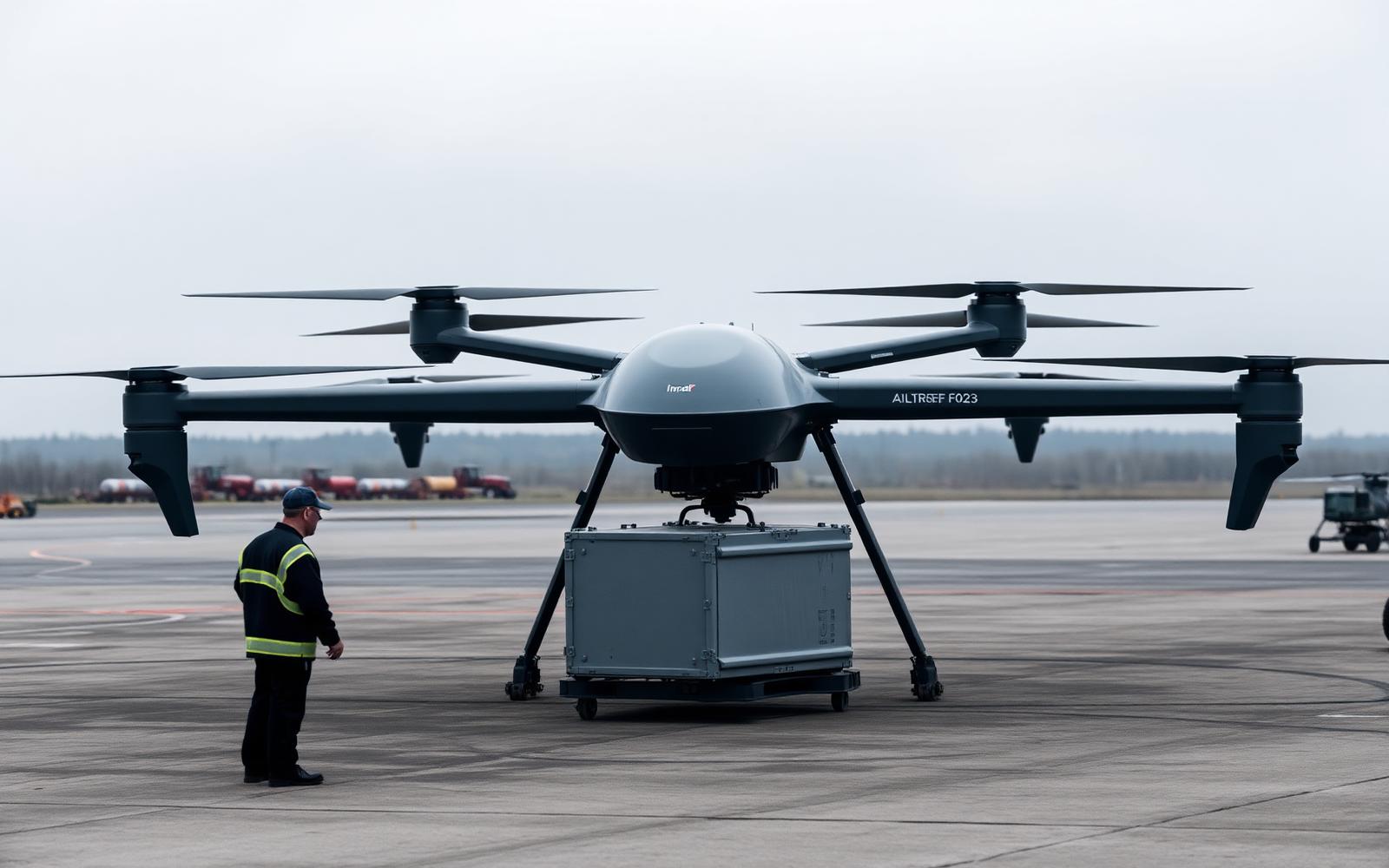
Payload classes and what each one is good for
Cargo drone economics are dominated by two numbers: how much mass leaves the ground and how far it goes before the battery or fuel runs out. Everything else — airframe material, redundancy, certification path — follows from where a design sits on that curve.
Small multirotors are cheap and near-instant but pay a heavy energy penalty per kilometre. Fixed-wing and hybrid VTOL aircraft cost more to build and operate but move payload at a fraction of the energy per tonne-kilometre.
Class | Payload | Typical range | Best use | Airframe cost |
|---|---|---|---|---|
Small multirotor | 0.5 - 5 kg | 5 - 20 km | Medical samples, last-mile parcels | $3k - $25k |
Hybrid VTOL | 5 - 25 kg | 50 - 200 km | Island and rural resupply | $50k - $250k |
Fixed-wing utility | 25 - 100 kg | 200 - 500 km | Regional freight, spares | $250k - $1M |
Heavy lift | 100 kg - 1 t+ | 100 - 800 km | Energy, mining, defence logistics | $1M+ |
What actually makes a cargo drone programme hard
- Energy density. Lithium cells sit around 250-300 Wh/kg at pack level; aviation fuel is roughly fifty times that, which is why long-range designs go hybrid.
- Redundancy. Flying over people demands duplicate flight controllers, power buses and, on multirotors, enough rotors to survive a motor loss.
- Payload interface. Winch, hard-mount or swappable pod each change the centre of gravity envelope and the ground operation.
- Certification and airspace. Beyond-visual-line-of-sight approval and detect-and-avoid capability drive schedule harder than the airframe.
- Ground operations. Charging, battery swap, loading and weather holds determine whether the fleet ever hits its utilisation targets.
Key takeaways
- Pick the payload and range first; the configuration follows from those two numbers.
- Battery energy density caps pure-electric range, so hybrid propulsion dominates above roughly 100 km with real payload.
- Regulatory approval for flight beyond visual line of sight usually costs more time than building the aircraft.
- Utilisation, not unit cost, determines whether a cargo drone route is profitable.
Frequently asked questions
Payload classes, range and the physics that sets both
How much weight can a cargo drone carry?
Cargo drone economics start with a brutal energy budget: on battery-electric multirotors, roughly 60-70% of takeoff mass is airframe and battery, leaving payload fraction in the 15-25% band. Every kilogram of payload buys itself a battery penalty, so range and payload trade against each other on the same curve. Hybrid and fixed-wing VTOL platforms shift that curve, at the price of complexity and certification burden.
Commercial delivery multirotors typically carry a few pounds to about 25 lb, heavy-lift platforms carry 25-100 lb, and hybrid VTOL or fixed-wing cargo aircraft range from roughly 50 lb into the thousands. Payload always trades against range: the same aircraft that carries 10 lb for 20 miles may carry 25 lb for 6.
Class | Payload | Typical range | Architecture | Typical mission |
|---|---|---|---|---|
Micro | under 2 kg | 5-15 km | Battery multirotor | Lab samples, pharmacy delivery |
Light | 2-10 kg | 15-60 km | Battery or hybrid VTOL | Parcel, spare parts, field resupply |
Medium | 10-100 kg | 60-300 km | Hybrid VTOL, fixed wing | Offshore logistics, remote clinics |
Heavy | 100-1,000 kg | 300-800 km | Turbine or hybrid fixed wing | Regional freight feeder |
Super heavy | 1,000 kg+ | 800 km+ | Converted or clean-sheet aircraft | Trunk-route cargo |
Are cargo drone deliveries legal in the United States?
Operating cost per kilogram-kilometre
Yes, within limits. Small drone commercial flight is allowed under FAA Part 107, but beyond-visual-line-of-sight routes and flight over people require waivers or exemptions, and delivery-for-hire generally requires Part 135 certification. Several operators hold those approvals today, and the approval timeline is usually longer than the hardware timeline.
Model cost per flight hour, then divide by payload-kilometres delivered. On a light-class electric platform, batteries amortised over 400 cycles, airframe over 1,500 hours, plus pilot or operator supervision, insurance and ground handling typically lands between $0.80 and $3.50 per kg-km at current utilisation.
The single biggest lever is not the airframe - it is flights per day. A platform flying six sorties daily halves the fixed-cost share versus one flying three.
Why do most cargo drones have such short range?
Certification and regulatory path
Because batteries store far less energy per pound than fuel, and multirotors burn most of that energy just hovering. Adding batteries adds weight, which demands more lift, which drains the batteries faster. Wings, lighter structures and hybrid power are the three ways out of that spiral.
- Small UAS operations under 25 kg usually start with Part 107 plus waivers for BVLOS and operations over people.
- Beyond visual line of sight is the value unlock and the hardest approval - plan a detect-and-avoid strategy from day one.
- Heavier platforms move into type or special airworthiness certification, adding 18-36 months and a design assurance burden.
- Airspace integration, remote ID and command-and-control link reliability all become documented design requirements, not features.
- Budget a compliance engineer as a permanent role, not a consultant hired once.
What does it cost to develop a custom cargo drone?
Development budget and schedule reality
Integrating an existing airframe with a custom payload and release mechanism is a modest program. A clean-sheet aircraft with redundant propulsion, custom avionics and a certification path is a multi-year, multi-million-dollar effort. Most companies should start by proving the mission economics on a modified commercial platform.
Phase | Duration | Typical spend | Exit criteria |
|---|---|---|---|
Concept and trade study | 6-10 weeks | $40,000-$90,000 | Payload-range curve, architecture locked |
Subscale prototype | 3-5 months | $120,000-$350,000 | Hover and transition demonstrated |
Full-scale prototype | 6-10 months | $400,000-$1.5M | Full mission profile flown with payload |
Reliability and certification | 12-30 months | $1M-$8M | Documented airworthiness case |
What a cargo drone delivery actually costs to fly
Airframe price is the number everyone quotes and the least useful one. Unit economics for drone logistics are dominated by battery cycle life, the ratio of remote pilots to aircraft, and the ground infrastructure that loads and charges them. A program that looks profitable on hardware cost alone usually collapses once observers, maintenance and insurance are added per flight.
Cost per delivery, small parcel class
Cost element | Per-flight share | Driver |
|---|---|---|
Battery depreciation | $0.80-$3.00 | 300-800 cycles before capacity fade |
Airframe depreciation | $1.00-$4.00 | Airframe life 1,000-3,000 flight hours |
Pilot / operator labor | $2.00-$12.00 | Falls sharply above 1:1 aircraft ratio |
Maintenance and spares | $0.50-$2.50 | Props, motors, ESCs |
Insurance and regulatory | $0.30-$1.50 | Waiver scope and operating area |
Ground infrastructure amortization | $0.50-$3.00 | Nests, chargers, loading labor |
The economics turn on one variable more than any other: how many aircraft a single operator may supervise. At one pilot per aircraft, most routes lose to a van. Approved one-to-many operations move labor from the largest line item to a minor one, which is why regulatory scope, not propulsion, is the real business case.
Questions to answer before funding a fleet
- What operator-to-aircraft ratio does your approval actually permit today?
- What is the measured battery cycle life at your payload, not the datasheet figure?
- Who loads, charges and swaps batteries, and what does that labor cost?
- What weather availability does your route have across a full year?
- What happens to the route economics if range drops 25 percent in cold weather?
Key takeaways
- Labor and battery life, not airframe price, determine cost per delivery.
- One-to-many operating approval is the pivot point for profitability.
- Model a full year of weather availability before committing to a route.
LA NPDT takes products from concept through engineering, prototyping and production. Tell us where your project stands and we will tell you what it takes.
Request a quoteFrom the archive
Work with LA NPDT: if you are moving from here to execution, start with our design optimization or talk to us about low-volume manufacturing.
Filed under:Tech Talk Podcast
Tagged:AlexaDronesHalloweenInnovationLatestNewsSkillTechnology
Related articles
All articles
Connected Product Development: Stack, Costs and How to Build One
The five layers of connected product development - hardware, firmware, connectivity, cloud and app - with realistic build and recurring costs.
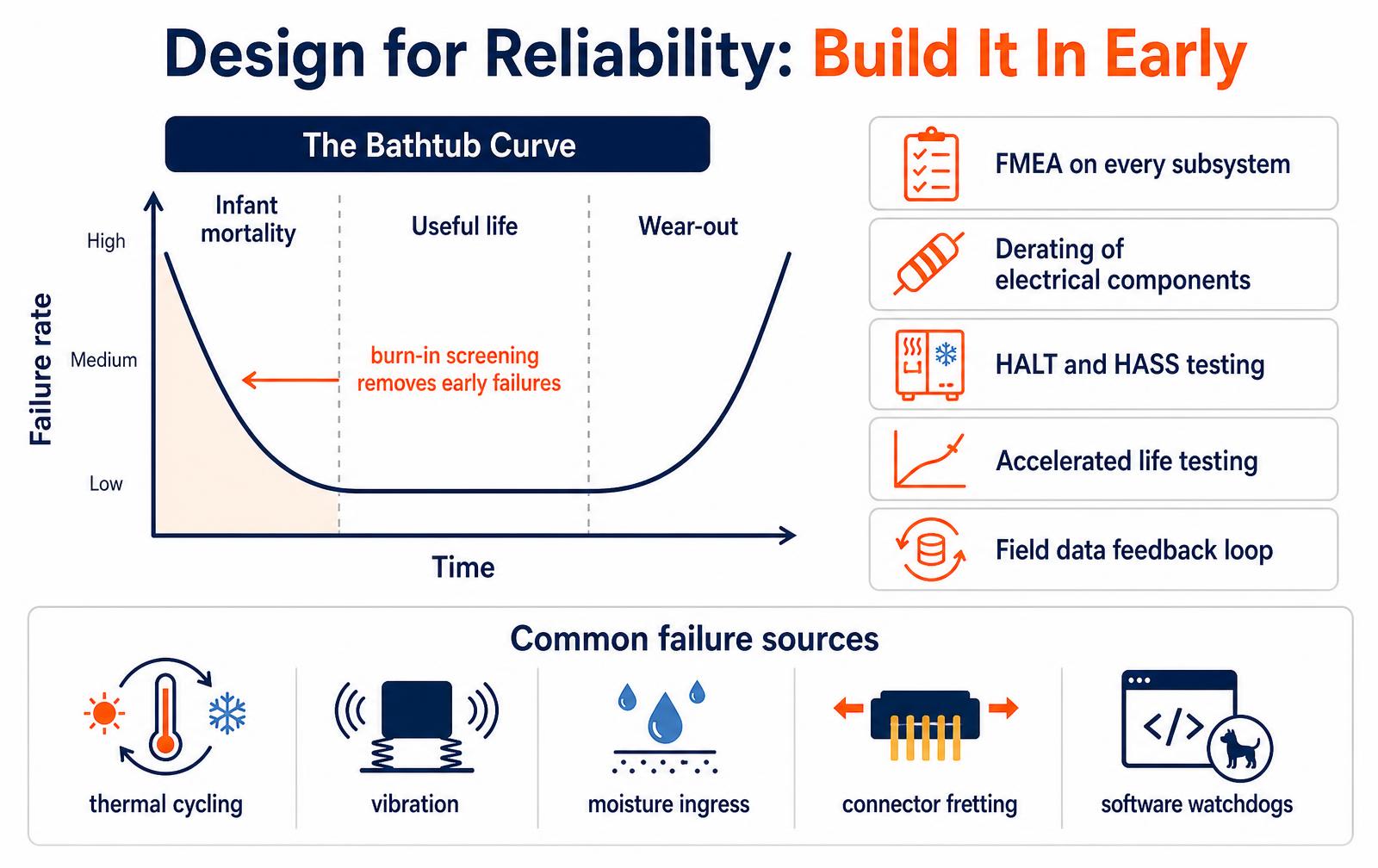
Design for Reliability: Methods to Extend Product Lifespan From Day One
Reliability is decided during design, not verified at the end. The methods, the failure sources and the cost of getting it wrong.

Product Engineering Company: What They Do, What They Cost, How to Pick One
A product engineering company turns a product idea into a manufacturable design. Here is the full scope, the cost of each stage, and how to tell a real team from a sales deck.
Services related to this guide
- Product design servicesIndustrial design and CAD taken all the way to manufacturable files.
- Rapid prototypingWorking prototypes in days, from 3D printing to vacuum casting.
- Electronic design servicesSchematic, PCB layout, firmware and bring-up, through to production handoff.
- Product development examplesReal projects we designed, prototyped and shipped.