
Concept design
The Concept Design Process, Step by Step
What happens between an idea and a set of drawings you can build from
Concept design is the stage where a product idea becomes something specific enough to engineer, quote and test. This page walks through the six steps we run, what you receive at the end of each one, and how to tell when a step is genuinely finished.
It is written for founders and product managers who have never commissioned design work before, so nothing here assumes you know the vocabulary.
Why the order matters
Most failed concepts are not failures of drawing skill. They fail because a decision was made in the wrong order — an enclosure was styled before the electronics were sized, or tooling was quoted before the mechanism was proven.
Each step below closes a specific class of unknown. Finishing them in order is what keeps the engineering phase from re-opening questions the concept was supposed to settle.
The six steps and their deliverables
Typical concept design sequence for a consumer or light industrial product.
| Step | What happens | What you receive |
|---|---|---|
| 1. Brief and constraints | We write down the job the product does, the user, the target cost, the size envelope, standards it must meet and the launch date. | A one-page design brief both sides sign off on. |
| 2. Research and benchmarking | We look at what already exists, how it is built, where it fails and what patents crowd the space. | A benchmark summary with teardown notes and gaps worth attacking. |
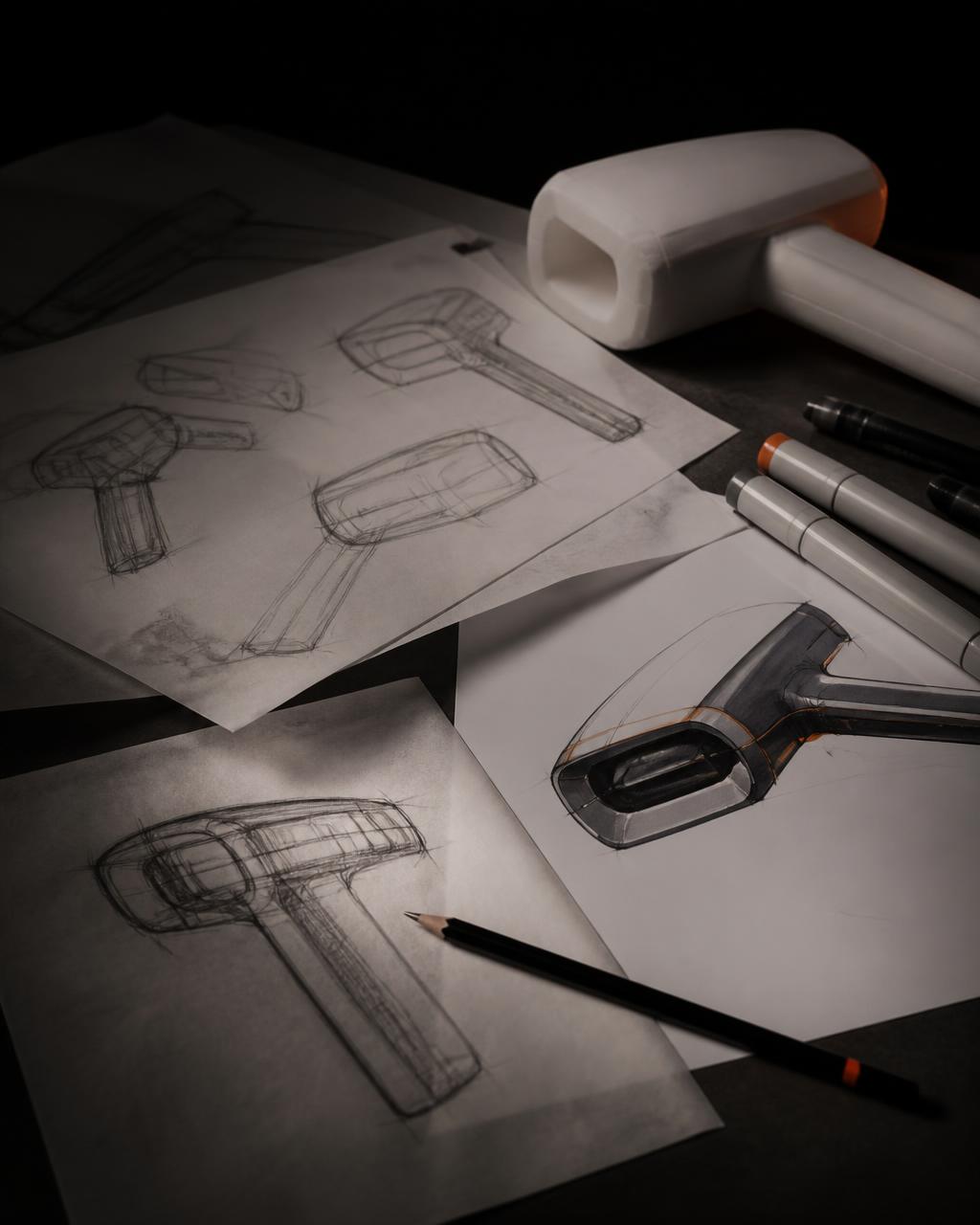
| 3. Ideation sketches | Wide, fast exploration of forms, mechanisms and layouts — deliberately more directions than you will use. | Sketch sheets showing 6–20 directions, grouped by approach. |
| 4. Concept selection | Directions are scored against the brief: cost, manufacturability, user fit, IP risk. Usually two survive. | A scored comparison and a written recommendation. |
| 5. Concept CAD | The chosen direction is modelled in 3D at real dimensions, with internal volumes for electronics, battery and fasteners. | A CAD model, key sections and a rough bill of materials. |
| 6. Renders and validation | Photoreal renders for stakeholders or crowdfunding, plus a low-cost appearance or fit model when the shape needs to be held. | Renders, a spec sheet and a prioritised list of what engineering must resolve next. |
1. Brief and constraints
- What happens
- We write down the job the product does, the user, the target cost, the size envelope, standards it must meet and the launch date.
- What you receive
- A one-page design brief both sides sign off on.
2. Research and benchmarking
- What happens
- We look at what already exists, how it is built, where it fails and what patents crowd the space.
- What you receive
- A benchmark summary with teardown notes and gaps worth attacking.
3. Ideation sketches
- What happens
- Wide, fast exploration of forms, mechanisms and layouts — deliberately more directions than you will use.
- What you receive
- Sketch sheets showing 6–20 directions, grouped by approach.
4. Concept selection
- What happens
- Directions are scored against the brief: cost, manufacturability, user fit, IP risk. Usually two survive.
- What you receive
- A scored comparison and a written recommendation.
5. Concept CAD
- What happens
- The chosen direction is modelled in 3D at real dimensions, with internal volumes for electronics, battery and fasteners.
- What you receive
- A CAD model, key sections and a rough bill of materials.
6. Renders and validation
- What happens
- Photoreal renders for stakeholders or crowdfunding, plus a low-cost appearance or fit model when the shape needs to be held.
- What you receive
- Renders, a spec sheet and a prioritised list of what engineering must resolve next.
How long each step takes
A single-part accessory can move through all six steps in two to three weeks. A powered device with a mechanism and a PCB usually takes five to eight weeks, because steps 3 to 5 iterate against electrical and mechanical constraints at the same time.
The slowest variable is almost never drawing time — it is decision time on your side. Concepts that get feedback within two days of each review finish roughly a third faster than ones reviewed weekly.
- Concept design cost and timelineReal ranges and what pushes a project to the top of them.
How to tell a concept is actually finished
- Every external dimension is fixed, and nothing inside is drawn as a floating block labelled 'electronics'.
- The manufacturing process for each part is named — injection moulded, sheet metal, machined, 3D printed for low volume.
- You can list the parts and roughly what each one costs at your target volume.
- A prototype shop could quote from the files without asking you a question.
- The open risks are written down, and each has an owner and a plan to close it.
What comes after concept design
Concept output feeds detailed engineering: tolerance work, material selection, electronics layout, firmware, and design for manufacture. Then prototyping proves it in the hand, and short-run production gets it in front of customers.
We do all of that in house with our own engineers, so nothing is re-drawn when a project moves from concept into engineering.
- Concept designThe full guide to turning an idea into sketches, CAD and renders.
- Rapid prototypingHow we build working prototypes and what they cost.
- All development servicesResearch, design, engineering, prototyping and short-run production.
Questions
Frequently asked questions
Do I need concept design if I already have a sketch?
Usually yes, but a shorter version. A sketch fixes intent; concept design fixes dimensions, internal volumes, materials and manufacturing process so an engineer or a factory can act on it.
Who owns the concept files?
You do. Sketches, CAD and renders transfer to you on final payment, and we sign an NDA before any material is shared.
Can concept design be used for a patent application?
Concept CAD and drawings are frequently the basis for design and utility patent drawings, though your attorney prepares the filing itself.
Where to go next
- Concept designThe full guide to turning an idea into sketches, CAD and renders.
- Industrial design servicesForm, ergonomics, CMF and surfaced CAD — what it includes and what it costs.
- Rapid prototypingHow we build working prototypes and what they cost.
- Product development portfolioProducts we designed, engineered and manufactured.
- All development servicesResearch, design, engineering, prototyping and short-run production.