
battery Pack Design: Cells, Bms, Thermal and Costs
A practical guide to battery pack design: choosing cells, sizing the architecture, specifying the BMS, managing heat and budgeting for UN 38.3 and UL certification.
November 7, 20196 min read

Written by Konstantin Dolgan, Ph.D., NPDP
Founder & CEO, Product Development Engineer
Published November 7, 2019Updated August 19, 2026
Most battery pack problems are decided in the first week of design, not on the production line. Cell choice fixes your energy, cost and certification path. Architecture fixes your voltage and current headroom. Everything after that is packaging, protection and paperwork - and all three cost more when the first three decisions were rushed.
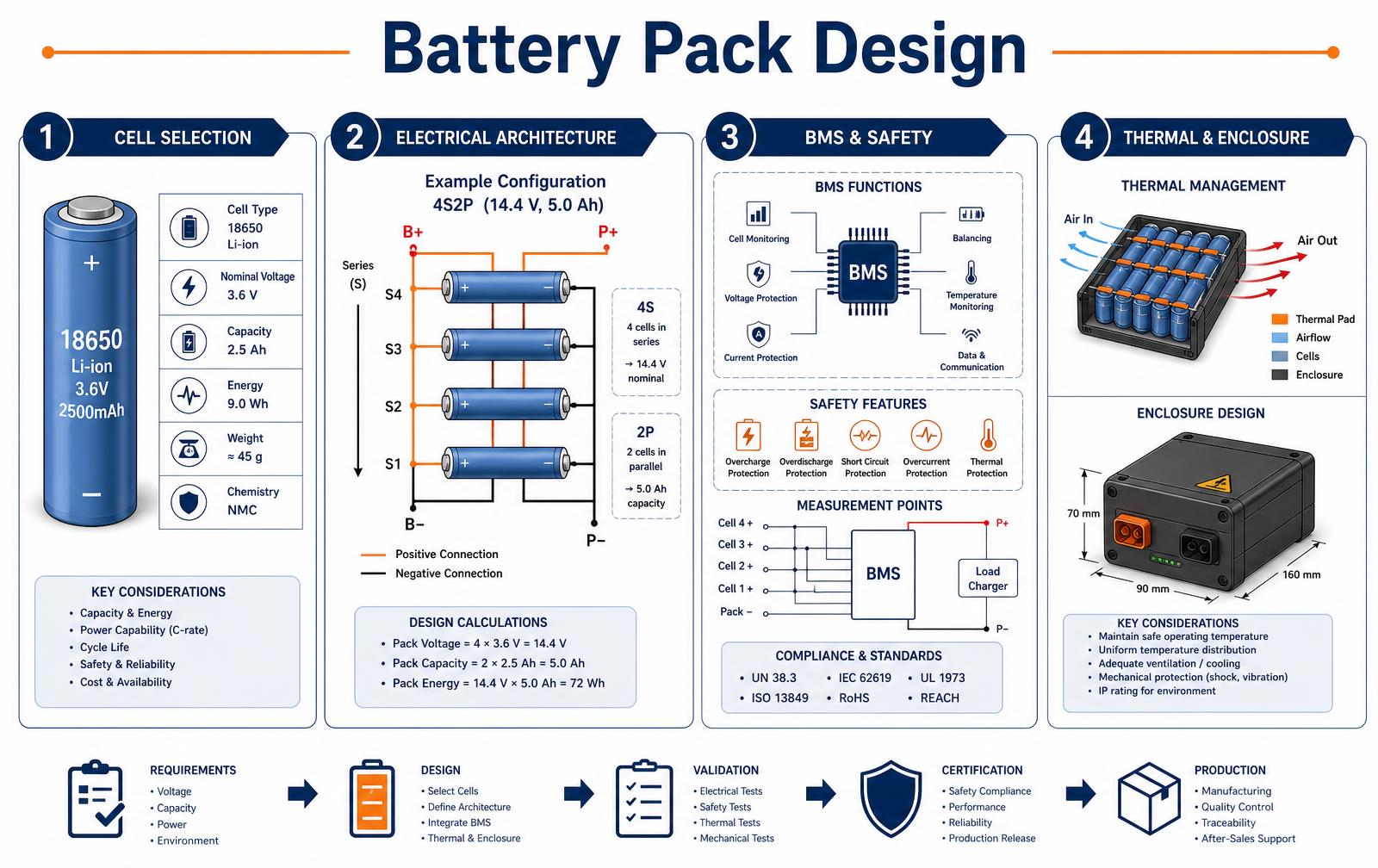
Step 1: Choose the cell format
Format | Typical energy density | Cost position | Best for |
|---|---|---|---|
18650 / 21700 cylindrical | 220-270 Wh/kg | Lowest per Wh | Power tools, e-mobility, robotics, anything volume-driven |
Pouch | 240-300 Wh/kg | Mid | Thin consumer devices and custom footprints |
Prismatic | 200-250 Wh/kg | Mid-high | Large stationary and automotive packs |
LiFePO4 (any format) | 90-160 Wh/kg | Low per cycle | Long cycle life, high safety margin, stationary storage |
Step 2: Size the architecture
Series count sets voltage, parallel count sets capacity and continuous current. A 4S2P pack of 2.5 Ah cells is 14.4 V nominal, 5.0 Ah and 72 Wh. Size the parallel string so the worst-case continuous draw stays under roughly 70% of the cell datasheet rating - running cells at their limit is how packs get hot, sag under load and fail cycle-life targets early.
step 3: Specify the Bms Honestly
- Protection set. Overcharge, over-discharge, overcurrent, short circuit and thermal cutoff are non-negotiable for any lithium pack that ships to consumers.
- Balancing. Passive balancing is fine for most packs under 100 Wh; active balancing earns its cost on large, long-life packs.
- Fuel gauging. Coulomb counting plus a voltage model is what makes a percentage readout believable; a bare voltage divider will not.
- Communications. Decide early whether the host needs I2C, CAN or BLE telemetry - retrofitting it means a new PCB spin.
Step 4: Thermal and enclosure
Keep cells between roughly 15 C and 45 C in use and never charge below 0 C without a heater. Thermal pads, spacing between cells and a conductive enclosure path solve most small-pack problems; forced air or liquid cooling only appears when continuous C-rates go high. The enclosure also carries the mechanical case: shock, vibration, crush and ingress protection.
What it costs and how long it takes
Phase | Typical duration | Typical cost |
|---|---|---|
Requirements and cell selection | 1-2 weeks | $3k-$8k |
Electrical design and BMS integration | 3-6 weeks | $15k-$45k |
Mechanical, thermal and enclosure | 3-5 weeks | $12k-$35k |
Prototype builds and testing | 4-6 weeks | $10k-$30k |
UN 38.3 transport testing | 3-5 weeks | $8k-$15k |
UL 2054 / IEC 62133 certification | 8-14 weeks | $15k-$40k |
Related reading: IoT product development stages and injection molding cost and break-even.
Certification and shipping requirements
Requirement | Applies to | Typical cost | Typical duration |
|---|---|---|---|
UN 38.3 transport testing | Every lithium pack shipped | $3k-$12k per pack design | 3-6 weeks |
IEC 62133 / UL 2054 | Cells and packs in consumer products | $8k-$25k | 6-12 weeks |
UL 2271 / UL 2580 | Light EV and traction packs | $25k-$80k | 3-6 months |
FCC / CE EMC | Packs with wireless BMS or chargers | $5k-$15k | 2-5 weeks |
Shipping classification | Air and sea freight paperwork | $500-$2k per SKU | 1-2 weeks |
Design mistakes that fail a pack
- Undersized cell count for peak current. Sizing to average draw cooks cells during surges.
- Nickel strip too thin. Interconnect heating shows up as premature capacity fade, not an obvious failure.
- No cell-level fusing on large parallel groups. A single internal short can take the whole pack.
- Sensing on the wrong point. Thermistors placed away from the hottest cell hide real temperatures.
- Ignoring swelling allowance. Pouch cells need compression and growth space or the enclosure deforms.
- Charger and BMS mismatch. Verify the charge profile against the exact cell datasheet, not a generic curve.
Certification and shipping requirements for battery products
Battery packs carry a regulatory load that surprises first-time hardware teams. The tests are not optional, the labs are booked out, and the results depend on production-representative cells — meaning you cannot start until the cell supplier is locked.
Requirement | Applies to | Typical cost | Lead time |
|---|---|---|---|
UN 38.3 | Any lithium cell or pack that ships | $8k–$25k | 4–8 weeks |
IEC 62133-2 | Portable sealed secondary cells and packs | $12k–$35k | 6–12 weeks |
UL 2054 / UL 1642 | North American market, household and commercial | $15k–$45k | 8–14 weeks |
IEC 62619 | Industrial applications | $18k–$50k | 8–16 weeks |
Shipping classification and packaging | Air and ground freight | $2k–$8k | 2–4 weeks |
Cell qualification / second source | Supply risk mitigation | $10k–$40k | 8–20 weeks |
Sizing a pack without guessing
- Start from the load profile, not from a capacity target: peak current, average current, duty cycle, and worst-case ambient.
- Derate usable capacity to 80–85% of nameplate for cycle life, then again for end-of-life at your warranty term.
- Check continuous discharge rating per cell against peak load; parallel count is often set by current, not energy.
- Confirm the charge window — most lithium chemistries refuse to charge below 0 °C without a heater.
- Model IR rise over life; a pack that just meets peak current at day one will not at cycle 500.
- Leave headroom for firmware that turns out to be less efficient than the estimate. It always is.
BMS features by product class
Feature | Simple 1S consumer | Multi-cell portable | Industrial / high current |
|---|---|---|---|
Overcharge / overdischarge cutoff | Required | Required | Required |
Cell balancing | N/A | Passive typical | Active on large packs |
Temperature sensing | One NTC | Two or more NTCs | Per-module sensing |
Coulomb counting / fuel gauge | Optional | Recommended | Required |
Communications | None | I2C or UART to host | CAN bus |
Redundant protection IC | Rare | Recommended | Required |
Thermal design rules that hold up
Keep cells between 15 °C and 35 °C in normal operation and you avoid most of the failure modes that show up in warranty data.
That means a conduction path from the cell body to something with mass, spacing that prevents thermal propagation between cells, and a firmware-level current limit that responds to measured temperature rather than to an assumed one.
For packs above roughly 100 Wh, model the worst case: fast charge at 40 °C ambient inside a closed enclosure, not the bench condition where everything passes.
Battery packs sit at the intersection of electronics, mechanical and compliance work — exactly the scope our development team handles as one program.
Frequently asked questions
How much does battery pack design cost?
Engineering a custom lithium pack typically runs $40,000 to $120,000 including electrical, mechanical and prototype builds, plus $20,000 to $55,000 for UN 38.3 and UL or IEC certification.
How long does it take to design a battery pack?
Plan on four to six months from requirements to a certified pack: roughly eight to twelve weeks of design and prototyping, then three to four months of overlapping transport and safety certification.
Do I Need a Custom Bms?
Usually not. Off-the-shelf BMS modules cover most packs under 60 V. A custom BMS is justified when you need specific telemetry, unusual form factor, tight cost targets at high volume, or functional-safety compliance.
Battery pack design: cells, chemistry and configuration
Pack design starts with the load profile, not the cell. Peak current, continuous current, runtime and operating temperature determine chemistry and cell format; everything else - series and parallel configuration, busbar sizing, thermal path - follows from that. Choosing a cell because it is cheap per watt-hour and then discovering its continuous discharge rating cannot carry the motor stall current is the classic way to restart a program.
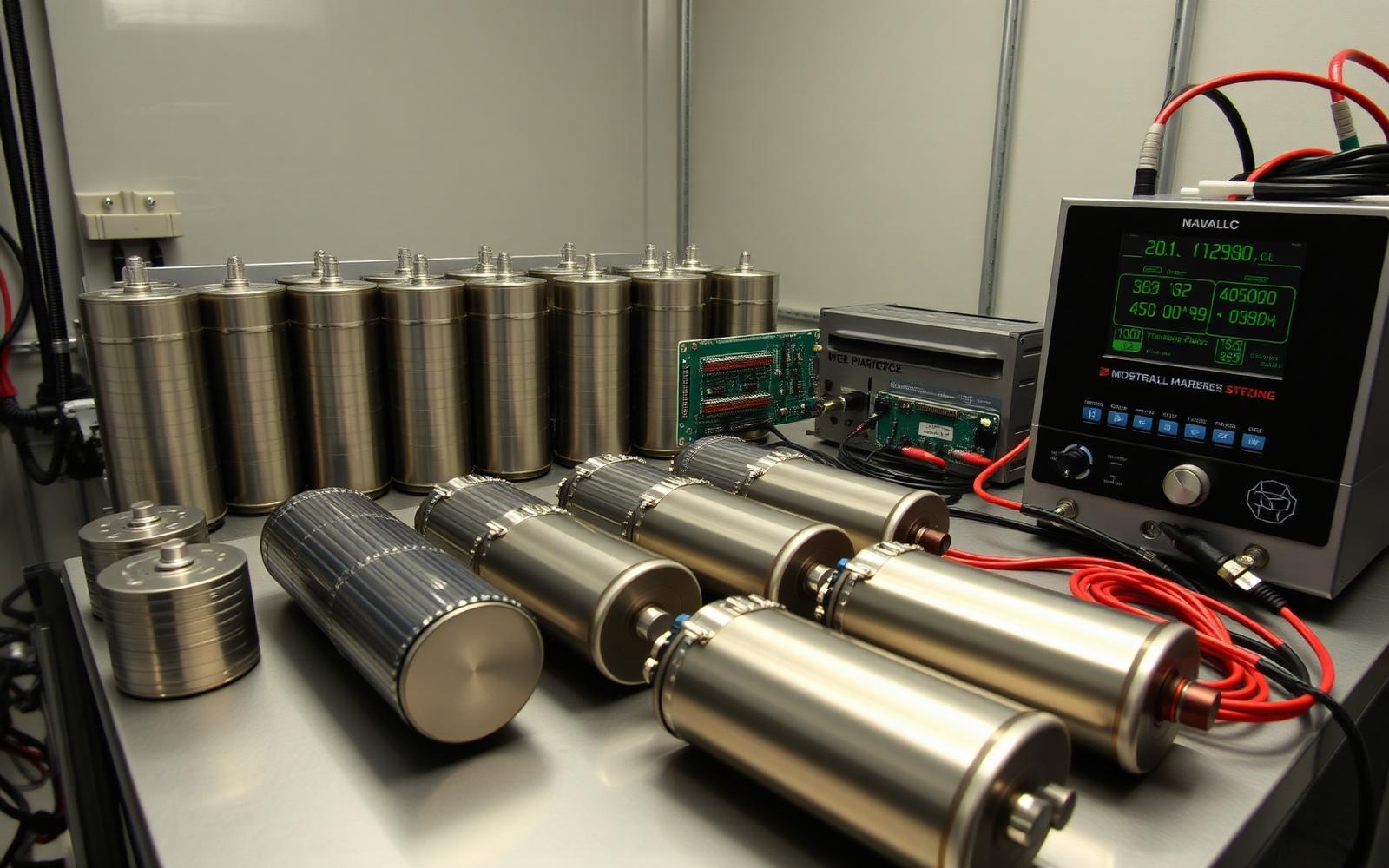
Chemistry / format | Energy density | Typical cycle life | Best for | Relative cost |
|---|---|---|---|---|
Li-ion NMC 18650 | 200-250 Wh/kg | 500-1000 | Tools, e-mobility, robotics | Low |
Li-ion NMC 21700 | 230-270 Wh/kg | 800-1200 | Higher current applications | Low to medium |
LFP prismatic | 120-160 Wh/kg | 2000-6000 | Stationary storage, safety-critical | Medium |
Li-polymer pouch | 250-300 Wh/kg | 300-600 | Thin consumer devices | Medium to high |
Custom pouch | Application specific | Varies | High volume consumer | High NRE |
Bms, Thermal Management and Safety
- Cell balancing. Passive balancing suits most packs under 500 Wh; active balancing pays for itself in large or long-life packs.
- Protection layers. Overvoltage, undervoltage, overcurrent, short circuit and thermal cutoff, with at least one hardware-only layer independent of firmware.
- Temperature sensing. One thermistor per module minimum, placed on the hottest predicted cell, not on the busbar.
- Thermal path. Cells above 1C continuous discharge usually need a conductive path to the enclosure or a phase-change pad.
- Propagation resistance. Cell spacing, mica barriers and vent paths so a single thermal runaway does not take the pack.
- Welding method. Spot welded nickel for most packs; laser welding for high current and tight resistance tolerance.
Certification and shipping costs
Requirement | Applies to | Typical cost | Duration |
|---|---|---|---|
UN 38.3 transport testing | Every lithium pack shipped | $3k-$12k | 3-6 weeks |
IEC 62133 / UL 2054 | Consumer and portable packs | $12k-$35k | 8-14 weeks |
UL 2271 / UL 2580 | Light EV and vehicle packs | $40k-$150k | 4-8 months |
Cell qualification | New cell source | $8k-$30k | 6-12 weeks |
- Key takeaway 1: Define the load profile before selecting cells.
- Key takeaway 2: Keep at least one protection layer in hardware, independent of firmware.
- Key takeaway 3: Thermal design and propagation resistance are safety features, not refinements.
- Key takeaway 4: Budget UN 38.3 and safety certification into the schedule from day one.
We design packs, BMS integration and enclosures with certification planned from day one.
Request a quoteCell chemistry selection at a glance
Chemistry | Energy density | Cycle life | Safety margin | Typical fit |
|---|---|---|---|---|
LCO (18650/pouch) | High (200-250 Wh/kg) | 300-500 | Lower — needs strict protection | Compact consumer devices |
NMC | High (180-240 Wh/kg) | 800-2,000 | Moderate | Power tools, e-mobility, robotics |
LFP | Moderate (90-160 Wh/kg) | 2,000-6,000 | High thermal stability | Stationary storage, long-life packs |
LTO | Low (60-90 Wh/kg) | 10,000+ | Very high | Fast-charge industrial duty cycles |
Pack architecture decisions that lock in cost
- Series count sets your electronics. Above 60 V the design crosses safety thresholds that add isolation, creepage and clearance requirements and more expensive BMS front ends.
- Parallel count sets your fault behaviour. Large parallel groups need fusing at the cell level, or a single internal short discharges the whole group into it.
- Interconnect method is a tooling decision. Spot-welded nickel is cheap at low volume; laser welding and busbars cost more up front and pay back in resistance and repeatability.
- Serviceability is a business decision. A potted pack is cheaper to build and impossible to repair; regulations in several markets are moving the other way.
Certification and shipping costs to budget
Requirement | Applies to | Typical cost | Lead time |
|---|---|---|---|
UN 38.3 transport testing | Every lithium pack shipped | $3k-$12k | 3-6 weeks |
IEC 62133 / UL 2054 | Consumer and portable packs | $8k-$25k | 6-12 weeks |
UL 2271 / UL 2580 | Light EV and vehicle packs | $30k-$120k | 3-6 months |
Cell qualification data | Any new cell source | $0-$15k | 2-8 weeks |
Air freight dangerous goods handling | Shipping | Per-shipment surcharge | Ongoing |
Thermal design rules of thumb
- Keep cell-to-cell temperature spread under 5 °C; larger gradients age the pack unevenly and the weakest string sets capacity.
- Design for the worst realistic ambient plus the worst duty cycle, not the nominal case.
- Charge below 0 °C plates lithium and permanently reduces capacity — the BMS must block it, not just warn.
- Leave a thermal propagation barrier between cells if a single-cell failure must not cascade.
- Validate with instrumented thermocouples on a real pack; simulation alone under-predicts hot spots at interconnects.
Frequently asked questions
Can we use an off-the-shelf BMS? Often yes for early builds, and it is the right call to prove the product. Custom BMS design is justified when you need specific balancing behaviour, tight form factor, or data the stock board will not give you.
How long does a pack program take? Six to twelve months from requirements to certified pilot packs for a portable product, longer where vehicle standards apply. Testing, not design, dominates the schedule.
Should we second-source cells? Yes, and qualify the second source before you need it. A cell substitution after certification usually means repeating a portion of the test programme.
Work with LA NPDT: if you are moving from here to execution, start with our electronic design services or talk to us about IoT development.
Filed under:Tech Talk Podcast
Tagged:3D PrintingBatteriesLatestNewNew ProductNewsTechTechnologyUniversityUpdates
Related articles
All articles
Consumer Product Design: Process, Costs and Timeline
From discovery to production launch: how consumer product design is actually run, what it costs at each complexity level and how long it takes.
Sheet Metal Design Guidelines: Bends, Tolerances and Costs
Sheet metal design guidelines for prototype and low-volume parts: bend radii, reliefs, hole spacing, tolerances, finishes and cost drivers.
Services related to this guide
- Product design servicesIndustrial design and CAD taken all the way to manufacturable files.
- Rapid prototypingWorking prototypes in days, from 3D printing to vacuum casting.
- Electronic design servicesSchematic, PCB layout, firmware and bring-up, through to production handoff.
- Product development examplesReal projects we designed, prototyped and shipped.