Consumer Product Design: Process, Costs and Timeline
From discovery to production launch: how consumer product design is actually run, what it costs at each complexity level and how long it takes.
August 12, 20268 min read

Written by Konstantin Dolgan, Ph.D., NPDP
Founder & CEO, Product Development Engineer
Published August 12, 2026
Consumer products are judged in four seconds on a shelf and in four weeks of ownership. That double standard drives the whole process: the design has to sell the promise instantly and then survive daily use without a service technician. This guide walks the six phases of consumer product design, what each one produces, how long it takes and what it costs.
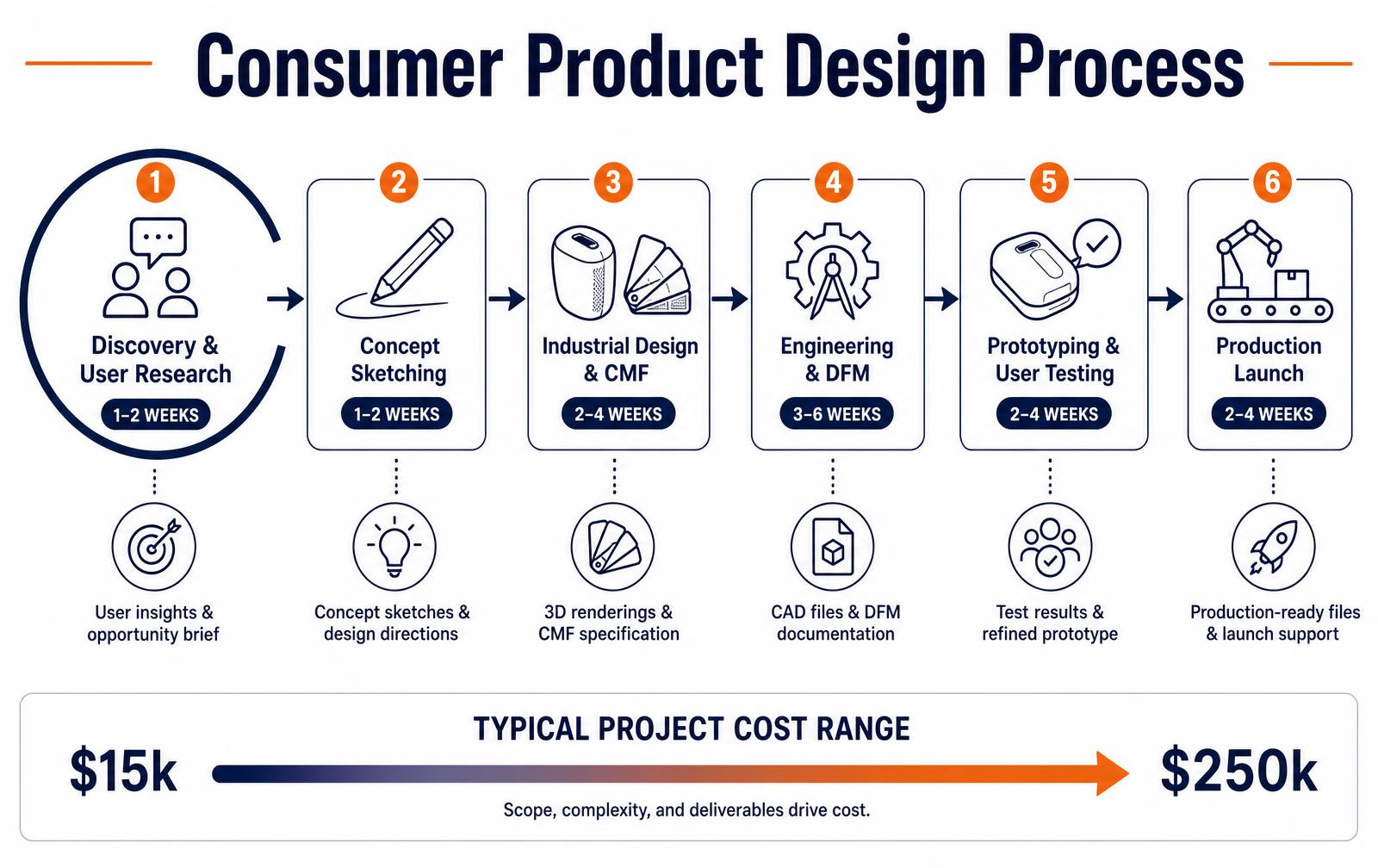
The six phases of consumer product design
- Discovery and user research - interviews, competitive teardowns and a written opportunity brief that names the buyer and the job to be done.
- Concept sketching - broad exploration of form language and interaction, narrowed to two or three directions worth engineering.
- Industrial design and CMF - surfaced 3D models plus the color, material and finish specification that decides how the product reads and what it costs to make.
- Engineering and design for manufacturing - wall thicknesses, draft, fastening strategy, tolerance stackups and a released CAD package.
- Prototyping and user testing - looks-like and works-like builds put in front of real users before tooling is cut.
- Production launch - tooling, first article inspection, pilot run and packaging released together.
How much does consumer product design cost?
Design fees are a fraction of the money a program spends, but they determine most of it. Every gram of material, every extra part, every finish decision made in phase three becomes a per-unit cost multiplied by lifetime volume. A thorough DFM pass that removes two parts and one secondary operation typically pays for the entire engineering phase within the first production run.
Product complexity | Example | Design and engineering fee | Tooling | Total to first production |
|---|---|---|---|---|
Simple molded product | Housewares item, organizer, accessory | $15,000-$40,000 | $8,000-$30,000 | $30,000-$80,000 |
Mechanical consumer device | Kitchen appliance, personal care tool | $40,000-$110,000 | $30,000-$120,000 | $90,000-$280,000 |
Connected electronic product | Wearable, smart home device | $110,000-$250,000 | $60,000-$250,000 | $220,000-$650,000 |
How long does it take?
Phase | Duration | Primary deliverable |
|---|---|---|
Discovery and research | 1-2 weeks | Opportunity brief and requirements |
Concept sketching | 1-2 weeks | Concept directions and renderings |
Industrial design and CMF | 2-4 weeks | Surfaced model and CMF specification |
Engineering and DFM | 3-6 weeks | Released CAD and drawing package |
Prototyping and user testing | 2-4 weeks | Working prototype and test findings |
Production launch | 2-4 weeks plus tooling lead time | Pilot parts and first article report |
What separates products that sell
- A single clear promise the packaging can state in five words.
- Unboxing and first use designed deliberately, because that is what gets photographed and reviewed.
- Part count driven down early - fewer parts means lower cost, faster assembly and fewer warranty failures.
- CMF chosen with the manufacturing process in mind, not selected from a mood board and forced onto tooling later.
- Real user testing on works-like builds before tooling, when changes still cost hundreds instead of tens of thousands.
- A cost model maintained from week one so the retail price is a design constraint, not a discovery.
Common mistakes
Three failures repeat. Skipping discovery and designing for the founder rather than the buyer. Freezing the industrial design before an engineer has confirmed it can be molded, which forces ugly compromises late. And treating packaging as an afterthought when for many consumer categories it is half of the purchase decision. Related reading: industrial design services and our product development process.
What consumer product design costs at each stage
Design fees confuse first-time founders because the same phrase covers wildly different scopes. Concept sketching and a few renderings is a small engagement. Full industrial design plus mechanical engineering, CAD release, DFM and tooling support is a program. Quoting the two against each other is how founders end up with beautiful renderings and no manufacturable files.
Ask any design partner to break the quote into stages with deliverables and exit criteria, so you can stop after a stage if the direction is wrong. Staged engagements also let you take the cost risk in pieces rather than committing the whole budget on day one.
Stage | Deliverable | Typical cost | Typical duration |
|---|---|---|---|
Research and brief | Requirements, benchmarks, target cost | $2k-$8k | 1-3 weeks |
Concept design | Sketches, 3-5 directions, renderings | $4k-$15k | 2-4 weeks |
Detailed design and CAD | Manufacturable parametric CAD | $10k-$40k | 4-10 weeks |
Prototype and refinement | Functional prototypes, revisions | $5k-$25k | 3-8 weeks |
DFM and tooling support | Tool-ready files, supplier liaison | $5k-$20k | 3-6 weeks |
Where consumer design programs go wrong
The common failures are predictable: no cost target, so the design is unaffordable. No manufacturing input, so the geometry cannot be molded without expensive actions. Too many concept directions, so budget burns before engineering starts. And no user testing, so ergonomic problems are discovered by customers. Each of these is cheap to prevent and expensive to discover late.
- Set the target landed cost before concept work begins.
- Cap concept directions at three and pick one quickly.
- Bring a manufacturer into the review at detailed design, not after.
- Put physical models in real users' hands before CAD release.
- Budget one full revision cycle after the first prototypes.
- Own your CAD files and the design rights in writing.
Consumer product design: what separates a gift from a business
Plenty of good gift concepts never become products because the economics only work at a price nobody pays. Consumer product design is the discipline of making the desirable version also the manufacturable one, and the constraints show up early if you look for them.
Design decision | Gift-scale answer | Product-scale answer | Cost consequence |
|---|---|---|---|
Enclosure process | 3D print or off-the-shelf case | Injection molded | $8k–$40k tooling, far lower unit cost |
Materials | Whatever prints well | Resin selected for flow and finish | Affects cycle time and scrap |
Fasteners | Screws everywhere | Snap fits with a few screws | Seconds per unit of assembly labor |
Finish | Sanded and painted | Textured in-mold (MT-11010 etc.) | Removes a secondary operation |
Packaging | Gift box bought online | Designed for dim weight and drop test | Often the largest freight lever |
Certification | None | FCC, CPSIA or UL as applicable | $6k–$45k and weeks of schedule |
Questions that predict whether a concept can scale
- Can the form be made in a two-part mold without side actions, or does the shape demand slides?
- Is the target retail price at least four times a realistic landed cost?
- How many SKUs does the idea imply, and can you afford tooling for each?
- Does the product need a battery, a radio or contact with children — each adds a compliance program?
- What does it weigh in its shipper, and which dimensional weight band does that land in?
- Is there a version of the idea that ships flat?
Turning a strong concept into something a factory can quote is exactly what our product design and development services exist to do.
Key takeaways
- Consumer product design typically runs $25k-$100k from brief to tool-ready files.
- Stage the engagement so you can stop or pivot between phases.
- A cost target in the brief prevents unaffordable designs.
- Manufacturing review before CAD release avoids tooling rework.
- Contract for ownership of files and design rights explicitly.

Choosing between a freelancer, a studio and a full-service firm
A solo industrial designer is the right choice when the product is simple and you already have engineering and a manufacturer lined up. A design studio adds depth in research, form development and visualisation but usually hands off before manufacturing.
A full-service development firm carries the project through mechanical engineering, DFM, supplier selection and first production, which costs more per hour and less per program when the alternative is managing three vendors yourself.
The deciding question is who owns the outcome. If nobody in your organisation can integrate design, engineering and manufacturing decisions, buying that integration is cheaper than discovering the gaps during tooling.
Partner type | Typical rate | Best for | Main risk |
|---|---|---|---|
Freelance designer | $60-$140/hr | Simple products, defined scope | No engineering handoff |
Design studio | $120-$220/hr | Form-driven consumer goods | Stops before manufacturing |
Engineering firm | $110-$200/hr | Technical products | Weaker on aesthetics |
Full-service developer | $120-$210/hr | Idea to production | Higher total engagement cost |
Frequently asked questions
What is consumer product design?
Consumer product design is the process of researching a user need and turning it into a manufacturable retail product, covering user research, industrial design, color material and finish, mechanical engineering, prototyping and production release.
How much does it cost to design a consumer product?
Simple molded products cost $15,000 to $40,000 to design, mechanical devices $40,000 to $110,000, and connected electronic products $110,000 to $250,000. Injection mold tooling adds $8,000 to $250,000 depending on part size and cavitation.
How long does consumer product design take?
Four to six months from discovery to released CAD for a typical product, plus eight to sixteen weeks of tooling and pilot production before first shipment.
Do I need a patent before starting design?
File a provisional application before public disclosure, then use the twelve-month window to complete design and testing so the non-provisional filing covers what you will actually sell rather than the original sketch.
Bring us a sketch or a problem statement. We will scope the design, the tooling and the realistic path to a product on shelf.
Designing for retail, not just for the user
A consumer product has two customers. The shopper decides in seconds at a shelf or on a product page, and the retailer decides months earlier based on margin, pack size and how many facings your box consumes. Designs that ignore the second customer arrive beautifully engineered and commercially unsellable, because the carton does not palletize, the price cannot carry retail margin, or the packaging cannot survive a drop test.
Retail requirement | What it constrains | Typical failure |
|---|---|---|
Landed cost and margin stack | Bill of materials and finish choices | Retail price lands 40% above the category ceiling |
Master carton and pallet fit | Product and package dimensions | Wasted cube adds freight cost on every unit |
Shelf facing width | Package footprint | Buyer refuses the SKU or demands a smaller pack |
Drop and vibration testing | Internal packaging design | Returns from transit damage erase the margin |
On-pack claims and labeling | Compliance and artwork schedule | Reprint or relabel before the product can ship |
The margin stack, worked backwards
Set the shelf price first, then work down.
A common consumer structure is a retailer margin of 40 to 50 percent of the shelf price, a distributor or platform take of 10 to 20 percent of what remains, freight, duty and warehousing of another 8 to 15 percent, and a target gross margin for the brand of 50 percent or better on what is left.
For a product on a shelf at 49 dollars, that arithmetic leaves a factory cost target in the range of 8 to 12 dollars. Every design decision, from wall thickness to whether the finish requires a secondary operation, is judged against that number.
- Write the cost target into the design brief as a hard requirement, alongside the functional specification.
- Cost the bill of materials at concept, not after CAD release, using quoted resin, hardware and electronics pricing at the real launch quantity.
- Count parts and secondary operations - each one carries labor, scrap and a potential quality escape.
- Quote packaging as part of the product, because for many categories it is 5 to 15 percent of the factory cost.
- Hold a contingency of 10 percent on tooling for the revisions first articles always reveal.
Pre-launch readiness checklist
- Production-intent samples built from production tooling, not prototypes, and reviewed against the drawing.
- Compliance testing complete for the destination markets, with certificates on file before goods ship.
- Packaging drop, compression and vibration testing passed with the actual retail carton.
- Instructions, warranty terms and support process written and tested with real first-time users.
- Photography and product page copy produced from final parts in the final CMF.
- Spare parts, service policy and a returns pathway defined before the first order lands.
Frequently asked questions
How much does consumer product design cost for a first product?
A simple molded consumer product typically runs 15,000 to 40,000 dollars in design and engineering plus 8,000 to 30,000 dollars in tooling. An electronic consumer device with a custom board, enclosure and firmware more commonly lands between 60,000 and 200,000 dollars to first production, depending on certification requirements.
What is the difference between industrial design and product engineering?
Industrial design defines form, interaction, ergonomics and the colour, material and finish specification. Product engineering makes that form manufacturable: wall thicknesses, draft, fastening, tolerances, materials, and the design for manufacturing work that keeps unit cost inside the target. A product needs both, and it is cheapest when they run in the same team.
When should a manufacturer join the project?
At detailed design, before CAD release. A manufacturer reviewing geometry at that point can remove tooling actions, suggest a cheaper resin or consolidate parts. Bringing them in after release converts those suggestions into change orders that cost weeks and tooling money.
What happens after the first production run?
The first run is a data-collection exercise as much as a shipment. Factory yield, the reasons parts were scrapped, the questions support receives in the first month and the language customers use in reviews all describe the same product from different angles, and together they define the revision list.
Consumer programs that treat launch as the finish line tend to carry an avoidable cost or an avoidable complaint through their entire life, because nobody scheduled the pass that would have removed it. Set a review at 60 and 180 days after launch.
At 60 days you have enough warranty data to identify the top two failure modes and enough reviews to see which feature people misunderstood.
At 180 days you have accurate demand and can justify a tooling change that lowers unit cost, a packaging change that reduces transit damage, or an instruction rewrite that cuts support volume.
Services related to this guide
- Product design servicesIndustrial design and CAD taken all the way to manufacturable files.
- Rapid prototypingWorking prototypes in days, from 3D printing to vacuum casting.
- Electronic design servicesSchematic, PCB layout, firmware and bring-up, through to production handoff.
- Product development examplesReal projects we designed, prototyped and shipped.