LA NPDT Named Top Product Development Firm by Shopify
Shopify lists LA NPDT among the world’s top product development companies for 2025, recognized for turning ideas into products.
October 31, 20257 min read

Written by Konstantin Dolgan, Ph.D., NPDP
Founder & CEO, Product Development Engineer
Published October 31, 2025Updated September 2, 2026
LA NPDT Featured by Shopify Among the Top Product Development Companies of 2025
We are proud to share that LA New Product Development Team has been featured in Shopify’s article, “Top 19 Product Development Companies of 2025.” In the piece, LA NPDT appears second on the list, alongside global leaders such as IDEO, Accenture, Frog, Smart Design, and Code and Theory. You can read the full article on Shopify: shopify.com/blog/product-development-companies.
What Shopify Highlighted
Shopify’s roundup explains how product development companies help brands move from idea to market by uniting strategy, design, engineering, prototyping, testing, manufacturing, and launch support.
Within that context, LA NPDT is described as a company that turns innovative ideas into market-ready products, offering product design, prototyping, manufacturing preparation, and product marketing support.
The article notes our interdisciplinary team and a structured, multi-stage process that keeps quality and market readiness front and center
How We Deliver, From Idea To Shelf
We start with requirements, constraints, and customer needs. Market and competitive scans inform positioning, expected price points, and functional tradeoffs. This stage clarifies whether the idea is feasible within timeline and budget, and what assumptions must be tested early.
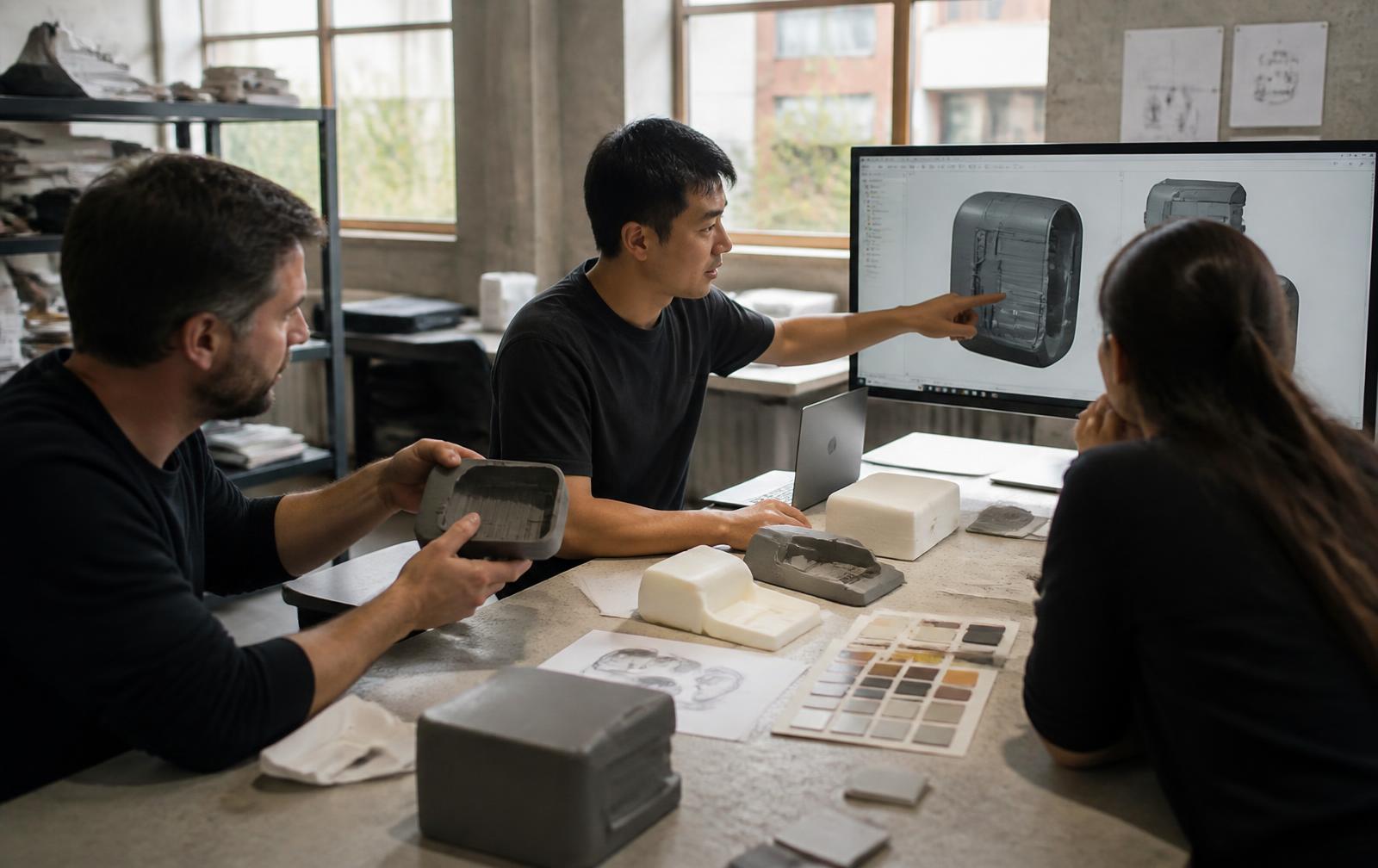
Industrial design and mechanical or electrical design proceed in lockstep with user experience requirements and manufacturability. We emphasize early design for manufacturing so that later transitions to tooling and production are smooth.
We build and iterate quickly. Prototypes validate ergonomics, reliability, performance, and compliance risks. Testing plans focus on the few variables that most affect user value and cost, so iterations deliver meaningful learning, not just cosmetic change.
We prepare drawings, tolerances, materials, and supplier packages. When needed, we help source factories, evaluate pilot runs, and implement quality controls that support consistent production.
Launch Support
Packaging, instructions, certifications, and product marketing assets are coordinated so that go-to-market is not an afterthought. Post-launch, we capture field feedback and plan enhancements, line extensions, or cost downs.
What Sets LA NPDT Apart
Interdisciplinary
Team
Team
Engineers, industrial designers, and product specialists work as one unit. That reduces handoffs and misalignment, and it speeds decision making.
Structured Stages
With Practical Gates
With Practical Gates
We run a staged process that makes risks visible. Each gate requires clear evidence before advancing, which helps control scope and cost.
Manufacturability
From Day One
From Day One
We aim to prevent late-stage surprises by considering tooling, assembly, test, and supply risk as soon as sketches begin to take shape.
Balanced Speed
and Rigor
and Rigor
We move fast when exploration is cheap, and we slow down when decisions become expensive to reverse. This keeps momentum high without ignoring quality.
Industries We Serve
Consumer and Lifestyle
From home goods to connected devices, we design for usability, durability, and brand expression.
Industrial and Commercial
We address reliability, safety, and lifetime cost, with attention to serviceability and standards.
Medical and Health-Adjacent
For health and wellness hardware, we apply appropriate documentation, risk management, and pathway awareness, and we coordinate with specialized regulatory partners when a device requires formal clearances.
Results Our Clients Value
- Faster validation of the right product for the right customer
- Fewer late changes during tooling and production
- Clear visibility into cost, schedule, and technical risk
- Repeatable processes that survive leadership or vendor changes
By embedding all this into an interactive video-AI format we’re making the support of an invention consultant accessible at an introductory level without the need to immediately hire a full consulting team.
A Note Of Thanks
We appreciate the spotlight from Shopify and we are honored to appear alongside respected names like IDEO, Accenture, and Frog. Most of all, we are grateful to our clients and partners who trust us with their ideas and their business.
Ready To Build What’s Next
If you are exploring a new product, planning a line extension, or preparing to scale manufacturing, we would be glad to help. Share your goals, constraints, and timeline, and we will outline a practical path from first conversation to production.
LA NPDT's Product Development Stages
Stage | Primary Focus |
|---|---|
Discovery and Feasibility | Requirements, constraints, market positioning |
Concept and Design | Industrial, mechanical, electrical design; manufacturability |
Rapid Prototyping and Test | Ergonomics, reliability, performance validation |
Manufacturing Preparation | Drawings, materials, supplier sourcing, quality controls |
Launch Support | Packaging, instructions, certifications, marketing assets |
Frequently asked questions
What services does LA NPDT offer for product development?
LA NPDT helps move products from idea to market. The company offers product design, prototyping, and manufacturing preparation. They also provide product marketing support. Their process includes discovery, concept, design, testing, and launch support.
How does LA NPDT approach the product development process?
LA NPDT uses a structured, multi-stage process. This process includes discovery, concept, design, rapid prototyping, and manufacturing preparation. Each stage has practical gates. This approach helps control scope and cost. It also makes risks visible.
What industries does LA NPDT serve?
LA NPDT serves multiple industries. These include consumer and lifestyle products. They also work with industrial and commercial clients. The company designs for medical and health-adjacent hardware. They coordinate with regulatory partners for devices needing formal clearances.
What did Shopify highlight about LA NPDT?
Shopify highlighted LA NPDT's ability to turn ideas into market-ready products. They noted the company's interdisciplinary team. Shopify also mentioned LA NPDT's structured, multi-stage process. This process prioritizes quality and market readiness. They provide product design, prototyping, and manufacturing preparation.
What makes LA NPDT's approach unique?
LA NPDT features an interdisciplinary team. This team includes engineers, designers, and specialists. They work to reduce handoffs and speed decisions. Their process integrates manufacturability from the start. This prevents late-stage surprises. They balance speed and rigor for effective development.
Sources and standards
- USPTO — patent basics — Official guidance on provisional and non-provisional filings for new products.
- NIST Manufacturing Extension Partnership — Federal program supporting US small and mid-size manufacturers.
- ISO 9001 quality management — The quality-system standard most contract manufacturers are audited against.
How to compare product development consulting companies
Awards and portfolios tell you a firm has shipped something; they do not tell you whether it fits your program. The useful comparison is structural: which disciplines are in-house, who owns the files, how the work is priced, and what evidence exists that their designs reached production. Ask the same five questions of every firm on your list and the differences become obvious quickly.
Comparison framework
Criterion | What good looks like | Red flag |
|---|---|---|
Disciplines in-house | ID, mechanical, electrical, firmware under one roof | Everything subcontracted invisibly |
Production evidence | Shipping products they can name and show | Renders only |
Pricing model | Phase-based with defined deliverables | Open-ended hourly with no scope |
IP and file ownership | Assigned to you on payment, native files included | Firm retains CAD or firmware |
Manufacturing network | Named factories and past transfer experience | No supplier relationships |
Communication cadence | Named engineer, weekly reviews, written notes | Account manager relay only |
Start with a paid discovery phase rather than a full program. A requirements document, a risk register and a phased budget are inexpensive relative to a development contract, and they reveal how a firm thinks before you are committed to it.
Questions to ask on the first call
- Which parts of this program would you do in-house, and which would you subcontract?
- Show me a production part you designed alongside its drawing package.
- What does phase one deliver, and how will we know it is done?
- Who owns the CAD, firmware and test data when we finish?
- Which manufacturers have you transferred designs to in the last two years?
Key takeaways
- Compare firms on disciplines, ownership and production evidence, not awards.
- A paid discovery phase is the cheapest way to test a partner.
- Phase-based pricing with defined deliverables beats open-ended hourly work.

Red flags that show up in the first two meetings
Most bad engagements were visible before the contract was signed, in patterns that felt like enthusiasm at the time. A firm that quotes a full concept-to-production program in a single call has not scoped it; it has priced a hope.
A firm that will not name a manufacturing partner or a molding region is either protecting a markup or has not done the sourcing work. And a firm that answers every constraint question with “we can do that” has not yet met your cost target.
- A fixed price with no feasibility phase. Nobody can price tooling risk before the mechanism is proven.
- No questions about volume. Annual volume decides process, tooling class and unit cost; a firm that does not ask is designing in the abstract.
- Renders as the primary portfolio. Ask to see production units, packaging and a certification report.
- Reluctance to discuss failures. Every long-running firm has a recovered program; a firm with none has a short memory or a short history.
- Contract silent on IP and native CAD. This is the single most expensive omission when a relationship ends mid-program.
- No named engineering lead. Programs run by rotating staff lose the reasoning behind earlier decisions.
A short paid feasibility engagement is the cheapest way to test all of this. Twenty thousand dollars spent watching a team work is better diligence than any reference call, and if the fit is wrong you have a technical deliverable and an exit rather than a stalled six-figure program.
What a directory listing tells you, and what it does not
Recognition lists are a useful filter and a poor decision. They tell you a firm has a track record visible enough to be reviewed by an outside party, which removes the bottom tier of the market. They do not tell you whether that firm has run your category, at your volume, under your regulatory burden. A team that excels at connected consumer hardware may be the wrong choice for a cosmetics fill-and-finish launch, and both may appear on the same list.
Treat any listing as a shortlist input and then run your own evidence check. The question that separates firms in practice is not capability breadth but whether they have carried a product from concept through tooling and first production runs &mdash. The phase where most consultancies hand off and most programs stall.
Engagement models and what each one costs
Model | Typical range | You carry | Best fit |
|---|---|---|---|
Feasibility sprint | $5,000-$20,000 | Decision on whether to proceed | Unproven concept, unclear physics or cost |
Phase-gated fixed fee | $60,000-$300,000 per program | Scope discipline | Defined product, known category |
Retained team (monthly) | $15,000-$45,000/month | Prioritization | Multi-SKU roadmap, ongoing engineering |
Design-only handoff | $25,000-$90,000 | Manufacturing risk and DFM rework | In-house manufacturing capability exists |
Concept-to-production | $120,000-$600,000 | Least; partner owns transfer | First-time hardware founders and small brands |
The cheapest model is not the design-only handoff. It is whichever model puts manufacturability decisions in the same hands that make design decisions. Splitting them saves fee and costs tooling: a wall thickness or draft choice made without the molder in the room typically surfaces as a $12,000 to $30,000 tool change three months later.
Diligence checklist before you sign
- Ask for two programs in your category that reached production, including one that ran into trouble and what it cost to recover.
- Confirm who owns the IP and the CAD in the contract, not in conversation. Native files, not STEP exports.
- Ask which decisions require your sign-off and what happens to schedule when a gate slips.
- Get the DFM stance in writing: will they quote and manage tooling, or hand you drawings?
- Meet the engineers who will do the work, not only the principal who sells it.
- Ask how change orders are priced before scope changes, because scope always changes.
- Check regulatory experience explicitly if you touch FCC, UL, FDA or CPSC pathways.
Key takeaways
- Use recognition lists to shortlist, never to select.
- Match category and volume experience, not headline capability breadth.
- Keep design and manufacturability decisions under one roof.
- Put IP ownership, native file delivery and change-order pricing in the contract.
- The most expensive engagement is the one that ends at the drawing package.
Comparing development partners?
Industrial design, mechanical, electrical and firmware under one roof, with production files you own.
Services related to this guide
- Free trademark searchScreen a product name against the live USPTO register in seconds.
- Idea evaluationAn honest read on whether an idea is worth building.
- Product design servicesIndustrial design and CAD taken all the way to manufacturable files.
- Product development examplesReal projects we designed, prototyped and shipped.