CPSC Lithium Battery Rules Are Moving in 2026: What Hardware Founders Should Change Before the Next Prototype
For founders and product teams building battery-powered industrial, pet, outdoor, or consumer hardware: what CPSC proposed on June 24, 2026 for lithium-ion micromobility batteries, and how to keep enclosure, BMS, and charger choices from locking you into a redesign after tooling.
September 14, 20266 min read

Written by Konstantin Dolgan, Ph.D., NPDP
Founder & CEO, Product Development Engineer
Published September 14, 2026
Short answer: on June 24, 2026 the U.S. Consumer Product Safety Commission published a notice of proposed rulemaking (NPR) for lithium-ion batteries used in micromobility products and the electrical systems of those products. It is a proposal, not a final mandatory standard.
If you are building any product that puts a lithium pack inside a housing, the design choices the proposal highlights (tamper-resistant enclosure, a battery management system that refuses to charge a hot pack, reverse polarity protection and charger pairing, and permanent warning labels) are far cheaper to design into a functional prototype than to retrofit after tooling.
This article is for founders and product teams who need to decide enclosure, BMS behavior, and charger pairing before a prototype freezes geometry.
What CPSC proposed on June 24, 2026
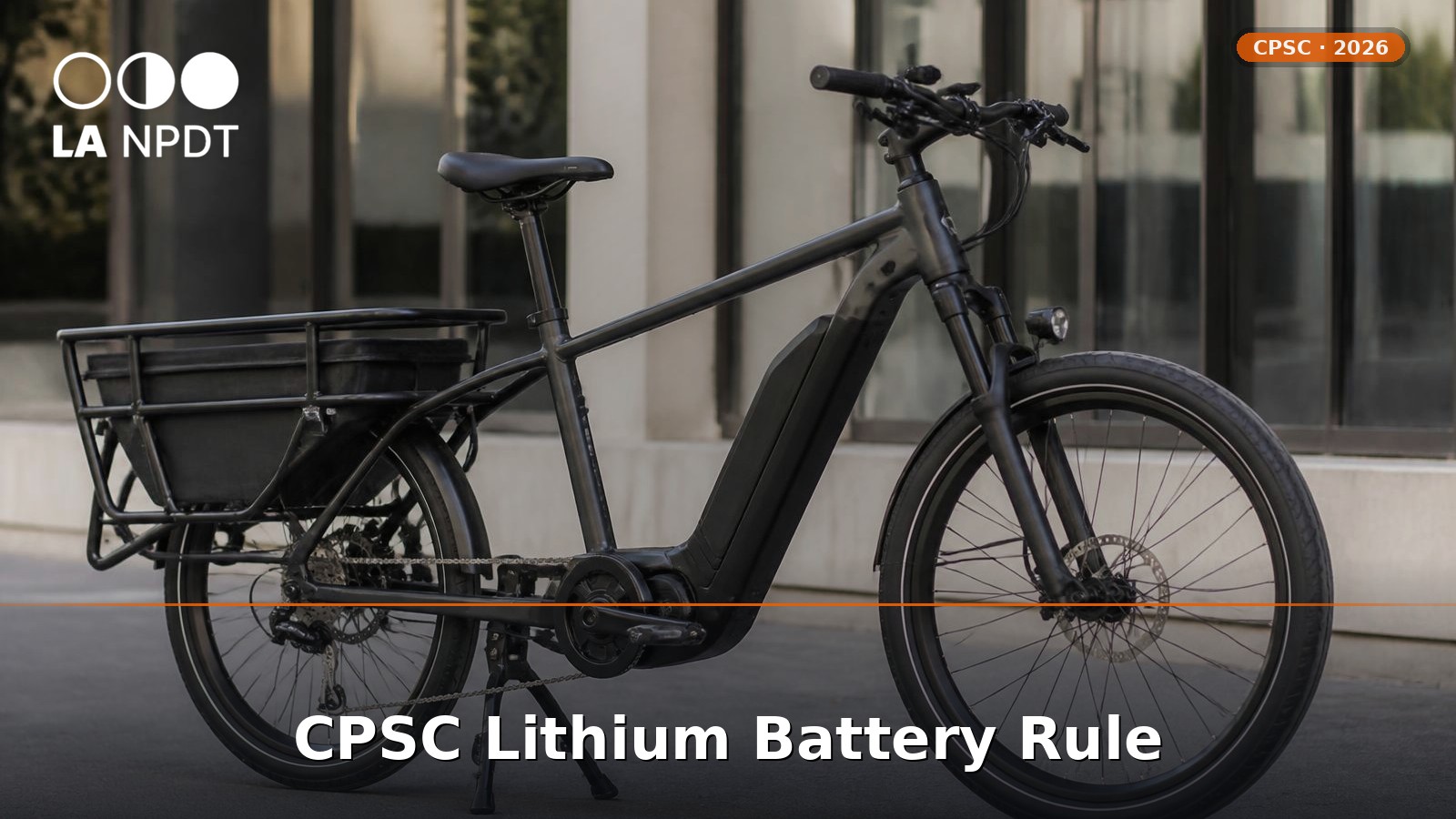
CPSC published a notice of proposed rulemaking for a safety standard covering lithium-ion batteries used in micromobility products and the electrical systems of those products, proposed as 16 CFR part 1265. The stated hazard focus is thermal runaway and the related risks of fire, explosion, escaping gas and flame, burns, overheating, and smoke.
Secondary summaries of the NPR describe the covered categories as e-bikes, personal eMobility products, user-replaceable battery packs sold separately from a micromobility product, e-bike conversion kit components, and aftermarket battery chargers marketed, intended, or designed for those products.
Rather than adopting voluntary standards as written, the proposal would require compliance with them plus modifications: ANSI/CAN/UL 2849:2020 for e-bikes, ANSI/CAN/UL 2272:2024 for personal e-mobility devices, and ANSI/CAN/UL/ULC 2271:2023 for user-replaceable light electric vehicle battery packs, each with the modifications described in the proposed rule text.
CPSC analysis in the NPR materials concludes that the unmodified voluntary standards are inadequate to eliminate or adequately reduce the identified unreasonable risks, which is why modifications are proposed instead of a plain incorporation by reference.
Examples of modifications highlighted in the NPR materials and law firm summaries include tamper-resistant battery enclosure requirements, a post-discharge charge test so the battery management system prohibits charging when cell surface temperature exceeds a specified upper limit, a reverse polarity test to reduce damage from incompatible chargers, and expanded warning label and instruction requirements.
Aftermarket chargers would carry pairing language, for example use only with the stated product or model, in the exact warning format set by the proposed text.
The comment window has closed. Written comments were due by August 24, 2026, and requests to present orally were due by July 24, 2026. Both deadlines are in the past as of this publication date.
Why this matters before you freeze a prototype
Every item on that modification list is a geometry or firmware decision. A tamper-resistant enclosure changes fastener strategy, parting lines, service access, and sometimes the whole housing architecture.
A charge inhibit above a temperature limit needs a sensor location, a thermal path, and firmware that was written with the test in mind. Reverse polarity protection and charger pairing constrain connector selection and the charger you ship or approve.
Permanent warning text needs physical room on the housing and space in the instruction set.
Those are all nearly free at functional prototype stage and expensive after a tool is cut. If a rule like this is finalized as described, the same decisions also become the subject of a compliance sample and a test report, so the version you prototype is the version somebody has to certify.
This is also a reason to treat regulatory movement the same way we treat material rules that are moving in 2026: as a design input during prototyping, not as a purchasing problem later.
Checklist before you lock the pack and housing
Run this once per program and keep the answers with the design file, so the next review starts from evidence instead of memory.
- Confirm whether your product falls inside the NPR scope (a micromobility product, a conversion kit component, a user-replaceable pack, or an aftermarket charger) or is only adjacent. Adjacent lithium products are not covered by this proposal, and you should not claim they are, but the same enclosure and charger pairing questions are still good design inputs.
- Specify a tamper-resistant battery enclosure approach in CAD, not as a post-tooling add-on.
- Write the BMS behavior for post-discharge temperature inhibit into the firmware requirements and the test plan at the same time.
- Define charger pairing and reverse polarity protection before connector selection freezes.
- Draft warning and instruction language early enough that the housing still has room for permanent markings.
- If any SKU could be a children product, budget third-party testing and certification time into the prototype to pilot plan.
- Watch the Federal Register for a final rule, and keep the 180-day compliance clock described in the proposal in your schedule assumptions.
Founder decision map
Situation | What to do on the next prototype | Why |
|---|---|---|
Clearly in scope micromobility product | Design to the referenced UL standard plus the proposed modifications and build a sample you could hand to a lab | If the rule is finalized as described, this is the design that gets certified |
Adjacent battery-powered industrial, pet, or outdoor product | Treat enclosure access, charge inhibit when hot, and charger pairing as voluntary design inputs | Not covered by this proposal, but the same failure modes drive the same design answers |
Aftermarket pack or charger business | Plan for pairing warnings and reverse polarity protection now, and for label space on the product | Packs and aftermarket chargers are called out in the proposed scope |
Children product SKU | Add third-party testing and certification time to the plan before the pilot build | Children products covered by a final rule would be expected to carry testing and certification obligations |
Tooling quoted but enclosure not locked | Hold the enclosure and connector decisions for one compliance-minded design review | The cheapest moment to change fastener strategy or a connector is the moment before a tool is cut |
What this is not
- Not legal or regulatory advice. Scope, applicability, and compliance obligations should be confirmed with qualified counsel or a regulatory consultant.
- Not a claim that the rule is final. It is a proposed rule, and no final mandatory standard is in force on the basis of this NPR.
- Not a market report. There are no market sizes, injury counts, or forecasts here.
- Not a claim that every lithium product is covered. Scope in the proposal is micromobility as defined in the NPR.
Sources
- SGS SafeGuardS 089/26 (June 29, 2026), summary of scope, referenced UL standards, modifications, and comment deadlines.
- Morrison Foerster client alert (July 16, 2026), summary of the proposed modifications, the 180-day compliance period, the anti-stockpiling provision, and children product testing expectations.
If you are still proving the concept, design the pack enclosure and charger interface into the functional prototype rather than around it later. If you are already quoting tooling, freeze those interfaces only after a compliance-minded design review.
Related reading on design for manufacturability, electronic product prototyping, and getting a prototype made.
If you want a second set of eyes before the enclosure locks, talk with our team or apply to partner with us, and read more from Konstantin Dolgan on taking hardware from idea to production.
Frequently asked questions
Is the CPSC micromobility battery rule final?
No. What CPSC published on June 24, 2026 is a notice of proposed rulemaking. It sets out a proposed 16 CFR part 1265 and asks for comment. Written comments were due by August 24, 2026 and requests to present orally were due by July 24, 2026, so both windows have closed, but a proposal is not a mandatory standard until a final rule is published.
Which Products Does the June 24, 2026 Npr Cover?
Summaries of the proposal describe the covered categories as e-bikes, personal eMobility products, user-replaceable battery packs that are not sold with a micromobility product, e-bike conversion kit components, and aftermarket battery chargers marketed, intended, or designed for those products. Other lithium-powered hardware is outside the proposed scope.
Which UL standards does the proposal build on?
ANSI/CAN/UL 2849:2020 for e-bikes, ANSI/CAN/UL 2272:2024 for personal e-mobility devices, and ANSI/CAN/UL/ULC 2271:2023 for user-replaceable light electric vehicle battery packs, each with the modifications described in the proposed rule text rather than as published.
What enclosure and BMS changes should I prototype now?
Four things map directly onto prototype decisions: a tamper-resistant battery enclosure, a battery management system that prohibits charging when cell surface temperature is above the specified upper limit after discharge, reverse polarity protection so an incompatible charger does less damage, and permanent warning and instruction content, including pairing language on aftermarket chargers.
What happens if the rule is finalized?
As summarized by Morrison Foerster, manufacturers would have 180 days from publication of a final rule to comply, and the proposal includes an anti-stockpiling provision that limits manufacture and import of noncompliant products during the transition. Children micromobility products covered by a final rule would be expected to trigger third-party testing and certification obligations.
Is this legal advice?
No. This is engineering-side reading of a public proposal, written to help you sequence design decisions. Confirm scope and obligations for your specific product with qualified counsel or a regulatory consultant.
Services related to this guide
- Best prototyping companiesDevelopment firms, instant-quote bureaus and local shops — who fits which job.
- Free prototype cost calculatorFive to eight questions, an instant cost range for a first prototype.
- Prototype development companiesWhich firms take a sketch to a working prototype — and which only fabricate parts.
- Rapid prototypingWorking prototypes in days, from 3D printing to vacuum casting.