FCC Covered List 2026: Logic-Bearing Components Hardware Founders Must Check Before the Next Prototype
For founders and product teams building connected RF / IoT / industrial / medical / robotics hardware: what the FCC's September 11, 2026 final rule changes about Covered List logic-bearing components, and what to verify in the BOM before the next functional prototype.
September 24, 20266 min read

Written by Konstantin Dolgan, Ph.D., NPDP
Founder & CEO, Product Development Engineer
Published September 24, 2026
Short answer: The FCC published final rule FR Doc 2026-18535 on September 11, 2026, with an effective date of October 13, 2026.
For new equipment authorization applications, the rule closes a component-part loophole when a device incorporates a logic-bearing hardware component produced by a Covered List entity and the device would be prohibited if that entity produced the whole device.
Connected-hardware teams should identify those parts, verify the legal producer, and lock acceptable alternates before the next functional prototype and PCB or module freeze.
Key takeaways
- Rule timing: FR Doc 2026-18535 was published September 11, 2026, at 91 FR 57798 and takes effect October 13, 2026.
- Loophole closed: New 47 CFR 2.903(b)(2) prohibits authorization of a device that incorporates a logic-bearing hardware component produced by a Covered List entity when the device would be prohibited if that entity produced the whole device.
- Bright-line definition: 47 CFR 2.902 draws from the digital-device standard, including timing signals or pulses above 9,000 cycles per second and digital techniques, or RF energy used for data processing.
- Entry type matters: The component rule applies to producer or provider-based Covered List entities, not production-location-based entries unless the producer is independently listed.
- Prospective application: Previously authorized equipment is unaffected. Pending applications as of the effective date are exempt unless later amended to add, substitute, or change a logic-bearing component.
- Prototype implication: Put producer identity and Covered List checks into the BOM workflow before PCB, module, and alternate-source decisions become expensive to reverse.
Video: dedicated LA NPDT explainer coming soon
What the FCC published and when it takes effect
The final rule is Protecting Against National Security Threats to the Communications Supply Chain Through the Equipment Authorization Program. It is identified as FR Doc 2026-18535, 91 FR 57798, in ET Docket No. 21-232 and FCC 26-50. The rule was published September 11, 2026, and becomes effective October 13, 2026.
The core component provision appears in new 47 CFR 2.903(b)(2). It prevents authorization of a device that incorporates a logic-bearing hardware component produced by a Covered List entity when that device would itself be prohibited if the listed entity had produced the complete device.
The rule is prospective for new authorization applications. Previously authorized equipment is not affected. Applications pending on October 13, 2026 are exempt unless an amendment later adds, substitutes, or changes a logic-bearing component.
What logic-bearing means in plain English
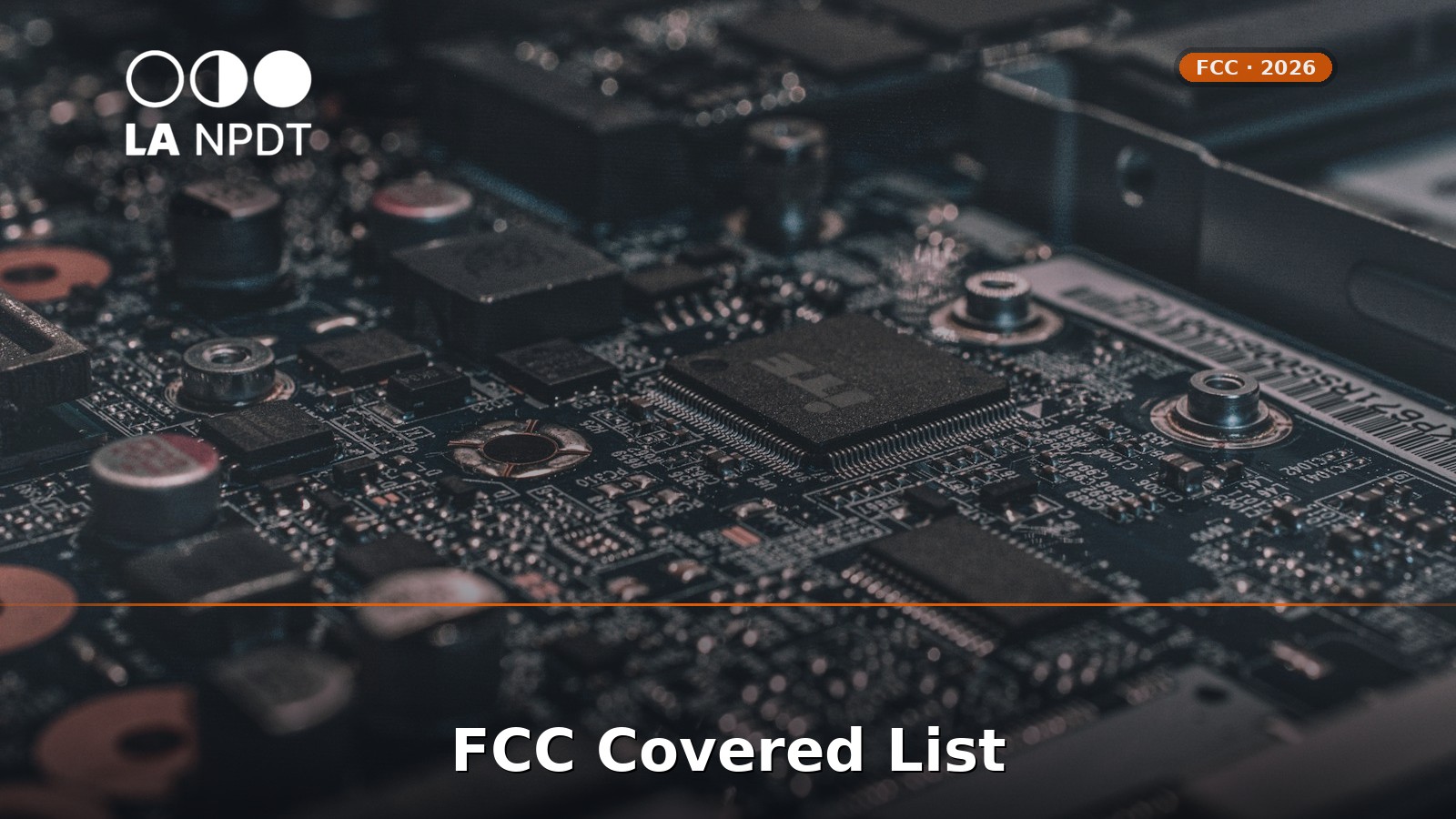
New 47 CFR 2.902 uses a bright-line standard drawn from the digital-device definition. A logic-bearing hardware component uses timing signals or pulses above 9,000 cycles per second and digital techniques, or uses RF energy for data processing. The practical question is whether the part carries out digital logic or RF data-processing work, not whether it is physically small or sold as a subassembly.
Usually in scope for review | Outside this component definition |
|---|---|
Microcontrollers (MCUs), systems on chip (SoCs), field-programmable gate arrays (FPGAs), radios, modems, and digital timing parts | Housings, fasteners, resistors, wiring, and plain battery cells |
Wi-Fi, Bluetooth, cellular, and other connected modules that contain logic-bearing hardware | Purely mechanical or passive parts without the defined digital or RF data-processing function |
Power-management integrated circuits with digital control and similar digitally controlled parts | Software and firmware components, which the FCC did not extend this component rule to at this time |
This is a screening distinction, not a substitute for reviewing the rule text and the current Covered List. A component name alone may not reveal the producer or the functions inside a module. Record both before deciding whether the rule changes an authorization plan.
Producer or provider entries versus production-location entries
The FCC distinguishes entries that identify a producer or provider from entries based on where a product was produced. The new component restriction applies to producer or provider-based Covered List entities. It does not apply to production-location-based entries, including location-based entries for foreign-produced unmanned aircraft systems or routers, unless the component producer is independently on the Covered List.
Question | Producer or provider-based entry | Production-location-based entry |
|---|---|---|
What the entry identifies | A named entity that produces equipment or provides a covered service | Equipment characterized by where it was produced |
Does the logic-bearing component rule apply? | Yes, when the component producer is the listed entity and the complete device would be prohibited if that entity produced it | Not on location alone |
Important exception | Check the precise scope of the named entry | The rule can still apply if the actual producer is independently on the Covered List |
BOM evidence to retain | Producer legal name, part number, supplier record, and Covered List check date | Production location, producer legal name, and confirmation whether that producer has a separate listing |
Do not use a distributor storefront, trading name, or module label as the only identity field. The check is about the producer or provider legal name and the exact basis for the Covered List entry.
Prototype BOM and supply-chain checklist
Use these ten gates before the next connected-hardware prototype. The goal is to surface a disallowed or uncertain source while alternates can still be evaluated, not after a PCB, enclosure, test plan, or authorization strategy depends on it.
Gate | What to verify | Decision record |
|---|---|---|
1. Pull the current Covered List | Use the FCC Covered List updated September 18, 2026, or a later official update. | Record the URL and check date. |
2. Flag every logic-bearing BOM item | Review MCU, SoC, FPGA, modem, Wi-Fi, Bluetooth, cellular module, PMIC with digital control, and comparable digital or RF data-processing parts. | Mark each item as flagged, outside the definition, or requiring review. |
3. Identify the legal producer | Trace each flagged part beyond the distributor brand to the producer or provider legal name. | Save the producer name with the manufacturer part number. |
4. Check producer or provider status | Compare the legal producer against producer or provider-based Covered List entries. | Record the matching entry or a dated no-match result. |
5. Separate location-only entries | Do not treat a production-location entry as a producer listing unless the producer is independently listed. | Record the entry basis and production location separately. |
6. Decide authorization-path impact | For new applications after October 13, 2026, determine whether 47 CFR 2.903(b)(2) blocks the configuration. | Escalate affected or uncertain configurations before design freeze. |
7. Freeze acceptable alternates | Qualify alternate parts and modules before PCB or module freeze. | Capture footprint, interface, firmware, RF, power, thermal, and sourcing impacts. |
8. Document pending-application amendment risk | A pending application may lose the exemption if later amended to add, substitute, or change a logic-bearing component. | Link each planned component change to the authorization review. |
9. Note marketplace FCC ID duties | If sold through online marketplaces, track the FCC ID point-of-sale display obligations and the March 1, 2027 and June 1, 2027 compliance dates, depending on the applicable title and access requirement. | Assign an owner for listing content and compliance timing. |
10. Cross-check only applicable regimes | Review the EU CRA, FDA cybersecurity, and QMSR requirements only when those products and markets apply. Do not treat them as the same rule. | Link each applicable regulatory requirement to its own evidence and owner. |
Why this belongs before PCB and module freeze
A logic-bearing component is often architecture-bearing too. Replacing a microcontroller, radio module, modem, FPGA, or digitally controlled power component can affect pinout, board area, power rails, antenna layout, thermal behavior, firmware interfaces, test fixtures, and lead-time assumptions. That makes the BOM review a prototype planning task, not only a filing-stage task.
For connected products, place the review beside the technical supplier record used by the electrical team. Our IoT product development and electronic product prototyping guide pages show where architecture, module selection, PCB work, and functional testing fit in the broader development path.
When a medical device is involved, keep this FCC equipment-authorization question separate from device cybersecurity and quality-system work. Review the FDA medical device cybersecurity checklist, the FDA QMSR 2026 guide, and our medical device prototyping capabilities only where those requirements apply.
Other equipment-authorization changes to track
The final rule also requires Covered List entities to use full certification, rather than a permissive change or Supplier Declaration of Conformity path, for modifications.
It adds online-marketplace FCC ID display obligations at the point of sale, with compliance dates of March 1, 2027 and June 1, 2027 depending on the applicable title and access requirement. The rule also revises the critical-infrastructure definition used for Covered List entries based on how equipment is used.
These provisions affect different actors and timelines. Keep them in the compliance plan, but do not let them obscure the immediate prototype question: who produced each logic-bearing component in the configuration intended for a new authorization application?
What this article is not
- It is not legal advice. Product teams should use qualified legal and equipment-authorization counsel for a specific device and filing.
- It is not a claim that every bench model needs a complete hardware bill of materials on day one. The level of control should match the prototype purpose, but authorization-bound configurations need traceable component decisions before freeze.
- It is not a substitute for the final rule or current Covered List. Read the Federal Register text, FCC order, and current official list.
- It is not a duplicate of other regimes. The EU Cyber Resilience Act, FDA cybersecurity guidance, and FDA QMSR each have different scope and obligations.
Where to go next
If your next prototype includes connected modules, radios, programmable logic, or digitally controlled subsystems, LA NPDT can help turn this checklist into an engineering-ready BOM review, architecture plan, and alternate-source decision before PCB or module freeze. Start with product development consulting or apply to partner with us for a focused project discussion.
Sources
Frequently asked questions
When does the FCC Covered List logic-bearing component rule take effect?
The rule takes effect October 13, 2026. The FCC published FR Doc 2026-18535 on September 11, 2026, at 91 FR 57798 under ET Docket No. 21-232 and FCC 26-50. It applies prospectively to new equipment authorization applications, subject to the treatment of pending applications described in the final rule.
What is a logic-bearing hardware component under the new rule?
New 47 CFR 2.902 uses a bright-line standard drawn from the digital-device definition. It covers hardware using timing signals or pulses above 9,000 cycles per second and digital techniques, or RF energy for data processing. Examples for BOM screening include MCUs, SoCs, FPGAs, radios, modems, and digital timing parts. Purely mechanical and passive parts are excluded, and this component rule does not extend to software or firmware at this time.
Does the rule apply to production-location Covered List entries?
Not on the basis of production location alone. The component rule applies to producer or provider-based Covered List entities. A production-location-based entry does not trigger the component provision unless the actual component producer is independently on the Covered List.
What should hardware founders check before the next prototype?
Flag each logic-bearing BOM item, identify its producer or provider legal name, compare that entity with the current FCC Covered List, distinguish producer-based entries from location-based entries, and qualify acceptable alternates before PCB or module freeze. Also document whether a planned application or pending-application amendment changes the authorization analysis.
Tagged:Product Development
Services related to this guide
- Best prototyping companiesDevelopment firms, instant-quote bureaus and local shops — who fits which job.
- Free prototype cost calculatorFive to eight questions, an instant cost range for a first prototype.
- Prototype development companiesWhich firms take a sketch to a working prototype — and which only fabricate parts.
- Rapid prototypingWorking prototypes in days, from 3D printing to vacuum casting.