Customer Needs Analysis: How to Turn Signals Into Requirements
Most products fail because the team solved a need nobody actually had, or solved a real need badly. Customer needs analysis is the discipline that prevents both.
May 12, 20256 min read

Written by Yelena Rymbayeva, MPhil Communication & Media Studies, BTech Quality Control
Marketing & Product Leader, Technology Commercialization
Published May 12, 2025Updated September 2, 2026
Customer needs analysis is the process of collecting evidence about what users are trying to accomplish, separating underlying needs from proposed solutions, prioritizing those needs by importance and current satisfaction, and converting them into testable product requirements. It sits at the front of every credible development process, before concepts and long before CAD.
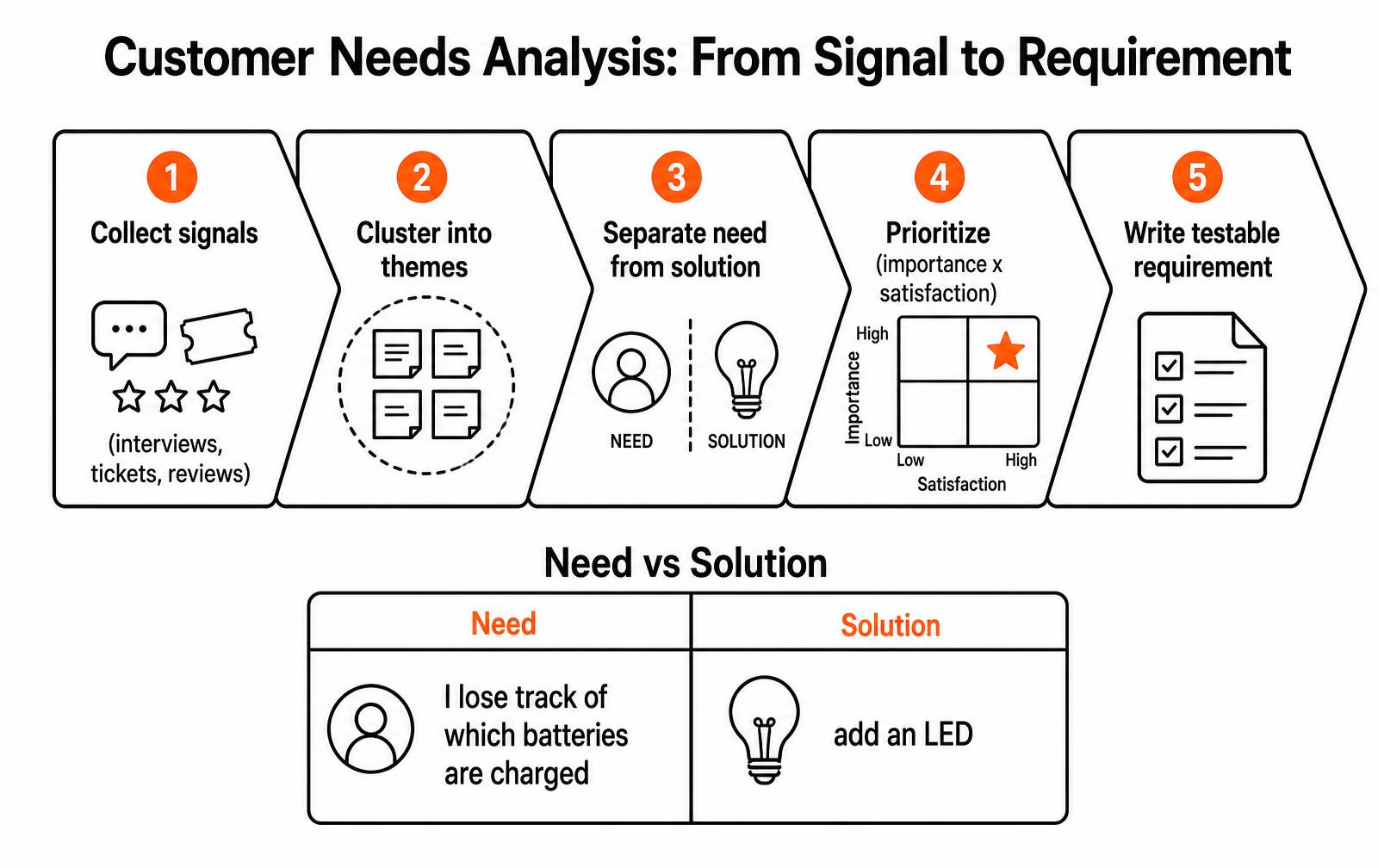
The failure mode is rarely a lack of feedback. It is feedback that arrives as feature requests, gets logged as feature requests, and gets built as feature requests — with nobody ever asking what problem the customer was actually trying to solve.
Where to collect signals
Source | What it is good at | What it misses |
|---|---|---|
1-on-1 interviews | Depth, context, the why behind behavior | Scale and statistical confidence |
Contextual observation | Workarounds people never mention | Time cost, small samples |
Support tickets and reviews | Volume, unfiltered frustration | Only from people who bothered to complain |
Surveys | Quantifying how widespread a need is | Cannot discover needs you did not ask about |
Sales and churn calls | Purchase blockers and deal-breakers | Skewed toward the loudest objections |
Usage analytics | What people actually do | Never explains why |
Use at least one qualitative and one quantitative source. Interviews tell you what to measure; surveys and analytics tell you how much it matters.
Step 1: Interview for behavior, not opinions
- Ask about the last time, not about generalities. "Walk me through the last time you had to do this" beats "how often do you..."
- Chase the workaround. Duct tape, spreadsheets and hand-written notes are unmet needs with evidence attached.
- Ask what they tried and abandoned. Abandoned alternatives reveal the real evaluation criteria.
- Never pitch during discovery. The moment you describe your idea, the interview becomes a politeness test.
- Stop at saturation. Eight to twelve interviews in a single segment usually surface most recurring themes.
Step 2: Separate needs from solutions
Customers speak in solutions because that is how humans communicate. Your job is to translate back.
What they said (solution) | The underlying need | Better solution space |
|---|---|---|
"Add a bigger battery" | I cannot risk it dying mid-shift | Runtime, charging speed, state-of-charge visibility, swappable pack |
"Make it waterproof" | I use it outdoors and cannot baby it | Ingress protection, drop resistance, glove operation |
"Add an app" | I cannot tell what state the device is in | On-device indication, alerts, remote status |
"Make it cheaper" | The value is not obvious at this price | Cost reduction, or better communicated value |
Write each need in the customer's words as a stable statement of what they are trying to accomplish. Stable needs outlive technologies; solutions do not.
Step 3: Prioritize with importance and satisfaction
Score every need on two dimensions with a representative sample: how important it is, and how satisfied they are with current options. The gap between them is opportunity.
- High importance, low satisfaction — the opportunity zone. Build here.
- High importance, high satisfaction — table stakes. Match competitors, do not over-invest.
- Low importance, low satisfaction — real complaints that will not drive purchase. Defer.
- Low importance, high satisfaction — ignore, and consider removing cost.
Kano analysis adds a useful second lens: which needs are basic expectations, which are linear performance drivers, and which are delighters that create preference. Delighters decay into expectations over time, which is why the analysis has to be repeated.
Not sure your product is solving the right problem?
Our discovery engagements combine customer interviews, market analysis and technical feasibility so you commit engineering budget to needs that are real.
Step 4: Write requirements a team can build against
A need becomes a requirement when it is specific, measurable and verifiable. "Long battery life" is a wish. "Operates for a full 10-hour shift at 25°C with a 30-minute recharge to 80 percent" is a requirement — testable, arguable and costable.
- State the need, the metric, the target value and the acceptance test.
- Mark each as must-have, should-have or nice-to-have before engineering sees it.
- Trace every requirement back to the evidence that produced it — interview, survey or ticket volume.
- Review the set with engineering and manufacturing before it is frozen; some targets are 10x more expensive than others.
- Revisit after prototype testing, when real physics has an opinion.
From there the requirement set feeds concept development and concept testing, where you validate that the solution actually addresses the need you documented.
Common mistakes
- Interviewing only enthusiasts. Friends and early fans confirm; strangers inform.
- Counting requests instead of weighing needs. Ten people asking for the same feature can share one shallow need.
- Skipping non-users. The people who rejected your category explain the biggest addressable gap.
- Freezing needs at kickoff. Needs shift with markets, regulation and competitors.
- Letting the loudest stakeholder overrule evidence. Documented traceability is the only reliable defense.
Ready to build against real requirements?
We run structured discovery and translate findings into an engineering-ready requirements document, then design and build against it.
Turning the analysis into a requirements document
The point of customer needs analysis is a document that an engineering team can build against and a test team can verify. Keep it in one table, keep the customer's language visible next to the engineering target, and record how each requirement will be proven. Anything that cannot be verified is a wish, and it should be labeled as one.
Need (customer's words) | Engineering requirement | Target | Verification |
|---|---|---|---|
"It should not die during a shift" | Runtime on a full charge under typical duty | ≥ 9 hours at 40% duty | Bench discharge test, 5 units |
"I use it with gloves on" | Control actuation force and target size | ≤ 6 N, ≥ 15 mm target | Usability test with nitrile and work gloves |
"It gets dropped a lot" | Drop survival onto concrete | 6 drops, 1.2 m, no functional loss | IEC 60068-2-31 drop sequence |
"I have to clean it daily" | Chemical and ingress resistance | IP65, resists isopropyl and quaternary cleaners | Spray test plus 30-day chemical soak |
Keeping the needs alive through development
Requirements documents die quietly. Six months into a program the team is solving detail problems and nobody reopens the file, so a trade-off gets made that violates the need that started the project. The fix is procedural: review the needs table at every phase gate, mark each requirement as met, at risk, or dropped, and require a named approval for anything dropped.
- Trace each requirement to the concept feature that satisfies it, so deleting a feature raises a flag.
- Re-test the top five needs on every prototype build, not just at the end.
- Take changes back to customers when a trade-off touches something they told you was essential.
- Keep the rejected needs list; it becomes the roadmap for version two.
Common signals that the analysis was too shallow
- Every need scores as high importance. A prioritization that ranks nothing has not been done.
- The needs read like features. If a requirement names a mechanism, the solution space was closed too early.
- All input came from buyers, not users. The person who purchases and the person who uses often want opposite things.
- No one disagreed. Real user research surfaces conflicts between segments; unanimous findings usually mean leading questions.
From Raw Signals to Clustered Needs: The Working Session
Interview notes are not analysis. The step that separates a useful needs analysis from a folder of transcripts is a structured clustering session, run within a week of the last interview while the context is still fresh. Pull every verbatim onto its own card — one observation per card, in the customer's words, with the participant ID attached so you can trace it back.

Cluster bottom-up, without predefined categories. Group cards that describe the same underlying job, then name each cluster as a need statement in the form "I need to [outcome] so that [reason]". Resist naming clusters after features. If a cluster can only be described by a solution, it is a solution cluster and you have skipped a level of abstraction — ask what the solution is for and re-name it.
Then attach evidence weight to each cluster: how many distinct participants contributed to it, how many independent channels it appeared in (interviews, tickets, reviews, warranty data), and whether the participants who raised it are inside your priority segment.
A need raised by nine of twelve interviewees and echoed in support tickets is a requirement. A need raised once by an outlier is a hypothesis to watch, and labelling it that way is what keeps the roadmap honest.
Close the session by assigning each cluster to a decision: specify now (goes into the requirements document with a measurable target), investigate (needs quantitative validation before it earns scope), or park (documented, dated, and revisited at the next planning cycle). Every cluster gets one of the three. Leaving needs unassigned is how research quietly disappears between discovery and development.
Frequently asked questions
What is customer needs analysis?
Customer needs analysis is a structured process for identifying what customers are trying to accomplish, distinguishing underlying needs from the solutions they propose, prioritizing needs by importance and current satisfaction, and translating them into measurable product requirements.
How do you conduct a customer needs analysis?
Collect signals from interviews, observation, support tickets, reviews, surveys and usage data; cluster them into themes; restate each theme as a need rather than a feature; score importance and satisfaction with a representative sample; then write testable requirements traced back to the evidence.
How many customer interviews are enough?
Eight to twelve interviews within a single well-defined segment typically reach thematic saturation, where new conversations stop producing new themes. Multiple segments require that number each. Quantifying how widespread a need is requires a survey, not more interviews.
What is the difference between a customer need and a feature request?
A feature request is a proposed solution — "add a bigger battery." A need is the underlying goal — "I cannot risk the device dying mid-shift." Needs are stable and open multiple solution paths; feature requests lock you into one, often not the best one.
How do you prioritize customer needs?
Score each need on importance to the customer and satisfaction with existing options. Needs that are highly important and poorly served are the best opportunities. Kano analysis adds classification into basic expectations, performance drivers and delighters.
When should customer needs analysis happen?
Before concept development, and again after prototype testing. Doing it first prevents building the wrong thing; repeating it after users handle a prototype catches needs that only surface when people interact with something real. Work with LA NPDT: if you are moving from here to execution, start with our product design services or talk to us about industrial design and development .
Filed under:Uncategorized
Services related to this guide
- Product design servicesIndustrial design and CAD taken all the way to manufacturable files.
- Rapid prototypingWorking prototypes in days, from 3D printing to vacuum casting.
- Electronic design servicesSchematic, PCB layout, firmware and bring-up, through to production handoff.
- Product development examplesReal projects we designed, prototyped and shipped.