Sports Product Design: How the Hand Tennis Glove Was Engineered
Sports equipment is judged on court, not in a review meeting. Here is how a taped-together prototype became a production glove, told through the material and stitching problems we had to solve.
August 22, 202611 min read

Written by Konstantin Dolgan, Ph.D., NPDP
Founder & CEO, Product Development Engineer
Published August 22, 2026
Sports product design is the discipline of designing equipment whose performance is decided by a human body in motion, which means the only real test is play. Requirements are physical - rebound, spin, grip, shock, wear - and they are verified by athletes on a court, not by a review meeting. This is what that looked like on one project: turning a taped-together prototype into production equipment for a brand-new sport.
The brief: a glove that plays like a racket
Anthony Soto came to us with an idea most people have had without acting on it. Anyone who has swatted a tennis ball back over the net with an open hand knows how good it feels - and how quickly it stops working. Bare hands sting, control is inconsistent, and the ball dies on impact. He had built a crude hand-made prototype and played with it enough to know the concept had legs.
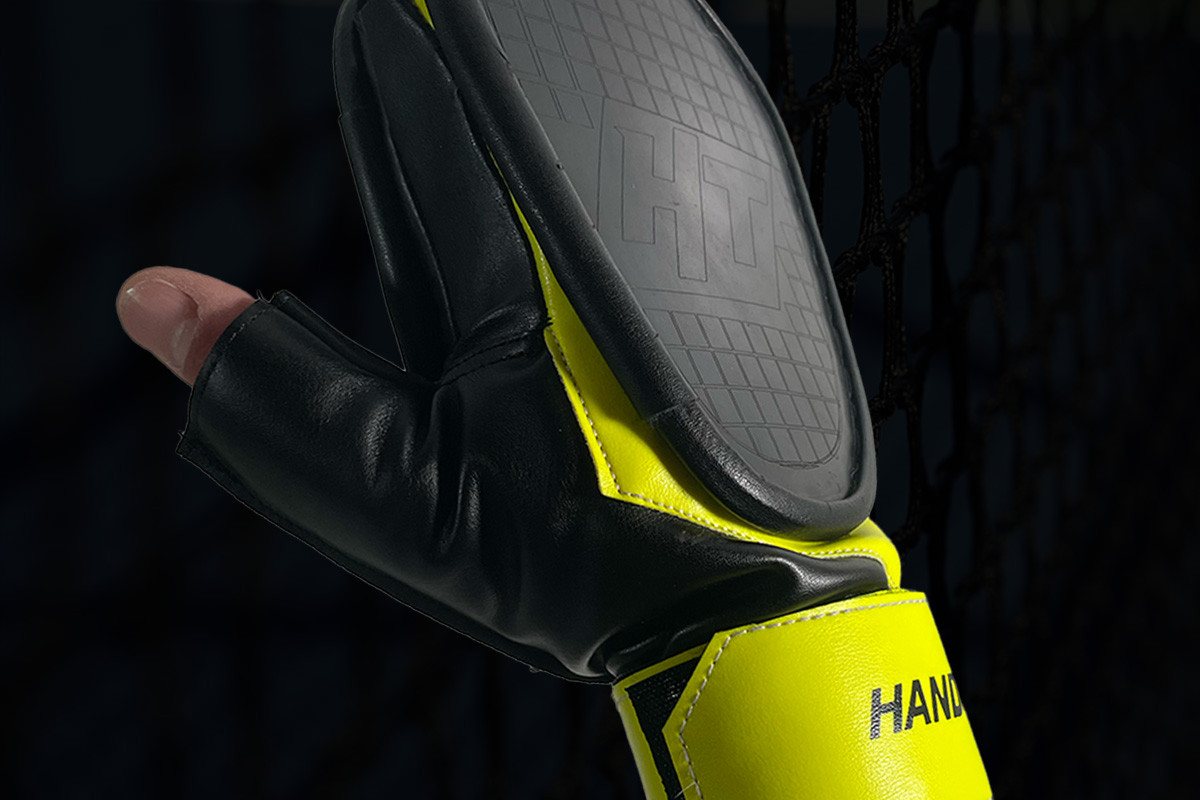
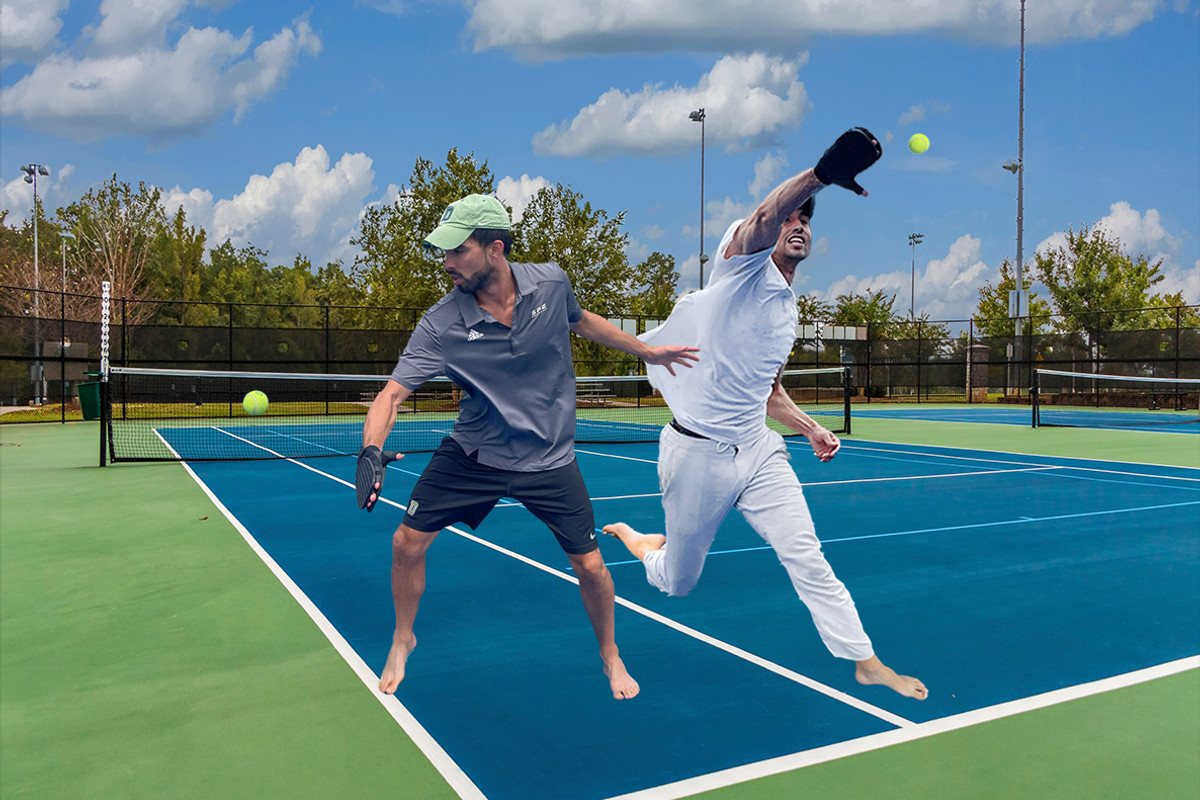
The target was specific: an MMA-style glove crossed with a hard, pickleball-like striking face, worn on the hand, capable of hitting a standard tennis ball on a standard court. Not a toy, not a paddle with straps - a glove that plays.
Why sports equipment is a different design problem
Requirement | How it is judged | Where it usually fails |
|---|---|---|
Performance | Rebound height, shot depth, spin on slice and topspin | Materials that feel right in the hand but kill the ball |
Feel and sound | What the athlete reports at impact | Cannot be simulated - it has to be hit |
Shock | Energy transmitted into the palm and wrist | Rigid faces that bounce well and hurt |
Durability | Surface condition after weeks of play, not one session | Blends that glaze or abrade after day one |
Fit | Stays on the hand through a full point, across hand sizes | Straps and closures designed after the geometry is frozen |
Manufacturability | Whether a glove factory can actually sew it | Seams placed where the product tears |
Everything hard lived in one component
Almost every difficult problem on this project sat in the striking pad, and its requirements pull against each other. Off-the-shelf materials failed one or another: soft elastomers absorbed the ball and gave no depth; rigid plastics bounced well but cracked, transmitted shock straight into the hand, and refused to move with the glove. The answer was not a catalogue part. It had to be developed.
Design: start with the hand, then the geometry
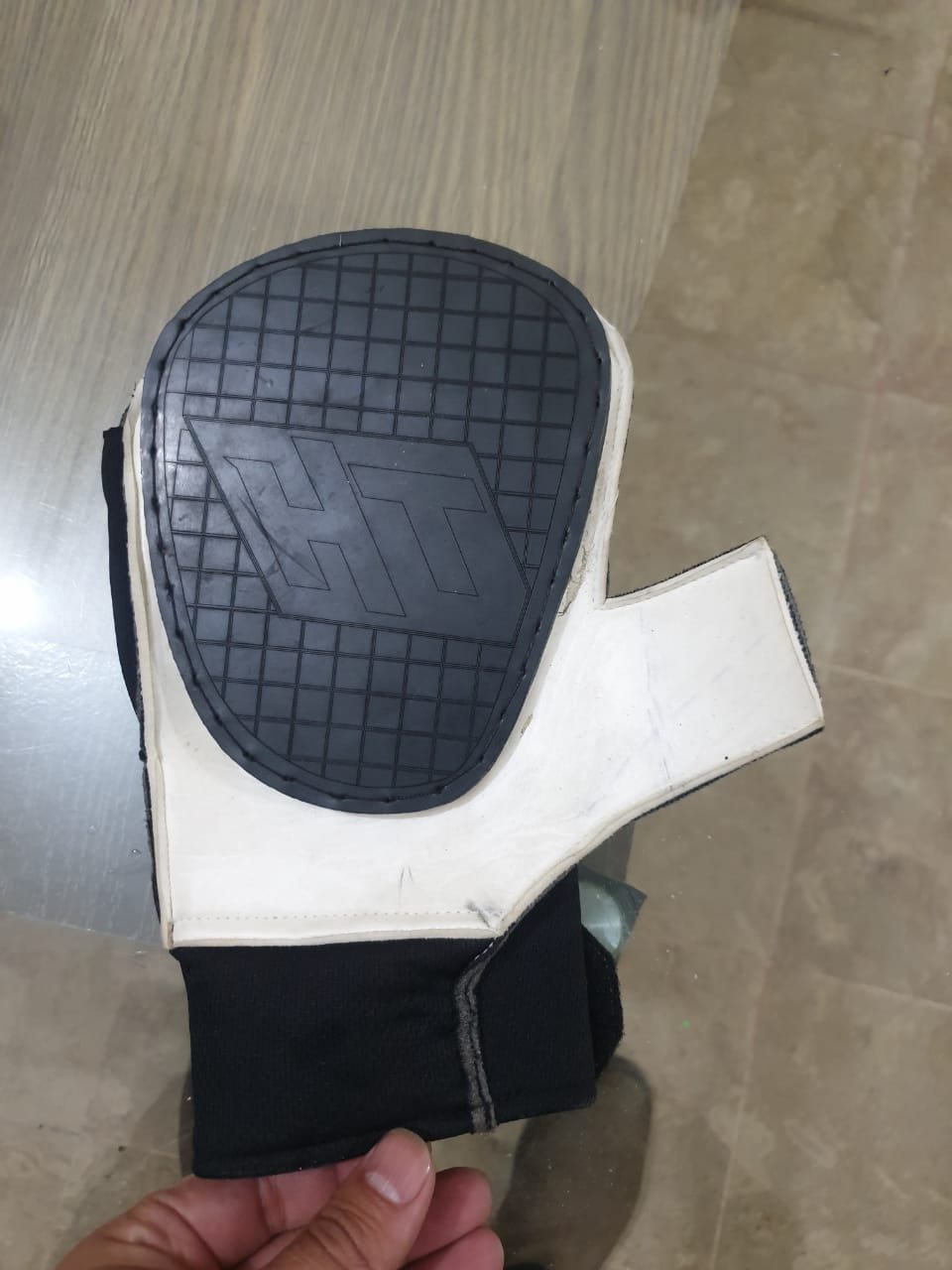
We started with the hand. The glove had to load impact into the heel and palm rather than the fingers, keep the wrist free enough to swing, and stay on through a full point. From that ergonomic study we developed the architecture in CAD: the pad profile and its crown, the leather panel layout, the strap and closure, the seam lines, and the transition between the rigid face and the flexible body.
Each revision was driven by play, not opinion. The CAD carried the geometry; the courts decided whether it was right.
Material development: hitting balls until the blend was right
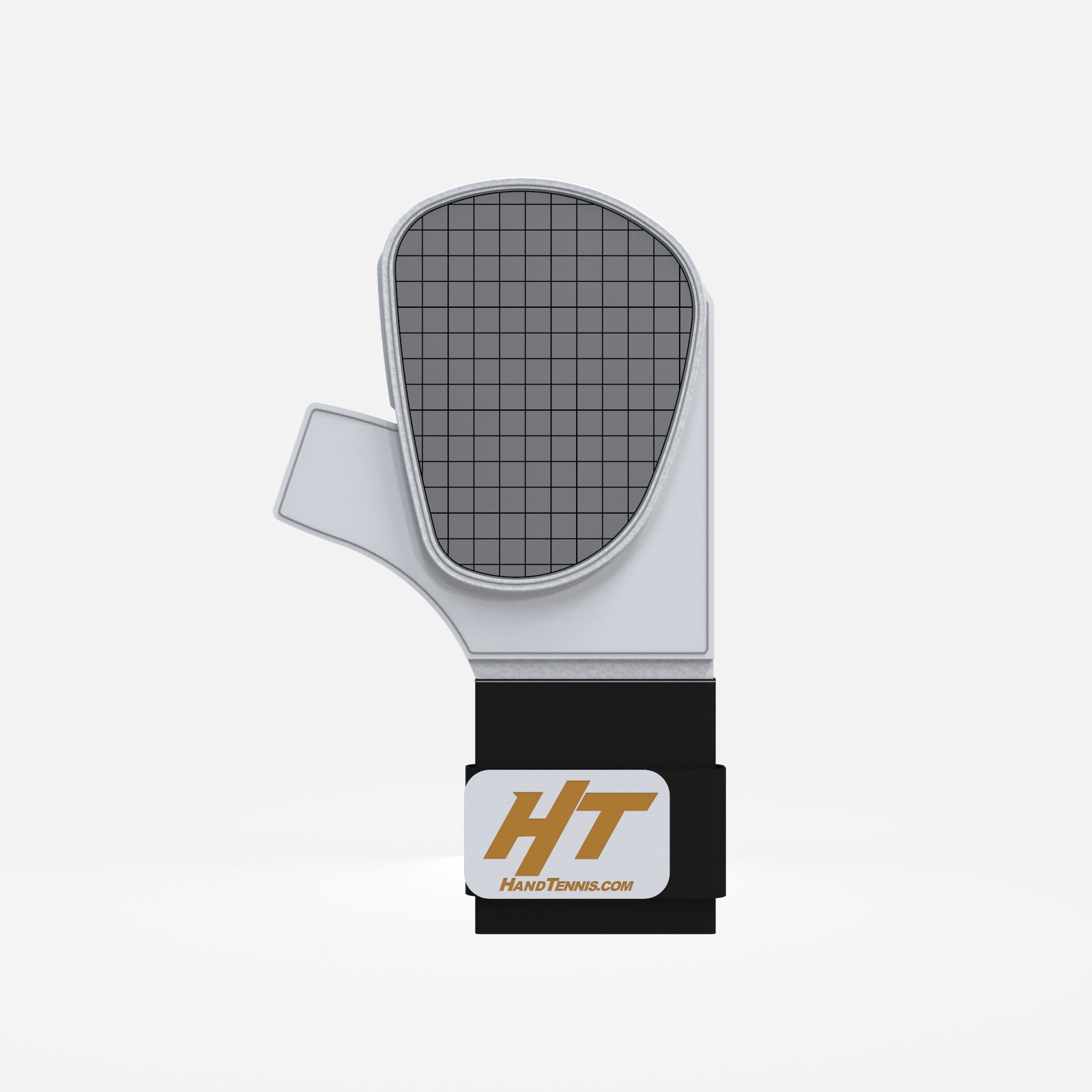
This was the core of the engineering effort. We prototyped and tested a long series of rubber and plastic blends, varying hardness, filler content and the ratio between the elastomeric and rigid phases - then hit real tennis balls with each one.
Candidates were scored the way a player would score them: rebound height and shot depth, spin generated on slice and topspin, sound and feel at impact, shock transmitted to the palm, and surface condition after extended hitting. Blends that were too soft swallowed the ball.
Blends that were too hard were unforgiving and abraded the ball. Several performed well on day one and glazed over after a week of play - which is why durability has to be tested over weeks, not sessions.
The composition we converged on hit every mark: consistent bounce, real spin, a controlled amount of flex, no premature wear, and full compatibility with the leather construction and the production process behind it.
The stitching problem
Every iteration surfaced a different manufacturing problem, and the most stubborn was stitching. To keep the striking face flat and fully supported, the seam had to run very close to the edge of the pad. But a seam that close to an edge is exactly where a glove tears first, and every hit loads that line directly.
We worked through it with revised seam allowances, a reinforced binding at the pad perimeter, changes to stitch pattern and thread, and adjustments to the pad edge geometry itself so the material carried some of the load instead of leaving it all to the thread. Later iterations refined the closure and strap, the pad-to-leather bond line, and fit across hand sizes.
Design for manufacturing and first articles
With the design proven on court, we prepared it for production: tolerances and material specifications, tooling-friendly pad geometry, a panel and assembly sequence a glove factory could actually run, sizing, and the documentation needed to quote and produce it. Then we produced the first articles - the first real, sellable samples of the glove - followed by a short-run batch. Daymond John tried a pair and gave the glove his own stamp of approval.
What to take from this if you are designing sports equipment
If your product... | Do this |
|---|---|
Has one performance-critical component | Budget most of your engineering time and prototypes there, not spread evenly |
Depends on feel | Set up a scored play test with athletes before CAD is frozen |
Uses a custom compound | Test durability over weeks - glazing and abrasion show up late |
Is sewn or bonded | Review seam placement with a factory early; seams fail where loads land |
Mixes rigid and flexible parts | Design the transition between them deliberately - it is where cracks start |
Why sports products cannot be validated on a screen
Sporting goods are judged by feel, and feel is not a simulated quantity. Rebound, damping, grip and fatigue all live in the interaction between a body and a material under load, so every meaningful decision on a project like this is settled by making samples and hitting things with them. Simulation narrows the candidates; the hand decides.
Property | How it is tested | Rounds usually needed | Typical cost per round |
|---|---|---|---|
Rebound and energy return | Ball strikes from a fixed drop height, measured return | 3 - 6 | $800 - $2,500 |
Impact comfort | Repeat strikes by real players, subjective scoring | 3 - 5 | $500 - $1,500 |
Grip and retention | Hold tests wet and dry, slip observation | 2 - 3 | $400 - $1,200 |
Seam and bond durability | Cyclic loading to failure at the pad-to-leather joint | 2 - 4 | $900 - $2,000 |
Fit across hand sizes | Fitting sessions across a size range | 2 - 3 | $600 - $1,800 |
The failure nobody budgets for: the joint between two materials
On this project the pad worked and the glove worked; what kept failing was where they met. That is the norm in soft goods. A rigid or semi-rigid element stitched into a flexible one concentrates every impact at the seam, and the thread cuts the substrate long before either material wears out.
Fixing it is unglamorous work - reinforced binding, revised seam allowance, a different stitch pattern, sometimes a bonded layer under the stitching - and it is the difference between a demo and a product.
Checklist: taking a sports product from prototype to production
- You have a repeatable test protocol, not just opinions from good sessions.
- The material blend is specified by supplier and grade, not by sample number.
- Every material interface has been cycled to failure at least once.
- Sizes are defined from measured hands, not scaled from one prototype.
- The sewing or moulding partner has quoted the actual construction, with a sample.
- Any performance claim you plan to print can be evidenced by your own test data.
Building a test protocol you can defend
Sports products live or die on claims, and a claim you cannot evidence is a liability. Before the tuning rounds start, write down what you are measuring, how, and what result counts as better. It removes the argument that otherwise consumes every review meeting, and it produces the data you will need for packaging copy and for retail buyers who ask.
Element | Definition | Why it matters |
|---|---|---|
Fixed test rig | Same drop height, same surface, same ball batch | Removes the tester as a variable |
Blind sample coding | Testers do not know which sample is which | Kills the newest-is-best bias |
Minimum sample count | At least five strikes per sample per round | One good hit proves nothing |
Scored subjective sheet | Comfort, control and confidence on a fixed scale | Turns opinions into comparable numbers |
Destructive round | Cycle to failure at the weakest joint | Finds the warranty problem before customers do |
Soft goods manufacturing: what changes at production
Sewn products are made by people, so consistency is a process question rather than a tooling one. The prototype sewn by a skilled sample maker is not what a production line will produce unless the construction is simplified and documented. Expect to spend real time on a tech pack - stitch types, seam allowances, reinforcement points, material tolerances - and expect the first production lot to reveal one construction step nobody can do quickly.
- A tech pack with graded measurements for every size, not one sample size.
- Named materials with supplier, grade and an approved colour standard.
- Stitch and seam callouts at each interface, especially around rigid inserts.
- An approved gold sample the factory is measured against.
- An AQL inspection standard agreed before the first lot ships.
- A named contingency if the performance material is out of stock.
Performance, comfort and cost: the three-way trade
Every meaningful decision on a sports product moves at least two of these three, and usually in opposite directions. Making the trade explicit early stops the project from oscillating - a team that has agreed which of the three wins can settle a material question in an afternoon instead of a month.
Change | Performance | Comfort | Unit cost |
|---|---|---|---|
Thicker impact layer | Better absorption | Bulkier, less feel | Higher |
Higher-grade elastomer | Better energy return | Neutral | Notably higher |
More panels for shaping | Neutral | Better fit | Higher - more sewing time |
Reinforced seams at inserts | Neutral | Slightly stiffer | Modest increase, big durability gain |
Fewer sizes | Neutral | Worse for outliers | Lower - fewer graded patterns |
How to brief a materials supplier
Suppliers cannot help with a brief written in adjectives. Give them the load case - mass, velocity, contact area, repetition - the temperature and moisture the product lives in, the thickness you can afford, and the target price per unit area. With those five numbers a good supplier will shortlist grades in a day; without them you get a catalogue and three wasted weeks.
- Load case in numbers, not descriptions.
- Maximum thickness and mass the product can carry.
- Operating temperature and moisture exposure.
- Required durability in cycles, and what failure looks like.
- Target cost per unit area, and the annual volume behind it.
- Any skin-contact or regulatory requirement for your markets.
Getting athletes to test honestly
Feedback from players is the most valuable input on a sports product and the easiest to collect badly. People are polite, they want the inventor to succeed, and they rate whatever they used most recently as best. Structure the sessions so the honest answer is the easy one.
- Give testers unlabelled samples and rotate the order between people.
- Ask what is wrong with it before asking whether they like it.
- Record the session; what a player says afterwards differs from what they do during it.
- Include people who are not your friends and who play at a different level.
- Use a fixed score sheet so rounds can be compared, not remembered.
- Let one round run long enough for fatigue and sweat to change the answer.
Pricing a sports product people have not seen before
A new category has no shelf price to anchor to, so buyers price it against the nearest thing they understand. Work out what that comparison is - a premium glove, a training aid, a piece of protective gear - because it sets the ceiling regardless of what the product cost to make. If the landed cost will not support a price near that anchor, the answer is usually to simplify the construction, not to argue with the market.
Perceived category | Buyer's mental price | What the product must show |
|---|---|---|
Accessory or glove | Low | Comfort and durability |
Training aid | Medium | A measurable improvement |
Protective equipment | Medium to high | Evidence it prevents injury |
Performance equipment | Highest | Proof it changes play, ideally by athletes |
Terms that come up in soft-goods manufacturing
Term | What it means | Why it matters |
|---|---|---|
Tech pack | The full build specification for the factory | Without it every factory builds a different product |
Grading | Scaling a pattern across sizes | Not a simple percentage - fit changes with size |
Gold sample | The approved reference unit | Production is judged against it |
Bar tack | A dense reinforcing stitch at a stress point | Where rigid meets soft, this is what holds |
AQL | The agreed acceptable defect level | Decides what you can reject on arrival |
Lay plan | How pattern pieces are cut from material | Drives material waste and unit cost |
If you are developing your own sports product
The order matters more here than in most categories, because feel cannot be evaluated until something exists and every later decision depends on that evaluation.
- State the performance claim you intend to make. It defines every test that follows.
- Build a crude rig and a crude sample in week one - the ugly version answers the real question.
- Shortlist materials with a supplier using numbers, not adjectives.
- Run blind rounds with players who will tell you the truth.
- Break the construction on purpose before a customer does.
- Write the tech pack, approve a gold sample, then order.
If it involves a moulded or overmoulded component, the prototype cost calculator will bracket the build cost, and our discovery engagement covers the first three steps as a fixed piece of work.
Frequently asked questions
How do I find a factory for a sports product?
Start from products that resemble yours in construction rather than in category - the factory that makes technical gloves is a better fit than one that makes tennis accessories. Ask for a paid sample before any order; a sample tells you more about a factory in three weeks than any amount of correspondence, and paying for it puts you in the queue as a customer rather than an enquiry.
Can I make performance claims on the packaging?
Only ones you can evidence with your own test data, and the wording has to match what you measured. A claim of measured energy return under a stated test is defensible; a claim of injury prevention is a regulated medical-adjacent statement that needs far stronger evidence. Decide which claims you want early, because they determine the testing you have to fund.
Do I need endorsements to sell a sports product?
Not to launch, but you need credibility from somewhere. Coaches and clubs are cheaper and more persuasive than a famous name early on: a training facility using the product daily generates video, testimony and durability data at once. Save paid endorsement for when you can supply the demand it creates.
What is the hardest part of developing a sports product?
Knowing when it is finished. Feel is subjective, every round produces new preferences, and a team can tune a product indefinitely. The fix is deciding the pass condition in advance - a target on the rig, a score on the sheet - and shipping when it is met, then improving in version two with real customer data instead of opinions.
How do I test a sports product without a lab?
Build a rig. A fixed drop height, a clamped sample and a phone camera at high frame rate produce comparable, repeatable data for a few hundred dollars, which is all you need to rank candidate materials. Labs become necessary when you have to certify a claim or satisfy a retailer, not when you are choosing between samples.
What is the minimum order quantity for a sewn sports product?
Typically 300 to 1,000 units per colourway with a mid-size factory, and often 100 to 300 with a smaller sample-focused workshop at a higher unit price. Material minimums usually bite before the factory minimum does - performance foams and technical fabrics are frequently sold by the roll, which can set your first order size for you.
Can I patent a sports product like this?
Often yes, on the mechanism or the construction rather than the general idea - the specific way an energy-returning element is integrated into a glove is the kind of thing a utility claim can cover, while a design patent protects the visual form. Start with a prior art search , because sporting goods is a crowded field and the search usually reshapes the claim before it costs you anything.
How long does it take to develop a sports product?
Eight to fourteen months to a saleable product. Material development and test rounds run four to seven months of that, the tech pack and factory sampling another two to three, and the first production lot six to ten weeks after the gold sample is approved. Products with a moulded component add tooling time on top.
What does it cost to develop a sports product?
For a soft-goods product with a custom performance element, expect $25k - $80k through to production-ready, with material development and physical test rounds the largest single line. Hard goods with tooling run higher. Our product development cost breakdown splits this by stage.
How many prototype rounds should I plan for?
Plan four to six. The first two answer whether the idea works at all, the middle rounds tune the feel, and the last ones exist to break the construction on purpose so the factory does not discover the weakness for you. Teams that budget for two rounds almost always end up running five and paying for the surprise.
Services related to this guide
- Product design servicesIndustrial design and CAD taken all the way to manufacturable files.
- Best industrial design firmsWhich studios take an idea from form to manufacturable hardware, and what they charge.
- Prototype designLooks-like, works-like or pre-production: what each proves and what it costs.
- Product development examplesReal projects we designed, prototyped and shipped.