
New Product Development Companies LA – 7 Reasons to Market Your Idea!
Marketing product ideas for new product development companies la can be a challenging task. Despite this, you must continue to succeed!
June 27, 20179 min read

Written by Konstantin Dolgan, Ph.D., NPDP
Founder & CEO, Product Development Engineer
Published June 27, 2017Updated August 19, 2026
New Product Marketing Companies: What They Do and When to Hire One
New product marketing companies take a finished or near-finished product and build the demand around it: positioning, pricing story, packaging, launch assets, channel materials and the first campaigns. They are not product development firms, and hiring one before the product is manufacturable is the most expensive sequencing mistake an inventor makes.
This guide covers what these firms actually deliver, what the work costs, how to brief one so the money is not wasted, which parts an inventor should keep in-house, and how a marketing partner fits alongside engineering and manufacturing on a hardware launch.

What these firms actually deliver
Deliverable | What it contains | Typical fee | When it is needed |
|---|---|---|---|
Positioning and messaging | Buyer definition, value proposition, claim hierarchy | $3,000 – $12,000 | Before any asset is designed |
Pricing and margin story | MSRP, wholesale and distributor tiers with margin math | $2,000 – $8,000 | Before you quote a retailer |
Packaging design | Structure, graphics, dielines, print-ready files | $4,000 – $20,000 | Before first production run |
Photography and video | Studio shots, in-use imagery, 30 – 60 second demo | $3,000 – $25,000 | Before listings go live |
Listing and ecommerce setup | Amazon or Shopify copy, A+ content, keyword build | $2,000 – $10,000 | At launch |
Sell sheet and buyer deck | One-page trade sheet, retailer presentation, terms | $1,500 – $6,000 | Before a buyer meeting |
Launch campaign | Paid media, PR outreach, influencer seeding, first 90 days | $5,000 – $40,000 plus ad spend | At launch |
A firm that offers all of these is a full-service partner; most inventors buy two or three line items and do the rest themselves. Assume the fee excludes media spend, print costs and sample production unless the proposal says otherwise in writing.
Marketing firm, product development firm, or agency of record?
Partner type | Owns | Hire when | Do not expect |
|---|---|---|---|
Product development firm | Design, engineering, prototyping, manufacturing transfer | The product is not yet manufacturable | Demand generation |
New product marketing company | Positioning, packaging, launch assets, first campaigns | The product is proven and priced | Engineering fixes |
Digital agency | Ads, SEO, email, marketplace management | There is a product with proven demand to scale | Category strategy |
Licensing agent | Introductions to manufacturers, deal negotiation | You do not intend to manufacture at all | Retail launch execution |
Fulfillment / 3PL | Warehousing, pick-pack, returns | Orders are coming | Anything upstream of the order |
Marketing cannot fix a unit cost that leaves no margin, a product that fails in the second week of use, or a claim you cannot substantiate. Fix those first; they are development problems.
What to have ready before the first call
- A working product — not a render. Sampling and photography need real units.
- A landed unit cost including tooling amortization, freight, duty and defect allowance.
- Your target retail price and the margin each channel will demand from it.
- Defensible claims with test data or third-party certification behind each one.
- IP status — filed, pending or granted, plus trademark availability for the name.
- Regulatory position — FCC, UL, FDA, CPSC or CE, whichever applies.
- An honest volume plan for the first 12 months, with the cash to fund it.
- A named decision maker on your side. Committee-approved marketing is slow and expensive.
Seven reasons inventors still market their own product
Hiring a firm does not remove you from the work, and there are real advantages to owning parts of it. These are the arguments we hear most often from founders who kept marketing in-house at the start.
Reason | What you gain | What it costs you |
|---|---|---|
You control the narrative | Positioning stays true to why you built it | Your time, every week |
You learn the buyer directly | Objections reach you unfiltered | Slower asset production |
You build management skill | You can brief and judge an agency later | A learning curve paid in early mistakes |
The second product is easier | Reusable templates, photography style, channel contacts | Nothing, if you document as you go |
R&D and marketing stay connected | Feature decisions reflect what buyers reject | Requires discipline to log feedback |
You practice reverse-engineering problems | Faster diagnosis when a channel stalls | Occasional expensive detours |
You build a personal brand | Credibility that outlasts one product | Public exposure some founders dislike |
Have a product that is ready to sell but not ready to launch?
Talk to our teamA realistic first-launch sequence
Weeks | Focus | Owner | Output |
|---|---|---|---|
1 – 2 | Positioning, pricing, claim substantiation | You plus strategist | One-page positioning brief |
3 – 5 | Packaging structure and graphics | Design partner | Print-ready dielines |
4 – 6 | Photography and demo video | Studio | Asset library for all channels |
6 – 8 | Listings, sell sheet, buyer deck | Marketing partner | Live listings, trade materials |
8 – 10 | Soft launch to a narrow audience | You | Conversion data, review seeding |
10 – 16 | Paid media and retail outreach | Agency or you | First reorders and buyer meetings |
Two things routinely break this schedule: packaging print lead times, which run three to six weeks after files are approved, and claim substantiation, which can require lab testing nobody budgeted for. Start both early. If the product itself is still changing, see our product development process before committing to launch dates.
How to evaluate a marketing partner
- Ask for two launches in your category with the actual outcome, not the campaign highlights.
- Require a written scope with exclusions. Media spend, print and shipping samples are the usual hidden costs.
- Confirm you own the files — layered artwork, dielines, raw photography, ad accounts under your login.
- Insist on one accountable strategist, named in the contract, not a rotating pod.
- Agree on measurement up front — cost per acquisition, sell-through rate, reorder rate, not impressions.
- Start with a paid discovery phase before signing a retainer; it tests the working relationship cheaply.
Key takeaways
- New product marketing companies build demand; product development firms build the product. Sequence them in that order.
- Expect $15,000 to $60,000 for a credible first-launch package, excluding media spend and print.
- Arrive with landed cost, price, claims, IP status and real units — a partner cannot create those for you.
- Own the files, the accounts and the buyer relationship, whoever executes the work.
Channel choices change everything downstream
Before a single asset is designed, decide which channel you are launching into. Each one imposes a different margin structure, packaging standard and cash cycle, and a firm that starts designing packaging before this decision is made will design the wrong packaging.
Channel | Margin the channel takes | Packaging demand | Cash cycle | Best for |
|---|---|---|---|---|
Direct to consumer (own site) | 0% (but 15 – 30% acquisition cost) | Shipper-safe, minimal retail graphics | Immediate | Higher-priced, story-driven products |
Amazon | 15% referral plus FBA fees | Frustration-free, ships in own container | 14 days | Search-driven, established categories |
Independent retail | 40 – 50% off MSRP | Full retail-ready graphics, hang tab or shelf box | 30 – 60 days | Regional proof before national buyers |
National retail | 45 – 55% plus program costs | Retail-ready, case pack and planogram compliance | 60 – 90 days | Volume, once the product is proven |
Distributor / rep network | 20 – 30% on top of dealer margin | Trade packaging plus spec sheet | 45 – 75 days | B2B and specialty products |
Licensing | Royalty of 3 – 7% of wholesale | None — the licensee handles it | Quarterly | Inventors who will not manufacture |
Work the margin backwards from the channel to the landed cost before approving any launch spend. A product with a $22 landed cost cannot support a $39 MSRP through national retail, and no amount of marketing changes that arithmetic.
Metrics that tell you whether the launch is working
- Sell-through rate — units sold divided by units shipped to the channel, weekly. Below 8% in retail means a shelf problem, not an awareness problem.
- Reorder rate — the only metric a retail buyer treats as proof.
- Cost per acquisition against contribution margin — if CPA exceeds margin, more spend makes losses larger.
- Return rate and reason codes — over 5% on a durable good is usually a product or expectation problem.
- Review velocity and rating — the first 30 reviews set conversion for the following year.
- Attach rate on accessories or consumables, where the real margin usually lives.
Frequently asked questions
What do new product marketing companies do?
They turn a finished product into something a buyer will stock or a customer will click: positioning and messaging, pricing and margin structure, packaging design, photography and video, ecommerce listings, sell sheets and buyer decks, and the first launch campaigns. They do not design or engineer the product itself.
How much does it cost to hire a product marketing firm?
Individual deliverables run from about $1,500 for a sell sheet to $25,000 for a full photography and video package. A credible first-launch bundle — positioning, packaging, assets and listings — typically lands between $15,000 and $60,000, excluding media spend, print production and sample manufacturing.
Should I hire a marketing company before or after product development?
After. Marketing cannot fix an unmanufacturable design, a unit cost with no margin, or an unsubstantiated claim. Complete engineering and manufacturing readiness first, then bring in a marketing partner four to six months before the intended launch date.
Can an inventor market a new product without an agency?
Yes, and many do successfully at the start. Owning positioning and early customer conversations gives you unfiltered objections and a template for the next product. The trade-off is founder hours: a self-run launch usually consumes two to three months of near-full-time work.
What should I have ready before contacting a marketing partner?
Working production-representative units, a landed unit cost, a target retail price with channel margins, substantiated performance claims, IP and trademark status, applicable regulatory approvals, and a 12-month volume plan you can fund.
How do I evaluate a new product marketing company?
Ask for two launches in your category with actual sell-through outcomes, require a written scope with an exclusion list, confirm you own all artwork files and ad accounts, insist on a named strategist, and agree on measurement in units and reorders rather than impressions.
What new product marketing companies actually do that development firms do not
Confusion between the two categories costs founders months. A development firm owns the artifact: requirements, industrial design, engineering, tooling and the first production run.
A marketing company owns the demand around that artifact: positioning, pricing architecture, packaging communication, channel strategy, launch assets and the first ninety days of sell-through. The two disciplines overlap in exactly three places, and those overlaps are where launches usually fail.
The first overlap is the value proposition. Marketing writes the claim; engineering has to make the claim testable. If the box says runs eight hours on a charge, someone has to define the duty cycle that produces eight hours and verify it on production units, not on a hand-built prototype.
The second overlap is packaging. Retail packaging is a manufactured part with tolerances, drop-test requirements and a pack-out cost that lands in your landed cost per unit. The third overlap is pricing.
Price is set by the market, but margin is set by tooling amortization, cycle time and scrap rate, all of which are engineering decisions made long before a marketer sees a spreadsheet.
When a single team carries all three overlaps, the launch story and the physical product stay in sync. When they are split across vendors who never meet, you get the classic outcome: beautiful campaign, product that misses the claim, returns above ten percent. Our new product marketing work is deliberately attached to the engineering record for that reason.
Launch task | Development firm | Marketing company | Who should own it |
|---|---|---|---|
Requirements and claim definition | Defines testable specs | Writes the market claim | Joint — claim must be verifiable |
Industrial design and CMF | Owns geometry, materials, finish | Advises on shelf presence | Development, with marketing review |
Retail packaging | Structural design, drop test, pack-out cost | Graphics, copy, hierarchy | Joint — structure and graphics together |
Pricing architecture | Supplies landed cost and volume breaks | Sets price ladder and promotions | Marketing, gated by real cost data |
Channel and retailer readiness | UPC, case pack, compliance docs | Buyer decks, terms, planograms | Marketing, fed by development docs |
Launch content and photography | Provides production-accurate units | Shoots, edits, distributes | Marketing |
Post-launch iteration | Root-causes returns and failures | Reads reviews and conversion data | Joint — weekly for the first quarter |
What a launch-ready marketing scope contains
A proposal that lists brand strategy and go-to-market as line items is not a scope. Ask for deliverables you can inspect. On hardware launches we run, the marketing scope is written as a bill of materials for demand: every asset has an owner, a source of truth and a date tied to the production schedule, not to a campaign calendar invented in isolation.
Timing matters more than most founders expect. Retail buyer meetings for a holiday launch happen nine to twelve months earlier. Certification photography needs production-representative units, which means the marketing shoot depends on the first-article inspection date. Miss that dependency and you shoot a prototype that does not match the shipped product, which is a compliance problem as well as a credibility one.

- Positioning statement with a single primary claim that engineering has agreed to verify on production units
- Price ladder covering MSRP, MAP, distributor and promotional floors, built on real landed cost from the manufacturing plan
- Packaging system: structural drawings, graphics, regulatory marks, UPC and case-pack labeling
- Buyer-ready one-pager with dimensions, case pack, lead time, MOQ and warranty terms
- Photography and video shot on production-representative units, not appearance models
- Launch site or landing page with schema-marked product data and a working checkout or lead path
- Review and warranty response plan for the first ninety days, with a named owner
- Weekly post-launch metrics review: conversion, return rate, return reasons, review sentiment
Realistic budget bands
Scope | Typical range | What it buys | Common failure if underfunded |
|---|---|---|---|
Minimum viable launch | $12k–$30k | Positioning, packaging graphics, basic photography, one landing page | Product looks unfinished next to shelf competitors |
Direct-to-consumer launch | $35k–$90k | Above plus video, paid testing budget, review seeding, email flows | No demand signal; inventory sits |
Retail-channel launch | $60k–$150k | Above plus buyer decks, planogram assets, case-pack compliance, trade show | Buyer meeting fails on missing logistics data |
Category expansion | $150k+ | Multi-SKU architecture, brand system, agency retainer | SKUs cannibalize each other |
Those bands assume the product itself is finished. If the design is still moving, marketing spend converts into rework: reshoots, reprinted cartons, revised claims. The cheapest way to control launch cost is to freeze the design before the marketing scope starts, which is the sequencing we use in product development consulting engagements.
Vetting checklist before you sign
- Ask for two hardware launches in your price tier, with unit volumes and channel named
- Ask who writes the primary claim and how it gets verified — if nobody answers, the claim is marketing fiction
- Ask for the packaging structural engineer's name; graphics-only shops outsource this and lose the cost
- Confirm they will work from your landed cost model rather than a target margin invented after the fact
- Confirm asset delivery dates are pinned to first-article inspection, not to a generic campaign calendar
- Ask what happens in week one if return rate exceeds five percent — a real answer includes a root-cause loop with engineering
- Check that they will hand over source files, not just exports; you will need them for the second SKU
Frequently asked questions
Do I need a marketing company before or after the prototype? After a working prototype, before tooling. Positioning influences finish, color and packaging size, and all three are cheap to change before steel is cut and expensive afterwards. Teams that start in product discovery with a rough positioning hypothesis change less later.
Can one firm do development and marketing? Yes, and for first products it usually reduces total cost because the claim, the cost model and the packaging live in one document set. The risk is depth: verify the marketing side has real channel experience, not just a design team writing copy.
How long before launch should marketing engage? Six months for direct-to-consumer, nine to twelve months for retail, because buyer calendars run that far ahead. Certification photography and packaging print lead times add four to six weeks on their own.
What is the most common budget mistake? Spending the whole budget on the launch moment. Reserve at least a quarter of it for the ninety days after launch, when review response, listing optimization and return-reason fixes produce the highest return per dollar. See how this plays out across real programs in our portfolio.
How to evaluate a new product development company
Evaluation area | Weak signal | Strong signal |
|---|---|---|
Portfolio | Renders only, no production photos | Shipped units, retail packaging, part numbers |
Process | Fixed waterfall deck | Gate criteria with documented kill points |
Costing | Estimate given after design freeze | Target landed cost set before CAD begins |
Tooling | Hands over STEP files and exits | Owns DFM, T1 samples, and mould corrections |
Testing | Ad hoc bench checks | Named standards, test plan, third-party lab |
IP | Vague ownership clause | Assignment on payment, clear background IP list |
Team | Account manager fronts every call | Lead engineer available to you directly |
Questions that separate real capability from sales copy
- What is your target landed cost method? A capable firm quotes a cost model with material, cycle time, assembly labour, freight, duty, and scrap before design freeze.
- Which standards apply to my product? They should name them unprompted: UL, FCC Part 15, IEC 62368, CPSIA, FDA 21 CFR, EN 71, depending on the category.
- How do you handle a failed drop test at T1? Listen for a root-cause process, not a promise that it will not happen.
- Who is on the call in month six? Continuity of the lead engineer matters more than the size of the firm.
- What does a change order cost? Get the rate and the approval path in the contract, not in an email later.
- Can I speak to a client whose program was delayed? The willingness to offer that reference is itself the answer.
Budget reality by program type
Program type | Typical development range | Tooling | Main cost driver |
|---|---|---|---|
Simple moulded housewares | $25k-$60k | $8k-$30k | Cavity count and finish |
Mechanical consumer device | $60k-$140k | $25k-$90k | Assembly and tolerance stack |
Connected consumer device | $120k-$300k | $40k-$150k | Firmware and certification |
Regulated or medical adjacent | $200k-$600k | $60k-$250k | Documentation and validation |
A working engagement sequence
- Weeks 1-2, discovery. Requirements, target cost, target retail price, volume assumption, regulatory scope.
- Weeks 3-6, concepts. Three to five directions, screened against cost and manufacturability, not aesthetics alone.
- Weeks 7-14, engineering. Detailed CAD, tolerance analysis, material selection, functional prototypes.
- Weeks 15-20, validation. Test plan executed, failures fixed, design frozen with a written change log.
- Weeks 21-30, tooling and T1. DFM review, mould build, first shots, corrections, first article inspection.
- Weeks 31+, production support. Pilot run, packaging validation, quality plan handed to the factory.
Work with LA NPDT: if you are moving from here to execution, start with our our product development process or talk to us about end-to-end product development.
Filed under:Education
Tagged:New Product Development companiesProduct DesignProduct DevelopmentProduct IdeaPrototypeSavingsShreveportSkillStartupTexas
Related articles
All articles
Why Your "I Wish This Tool Existed" Idea Could be a Market Hit
Inventors who create products for themselves have higher chances to succeed on a market. Why? They didn't wish this tool existed, they created it.
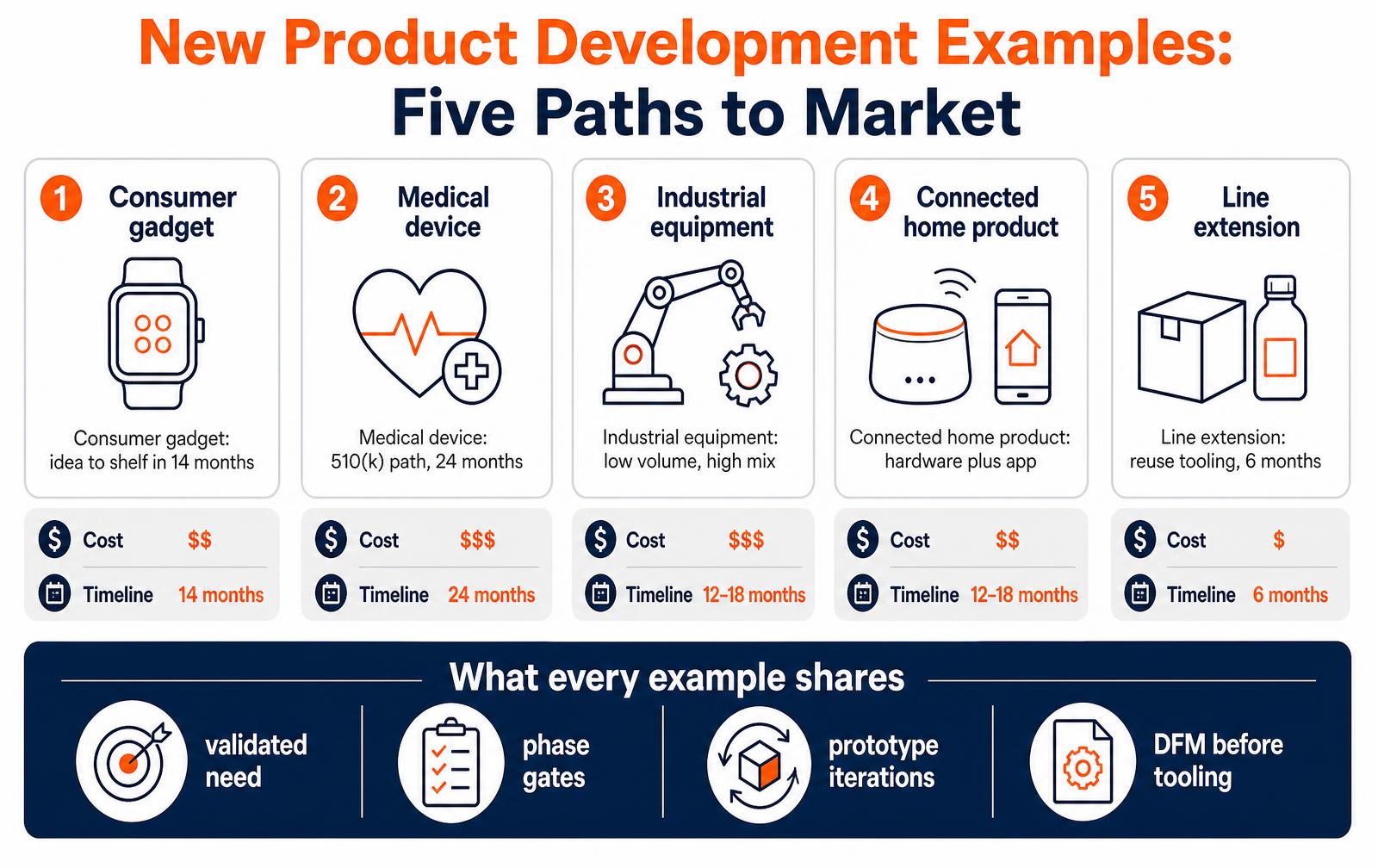
New Product Development Examples: Five Real Paths From Idea to Market
Textbook funnels do not match real projects. Here are five new product development examples with the timelines, budgets and failure modes that go with them.

The SBIR Commercialization Plan Reviewers Believe: Manufacturing Evidence, Not Market Size
Market slides do not make a commercialization plan credible. Manufacturing evidence does. How the AtmoSpark atmospheric water generator earned its production story.
Services related to this guide
- Product design servicesIndustrial design and CAD taken all the way to manufacturable files.
- Rapid prototypingWorking prototypes in days, from 3D printing to vacuum casting.
- Electronic design servicesSchematic, PCB layout, firmware and bring-up, through to production handoff.
- Product development examplesReal projects we designed, prototyped and shipped.