The SBIR Commercialization Plan Reviewers Believe: Manufacturing Evidence, Not Market Size
Market slides do not make a commercialization plan credible. Manufacturing evidence does. How the AtmoSpark atmospheric water generator earned its production story.
August 22, 20266 min read

Written by Konstantin Dolgan, Ph.D., NPDP
Founder & CEO, Product Development Engineer
Published August 22, 2026
A commercialization plan becomes credible when it shows how the product gets made and what a unit costs, not when it shows a large addressable market. Reviewers have read the market slide before. What they rarely see is a DFM decision, a tooling comparison and a unit-cost build-up from a team that has actually held the prototype.
Why commercialization sections read as filler
Most commercialization plans are written by whoever is left when the technical volume is finished, and they inherit the same three ingredients: a market forecast from a report, a list of customer segments, and a pricing assumption with no cost behind it. None of that is checkable.
A reviewer scoring commercial potential is asking a narrower question: is there a plausible route from this prototype to a product someone can buy, at a price that leaves a margin?
What plans usually say | What the reviewer cannot verify | What to write instead |
|---|---|---|
The market is worth $X billion | Whether any of it is reachable by you | The specific first customer segment and why they buy first |
We will manufacture at scale | Whether the design can be made at all | Which processes you selected, and at what volume they win |
Unit cost will fall with volume | Where it starts and how fast it falls | A BOM-based unit cost at two volumes, with the drivers named |
We have strong IP | How it affects the production route | Which design decisions the IP constrains, and the alternatives |
Partners will handle production | Whether any partner has seen the design | Named process requirements a contract manufacturer can quote against |
AtmoSpark: from research-grade to producible
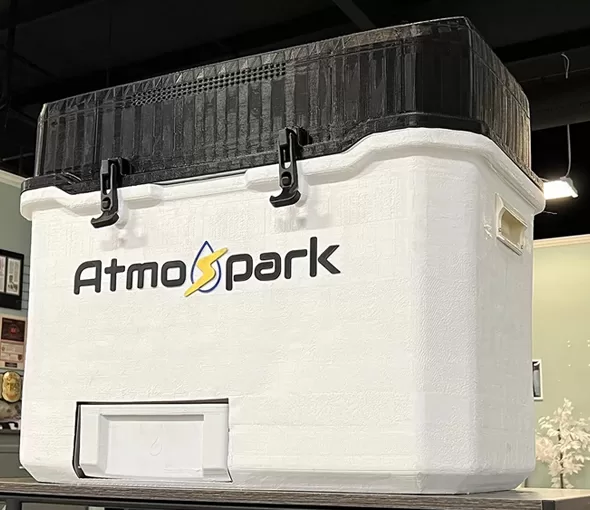
AtmoSpark Technologies came out of the NSF I-Corps ecosystem with a genuinely hard technical idea: BluElement, a device that pulls potable water out of humid air, for boaters, RV owners and communities where clean water supply is unreliable. The technology worked. What did not exist yet was a product: an enclosure, an integrated electro-mechanical system and a design anyone could quote for production.
Our work covered competitive review, industrial and mechanical design, enclosure engineering, electrical and firmware integration, component sourcing and design for manufacturing. The result was a fully functional mechanical and electro-mechanical prototype in under a month. Details are in the AtmoSpark case study.
The manufacturing evidence a plan needs
- Process selection per major part, with the volume assumption stated: printed and machined for early units, tooled processes once volume justifies the capital.
- A component sourcing view: which parts are catalogue items, which are custom, and which have a single supplier and therefore a risk.
- DFM changes already made: part count reductions, wall thickness and draft decisions, fastener consolidation, service access.
- A unit-cost build-up at two volumes, showing where cost actually sits, which for an integrated device is usually components and assembly labour rather than the enclosure.
- Assembly time and fixture needs, because labour is the line most first-time hardware teams omit entirely.
- Regulatory and test obligations that affect the design, not just the launch date.

Tooling: the comparison that makes the plan concrete
The single most persuasive table in a commercialization plan is the one that shows you know when to spend on tooling. Injection moulding beats printing and machining on per-part cost and beats them badly, but only after the tool is paid for. Writing down where that crossover lands for your own housing tells a reviewer you have engineered a product rather than a demonstrator.
Process | Up-front cost | Per-part cost | Where it wins |
|---|---|---|---|
3D printing | None | Highest | Prototypes, pilot units, geometry that is still changing |
CNC machining | Low (fixturing) | High | Low volumes, metal parts, tight tolerance features |
Urethane casting | Low (silicone tools) | Medium | Tens to low hundreds of cosmetic parts |
Injection moulding | High (steel or aluminium tool) | Lowest | Volumes where the tool amortises, typically thousands of parts |
Our breakdown of compression moulding versus injection moulding works through the same trade-off on a real consumer product, and the prototype cost guide shows how the early build numbers are put together.
A commercialization plan checklist
- Name the first customer, not the total market.
- Attach a bill of materials with real part numbers for anything catalogue.
- State a unit cost at two volumes and name the top three cost drivers.
- Show one DFM change you already made and what it saved.
- Give the tooling decision and the volume that justifies it.
- List the certifications the design must meet and what they cost in time.
- Point to a functional prototype, with photographs, as evidence the design exists.
One thing we would change
Start the cost model with the first CAD, not after the prototype works. Cost is set by geometry and component choices made in the first weeks, and by the time a working unit exists most of it is locked. A rough spreadsheet kept alive alongside the design catches the expensive decisions while they are still cheap to change, and it becomes the commercialization plan almost for free.
A unit-cost build-up you can copy
This is the shape of the table we build for an integrated electro-mechanical device — a pump or fan, a controller, sensors, an enclosure and an assembly step. The percentages are illustrative rather than AtmoSpark figures, but the structure is the one reviewers can follow, and filling it in forces every assumption into the open.
Cost line | Typical share at low volume | What changes at volume | Where teams get it wrong |
|---|---|---|---|
Custom enclosure and structural parts | 25-40% | Falls sharply once tooled | Assuming printed-part cost is the product cost |
Electro-mechanical components | 20-35% | Modest volume discounts only | Single-source parts quoted at sample pricing |
Electronics and controller | 10-25% | Falls with panelised boards | Prototype board cost carried forward unchanged |
Assembly labour | 10-20% | Falls with fixtures and a defined sequence | Omitted entirely from the first model |
Test and quality | 3-8% | Falls with automated test | No test time budgeted per unit |
Packaging, shipping, spares | 3-8% | Roughly flat | Forgotten until the first shipment |
Price, margin and the number reviewers check
Once a unit cost exists, the pricing paragraph writes itself, and it becomes checkable. State the landed cost, the intended selling price and the channel: a device sold direct carries different margin arithmetic than one sold through a distributor who expects a discount off list. Then show what has to be true for the business to work — the volume at which fixed costs are covered, and the cost reduction the tooling investment buys.
Reviewers are not looking for large numbers. They are looking for internal consistency: a price that is defensible against the alternatives your customer already buys, a margin that survives a channel, and a cost that comes from a bill of materials rather than from an assumption.
Manufacturing risks worth naming yourself
- Single-source components, especially anything with a long lead time or an allocation history.
- Custom parts whose tolerance stack has never been tested across a production spread rather than a single hand-built unit.
- Processes that work at prototype scale but have no volume equivalent, such as hand finishing or manual calibration.
- Certification testing that could force a design change late, so it belongs in the schedule before design freeze.
- Assembly steps that require judgement, which is where yield problems appear once someone else builds it.
- A supplier base concentrated in one region, which reviewers increasingly ask about directly.
Where the cost numbers come from before you have a factory
Reviewers do not expect a signed manufacturing contract at Phase II. They expect the numbers in your plan to be traceable to something. This is the sequence we run to produce a defensible unit cost while the design is still moving.
Step | What we send the supplier | What comes back | Time |
|---|---|---|---|
1. Freeze a costing configuration | A drawing set good enough to quote, not good enough to tool | A quotable definition | 1-2 weeks |
2. Quote the long-lead items first | Custom parts, motors, sensors, anything over eight weeks lead time | Price and lead time at 100 / 1,000 / 10,000 units | 2-3 weeks |
3. Quote fabrication and assembly | Process routing and a target volume | Piece price plus setup and labour estimate | 2-4 weeks |
4. Price the tooling separately | Part geometry and expected annual volume | Tool cost and amortisation per unit | 2-3 weeks |
5. Add the unglamorous lines | Packaging, freight, scrap, test time, certification | The 10-20% most plans forget | 1 week |
On AtmoSpark that arithmetic is what made the commercialization narrative credible, because the cost claims followed from the design rather than the other way round. The engineering that lowers those numbers is design for manufacturability and low-volume manufacturing planning. Our SBIR engineering support covers both. For commercialization-plan requirements by agency, see Read more on Sbir and NSF America's Seed Fund.
Frequently asked questions
What is an SBIR commercialization plan?
It is the section of a Phase II proposal describing how the funded technology becomes a product or service in the market: the customer, the production route, the cost and price structure, the funding and partners required, and the milestones between the prototype and first revenue. Agencies publish their own required format, so follow the solicitation rather than a generic template.
How long should an SBIR commercialization plan be?
Whatever the solicitation allows, usually a small number of pages. Length is not the constraint that matters; density of verifiable fact is. Two pages containing a bill of materials, a tooling decision and a unit-cost build-up outscore ten pages of market narrative.
Do I need a manufacturing partner before Phase II?
Not a signed one. You do need a design that a contract manufacturer could quote, which means defined processes, materials, tolerances and an assembly sequence. Naming the process requirements is credible; naming a partner who has never seen the design is not.
What is NSF I-Corps and how does it relate to SBIR?
I-Corps is an NSF program that trains research teams in customer discovery, and it often precedes an SBIR or STTR application. Details are on the NSF I-Corps page . Teams that come through it usually arrive with a validated customer problem; what they still need is the engineering evidence that the product can be built and sold at a viable cost.
When does tooling investment make sense for an SBIR-funded product?
When the projected volume amortises the tool inside a credible sales horizon and the geometry is stable enough that the tool will not be recut. For most small enclosures that crossover sits in the thousands of parts. Committing to steel while the design is still changing is the most expensive mistake available in hardware. What SBIR funds may be spent on is set by your award terms, so confirm allowability before budgeting a tool.
Should a commercialization plan include letters of support?
Yes, when they are specific. A letter from a named potential customer describing the problem, the conditions of use and what they would evaluate is evidence. A generic endorsement of the technology is not, and reviewers have seen enough of them to discount it instantly.
How accurate does a Phase II cost estimate need to be?
Close enough that the business case survives being wrong by a third. Show the estimate, the volume it assumes, and what happens to margin if material cost rises. Reviewers are testing whether you understand the drivers, not whether you can predict a price two years out.
What makes a commercialization plan fail review?
A market size with no path to the first hundred units, a unit cost with no source behind it, and a risk section that names no manufacturing risk. Each one signals that the plan was written apart from the engineering rather than out of it. Related reading: what earns a Phase I team its Phase II award , what a Direct to Phase II prototype has to prove , and our SBIR engineering support across every phase .
Services related to this guide
- Product design servicesIndustrial design and CAD taken all the way to manufacturable files.
- Rapid prototypingWorking prototypes in days, from 3D printing to vacuum casting.
- Electronic design servicesSchematic, PCB layout, firmware and bring-up, through to production handoff.
- Product development examplesReal projects we designed, prototyped and shipped.