Cross Functional Playbook: How Engineering, Design and PMs Collaborate
A comprehensive guide to cross-functional collaboration in product development, explaining how engineering, design, and product management teams work together to manage complexity, drive innovation, resolve conflicts, and build effective workflows using modern processes, leadership practices, and collaborative tools.Я предпочитаю этот ответ
November 21, 20257 min read

Written by Konstantin Dolgan, Ph.D., NPDP
Founder & CEO, Product Development Engineer
Published November 21, 2025Updated September 2, 2026
Modern products are getting more complex. This shift creates a need for better tools and teamwork methods. New team structures are now common in product development systems. Products are more advanced and global competition is rising. Integrated workflows are now a must. Firms should view collaborative product development (CPD) as a whole. This includes both internal and external teamwork as key parts of CPD.
Cross-Functional Collaboration in Product Development is now vital. Development cycles are shorter and market pressure is high. Both products and production systems are getting more complex.
These factors demand new team models to meet market goals. Design experts with different skills and views must work closely together. This teamwork helps make sure products succeed.
Collaborative design unites pros around one goal. They build products through interaction and shared work.
Figure 1. Typology of collaborative work.Source: HAL: research paper on collaborative design processes
Complexity, Innovation, and the Need for Integrated Design
Today, design faces tight limits on cost, time, and quality. Designers work in large networks across the globe. Meanwhile, new technologies are merging. Design management must be fast and ready for change. You must know your work setting to lead these design efforts. This helps you support your team in a timely way. It is key for Cross-Functional Collaboration in Product Development.
Innovation is a group effort. Designers in many fields need to work with other experts. A furniture designer might work with a fabric pro. A heat expert might work with a blade specialist. These pairings help firms make products that customers like. The main difference is how teams make choices. Furniture design uses gut feelings. Picking a jet engine needs hard data and math.
The real test for teamwork is in fields like car making. Buyers choose cars based on both feelings and facts. The stakes are very high. If a critic like Jeremy Clarkson hates a car's feel, it hurts the brand. A bad review can risk billions in engineering and factory costs.
Modern Product Teams and Their Cross-Functional Dynamics
Modern product development is hard. No one person knows everything about the whole product life cycle. Success relies on mixing marketing, design, and factory skills. You must coordinate your resources well. Old step-by-step models are gone. Teams now work on tasks at the same time. The 1986 “rugby” model is still very useful. In this model, the team passes the ball back and forth. Cross-Functional Collaboration is now a staple of product design.
Typically, each team comprises a Product Manager (PM), Design Lead (DL), and Tech Lead (TL), representing the core dimensions of business value, user experience, and technical feasibility.
Examples of joint activities that foster shared understanding include:
- Engineers participating in customer calls and usability testing.
- Engineers contributing to design workshops and early ideation sessions.
- Designers engaging in sprint planning.
- PMs attending architecture reviews.
- Collective analysis of customer insights and product roadmaps.
- Shared retrospectives to refine collaboration practices.
- Joint evaluation of released features, adoption metrics, and potential enhancements.
Looking ahead, collaboration with design teams remains essential. Designers and PMs share a common goal: to create products that are both functional and delightful for users. Their collaboration spans:
- Understanding user experience (UX)
- Defining product features.
- Iterating based on feedback.
Working with engineering teams is also vital. Engineers build the product once designs are final. PMs help this move by making sure goals and priorities are clear.
You must also work with marketing teams. Building the product is only half the job. You must make sure people see it. Linking product and marketing plans is key to teamwork.
Leadership Challenges, Conflicts, and Best Practices
Cross-functional leadership has many perks but brings big tests. Good leadership across teams is vital for product success. This is true in fast firms where teams must work as one.
In this case, teamwork is the main goal. The group output should beat the sum of its parts. Mixing different skills helps drive great results. But this needs clear goals and a plan.
Shared work also brings new tests. Different words and goals can cause blocks. These splits can slow you down. You must manage these gaps to keep moving forward.
Conflicts will happen. Diverse teams often clash on features, dates, or tools. Leaders must be good at solving fights. This keeps the work on track and prevents delays.
To overcome these challenges, several best practices can be applied to strengthen Cross-Functional Collaboration in Product Development:
- Clear and consistent communicationAlignment of goals across teamsEmpathy and active listeningEffective conflict resolution strategiesLeveraging individual and team strengths.
When these practices are embraced, collaboration yields powerful benefits: richer idea generation, stronger alignment, accelerated processes, and more effective cross-functional leadership.
Contact us today to learn how LA NPDT can assist in realizing your project.
Collaboration Models, Tools, and Final Considerations
- Collaboration, at its core, is a constructive process where multiple parties explore differing viewpoints to co-create solutions that exceed individual limitations. Team collaboration remains the most traditional and effective form of cooperation, built on shared awareness and coordinated effort.
- Cross-functional collaboration, by contrast, unites departments in pursuit of shared organizational goals. Organizations that excel in this area tend to outperform in innovation and industry transformation.
- Cloud collaboration has further revolutionized teamwork, allowing teams to upload, access, and refine work entirely online. Virtual collaboration has expanded rapidly, offering new avenues for engaging distributed teams.
- Technological tools play a vital role in supporting these efforts. Product Data Management (PDM) systems facilitate essential tasks such as configuration control, version tracking, and project coordination.
Conclusion
Design processes are complex. Teams must manage work and share knowledge to succeed. You should focus on Cross-Functional Collaboration in Product Development. Use human-centered rules to stay fast and effective in new settings.
Global teams need specific plans, tools, and team tactics to talk well. Leaders must share a vision and set clear paths to stop fights. Every group must know its role in the full cycle. Success depends on a place where team teamwork can grow.
Subscribe
Dive deep into the dynamic world of new product development with LA NPDT Insights Blog.
Cross-Functional Team Roles and Their Focus
Role | Core Dimension Represented |
|---|---|
Product Manager (PM) | Business Value |
Design Lead (DL) | User Experience (UX) |
Tech Lead (TL) | Technical Feasibility |
Frequently asked questions
Why is cross-functional collaboration important in product development?
Shared work is vital as products and systems get more complex. Fast cycles need smooth workflows to beat rivals and meet market needs. This method brings different experts together. They share knowledge and talk often to build great products.
What roles typically make up a modern cross-functional product team?
Modern teams usually have a Product Manager (PM), a Design Lead (DL), and a Tech Lead (TL). These roles cover business value, user needs, and technical builds. Their joined work is key to managing a product's life today.
How do engineers, designers, and product managers collaborate in product development?
These roles work together on many tasks. Engineers join customer calls and design talks. Designers help with sprint plans. PMs go to build reviews. They all look at user data and maps. They review released features and metrics to improve how they work.
What is the 'rugby model' in product development?
Takeuchi and Nonaka created the 'rugby model' in 1986. It shows a parallel way to build products. In this model, the team passes the project 'ball' constantly. This builds shared duty and constant talk. It replaced old step-by-step methods and fits modern teamwork well.
What are the key interactions between design teams and product managers?
Designers and Product Managers work together to build useful tools that users love. They team up to study user needs and choose new features. They also update the design based on user feedback. This bond makes sure the user stays at the heart of the project. It covers every step from the first idea to the final product.
Sources and standards
- USPTO — patent basics — Official guidance on provisional and non-provisional filings for new products.
- NIST Manufacturing Extension Partnership — Federal program supporting US small and mid-size manufacturers.
- ISO 9001 quality management — The quality-system standard most contract manufacturers are audited against.

Who owns what across the build
Phase | Product manager owns | Design owns | Engineering owns | Shared decision |
|---|---|---|---|---|
Discovery | Problem statement, market sizing | User research, journey maps | Feasibility spikes | Which problem is worth solving |
Concept | Success metrics, scope guardrails | Form, interaction, CMF direction | Architecture options, risk list | Concept freeze |
Detail design | Requirement trade calls | Tolerance-aware CAD surfaces | Part design, DFM, tolerance stack | Cost target vs feature set |
Validation | Test acceptance criteria | Usability protocol | DVT plan, failure analysis | Ship or iterate |
Launch | Pricing, positioning, support plan | Packaging, unboxing, docs | Pilot run, yield, first-article | Production release |
The four meetings that keep a cross functional product team aligned
- Monday scope review (30 min). One slide: what changed in requirements, what it costs in schedule and unit cost. No change gets accepted verbally.
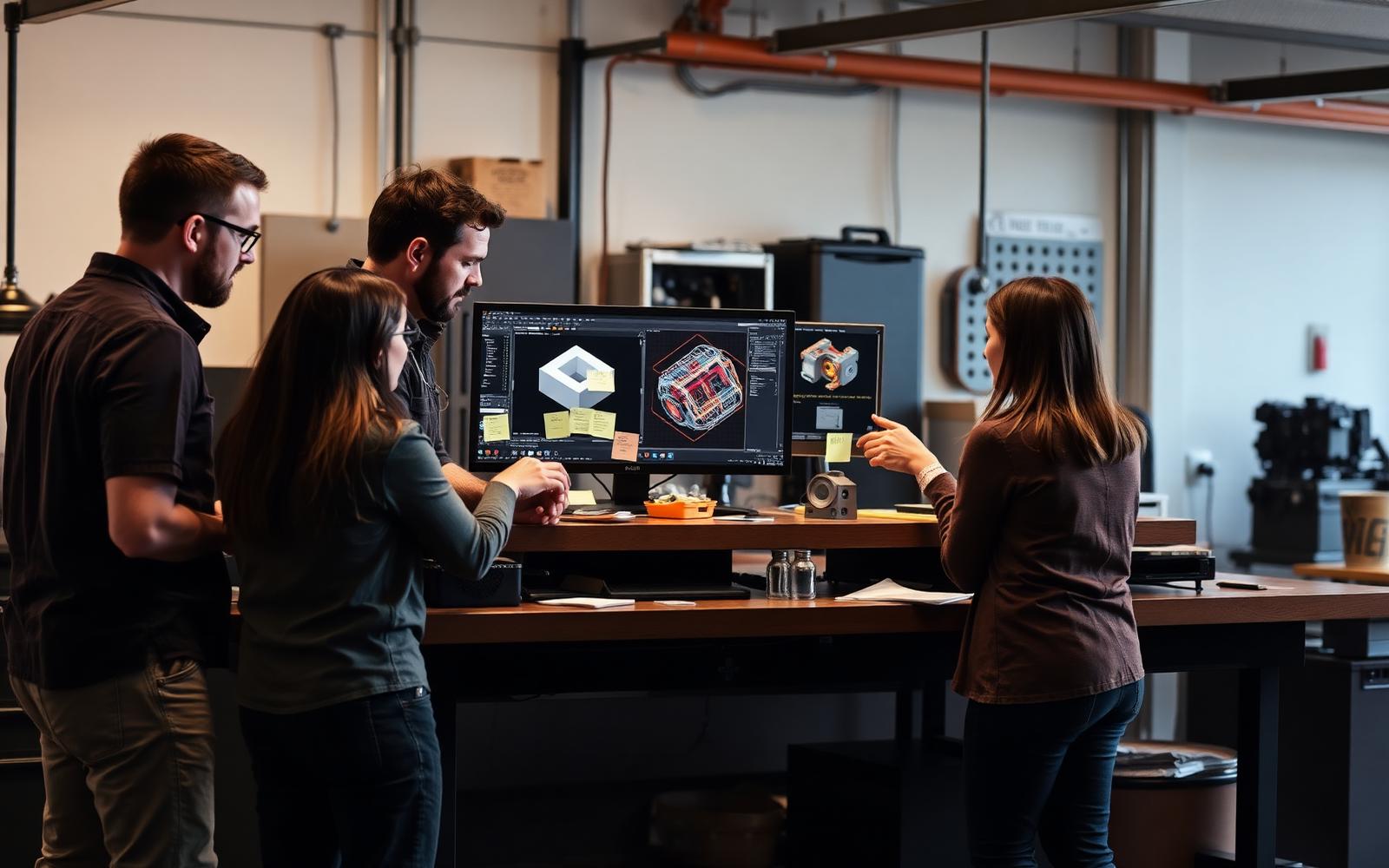
- Midweek design-engineering bench review (45 min). Physical parts on the table, CAD on the screen. Every open tolerance, fit and finish question is closed or assigned.
- Weekly risk burn-down (20 min). Top five technical risks, owner, retirement plan, date. Risks that have not moved in two weeks get escalated, not repeated.
- Biweekly cost and BOM review (45 min). Costed BOM line by line against the target. Cost is treated as a requirement, not a report.
Handoff friction points and how to remove them
Most team failures do not stem from bad moods. They happen when a team hands off work that others cannot use. Designers might send a model without a datum scheme. Then, engineers must guess. Engineers might change a radius on a drawing without a word. The design team only sees this at the first article step. Product managers might ask for a "premium feel." They should ask for a gap under 0.4 mm and no rattle at 3 g.
Fix this by setting rules for every handoff before you start. A design handoff to engineering needs a datum scheme. It also needs a list of key quality points and clear tolerances. A handoff to the factory needs 2D drawings with tolerances. It needs a bill of materials with approved parts. You must also include a clear plan for inspection. These written rules shorten review cycles because the intent is clear.
Metrics worth tracking
Metric | What it tells you | Healthy range |
|---|---|---|
Requirement churn after concept freeze | How disciplined the front end is | Under 10% of requirements changed |
Design-review rework rate | Whether handoff artifacts are complete | Under 20% of parts revised after release |
Risk retirement velocity | Whether the team attacks unknowns early | Top risk closed every two weeks |
First-article pass rate | Quality of drawings and tolerance work | Above 80% dimensions in spec |
Cost variance to target at pilot | How real the cost model was | Within 10% of target landed cost |
None of these require new software. They require a shared definition of done and a weekly cadence where all three disciplines look at the same numbers. Teams that publish these five metrics on one page tend to catch schedule slip four to six weeks earlier than teams that rely on status narratives.
Filed under:EducationUncategorized
Tagged:2025
Services related to this guide
- Product design servicesIndustrial design and CAD taken all the way to manufacturable files.
- Best industrial design firmsWhich studios take an idea from form to manufacturable hardware, and what they charge.
- Prototype designLooks-like, works-like or pre-production: what each proves and what it costs.
- Product development examplesReal projects we designed, prototyped and shipped.