Our work / Easy-Peezy Boxes
Making Medication Management Easier, Safer, and More Reliable
- Product Design & Engineering
- Prototyping
- DFM
- Manufacturing Support
- Packaging & Sell Sheets
- Website & launch materials

Written by Onega Ulanova, IRCA Lead Auditor, MS Eng. & Tech. Management, Executive MBA
Co-Founder, Quality Management Executive & Lead Auditor
Updated August 31, 2026
Designing a pill organizer for people with limited dexterity is a mechanism problem, not a container problem: the product has to bring pills to the surface instead of asking arthritic fingers to dig into a compartment.
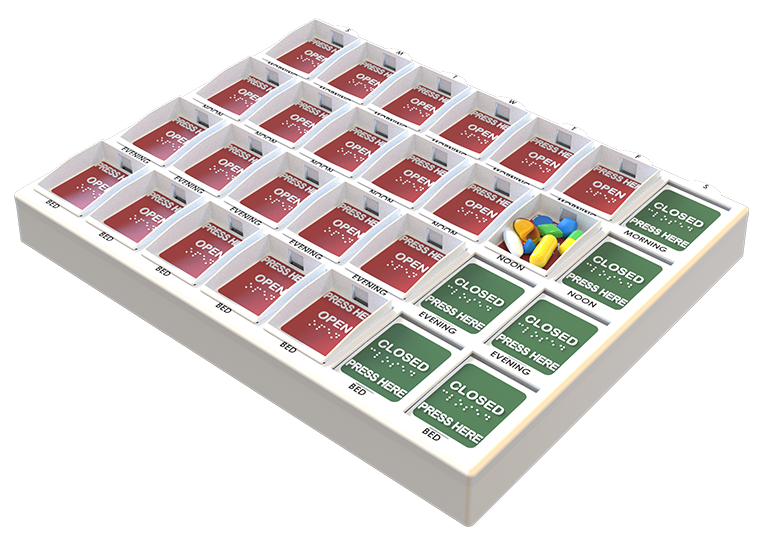
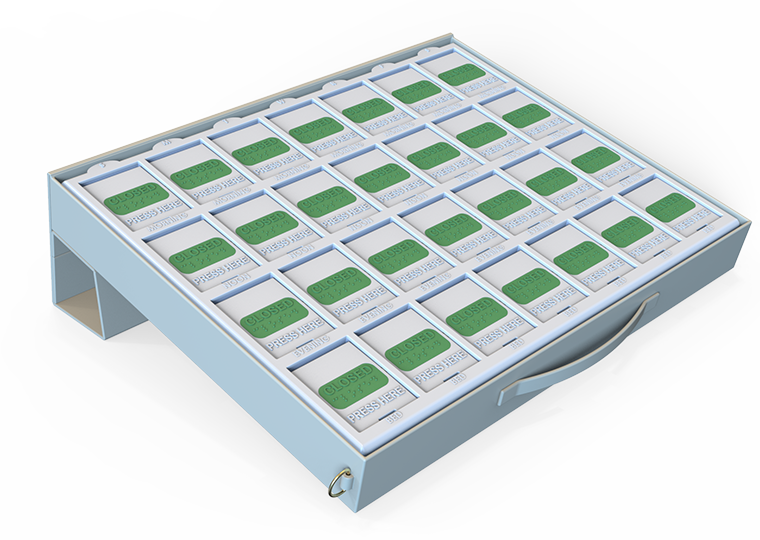
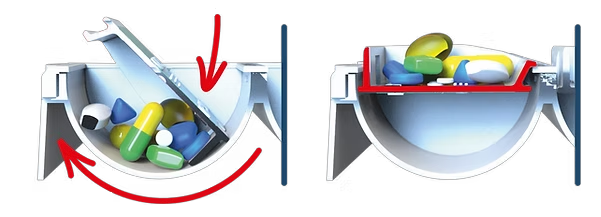
Easy-Peezy Boxes, invented by Carmen Adamucci Sr. after watching his grandmother-in-law struggle with standard organizers, is built on a patented scooping mechanism. We proved it in a single-cell prototype, then scaled it into a 28-cell weekly organizer.
Project at a glance
- Client
- Carmen Adamucci Sr., CEO and inventor — Easy-Peezy Boxes
- Category
- Medication management / assistive consumer product
- Core technology
- Patented scooping mechanism that lifts pills to the surface
- Configuration
- 28 cells — 7 days x 4 dosing periods, up to 12 pills per cell
- Accessibility features
- Rotational retrieval, embossed lettering, rubberized grip surfaces, color-coded taken/not-taken lids
- What we delivered
- Single-cell proof prototype, full multi-cell product design, and the engineering to make it manufacturable
The client

Carmen Adamucci Sr., CEO and inventor
The challenge
Our solution
Scaling to a full-week, multi-cell system
- Smooth, controlled pill retrieval by rotation
- Embossed lettering for tactile readability
- Rubberized top and bottom surfaces for grip
- Color-coded lids to indicate whether pills have been taken
- Clear visual cues for caregivers and users alike
Designing for accessibility and confidence
- Arthritis-friendly scooping mechanism
- High-contrast, embossed labels that are easy to read and feel
- Color cues to prevent missed or double doses
- A robust layout that supports caregivers and users alike
From prototypes to manufacturing readiness
- Multiple prototype iterations
- Materials selection for durability and user comfort
- Tolerance and assembly testing
- Design for Manufacturing (DFM) to support repeatable production
Packaging, sell sheets and launch materials
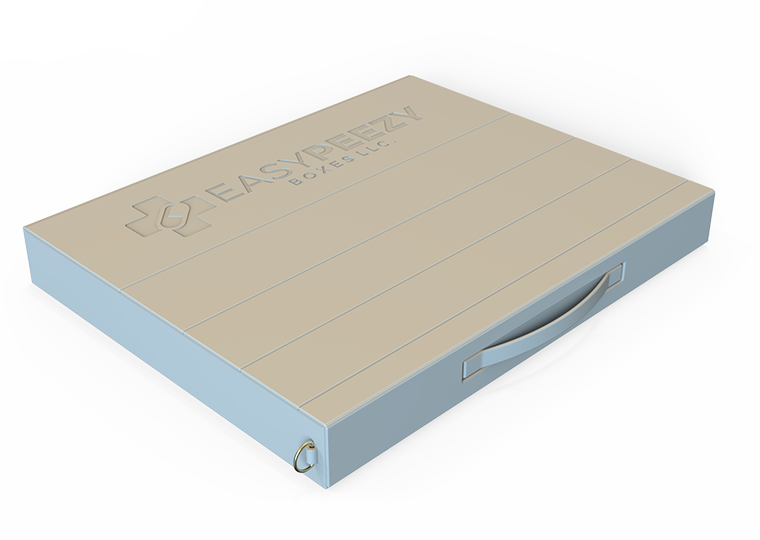
- Product packaging design
- A professional sell sheet explaining features and benefits
- Website content and visual assets
- Marketing graphics that highlight the product’s purpose, usability, and emotional connection
The result
- Reduce frustration and physical strain
- Support independent medication management
- Provide caregivers with clear visual feedback
- Enhance confidence for users of all abilities
Services provided
- 01
Product concept development
Worked with Carmen Adamucci Sr. to interpret his patent into an engineered design. - 02
Mechanical design and engineering
Developed the scooping mechanism, cell layout, labeling and grip surfaces. - 03
Prototyping and iteration
Built and tested single-cell and full 28-cell prototypes. - 04
Design for manufacturing
Optimized geometry, materials, and assemblies for scalable production.
Branding, packaging and sell sheets
Website and visual content
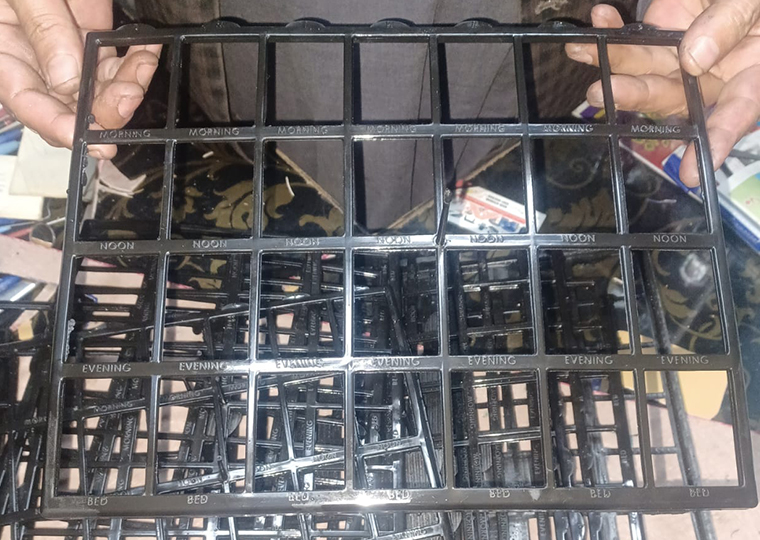

Production mold and sample part
Working with inventors
Capabilities used on this project
Rapid prototyping services
3D printing, CNC machining, urethane casting and functional prototype builds with published materials, tolerances and lead times.
Low-volume manufacturing
Bridge tooling, short-run production and supplier management for first commercial batches.
How a dexterity-friendly pill organizer gets engineered
A patent protects the idea. Everything below is what turns that idea into a product that can be molded, assembled and used every morning.
1. Prove the mechanism in one cell
Before designing a week's worth of anything, we built a single-cell prototype to validate that the scooping motion actually lifts pills to the surface and feels right in the hand. One cell is cheap to iterate; twenty-eight is not.
2. Set capacity and dosing structure from real routines
The layout follows how people actually take medication: seven days by four dosing periods — morning, noon, evening and bedtime — with each cell holding up to twelve pills. Capacity and clarity pull against each other, and that ratio is where the design lives.
3. Design the interaction for hands that shake
Retrieval is by controlled rotation rather than pinching. Lettering is embossed so it can be read by touch as well as sight, and the top and bottom surfaces are rubberized so the box stays put on a nightstand while one hand operates it.
4. Build in a memory aid, not just storage
Missed and double doses are the real failure mode. Color-coded lids indicate whether a dose has been taken, so the state of the week is visible at a glance without the user having to remember anything.
5. Multiply the mechanism carefully
Repeating a mechanism twenty-eight times multiplies tolerance stack-up, part count and assembly time. Scaling from the validated single cell meant re-checking fit and travel across the full array before any tooling decision.
6. Take the design to manufacturability
Wall thicknesses, draft, gate locations and the number of distinct molded parts decide whether the organizer can hit a drugstore price. Those decisions are made against the mechanism, which is why the mechanism is validated first.
| Aspect | Standard organizer | Easy-Peezy approach | Effect on the user |
|---|---|---|---|
| Retrieval | Fingers dig into a compartment | Rotation scoops pills to the surface | Usable with arthritis or limited grip |
| Labeling | Printed day letters | Embossed, tactile lettering | Readable by touch and in low light |
| Stability | Light plastic shell | Rubberized top and bottom | One-handed operation stays put |
| Adherence | No feedback | Color-coded lids show taken doses | Fewer missed and doubled doses |
Questions about this project
Straight answers from the engineers who ran the build. Have a different question? Ask us directly.
Talk to an engineerI have a patent on a mechanism. What happens next?
A patent describes a principle; a product has to survive tolerances, molding and daily handling. The first step is a functional prototype of the smallest unit that contains the mechanism, so you learn what the claim does not specify before you spend money on the full product.
Why start with one cell instead of the whole organizer?
Because every change to the mechanism would otherwise have to be made twenty-eight times. Validating a single cell lets you iterate the geometry in days, and only then multiply it into the full weekly layout.
What makes a product genuinely usable for people with arthritis?
Removing pinch and dig motions, adding tactile information so users are not relying on small print, and stabilizing the product so it can be operated with one hand. Those three moves cover most of the difference between a frustrating organizer and one that gets used.
Does a higher part count make a product too expensive to make?
Not automatically, but it does set the ceiling on price. Repeated cells share one mold cavity design, so unit cost is driven more by cycle time, assembly and material choice than by the number of compartments — provided the design is settled before tooling.
Industries this project belongs to
See how we approach development in each of these categories, and the other products we have taken from sketch to production there.