Serving Los Angeles
Prototyping Services for Los Angeles Products
Working prototypes built in house and shipped to LA
We build appearance models, functional prototypes and pre-production units in house — printed, machined, cast, wired and programmed — and ship them to the Los Angeles area in two to three days.
Because the same team designs and engineers the product, a prototype that comes back wrong gets fixed by the person who drew it, not queued behind a vendor's schedule.
- Built in house
- Shipped to LA in 2 – 3 days
- Printing, CNC, casting, electronics
- Design fixes included
Where can a Los Angeles product get prototyped?
Short answer
LA NPDT builds prototypes for Los Angeles clients in house — 3D printed, CNC machined, urethane cast, wired and programmed — and ships them to the LA area in two to three days. Appearance models take one to two weeks and cost roughly $1,500 to $6,000; functional prototypes take two to five weeks and typically run $4,000 to $25,000. Unlike a prototype shop, we can also design and engineer the part before we build it.
What we build, what it proves and what it costs
Prototype type, purpose, lead time and typical cost
| Prototype type | What it proves | Typical lead time | Typical cost |
|---|---|---|---|
| Appearance model | How the product looks and photographs | 1 – 2 weeks | $1,500 – $6,000 |
| Fit and form model | Size, ergonomics, part fit | 1 – 2 weeks | $1,200 – $5,000 |
| Functional prototype | That the mechanism or circuit actually works | 2 – 5 weeks | $4,000 – $25,000 |
| Electronics bring-up | Board, firmware and power behaviour | 3 – 6 weeks | $8,000 – $40,000 |
| Pre-production unit | That it can be made and assembled repeatably | 4 – 8 weeks | Quoted per unit |
Appearance model
- What it proves
- How the product looks and photographs
- Typical lead time
- 1 – 2 weeks
- Typical cost
- $1,500 – $6,000
Fit and form model
- What it proves
- Size, ergonomics, part fit
- Typical lead time
- 1 – 2 weeks
- Typical cost
- $1,200 – $5,000
Functional prototype
- What it proves
- That the mechanism or circuit actually works
- Typical lead time
- 2 – 5 weeks
- Typical cost
- $4,000 – $25,000
Electronics bring-up
- What it proves
- Board, firmware and power behaviour
- Typical lead time
- 3 – 6 weeks
- Typical cost
- $8,000 – $40,000
Pre-production unit
- What it proves
- That it can be made and assembled repeatably
- Typical lead time
- 4 – 8 weeks
- Typical cost
- Quoted per unit
Costs assume one to three units and exclude tooling. Transit to Los Angeles adds two to three days.
LA NPDT compared with Los Angeles prototype shops
Shops quote from finished files. We can start earlier than that, which matters when the design is not settled.
Most prototype rounds fail on something the file never showed: a snap that is too stiff, a board that grows two millimetres, a seal that leaks under load. When the shop is a separate company, that is a change order and a new lead time. When it is the same team, it is a revision and a re-print.
Los Angeles-area prototyping providers compared on advertised scope
| Provider | Base | Processes advertised | Design and engineering | Why a client might pick us instead |
|---|---|---|---|---|
| LA NPDTUs | Ruston, Louisiana — ships to LA in 2 – 3 days | 3D printing, CNC, urethane casting, electronics assembly, firmware bring-up, functional and pre-production builds | In house — we can design the part we are about to build | One team fixes the design when the prototype comes back wrong |
| ARRK (US) | Southern California | Rapid prototyping, urethane casting, 3D printing, CNC machining, tooling, injection moulding | Not advertised as a design service | You do not need finished CAD before you can start with us |
| Stratasys Direct | Valencia, CA | On-demand industrial 3D printing and machining, additive manufacturing at scale | Manufacturing engineering support, not product design | Mechanical, electrical and firmware work continue between prototype rounds |
| Gentle Giant Studios | Los Angeles, CA | 3D scanning, prototyping, fabrication and fine-art/entertainment production | Creative design and fabrication focus | Engineering for products that must be manufactured repeatably, not only fabricated once |
LA NPDTUs
- Base
- Ruston, Louisiana — ships to LA in 2 – 3 days
- Processes advertised
- 3D printing, CNC, urethane casting, electronics assembly, firmware bring-up, functional and pre-production builds
- Design and engineering
- In house — we can design the part we are about to build
- Why a client might pick us instead
- One team fixes the design when the prototype comes back wrong
ARRK (US)
- Base
- Southern California
- Processes advertised
- Rapid prototyping, urethane casting, 3D printing, CNC machining, tooling, injection moulding
- Design and engineering
- Not advertised as a design service
- Why a client might pick us instead
- You do not need finished CAD before you can start with us
Stratasys Direct
- Base
- Valencia, CA
- Processes advertised
- On-demand industrial 3D printing and machining, additive manufacturing at scale
- Design and engineering
- Manufacturing engineering support, not product design
- Why a client might pick us instead
- Mechanical, electrical and firmware work continue between prototype rounds
Gentle Giant Studios
- Base
- Los Angeles, CA
- Processes advertised
- 3D scanning, prototyping, fabrication and fine-art/entertainment production
- Design and engineering
- Creative design and fabrication focus
- Why a client might pick us instead
- Engineering for products that must be manufactured repeatably, not only fabricated once
Facts taken from each firm's own public website in August 2026 and describe the services they advertise, not our opinion of their work. The last column is our own positioning, not a claim about them.
Prototypes we built and what happened next
Processes, materials and the tolerances they hold
Which process we choose depends on what the prototype has to prove — looks, fit, function or manufacturability.
Prototyping process, typical materials and achievable tolerance
| Process | Typical materials | Typical tolerance | Best for |
|---|---|---|---|
| SLA / resin printing | Standard, tough and clear resins | ±0.1 – 0.2 mm | Appearance models, fine detail, clear parts |
| FDM printing | PLA, PETG, ABS, ASA, nylon | ±0.3 – 0.5 mm | Fit checks, jigs, large or rough-and-ready parts |
| SLS printing | Nylon PA12, glass-filled nylon | ±0.3 mm | Living hinges, snap fits, functional mechanisms |
| CNC machining | Aluminium, steel, brass, Delrin, PC, ABS | ±0.05 – 0.1 mm | Load-bearing parts, sealing faces, production-like finish |
| Urethane casting | Rigid and elastomeric urethanes, silicone | ±0.2 mm | 10 – 50 units before tooling exists |
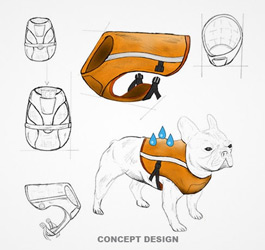
| Sheet and soft goods | Sheet metal, fabrics, foams, webbing | Pattern dependent | Enclosure brackets, wearables, carriers and vests |
| Electronics build | Custom PCBs, off-the-shelf modules, Li-ion packs | Per fab capability | Board bring-up, firmware, power and battery behaviour |
SLA / resin printing
- Typical materials
- Standard, tough and clear resins
- Typical tolerance
- ±0.1 – 0.2 mm
- Best for
- Appearance models, fine detail, clear parts
FDM printing
- Typical materials
- PLA, PETG, ABS, ASA, nylon
- Typical tolerance
- ±0.3 – 0.5 mm
- Best for
- Fit checks, jigs, large or rough-and-ready parts
SLS printing
- Typical materials
- Nylon PA12, glass-filled nylon
- Typical tolerance
- ±0.3 mm
- Best for
- Living hinges, snap fits, functional mechanisms
CNC machining
- Typical materials
- Aluminium, steel, brass, Delrin, PC, ABS
- Typical tolerance
- ±0.05 – 0.1 mm
- Best for
- Load-bearing parts, sealing faces, production-like finish
Urethane casting
- Typical materials
- Rigid and elastomeric urethanes, silicone
- Typical tolerance
- ±0.2 mm
- Best for
- 10 – 50 units before tooling exists
Sheet and soft goods
- Typical materials
- Sheet metal, fabrics, foams, webbing
- Typical tolerance
- Pattern dependent
- Best for
- Enclosure brackets, wearables, carriers and vests
Electronics build
- Typical materials
- Custom PCBs, off-the-shelf modules, Li-ion packs
- Typical tolerance
- Per fab capability
- Best for
- Board bring-up, firmware, power and battery behaviour
Tolerances are what we routinely hold on prototype quantities; tighter is possible on machined features when a drawing calls for it.
Not an LA office — an LA client base
Short answer
We are not headquartered in Los Angeles. Our engineers work from Ruston, Louisiana and serve Los Angeles clients remotely, with Pacific-time overlap into the afternoon and prototypes in the LA area within two to three days.
For prototyping that means the parts are made here and shipped to you: photos and video of the build before the box leaves, two to three days in transit to the Los Angeles area, and expedited options when a shoot or a pitch will not move.
- How we work with Los Angeles clientsThe full picture: scope, costs, named-firm comparison and logistics.
Where to go next
- Rapid prototypingHow we build working prototypes and what they cost.
- Product development for Los Angeles clientsHow we work with LA founders and brands, and what it costs.
- Product design for Los AngelesConcept, industrial design and CAD for LA-based products.
- Service areasHow we work with clients in every US metro from our Louisiana base.
- Product development portfolioProducts we designed, engineered and manufactured.
Questions
Frequently asked questions
Can you ship prototypes to Los Angeles?
Yes. Prototypes typically reach the Los Angeles area two to three days after they leave our shop, and we send photos and video of the build before shipping.
How much does prototyping cost in LA?
An appearance model typically runs $1,500 to $6,000 and a functional prototype $4,000 to $25,000 depending on the mechanism. Electronics bring-up with firmware starts around $8,000. Our rates are set by Louisiana overhead rather than Los Angeles overhead.
Do I need finished CAD before you can start?
No. A prototype shop such as ARRK or Stratasys Direct quotes from finished files; we can start from sketches or a rough idea, design the part, then build it.
Do you build electronics prototypes as well as enclosures?
Yes. Schematic, PCB layout, assembly, firmware and bring-up are done in house alongside the mechanical work.
What processes do you use?
SLA and FDM printing, CNC machining, urethane casting, sheet and soft-goods fabrication, plus electronics assembly and programming — chosen by what the prototype has to prove, not by what is fastest to quote.
What happens if the prototype comes back wrong?
The engineer who drew it revises it and we rebuild. Because design and build sit in one team, that is a revision rather than a change order to a separate vendor.
Can you make a small production run after the prototype?
Yes. Short-run manufacturing, assembly and packing are in house, so you can sell the first units before committing to hard tooling.
Where to go next
- Rapid prototypingHow we build working prototypes and what they cost.
- Product development for Los Angeles clientsHow we work with LA founders and brands, and what it costs.
- Concept designThe full guide to turning an idea into sketches, CAD and renders.
- Service areasHow we work with clients in every US metro from our Louisiana base.
- Product development portfolioProducts we designed, engineered and manufactured.