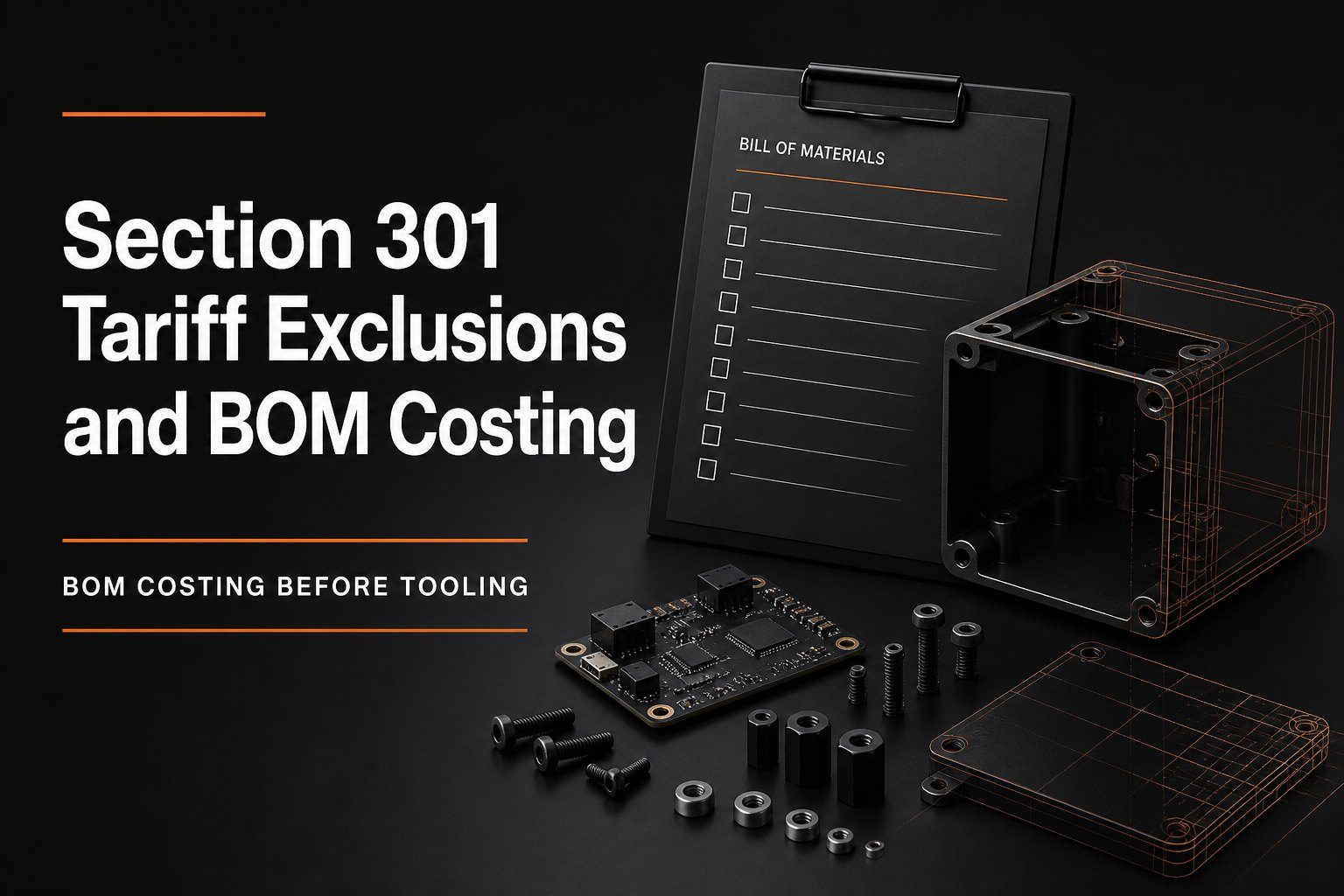
Section 301 Exclusions Expire November 2026: What Hardware Founders Must Recost Now
178 remaining U.S. Section 301 product exclusions are scheduled to end at 11:59 p.m. EDT on November 9, 2026. Here is what that means for BOM costing, supplier quotes, and prototype-to-production plans.
September 7, 20265 min read

Written by Konstantin Dolgan, Ph.D., NPDP
Founder & CEO, Product Development Engineer
Published September 7, 2026
Short answer: the U.S. Trade Representative extended the 178 remaining Section 301 product exclusions, and that relief now runs through 11:59 p.m. eastern daylight time on November 9, 2026. If any line on your bill of materials is China-origin and quietly depends on one of those exclusions, your landed cost can change the day the exclusion ends.
This guide is written for founders and product teams moving from a functional prototype toward production quotes in industrial, medical, electromechanical, pet, and hunting hardware. It is educational, not legal or customs advice.
What actually expires on November 9, 2026
USTR extended the 178 current exclusions connected to the Section 301 investigation of China acts, policies, and practices related to technology transfer, intellectual property, and innovation. Two annexes carry the relief.
Annex A covers exclusions under HTSUS heading 9903.88.69 and U.S. notes 20(vvv)(i) through 20(vvv)(iv). Annex B covers exclusions under HTSUS heading 9903.88.70 and U.S. note 20(www), which are the solar manufacturing equipment exclusions.
The extension applies to goods entered for consumption, or withdrawn from warehouse for consumption, on or after 12:01 a.m. EST on November 30, 2025, and before 11:59 p.m. EDT on November 9, 2026.
The decision followed the November 1, 2025 White House announcement of a U.S. and China trade and economic deal, and USTR also weighed public comments and interagency advice.
USTR has said it may continue to consider further extensions or additional modifications as appropriate, so treat November 9, 2026 as the planning date, not a guaranteed cliff.
One detail matters more than the headline count: the scope of each exclusion is governed by the ten-digit HTSUS numbers and the product descriptions in the cited U.S. notes. A product that looks similar to an excluded product is not automatically covered.
Why this matters before you freeze a BOM
Exclusion relief is product-specific and HTS-specific. In practice, a contract manufacturer quote can reflect exclusion pricing without ever saying so on the quote sheet. When the exclusion ends, covered entries are again subject to the underlying Section 301 additional duties that apply to that product list assignment. We are deliberately not naming a rate here. Confirm the exact rate for your HTS codes with a licensed customs broker.
The cost of reacting late is not the duty alone. It is the tooling you already cut, the supplier you already qualified, and the retail or distributor price you already published. Sourcing changes are inexpensive while the design is still fluid and expensive once steel is committed. If you are sizing production economics, our guide to estimating mass production cost is the right companion piece to this one.
Checklist before you request production quotes
Work through this once per program, and keep the output next to your BOM so the next quote round starts from evidence instead of memory.
- Map every China-origin line on the BOM to a ten-digit HTS candidate, including purchased subassemblies and packaging.
- Ask your customs broker whether any line currently claims 9903.88.69 or 9903.88.70.
- Rebuild landed cost two ways: with the exclusion applied, and without it, meaning the underlying Section 301 additional duties are restored.
- Re-quote alternate origins (Mexico, Vietnam, India, the United States, the EU) for the highest-exposure lines only, not the whole BOM.
- Decide whether a tooling or DFM change is cheaper than absorbing duty, and price both paths before committing.
- Put a November 2026 review date on any quote that assumes exclusion pricing, and ask suppliers to state their duty assumption in writing.
Founder decision map
Situation | What to do by early fall 2026 | Why |
|---|---|---|
Confirmed exclusion-dependent China parts | Model both duty scenarios and pre-negotiate a price adjustment clause | Relief ends 11:59 p.m. EDT November 9, 2026 unless USTR acts again |
No China content on the BOM | Document origin evidence and move on | Exposure is low, but buyers and investors still ask for proof |
Mixed BOM with a few China lines | Rank lines by annual spend and duty exposure, then re-source only the top ones | Re-sourcing everything burns runway for little savings |
Medical or industrial components with uncertain HTS | Get a broker classification opinion before quoting production | Exclusion scope follows the ten-digit HTS and the note product description |
Supplier quotes valid past November 9 with no duty language | Ask for written duty assumptions and a validity date | Silent quotes shift the duty risk onto you at the worst moment |
What this is not
- Not a market-size report. It is a costing and sourcing planning note.
- Not legal or customs advice. Classification and duty rates belong to a licensed customs broker or trade counsel.
- Not a prediction. USTR may extend or modify again, and we do not assume either outcome.
- Not a blanket China duty holiday. Exclusions are narrow product descriptions tied to specific HTS numbers.
How this fits prototype-to-production timing
The path from idea to a functional prototype, then to design for manufacturing, then to production, gives you exactly one cheap window to change materials, fasteners, motors, enclosures, or electronics modules. That window closes when tooling is cut. Duty exposure belongs in the DFM conversation next to material cost and cycle time, not in a spreadsheet opened after the first production purchase order.
For teams still choosing a partner for that stage, how to choose a product development company covers the evaluation criteria, and product development consulting explains how we scope the work. At LA NPDT we take concepts to functional prototypes and into low volume production for industrial, medical, pet, and hunting hardware, so sourcing risk usually surfaces during DFM rather than after launch.
Sources
- USTR, Notice of Product Exclusion Extensions (PDF), primary source for the 178 exclusions, annexes, and dates.
- Federal Register, Notice of Product Exclusion Extensions (December 1, 2025), the published notice.
- Secondary, founder context only: Expeditors newsflash summarizing the same notice.
- Related on this site: estimating the cost of mass production.
If you are still proving the concept, start with a fixed-scope feasibility or prototype plan so sourcing choices stay reversible. If you are already quoting production, rebuild landed cost with and without exclusion assumptions before you commit tooling. Talk with our team if you want a second set of eyes on the BOM, or read more from Konstantin Dolgan on taking hardware from idea to production.
Frequently asked questions
When do the remaining Section 301 exclusions expire?
The 178 remaining exclusions are extended through 11:59 p.m. eastern daylight time on November 9, 2026. The extension applies to goods entered for consumption, or withdrawn from warehouse for consumption, on or after 12:01 a.m. EST on November 30, 2025 and before that November 9, 2026 cutoff. USTR may consider further extensions or modifications, so verify status close to the date.
What are Htsus 9903.88.69 and 9903.88.70?
They are the special tariff headings used to claim the extended exclusions. Annex A exclusions sit under 9903.88.69 with U.S. notes 20(vvv)(i) through 20(vvv)(iv). Annex B exclusions sit under 9903.88.70 with U.S. note 20(www), covering solar manufacturing equipment. The actual scope of any exclusion is set by the ten-digit HTSUS numbers and the product descriptions written into those notes.
Does an exclusion extension mean my whole product is duty-free?
No. An exclusion applies to specific products described in the relevant U.S. note, not to a company, a brand, or an entire finished assembly. Other components on the same BOM may carry duties, and normal customs duties still apply on top of the Section 301 question. Confirm line by line with your broker.
What should I do if my supplier quote assumes China pricing through 2027?
Ask the supplier to state in writing whether the quote assumes an active Section 301 exclusion, which HTS codes they used, and what happens to price after November 9, 2026. Then rebuild landed cost without the exclusion so you know the downside before you sign. If the delta threatens your margin, price an alternate origin or a design change in parallel.
Is this legal or customs advice?
No. This is a planning guide for product teams. Classification, exclusion eligibility, duty rates, and entry filings should be confirmed with a licensed customs broker or trade counsel, and CBP issues the entry guidance and implementation instructions that govern how these exclusions are applied at the border.
Where do I put duty risk in a product development budget?
Treat it as a line in landed cost during DFM, not as a surprise in the first production run. Carry two landed cost figures for any exclusion-dependent part, keep a contingency against the higher one, and revisit the assumption whenever a quote is renewed or an origin changes.
Services related to this guide
- Product design servicesIndustrial design and CAD taken all the way to manufacturable files.
- Rapid prototypingWorking prototypes in days, from 3D printing to vacuum casting.
- Electronic design servicesSchematic, PCB layout, firmware and bring-up, through to production handoff.
- Product development examplesReal projects we designed, prototyped and shipped.