EU AI Act 2026: What AI Hardware Founders Should Build Into the Prototype Now
For founders and product teams building physical products with AI inside, from voice devices and companion robots to smart toys and machinery. What the 2026 AI Omnibus changed, which EU AI Act dates apply to your product, and what to design into the prototype now.
October 29, 20267 min read

Written by Konstantin Dolgan, Ph.D., NPDP
Founder & CEO, Product Development Engineer
Published October 29, 2026
Short answer
The EU AI Act changed shape in 2026.
The AI Omnibus, Regulation (EU) 2026/1744, entered into force on 27 July 2026 and pushed the high-risk rules back: 2 December 2027 for stand-alone high-risk AI systems listed in Annex III, and 2 August 2028 for high-risk AI embedded in regulated physical products such as machinery, toys and lifts (European Commission).
The transparency rules in Article 50 did not move.
They have applied since 2 August 2026: a device whose AI talks or responds to people must tell them they are dealing with AI, and generative outputs must carry machine-readable marks, with a grace period to 2 December 2026 only for systems placed on the market before 2 August 2026 (European Commission).
For a hardware team, the practical answer is to design the AI disclosure into the first prototype that talks to a person, keep safety functions separate from AI features, and document the AI's intended purpose now, while changes are still cheap.
Who this is for
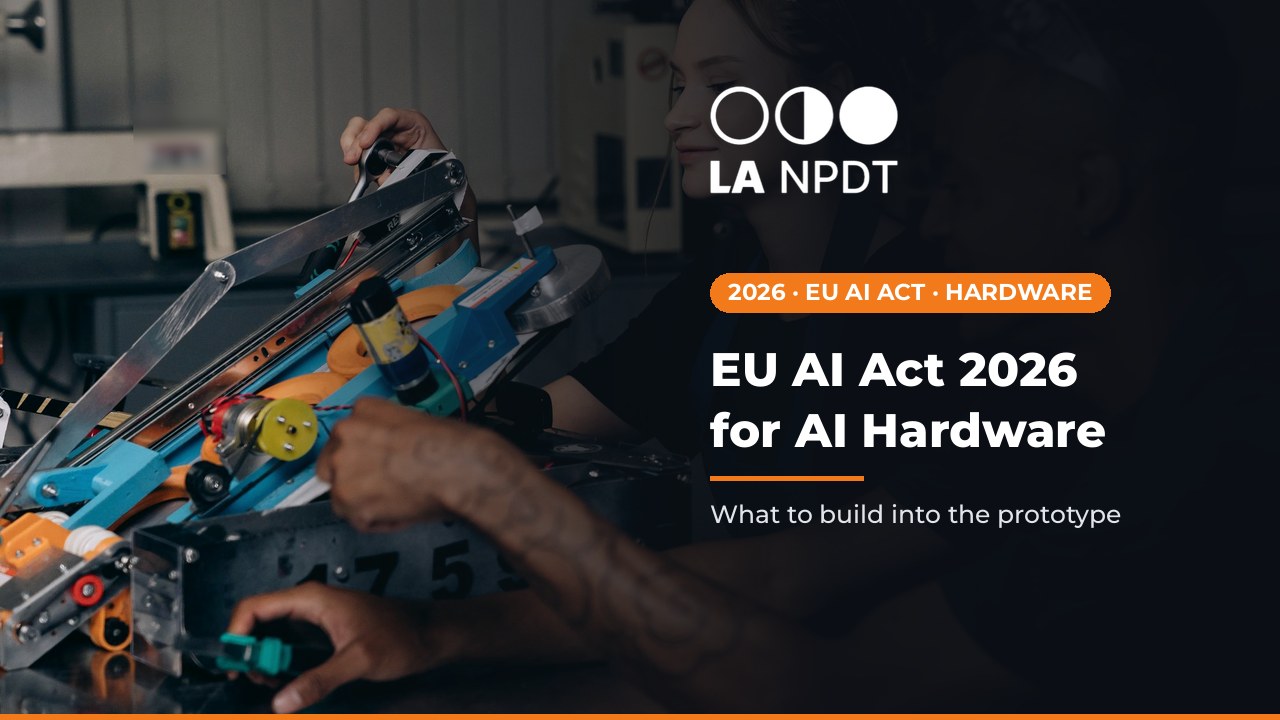
Founders and product teams building physical products with AI inside: voice-controlled devices, companion robots, smart toys, AI cameras, wearables with a coaching assistant, cobots and smart machinery.
If you plan to sell in the EU, or to license to a company that does, the decisions in this article belong in the concept and alpha prototype stages, not in a compliance sprint before launch.
If your AI runs on the device itself, our guide to edge AI hardware prototyping in 2026 covers the hardware side.
What changed in 2026
2 August 2026: Article 50 transparency rules apply
Article 50 of the AI Act applies from 2 August 2026, and enforcement of the transparency rules started on that date (AI Act Service Desk). Providers of AI systems that interact directly with people must design them so that people are informed they are interacting with an AI system, unless that is obvious.
The Commission's FAQ sets four cumulative conditions: it is an AI system, it is designed for a genuine two-way exchange, the interaction is direct, and the other party is a natural person (European Commission). Systems that work only in the background or machine to machine are outside this obligation.
27 July 2026: the AI Omnibus enters into force
The AI Omnibus was proposed on 19 November 2025 as part of the digital omnibus package.
The European Parliament approved it with 423 votes in favour, 57 against and 174 abstentions, the Council gave its final green light on 29 June 2026, and it entered into force on 27 July 2026 (European Parliament; Council of the EU; European Commission).
For hardware teams, the key change is time: high-risk obligations now start on 2 December 2027 for Annex III systems and 2 August 2028 for high-risk AI embedded in products covered by EU product safety laws listed in Annex I.
A clearer line on what counts as a safety component
Under Article 6(1), AI is high-risk when it is a safety component of a product covered by the Annex I laws and that product needs a third-party conformity assessment (Regulation (EU) 2026/1744, recital 20).
The Omnibus clarified that products with AI functions that only assist users or optimise performance will not automatically face high-risk obligations if their failure or malfunction does not pose health or safety risks.
It also removed overlapping AI requirements for machinery, which now only needs to comply with sectoral safety law while keeping an equivalent level of health and safety (European Parliament).
For machinery, see our EU Machinery Regulation 2027 prototype checklist.
2 December 2026: marking deadline for earlier systems
Generative AI systems must mark their outputs (images, audio, video, text) with machine-readable marks so they can be detected as AI-generated. Systems placed on the market before 2 August 2026 have until 2 December 2026 to comply with that marking obligation. The Commission describes a narrow exemption for outputs used in business-to-business or industrial contexts, under conditions set out in its guidelines (European Commission).
Smaller companies get more room
The Omnibus extends some simplifications that were reserved for SMEs to small mid-cap companies, simplifies the AI literacy requirement for companies, and expands access to regulatory sandboxes, including an EU-level sandbox (European Commission).
Which AI Act date applies to your prototype?
If your product... | Example | Rule | Applies from |
|---|---|---|---|
Talks or responds to people through AI | Voice assistant, companion robot, robotic pet, AI coaching wearable | Article 50(1): tell people they are interacting with AI, unless obvious | 2 August 2026 |
Generates images, audio, video or text | AI camera that creates images, device that generates speech | Article 50(2): machine-readable marking of outputs | 2 August 2026 (2 December 2026 for systems placed on the market before 2 August 2026) |
Uses AI as a safety component of a product under Annex I laws that needs third-party conformity assessment | AI safety function in a toy, lift or other regulated product | High-risk requirements (Chapter III) | 2 August 2028 |
Is a stand-alone high-risk use listed in Annex III | Separate use cases defined in Annex III | High-risk requirements (Chapter III) | 2 December 2027 |
Uses AI only to assist the user or optimise performance, where failure is not a health or safety risk | Smart scheduling or energy optimisation in an appliance | Not automatically high-risk; Article 50 can still apply if it interacts with people | Check case by case |
Sources: European Commission AI Omnibus news (27 July 2026), Commission Article 50 FAQ, European Parliament press release (June 2026). Classification depends on the facts of each product; check with a qualified advisor before you rely on it.
What to build into the prototype now
These are engineering steps that keep your options open. They do not replace a legal assessment.
- Design the AI disclosure into the interaction. The Commission's guidelines give the example of a voice assistant that says at the beginning of a session that it is powered by AI. The notice must come at the latest at the first interaction, and should be adapted when users may include vulnerable groups such as children (Commission guidelines). On a prototype, that means a spoken line, a screen message, a light pattern with a label, or a printed notice that you can test with real users.
- Decide if the AI nature is "obvious". The guidelines say a robotic companion pet that looks and acts like a real pet does not meet the obviousness exception. If your industrial design makes the product feel human or animal, plan the disclosure.
- Mark generated content at the source. If the device creates images, audio or video, plan firmware or cloud support for machine-readable marks, and budget processor, storage and power for it on the prototype board.
- Separate safety functions from AI features. Keep emergency stops, interlocks, thermal and battery protection in deterministic hardware or firmware that does not depend on the AI model. That supports the "assists or optimises only" position and makes the safety case easier to test. Our DFMEA for prototypes shows how to list AI failure modes next to mechanical ones.
- Write the intended purpose down. One page: what the AI does, who uses it, what it must never do, and what happens when it fails. It feeds your risk analysis, user testing and any later technical file.
- Log what the AI did during tests. Keep test logs of inputs, outputs and model versions from alpha and beta units. If the product is later classified as high-risk, you will want that history. See hardware beta testing.
- Check the other EU laws at the same time. Connected AI products often also fall under the EU Cyber Resilience Act. Plan one prototype test round that covers both.
Where AI tools fit in the development process
Using AI tools to design a product is a different question from shipping AI inside it. The Article 50 duties described above are about AI systems that interact with people or generate content for them, so focus the compliance work on the AI your users will meet. For what AI design tools do well today, see AI tools for hardware prototyping in 2026.
Founder checklist
- List every AI feature in the product and mark which ones talk to, respond to, or generate content for people.
- For each one, write the disclosure and test it on the first prototype that real users touch.
- Mark which features could affect health or safety, and move protections for those into non-AI hardware or firmware.
- Note which EU product laws cover the product (for example toys, machinery, radio equipment or medical devices) and whether a third-party conformity assessment applies.
- Put the 2 December 2026, 2 December 2027 and 2 August 2028 dates on the product roadmap.
- Get qualified regulatory advice before launch.
Frequently asked questions
Did the AI Omnibus delay all of the EU AI Act?
No. It delayed the high-risk rules to 2 December 2027 (Annex III) and 2 August 2028 (AI embedded in Annex I products). The Article 50 transparency rules have applied since 2 August 2026 (European Commission; AI Act Service Desk).
Does a voice-controlled device need to say it uses AI?
If its AI is designed for a genuine two-way exchange with people, Article 50(1) applies unless the AI nature is obvious. The Commission's guidelines give a voice assistant that says at the start of a session that it is powered by AI as an example of how to inform users.
Is a robot or smart toy automatically high-risk?
No. High-risk under Article 6(1) depends on whether the AI is a safety component of a product covered by Annex I laws that needs a third-party conformity assessment. The Omnibus clarified that AI that only assists or optimises, where failure is not a health or safety risk, is not automatically high-risk. Interactive robots and toys can still fall under Article 50.
When does the AI content marking rule apply to devices already on sale?
For generative AI systems placed on the market before 2 August 2026, the marking and detection obligation applies from 2 December 2026. New systems have had to comply since 2 August 2026 (European Commission).
What are the fines for breaking the transparency rules?
The Commission says fines can reach up to 15 million euros or 3% of total worldwide turnover for the preceding financial year, with proportionality for SMEs, and that national market surveillance authorities mainly enforce Article 50 (European Commission).
Does using AI to design my product make it an AI system under the Act?
Not by itself. The Article 50 duties covered here are about AI systems that interact with people or generate content for them. If the finished product contains no AI, AI-assisted CAD, code or simulation used during development does not add those duties to it. Check edge cases with a qualified advisor.
Building a product with AI inside?
Talk with an engineer about where the AI fits, how to keep safety functions independent, and what to test on the first prototype. Book an initial consultation with LA New Product Development Team or call +1 318-200-0526.
Sources
- European Commission, "AI Omnibus enters into force" (27 July 2026): Europa: ai omnibus enters force
- Regulation (EU) 2026/1744 (AI Omnibus), EUR-Lex: Read more on Europa
- European Commission, "Transparency obligations under Article 50 of the AI Act" (FAQ): Europa: transparency obligations under article 50 ai act
- European Commission, Guidelines on the implementation of the transparency obligations under Article 50 of the AI Act, C(2026) 5054 (20 July 2026): Europa: guidelines on the implementation of the transparency obligations for certain ai systems under article 50 of the ai act bzptwqhk0ikg1dtlddap41psfy
- AI Act Service Desk, "When does enforcement start?": Europa: when does enforcement start
- European Parliament, "AI Act: EP approves simplification measures and nudifier app ban" (June 2026): Europa: ai act ep approves simplification measures and nudifier app ban
- Council of the EU, "Artificial Intelligence: Council gives final green light to simplify and streamline rules" (29 June 2026): Europa: artificial intelligence council gives final green light to simplify and streamline rules
Services related to this guide
- Electronic design servicesSchematic, PCB layout, firmware and bring-up, through to production handoff.
- Rapid prototypingWorking prototypes in days, from 3D printing to vacuum casting.
- Product design servicesIndustrial design and CAD taken all the way to manufacturable files.
- Product development examplesReal projects we designed, prototyped and shipped.