10 Engineering Design Constraints You Can't Ignore
Design constraints are not obstacles to creativity; they are the definition of the problem. The teams that write them down early ship. The teams that discover them in tooling do not.
July 2, 20257 min read

Written by Konstantin Dolgan, Ph.D., NPDP
Founder & CEO, Product Development Engineer
Published July 2, 2025Updated September 2, 2026
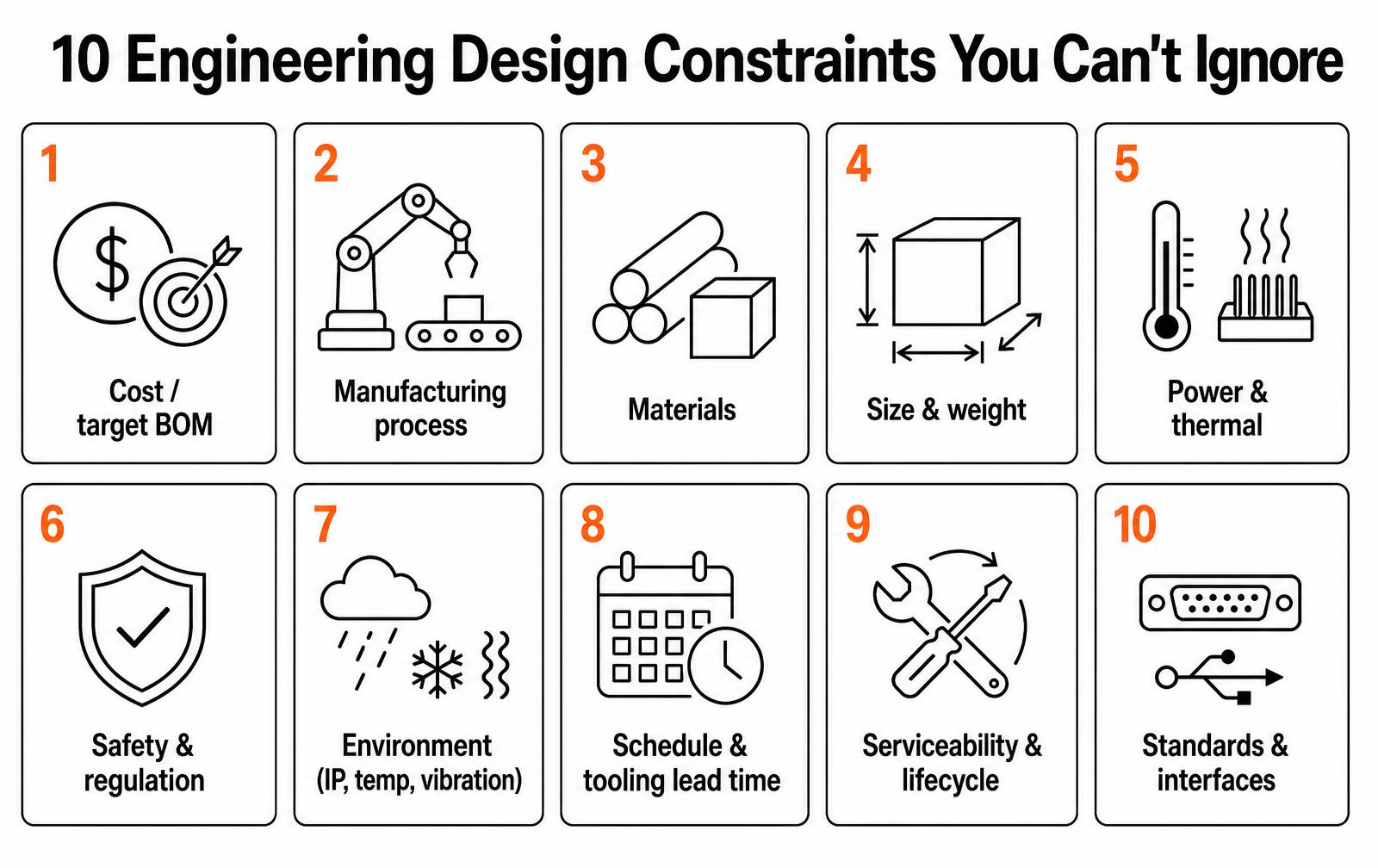
Design constraints are the fixed limits a product design must satisfy — cost, manufacturing process, materials, size and weight, power and thermal budget, safety and regulation, operating environment, schedule, serviceability, and standards compliance. Constraints define the solution space. A design that violates one is not a design, it is a proposal.
Requirements say what the product must do. Constraints say what the design may not do. Confusing the two is how programs end up with a beautiful concept that cannot be molded, powered or certified.
1. Cost and target BOM
Every design decision has a price. Set a target bill of materials cost before concept work starts, derived from the retail price and the margin structure your channel requires. A common consumer rule of thumb is a BOM at 20 to 30 percent of retail once distribution, retail margin, warranty and overhead are covered. Without a number, engineering optimizes for elegance and finance discovers the problem at pilot build.
2. Manufacturing process
Injection molding, die casting, sheet metal, machining and additive each impose their own geometry rules — draft angles, uniform wall thickness, bend radii, tool access, minimum feature size. Choose the process during concept selection, because switching later usually means redrawing every part. Volume drives that choice more than anything else.
3. Materials
Constraint driver | Question to answer early |
|---|---|
Strength and stiffness | What loads, impacts and fatigue cycles must it survive? |
Temperature | Operating and storage range, plus any process temperatures |
Chemical exposure | Cleaners, solvents, UV, salt, food or skin contact |
Regulatory | RoHS, REACH, food-contact, biocompatibility, flame rating |
Cost and availability | Is the grade stocked in your region and volume? |
4. Size and weight
Envelope constraints come from use context, shipping, retail packaging, handling limits and sometimes regulation. They are also the constraint most often set arbitrarily — challenge a size target once, in writing, before letting it dictate an expensive internal layout.
5. Power and thermal budget
For electronics, power is the constraint that quietly determines size, cost and runtime. Build the power budget in a spreadsheet at concept stage: every load, duty cycle, conversion efficiency and quiescent current. Thermal follows immediately — every watt that is not useful work becomes heat that must leave the enclosure, and that decides venting, material and often the whole architecture.
6. Safety and regulation
Certification is a design constraint, not a testing task. Creepage and clearance distances, insulation, grounding, sharp edges, pinch points, small-parts rules for children's products, biocompatibility for medical — each one dictates geometry. Identify the applicable standards during requirements and design to them from the first CAD session.
7. Operating environment
- Ingress protection against dust and water, expressed as an IP rating
- Temperature and humidity extremes, including shipping and storage
- Shock, drop and vibration profiles for the real use case
- UV, salt fog, chemicals and abrasion
- Electromagnetic environment — what it must tolerate and what it may emit
8. Schedule and tooling lead time
Time is a hard constraint because tooling is. Injection mold tooling commonly takes 6 to 14 weeks after design freeze, certification testing 4 to 12 weeks, and long-lead electronic components can exceed all of it. A launch date works backward through those fixed blocks; design freeze is rarely as flexible as it looks on a Gantt chart.
9. Serviceability and lifecycle
Decide early whether the product is repairable, whether batteries are user-replaceable, how it is opened, and what happens at end of life. Right-to-repair rules and EU ecodesign requirements are turning what used to be a philosophy question into a compliance constraint.
10. Standards and interfaces
Connectors, mounting patterns, communication protocols, fastener series, rack units and packaging modules all constrain geometry. Adopting an existing standard is nearly always cheaper than inventing an interface, and it makes accessories and service parts someone else's problem.
How to document constraints
- Write one constraint document alongside the requirements, with an owner for each line.
- State each constraint as a limit with a number and a source — standard, contract, physics or business decision.
- Mark which constraints are hard (violation kills the design) and which are soft (violation costs money).
- Review the set with manufacturing, compliance and finance before concept selection.
- Re-check at every gate. Constraints change when suppliers, markets or regulations change.
When the set is written down, concept evaluation becomes a comparison rather than an argument — which is the same discipline that makes design for manufacturing reviews productive instead of adversarial.
Turning constraints into a trade-off study
Once constraints are written down, most design arguments become arithmetic. A trade-off study lists the candidate concepts as columns and the constraints as rows, marks which concepts violate a hard constraint, and scores the survivors against the soft ones. It takes an afternoon and prevents the common failure where a team debates preference for three weeks and then discovers the favored concept was never manufacturable at the target cost.
Constraint | Type | How to express it | Typical evidence needed |
|---|---|---|---|
Target BOM cost | Hard | Dollar ceiling at a stated annual volume | Quoted parts list from a real supplier |
Certification | Hard | Named standard and test clauses | Pre-compliance test report |
Envelope | Hard | Bounding box with tolerance | CAD fit check in the use context |
Thermal | Hard | Max surface and junction temperature | Thermal model plus a bench measurement |
Tooling lead time | Hard | Weeks to first shots | Written supplier schedule |
Serviceability | Soft | Time to replace the wear part | Timed teardown of a prototype |
Aesthetics and finish | Soft | Reference sample and gloss level | Approved master sample |
Constraint conflicts and how to resolve them
Constraints collide. Sealing against water conflicts with cooling; low cost conflicts with certification margin; small envelope conflicts with battery life. The resolution is never to pick a winner in the abstract — it is to identify which constraint is externally fixed and which one your business controls.
- Regulatory limits are immovable. Design around them and stop negotiating.
- Cost targets are negotiable against price and volume. If the design cannot hit the number, the honest options are a higher price, a higher volume, or fewer features.
- Schedule is usually the softest constraint that everyone treats as the hardest. Shipping late hurts once; shipping a failing product hurts continuously.
- Escalate a conflict the day you see it. Constraint conflicts discovered after tooling release cost ten to fifty times more than the same conflict caught in concept.
Key takeaways
- Write constraints down before concept work begins, and separate hard limits from preferences.
- Attach evidence to each constraint — a quote, a standard clause, a measurement — so it cannot be argued away by opinion.
- Score concepts against the written set instead of debating them; hard-constraint violations eliminate, they do not deduct points.
- Revisit the list at each phase gate, since suppliers, regulations and markets all move during a program.
Frequently asked questions
What are design constraints in engineering?
Design constraints are fixed limits a design must satisfy, such as target cost, manufacturing process rules, material properties, size and weight envelopes, power and thermal budgets, safety standards, operating environment, schedule, serviceability requirements and interface standards.
What is the difference between requirements and constraints?
Requirements define what the product must do — its functions and performance targets. Constraints define the boundaries within which any solution must fall, such as maximum cost, available manufacturing processes or applicable regulations. Requirements can be met many ways; constraints eliminate options.
What are the most common design constraints?
Cost is the most universal, followed by manufacturing process rules, material availability and properties, size and weight limits, power and thermal budgets, and regulatory and safety standards. Schedule and tooling lead time constrain nearly every hardware program.
How do design constraints affect product cost?
Constraints determine which processes, materials and part counts are available, and those drive most of the bill of materials. Discovering a constraint late — a certification requirement or a molding rule — typically forces redesign and retooling, which is where the largest unplanned costs appear.
When should design constraints be identified?
During requirements definition, before concept development begins. Concepts should be screened against the constraint set, because a concept that violates a hard constraint is not a candidate no matter how attractive it looks.
Can design constraints change during development?
Yes. Supplier changes, regulatory updates, market shifts and test results all move constraints. Review the constraint document at every program gate and treat a changed constraint as a change request with schedule and cost impact, not a quiet edit.
Keeping design constraints alive through the program
Design constraints are usually captured well at kickoff and then quietly violated over months of individually reasonable decisions. A constraint that is not tracked against real measurements is an aspiration, and the drift only becomes visible when a prototype misses its target by a wide margin.
Constraint tracking table
Constraint | Target | Measured at concept | Measured at DVT | Status |
|---|---|---|---|---|
Unit cost | Set at kickoff | Estimated | Quoted | Track monthly |
Mass | Set at kickoff | CAD derived | Weighed | Track weekly near freeze |
Power draw | Set at kickoff | Calculated | Measured | Track per build |
Peak temperature | Set at kickoff | Simulated | Thermal test | Track per build |
Enclosure envelope | Set at kickoff | CAD | Physical | Freeze early |
Assembly time | Set at kickoff | Estimated | Timed on line | Track at pilot |
Publish the table where the whole team sees it and update it at every build. Visible drift gets corrected early; invisible drift gets discovered at the point where correcting it means new tooling.
Constraint discipline checklist
- Assign each constraint a numeric target and an owner.
- Measure against the target at every build, not only at the end.
- Require an explicit approval to relax any constraint.
- Record the trade accepted when a constraint is relaxed.
- Freeze envelope and interface constraints earliest.
Key takeaways
- Untracked constraints drift through many small reasonable decisions.
- Measure every constraint at every build against its numeric target.
- Relaxing a constraint should require explicit, recorded approval.
Engineering design constraints examples by product type
The ten constraints apply everywhere, but their weighting changes completely with the product category. A constraint that is a footnote on a shop-floor fixture is the entire program on a wearable. The table below shows how the same list re-orders across four categories we work in regularly.
Product type | Binding constraint | Typical example | What it forces early |
|---|---|---|---|
Wearable device | Size and power | Battery volume under 3 cc for a 14-hour runtime | Cell selection before enclosure CAD |
Outdoor equipment | Environment | -20 C to 60 C operation, UV and salt exposure | Material and seal selection at concept stage |
Medical accessory | Standards and safety | IEC 60601 and biocompatible contact materials | Test-house budget and schedule in the plan |
Consumer housewares | Cost and process | Landed cost under $6.20 at 25,000 units | Two-plate tooling, no side actions |
Writing a constraint document that engineers actually use
A constraint is only real if it can be tested. "Must be durable" is a wish; "must survive 26 drops from 1.0 m onto concrete per ISTA 3A with no functional loss" is a constraint. Each line in the document should name the limit, the number, the verification method and the owner. That structure is what turns a constraint list into a test plan later, without a second writing pass.
- Limit: what the design cannot exceed or must achieve.
- Value: a number with units and tolerance, never an adjective.
- Source: a standard, a customer requirement, a regulation or a business decision.
- Verification: the test, calculation or inspection that proves it.
- Owner: the person who can approve a change to that line.
Rank the finished list by how expensive each constraint is to violate. Constraints that cannot be fixed after tooling — envelope, process, regulatory — sit at the top and gate concept selection. Constraints that can absorb a late change, like surface finish or packaging graphics, sit at the bottom and should never stall a concept review.
Key takeaways
- An engineering design constraint without a number and a verification method is an opinion.
- Re-rank the ten constraints for your product category before concepts start.
- Constraints that cannot be changed after tooling must gate concept selection.
- One named owner per constraint keeps change control honest.
Need help holding a design to its cost and weight targets?
Work with LA NPDT: if you are moving from here to execution, start with our CAD engineering services or talk to us about design optimization.
Federally funded hardware carries these same constraints under review pressure — see what a Direct to Phase II prototype has to prove and our SBIR engineering support.
Filed under:Uncategorized
Services related to this guide
- Product design servicesIndustrial design and CAD taken all the way to manufacturable files.
- Best industrial design firmsWhich studios take an idea from form to manufacturable hardware, and what they charge.
- Prototype designLooks-like, works-like or pre-production: what each proves and what it costs.
- Product development examplesReal projects we designed, prototyped and shipped.