Direct to Phase II: What the Grapheno-1 Prototype Had to Prove
Skipping Phase I means the prototype carries the whole feasibility argument. Here is how a field-deployable electrochemical crack repair system was engineered under a Direct to Phase II award.
August 22, 20266 min read

Written by Konstantin Dolgan, Ph.D., NPDP
Founder & CEO, Product Development Engineer
Published August 22, 2026
A Direct to Phase II award skips the feasibility phase, which means the prior work has to stand in for Phase I and the prototype has to carry the entire technical argument. On Grapheno-1, an electrochemical system for arresting fatigue cracks in metal structures, that meant designing for a maintenance depot on day one rather than for a bench.
The SBIR phases, and where Direct to Phase II sits
Phase | What it funds | What it produces | Where D2P2 changes things |
|---|---|---|---|
Phase 0 (pre-award) | Nothing; your own money | Concept sketches, feasibility notes, a defensible work plan | Carries more weight, because it is the only design work before the build |
Phase I | Feasibility | A proof-of-concept and data supporting the claim | Skipped; prior work must supply the equivalent evidence |
Phase II | Development | A working prototype, verification data, a manufacturing view | Starts immediately, at full scope, with no warm-up period |
Phase III | Commercialization | Production engineering, pilot builds, first customers | Unchanged, but arrives sooner than teams expect |
Agencies run D2P2 differently and not every agency offers it, so read your solicitation rather than a summary. The structural point holds regardless: the risk you removed from the schedule reappears in the first months of the build.
The problem: cracks you cannot cut out
Fatigue cracking is among the most persistent failure mechanisms in aerospace, defense, transportation and critical infrastructure. Under cyclic loading a small crack propagates, and the conventional responses are invasive: crack removal, stop-drilling, shot peening or replacing the component outright.
Each of those takes the asset out of service. What has been missing is a portable way to arrest crack growth in place, extending service life without removing material.
Grapheno had laboratory-validated electrochemical methods and a strong scientific foundation. What the proposal needed was a system-level product concept that reviewers could evaluate as executable. The full engagement is documented in the Grapheno-1 case study.
Concept work before the award existed
- Translated electrochemical research into a field-deployable system architecture, so the science had a shape someone could carry to a repair.
- Defined realistic use cases, operator workflows and maintenance scenarios, including who touches the equipment and under what conditions.
- Established a development, prototyping and validation plan with milestones a program manager could track.
- Aligned system design decisions with the evaluation criteria and transition expectations in the solicitation.
This is the part teams underestimate. Under D2P2 there is no funded feasibility phase in which to discover that the process needs a benchtop power supply and a chemist standing next to it. Those discoveries have to happen during proposal work, on your own budget, or they happen later on the program schedule.
Engineering the system after the award
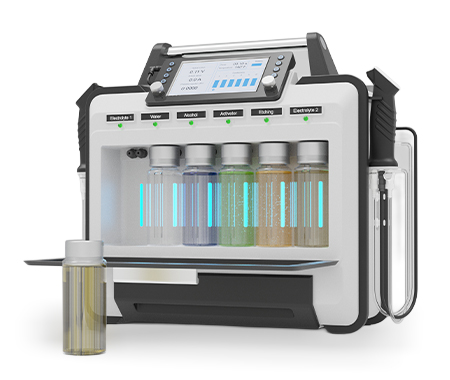
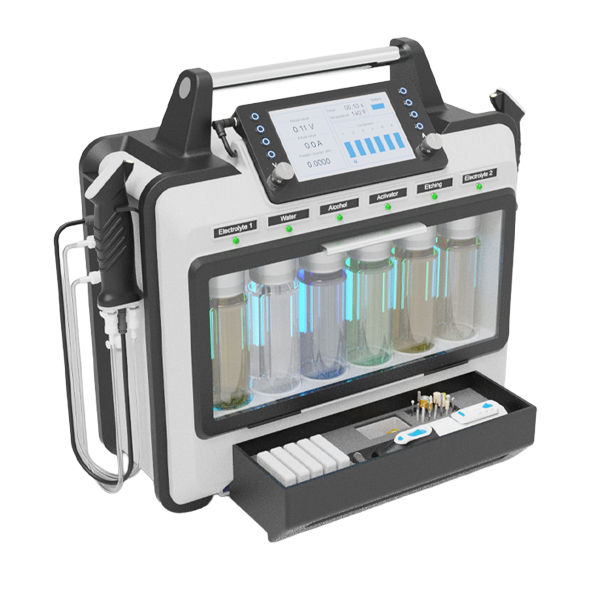
Once the award was in place we became the primary design, engineering and prototyping partner, executing the concept defined during the proposal phase and turning it into a working system capable of supporting testing, demonstration and program milestones. Grapheno-1 was engineered as a self-contained electrochemical treatment platform against a short list of design priorities.
Design priority | Why it was non-negotiable | What it changed in the hardware |
|---|---|---|
Portability | The system goes to the crack; the asset does not come to a lab | Self-contained package, handled by a technician, no external bench equipment |
Repeatable treatment conditions | A repair method that varies operator to operator cannot be qualified | Controlled process parameters rather than manual judgement |
Robustness | Field and depot environments are dirty, hot and unforgiving | Enclosure, connections and consumables specified for maintenance reality |
Clear operator interaction | The user is a maintainer, not the inventor | Simple sequence of steps, hard to perform out of order |
Long-term deployment | One-off demonstrators do not transition | Serviceable design, replaceable wear items, documented procedure |
Every one of those priorities is an engineering constraint before it is a marketing claim, and each one costs weight, cost or complexity somewhere else. Our guide to engineering design constraints covers how those trade-offs get resolved in practice.

Where the money actually goes
These are our typical bands for federally funded hardware work of moderate complexity, not Grapheno-1 invoices. They are useful for sizing a proposal budget before a scope exists.
Line | Typical share of an engineering budget | Notes |
|---|---|---|
System architecture and design | 20-30% | Highest leverage; decisions here set everything downstream |
Detailed engineering and analysis | 25-35% | Mechanical, electrical and firmware detail; grows with integration count |
Fabrication and parts | 20-30% | Machined and printed parts, electronics, consumables, one or two spares |
Test rigs and fixtures | 5-15% | Frequently forgotten, and frequently the reason data is thin |
Integration, test and documentation | 10-20% | Includes the report material the next proposal is built from |
One thing we would change
Put the maintainer in the room earlier. On a D2P2 build the schedule pressure pushes teams toward proving the physics first and shaping the workflow later, but workflow decisions constrain packaging, and packaging is expensive to revisit once electronics are laid out. A single session with someone who actually performs the repair is worth more than a month of assumptions.
Reading a solicitation as an engineering scope
Solicitation language is written by people who know the operational problem, and it usually encodes hardware requirements without stating them as specifications. Translating those phrases into engineering constraints before you write the budget is most of the work of a credible D2P2 proposal.
Solicitation phrase | What it means for the hardware | What it costs you |
|---|---|---|
Field-deployable | Runs on available power, survives transport, no lab bench | Enclosure, thermal design, connector selection, weight budget |
Operable by maintenance personnel | No expert interpretation in the loop | Interface design, error handling, procedure documentation |
Non-destructive | No material removal, no permanent modification | Process control and verification method |
Transition to depot use | Serviceable, repeatable, documented | Wear items, calibration approach, training material |
Compatible with existing assets | Fits geometry and materials already in service | Adapter strategy and a much longer test matrix |
The first ninety days of a Direct to Phase II build
With no Phase I behind it, a D2P2 program has to convert a proposal concept into a buildable design fast, before long-lead parts and test access become the schedule. This is roughly the sequence we run.
Weeks | Activity | Why it is this early |
|---|---|---|
1-2 | Requirements teardown from the solicitation and the proposal | Ambiguity here propagates into every later decision |
2-4 | System architecture, interface definition, make-versus-buy | Sets the long-lead list before it is a crisis |
4-6 | Detailed mechanical and electrical design of the critical path | The critical path is usually one subsystem, not the whole device |
5-8 | Order long-lead components; start fixture design | Procurement, not engineering, is the usual schedule breaker |
6-10 | First fabrication and subsystem bring-up | Finds the integration surprises while there is budget to react |
10-13 | Integrated function test, then the first honest schedule revision | The plan written before hardware existed is now obsolete |
Risks that only show up in the field
- Power. Bench supplies are clean and infinite; a depot outlet or a generator is neither.
- Consumables. Anything that must be mixed, refilled or refrigerated becomes a logistics problem the moment the device leaves the lab.
- Access geometry. The crack, joint or surface you are treating is rarely in an open space with room for two hands and a light.
- Environment. Temperature, humidity and contamination shift process parameters that were stable indoors.
- Operator variation. Two technicians following the same procedure will not produce the same result unless the design removes the judgement.
- Documentation. If the procedure is not written down clearly enough to follow without you, the system does not transition.
The Feasibility Evidence Package a D2P2 Proposal Leans on
Because there is no funded Phase I, a Direct to Phase II proposal has to show that the feasibility question was already answered somewhere else. In practice the evidence comes from four places, and teams usually have more of it than they realise, sitting in lab notebooks and old test reports.
Evidence source | What it proves | What it does not cover |
|---|---|---|
Prior lab or university research | The physics or chemistry works under controlled conditions | Nothing about packaging, power, operators or environment |
Prior federal or private funding | An outside body already vetted the technical premise | Rarely covers manufacturability or field use |
Bench prototypes built on internal funds | A working embodiment exists | Usually built by the inventor, on the inventor's bench |
Third-party or standards testing | Numbers a reviewer can trust without knowing you | Only the specific property tested |
Engineering feasibility study | That the lab result survives a real system architecture | Not a substitute for hardware test data |
On Grapheno-1 the science was established; the unknowns were portability, power and whether a technician could run it. That is where the engineering work went. If you are assembling the same case, see our SBIR engineering support, concept design and prototype build services, and check the Direct to Phase II rules for your agency at Read more on Sbir or DoD SBIR/STTR.
Frequently asked questions
What are the SBIR phases?
Phase I funds feasibility, Phase II funds development of a prototype, and Phase III covers commercialization without SBIR funds. Many teams also run an unfunded Phase 0: the concept and planning work done before submitting. Award sizes and durations differ by agency, and the current figures are published in the SBA program policy directive and in each solicitation.
What is a Direct to Phase II SBIR award?
It is a Phase II award granted without a prior Phase I from the same agency, on the basis that feasibility has already been established through other work. You must document that prior evidence. Availability varies by agency and by solicitation, so check the topic you are answering on sbir.gov .
Can you skip SBIR Phase I?
Only where the agency offers a Direct to Phase II path and your prior work genuinely covers the feasibility question. Skipping Phase I without that evidence is not a shortcut, it is an unfunded feasibility phase that lands inside your Phase II schedule.
How long does an SBIR prototype take to build?
For hardware of moderate complexity we typically plan three to nine months for a Phase I proof of concept and six to eighteen months for a Phase II prototype with verification. Field-deployable systems sit at the longer end because ruggedisation, operator workflow and repeatability all have to be proven, not just the core function.
What prior work counts as feasibility evidence for Direct to Phase II?
Generally, documented technical results that answer the same feasibility question a Phase I would have: laboratory validation, prior federally or privately funded research, published data or internally funded development. The agency defines what it will accept and how it must be documented, so read the specific solicitation. In practice, results someone outside your team can evaluate carry the argument; internal conviction does not.
Is Direct to Phase II riskier than the normal path?
Schedule-wise, yes. You start at full development scope with no funded period in which to discover unknowns, so any gap between the laboratory result and a usable system lands inside the Phase II clock. Teams that succeed usually did the equivalent of Phase I planning at their own expense during proposal preparation.
Which agencies offer Direct to Phase II?
Not all of them, and the terms change between solicitations. DoD components and NIH institutes have run Direct to Phase II topics; NSF does not. Treat the current solicitation as the only authority and confirm eligibility before you build a proposal around it.
Do you need a working prototype before a Direct to Phase II award?
Not a field-ready one. You need documented evidence that the core technical question is settled, which is often a bench embodiment plus measured data. The Phase II work is then the engineering that turns that embodiment into something an end user can operate. Related reading: what earns a Phase I team its Phase II award , the commercialization plan reviewers believe , and our SBIR engineering support across every phase .
Services related to this guide
- Best prototyping companiesDevelopment firms, instant-quote bureaus and local shops — who fits which job.
- Free prototype cost calculatorFive to eight questions, an instant cost range for a first prototype.
- Prototype development companiesWhich firms take a sketch to a working prototype — and which only fabricate parts.
- Rapid prototypingWorking prototypes in days, from 3D printing to vacuum casting.