Bio-Inspired Design Structures: Leveraging Natural Patterns in Engineering
Discover how Bio-Inspired Design Structures leverage nature’s patterns to create sustainable innovations in engineering, from robotics to renewable energy.
September 15, 202513 min read

Written by Konstantin Dolgan, Ph.D., NPDP
Founder & CEO, Product Development Engineer
Published September 15, 2025Updated September 2, 2026
Old methods for design and manufacturing no longer solve today's big problems. These include climate change, pollution, and aging infrastructure. We also face high computing needs and health crises. These range from food shortages to the need for new vaccines and organs.
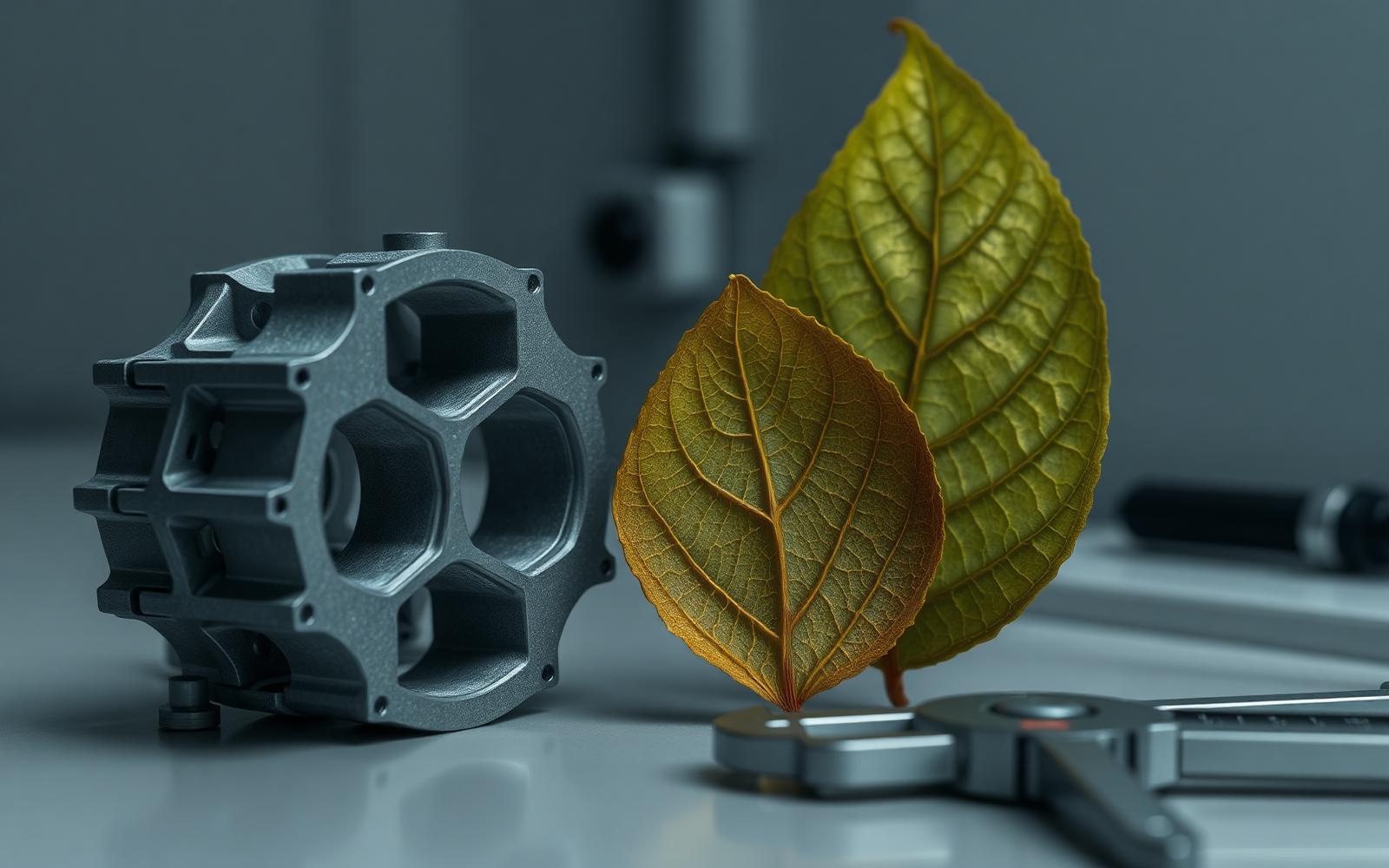
Bio-Inspired Design (BID) models engineering tools on nature. This field offers great potential. BID builds structures that mimic how animals move. It also copies biological shapes like DNA. BID is a dynamic process for new ideas. It is a top choice for fast-track projects. The work combines biology, physics, and medicine.
Bio-inspiration works in two main ways. Some systems are fully synthetic but follow natural laws. Others integrate with and mimic living structures. This range helps BID connect human-made tools with the natural world.
Engineering Through a Bio-Inspired Lens
Engineering affects almost every part of our lives. It includes the design of cars, roads, and phone networks. Engineers work in areas like testing and industrial style. They also work in mechanical, electrical, or civil fields.
Bio-inspired ideas are not new, but their impact is growing fast. BID now shapes buildings, city plans, software, and medical tools. Some inventions are amazing. These include gloves that stick like gecko feet and materials made from thin air.
Terminology in Bio-Inspired Design
Many terms describe how biology and technology meet. Each term has its own subtle meaning.
Biologically Inspired Design (BID) | Broadest term, often synonymous with biomimetics, emphasizing the design process. |
|---|---|
Biomimetics | ISO-defined as interdisciplinary collaboration between biology and technology to solve practical problems via biological modelling. |
Biomimicry | A design philosophy treating nature as a model for sustainable solutions across social, environmental, and economic domains. |
Bionics | A technical field focused on replicating or enhancing biological functions with mechanical or electronic systems. |
Bioreplication | The direct reproduction of biological structures to achieve specific functional outcomes. |
These methods show how Bio-Inspired Design structures help us. They inspire us. They also guide us to create new technologies.
Contact us today to learn how LA NPDT can assist in realizing your project.
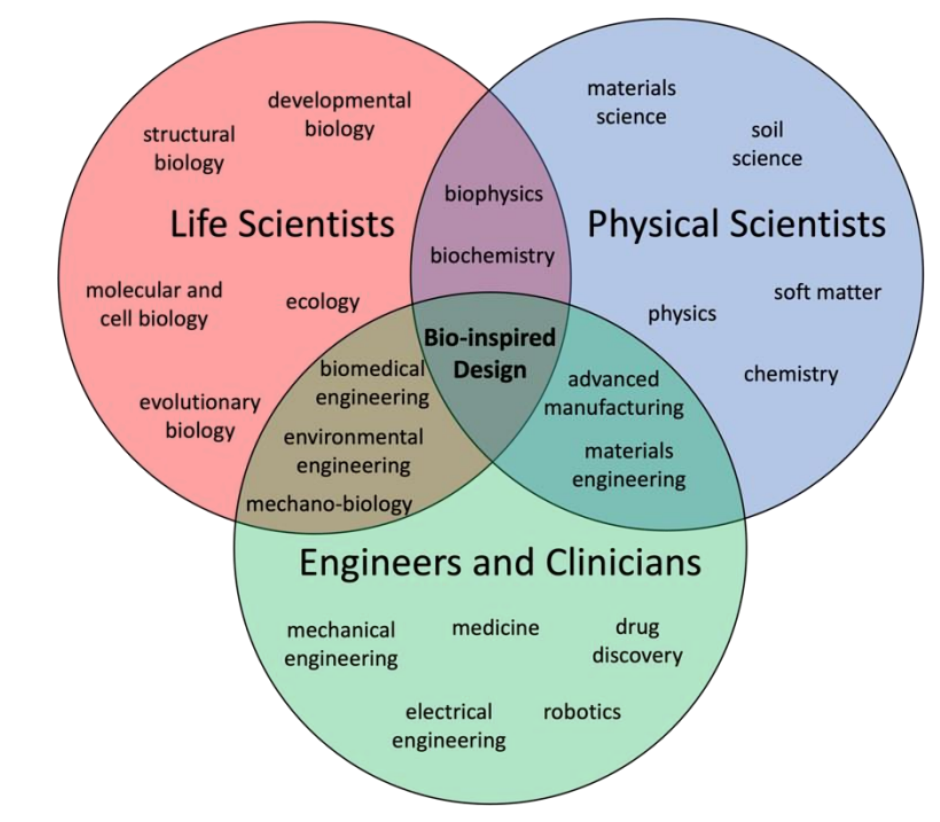
This Venn diagram shows how different research areas meet in bio-inspired design.
Applications of Bio-Inspired Design in Mechanical Engineering
Bio-inspired design has changed mechanical engineering. It uses nature's clever ideas. These become practical innovations. They help many different areas.
- The aerospace industry benefits from biomimicry. The Shinkansen bullet train has a nose like a kingfisher's beak. This design cuts down on noise and drag. Studying bird flight led to better aircraft wings. These wings improve lift and save fuel. This makes planes more efficient.
- Energy generation uses biomimicry. Wind turbine blades copy whale fin bumps. These bumps, called tubercles, boost aerodynamic performance. This makes turbines more sustainable.
- Robotics draws inspiration from nature. Animal movement has inspired robots. Snake-like machines can move through tight spots. They are perfect for search and rescue operations.
- Prosthetics mimic human bodies. Bionic limbs work like natural limbs. The Cheetah Flex-Foot was inspired by cheetahs. It helps amputees perform better in sports.
- Adhesives are now inspired by geckos. These adhesives stick to surfaces without leaving residue. They are useful in aerospace and medical fields.
- Materials can now heal themselves. This idea comes from how living things regenerate. These materials need less maintenance. They are used in construction, cars, and planes.
- Medical Devices are also improving. Owl feathers inspired new designs. This led to quieter surgical tools and ventilators.
- Transportation designs use biomimicry. Vehicle shapes are based on marine animal aerodynamics. This makes automobiles more fuel-efficient. It also makes them more streamlined.
Tasks in Bio-Inspired Design
All four BID types share five core tasks. You must define the problem and simplify its functions. Then you search for biological links and test your ideas. These steps happen in different orders. The text below explains each task and the tools you can use.
- Understand the problem clearly.
In any design workflow, defining the right problem is mission-critical.
- In the problem-driven approach, this is the first step. Engineers break down the challenge. They identify key obstacles. They create a design brief. This brief covers background, context, and desired features. No solutions are suggested yet. This keeps idea generation open.
- In the solution-driven approach, clarification comes later. This is after a biological phenomenon has been studied. Then, the team rephrases the question. It changes from 'what can we solve?' to match the new bio-inspired material or mechanism's properties.
- Deliverables often include a text brief. They may also include sketches. These sketches illustrate the current situation. They also show the planned improvement.
- This is the abstraction of functions.
Effective BID means turning technical issues into simple, biology-friendly terms.
- A direct search for "insufficient traction" might miss how geckos or tree frogs handle slick surfaces. This is an example.
- Abstraction removes domain-specific terms. Examples are "friction" or "load bearing." It reframes the problem in basic functional language. Consider "surface adhesion" or "energy dissipation." This allows a better look at biological strategies.
- Look for analogies or practical uses. Find similar things or ways to apply the idea.
Once abstracted, the challenge becomes locating relevant biological precedents.
- In problem-driven BID, you search literature and databases. This reveals organisms or mechanisms for the abstracted function. It helps solve a specific problem.
- In solution-driven BID, the goal changes. You find technical uses for a known bio-principle. This starts with a biological solution.
- Good search tools and organized biological databases speed up this discovery. They make exploration much faster. This helps researchers quickly find what they need.
- Understanding Biological Phenomena.
Grasping how nature’s solutions work is crucial before engineering them.
- Mechanical engineers can easily understand biomechanics. This means how animals move, such as walking, flying, or swimming.
- Biochemical and cellular processes often need help from biologists. This helps to understand complex cause-and-effect paths.
- Better understanding leads to more creative and dependable engineering solutions.
- We validate abstractions.
Teams build models. These models test if a biological idea can solve the problem. They are either computer simulations or real prototypes.
- These models test how natural functions can be made simpler. They check how they can be scaled or changed. This is done without losing their effectiveness.
- Validation shows if something is possible. It helps make improvements.
- Solutions will be evaluated.
When a bio-inspired prototype is ready, it needs two kinds of evaluation. We judge its performance and how new it is.
- Performance: Does it meet the first requirements? Does it do better than current products?
- Novelty: Designers check how unique the solution is. They look at variety, quality, and quantity. This is based on metrics from Shah. They see how many different options were made. They also check how well the problem area was explored.
- The SAPPhIRE causality model looks at design. It evaluates how much the new design differs from old ways.
- These tools help measure results in problem-focused projects. They also show if solution-driven findings can be used more widely.
A Step-by-Step Bio-Inspired Design Workflow
Beyond the core tasks, BID often unfolds as an iterative, nature-inspired journey:
- Observation and Immersion. Designers spend time in natural settings — forests, wetlands, deserts — observing ecosystems with curiosity and an open mind.Biomimicry Research. Notes and sketches transform into structured inquiries: literature reviews and expert interviews in biology, zoology, and ecology build a robust knowledge base.Analysis of Biological Phenomena. Cross-disciplinary teams dissect the mechanisms behind observed behaviours — how a lotus leaf repels water, or how a mantis shrimp’s hammer strikes with incredible force.Abstraction of Key Principles. From detailed observations, engineers extract the essence — self-cleaning surfaces, energy-efficient locomotion, impact-resistant structures — and define clear design parameters.Design and Development. With abstracted principles in hand, the team ideates new materials, forms, or mechanisms, applying them imaginatively to solve the target engineering problem.Prototyping and Testing. Physical models or computer simulations let designers iterate quickly, validating performance and uncovering unforeseen challenges.Iterative Refinement. Feedback from testing informs successive versions, each more optimized in function, form, and feasibility.Implementation and Scaling. The refined design transitions into real-world use — integrated into existing systems or launched as a standalone product — with scalability plans in place.Continuous Learning. The process loops back: ongoing observations and new scientific insights fuel the next wave of bio-inspired innovation.
Nature-Inspired Design Strategies (Nids)
Nature inspires good design. This helps us create systems that last. Three key ideas guide product development. These are Biomimicry, Cradle to Cradle, and Natural Capitalism.
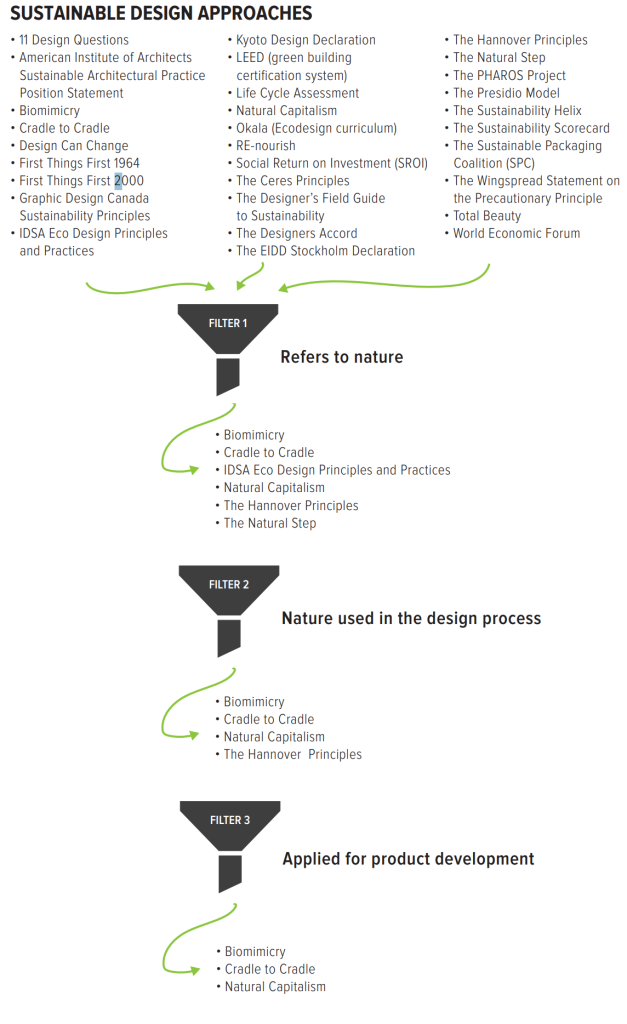
Nature-Inspired Design Strategies
- Biomimicry in Sustainable Product Development. This topic covers biomimicry. It focuses on how it helps develop sustainable products.
Biomimicry comes from the Greek words for life and imitation. It studies nature to solve human problems. Janine Benyus calls it a science that uses natural models. Nature has refined its solutions over 3.8 billion years.
Applications of biomimicry include:
- We research and invent new materials.
- We create new products and design systems.
- This includes architecture, communication, and mechanical engineering.
In sustainability, this method helps save energy and use fewer materials. It also helps build better systems. The main idea is innovation inspired by nature. The goal is to create life-friendly conditions.
- Cradle to Cradle in Sustainable Product Development.
Cradle to Cradle was first mentioned in the 1970s. McDonough and Braungart made it well-known. The old "Cradle to Grave" model often creates trash. In contrast, Cradle to Cradle sees products as raw materials for new things. This happens after the products have been used.
Key design principles drawn from natural systems:
- Waste equals food – cycle materials continuouslyUse current solar income – harness solar energy or passive solar processesCelebrate diversity – tailor designs to local ecosystems.
This plan goes past just being eco-efficient. It focuses on "eco-effectiveness." This means "doing good instead of less bad." It aims for a "beneficial footprint."
- This is about Natural Capitalism in Sustainable Product Development.
Hawken, Lovins, and Lovins started Natural Capitalism in 1999. It views nature's help as natural wealth. The next Industrial Revolution needs to use resources well. This helps companies earn money. It also protects the planet.
The Future of Bio-Inspired Design in Mechanical Engineering
Bio-inspired design is also called biomimicry. It will change mechanical engineering. It brings sustainable ideas from nature. Key future plans include:
- Sustainability and Environmental Conservation Greater emphasis on eco-friendly solutions, such as buildings inspired by termite mounds for passive cooling and materials that cut waste and energy use.Advancements in Materials Science Development of self-healing composites, super-strong spider silk–inspired fibres, and bio-adhesives that redefine manufacturing durability and reduce scrap.Healthcare and Biomedical Engineering Bio-inspired prosthetics and medical devices will mimic bodily systems — circulatory networks for targeted drug delivery and musculoskeletal mechanics for advanced orthotics — and lead to less invasive robotic surgeries.Efficient Energy Technologies Solar panels modelled on leaf photosynthesis and wind turbines shaped by bird aerodynamics will boost renewable energy performance and reliability.Aerospace and Transportation Vehicle and aircraft designs will follow the aerodynamics of marine animals and birds, resulting in quieter, more fuel-efficient travel and propulsion systems based on natural locomotion.Communication and Information Technologies Algorithms and data networks will draw from ant colony organization and neural architectures, enhancing data management, artificial intelligence, and distributed computing.Space Exploration Technologies inspired by extremophiles and efficient biological movement will enable more adaptable, resilient systems for missions beyond Earth.
Engineering and nature combine. They create good, green solutions. These ideas lead innovation. Our tools improve them. Bio-inspired design helps us. It offers practical ways to build a better world.
Conclusion
Designers use four main ways to create bio-inspired structures. These are called problem-driven, solution-driven, biomimicry, and bio replication. Each path uses similar steps, but in a different order. First, you define the problem. Then, you find natural solutions that match. Finally, you test the results.
As a young and fast-growing field, BID is ready for big steps forward. New trends include:
- Biologists, engineers, and computer scientists should work together more. This will help them improve methods and tools.
- Use technology to connect different areas of knowledge. This will lead to smarter searches. It will also help transfer ideas from biology to engineering more easily.
- Many reasons drive us to study nature. It offers new ideas. It provides sustainable solutions. It also guides us to new technologies. These motivations may be more connected than we first thought.
Modern society faces a key choice for a green future. Nature offers a huge library of proven designs and processes. These can help us build better buildings, products, and systems. We must treat nature as a mentor. We can use its time-tested patterns and biological wisdom. Architects and engineers can then build solutions for today’s problems. These tools also strengthen our bond with the ecosystems we need.
Engineers look to nature to improve aerospace, energy, and robotics. For example, consider the Shinkansen train or turbine blades shaped like whale fins. Bio-inspired design is very helpful as we face climate change. It also helps with fewer resources. This approach guides us toward green innovation. The future will bring better materials and energy tools. These new methods will save money. They will also help our planet.
Subscribe
Dive deep into the dynamic world of new product development with LA NPDT Insights Blog.
Frequently asked questions
What is Bio-Inspired Design (Bid) in Engineering?
Bio-Inspired Design (BID) bases engineering on how nature works. It shows great promise by copying natural tasks. This includes robots that move like animals or systems that build themselves like DNA. BID is a fast-moving process. It uses biology, physics, and medicine to solve big problems. It creates fully man-made systems or parts that work with living things.
What are some practical applications of Bio-Inspired Design in mechanical engineering?
Bio-Inspired Design led to the nose of the Shinkansen bullet train. Its shape comes from a kingfisher's beak. Wind turbine blades now use the shape of whale fins. Other tools include snake-like robots for rescue and prosthetic limbs like a cheetah. Engineers also made gecko-like glue and self-healing parts. Quiet tools for surgery use owl feathers as a model. Cars and boats now use shapes from the sea.
What types of problems does Bio-Inspired Design aim to solve?
Bio-Inspired Design tries to solve urgent needs that old methods cannot fix. These include climate change, pollution, and old power grids. It also helps with high computer needs and human health. Examples range from helping old people to finding enough food. Medicine uses it to make vaccines and replace body parts.
How does the Bio-Inspired Design process work?
The Bio-Inspired Design process has five main steps. First, you must clarify the problem. Then, you turn tasks into simple ideas. Next, you look for life forms that do those tasks. You must check these ideas and then test the final solution. The path changes if you start with a problem or a new discovery. Clarifying defines the goal. Turning tasks into simple terms helps you find the right match in nature.
Sources and standards
- Explore USPTO patent basics. This site offers official guidance. It covers provisional and non-provisional filings for new products. It is a good resource for inventors.
- Learn about the NIST Manufacturing Extension Partnership. This is a federal program. It helps small and mid-size manufacturers in the US. They offer support for growth.
- Understand ISO 9001 quality management. This standard sets quality systems. Most contract manufacturers are audited against it. It ensures high-quality production.
Which natural structures translate into hardware
Biomimicry works when natural shapes solve hard problems. These include stiffness at low mass or energy absorption. It fails when you copy looks but ignore how to make the part.
Natural structure | Engineering benefit | Typical mass saving | Manufacturing route |
|---|---|---|---|
Honeycomb core | Bending stiffness per unit mass | 30-50% | Extrusion, bonded panel, additive |
Trabecular / bone lattice | Load-path-aligned stiffness | 20-60% | Metal or polymer additive only |
Bamboo gradient wall | Buckling resistance in tubes | 15-30% | Filament winding, variable-wall extrusion |
Shark denticle surface | Drag and fouling reduction | Drag −5-10% | Textured tooling, film application |
Nacre layered composite | Crack arrest and toughness | Toughness ×2-8 | Layered composite lay-up |
Woodpecker cranial damping | Shock isolation for electronics | Peak g −30-60% | Multi-durometer overmoulding |
Burr / hook attachment | Reusable fastening without hardware | Part count −20-40% | Injection moulding |
Caption: savings are directional and depend on load case, material and volume.
The cost side nobody puts in the pitch deck
Approach | Unit cost effect at 10k units | Tooling / setup | When it pays |
|---|---|---|---|
Lattice via metal additive | 3-10× machined equivalent | Low | Low volume, high value, mass-critical |
Moulded honeycomb rib pattern | Neutral to −8% | Higher tool cost | Almost always worth evaluating |
Textured surface from tool | +2-5% | $3k-$15k texturing | Fluid or fouling-driven applications |
Multi-durometer overmould | +15-30% | Two-shot tool | Shock or sealing requirements |
Layered composite | 2-5× monolithic | Layup fixtures | Impact-critical, low to mid volume |
How to apply it without wasting a development cycle
- Begin with the constraint. Think about mass, stiffness, impact, or drag. Do not start with an organism you find interesting.
- Describe the load case first. Then, define your target. Only then should you search for a biological example.
- Consider the manufacturing process alongside the geometry. Do this in the same discussion. Otherwise, the design may not survive Design For Manufacturability (DFM).
- Use topology optimization to compare nature's solution to the algorithm's for your load path. Often, the algorithm's solution is better.
- Build a prototype of the structure by itself. Test it until it breaks. Do this before it becomes part of a larger assembly.
- Compare your design against a simple baseline. A ribbed pattern and a thicker wall often save money. They frequently win on cost.
Where bio-inspired design usually disappoints
- Geometry that only additive manufacturing can produce, on a product that must reach consumer price points.
- Surface textures specified without a fluid or fouling problem to solve.
- Lattices in parts where the dominant load is a single, well-understood axis.
- Structures that cannot be inspected or repaired in the field.
- Copying a form because it photographs well in a design review.
Pre-commitment checklist
- We have measured the constraint. The standard cost for this is known.
- The manufacturing process has been chosen. We have a quote for the target number of units.
- A physical sample of the item has been tested. It was tested until it broke.
- We have set the rules for inspecting the item. We also defined its quality standards.
- We confirmed the materials are available. We also found other suppliers for them.
- The benefit still works with the unit cost. It's not just better in the design comparison.
Pick your structure and materials early in a program. This is part of product engineering. Use rapid prototyping for test coupons before you pay for tooling.
Frequently asked questions
What is bio-inspired design?
Bio-inspired design borrows ideas from nature. It uses honeycombs, bone lattices, or shells. These solve problems like stiffness-to-mass or impact toughness in engineered parts.
Does bio-inspired design actually reduce cost?
Sometimes. Moulded rib and honeycomb patterns cost the same or less. Metal additive lattices cost three to ten times more than machined parts. They only suit low-volume, light-weight needs.
Which natural structures are used most in engineering?
We use structures like honeycomb cores. We also use trabecular bone lattices. We make gradient-wall tubes like bamboo. Other examples are nacre-like layered composites. We also create multi-durometer damping structures. These are inspired by cranial shock isolation.
Do I need 3D printing for bio-inspired structures?
Only for true internal lattices. Many ideas like rib patterns or layered toughening work for injection moulding. These methods keep production costs at a normal level.
Filed under:EducationUncategorized
Tagged:2025
Services related to this guide
- Product design servicesIndustrial design and CAD taken all the way to manufacturable files.
- Best industrial design firmsWhich studios take an idea from form to manufacturable hardware, and what they charge.
- Prototype designLooks-like, works-like or pre-production: what each proves and what it costs.
- Product development examplesReal projects we designed, prototyped and shipped.