Detailed Design Engineering: What It Delivers After Concept Design
What detailed design engineering delivers after concept design, and how to tell when a concept is actually ready to be engineered.
May 28, 20256 min read

Written by Konstantin Dolgan, Ph.D., NPDP
Founder & CEO, Product Development Engineer
Published May 28, 2025Updated September 2, 2026
Concept design is the early stage of product development where multiple possible solutions are explored, sketched and modeled roughly to decide what the product should be. Detailed design is the later stage where one chosen concept is engineered into complete, manufacturable documentation. Concept design answers what and why. Detailed design answers how.
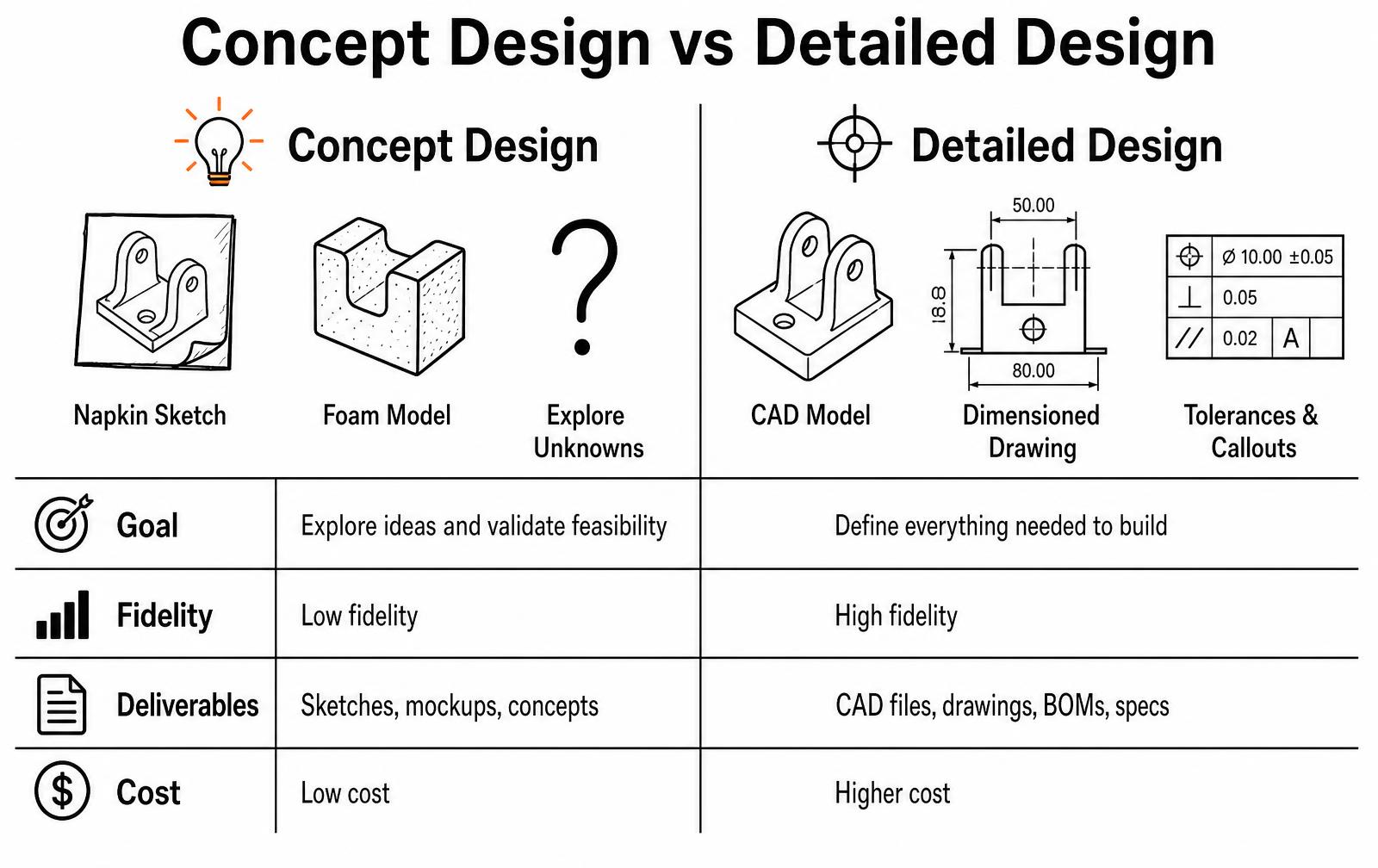
Confusing the two is one of the most expensive mistakes in hardware. Teams that jump into CAD before a concept is chosen end up engineering a direction nobody validated; teams that stay in concept mode too long burn budget on sketches that never get costed.
What is concept design?
Concept design turns a problem statement and a set of requirements into several distinct candidate solutions. The output is deliberately rough — the point is to compare directions, not to perfect one. Typical activities include user and market research, function analysis, sketching, mood and CMF exploration, rough form models and quick feasibility checks.
- Divergence first. Three to six genuinely different directions, not three versions of the same idea.
- Low fidelity on purpose. Foam, cardboard, printed shells and simple block CAD keep the team willing to throw work away.
- Feasibility spikes. Fast tests of the one or two things that would kill each direction.
- Selection with criteria. Score against cost, manufacturability, user preference and strategic fit — not taste.
What is detailed design?
Detailed design takes the single selected concept and engineers it to a state where a factory can build it. Nothing is left to interpretation: every dimension, tolerance, material, finish, fastener and component is specified and documented.
- Production-intent CAD with full assembly structure
- Dimensioned drawings with GD&T and critical-to-quality callouts
- Bill of materials with approved suppliers and part numbers
- Electrical schematics, PCB layout and firmware architecture where applicable
- Design for manufacturing and assembly review, draft angles, wall thickness, tooling strategy
- Test plan and compliance documentation
Concept design vs detailed design compared
Dimension | Concept design | Detailed design |
|---|---|---|
Goal | Decide what to build | Define how to build it |
Number of options | Several in parallel | One, refined |
Fidelity | Sketches, rough models, block CAD | Production-intent CAD and drawings |
Key question | Is this worth building? | Will this build correctly every time? |
Cost of change | Hours | Weeks, plus tooling |
Typical duration | 3 to 8 weeks | 8 to 24 weeks |
Typical cost | $8,000 to $35,000 | $30,000 to $150,000+ |
Main risk | Choosing the wrong direction | Executing the right direction badly |
Why concept design is where the money is decided
Industry studies of engineering programs consistently find that the early design phase commits the large majority of a product's total lifecycle cost while consuming only a small fraction of the budget. The architecture chosen during concept design — part count, material family, assembly approach, whether a feature needs a side action in the mold — sets the cost floor. Detailed design can protect that floor or erode it, but it can rarely move it.
This is why cutting concept design to save four weeks is usually a false economy. It moves the decision from a stage where changes cost hours to a stage where they cost tooling.
Not sure whether you need concept work or engineering?
Send us what you have — sketch, spec or existing CAD — and we will tell you honestly which stage you are actually in.
The handoff: when is a concept ready for detailed design?
- One direction is selected and the stakeholders who can reverse the decision have signed off.
- Requirements are written down and testable, not implied by a rendering.
- Key risks are retired — the mechanism works, the electronics fit, the battery lasts long enough.
- Rough cost is credible. A target BOM and tooling estimate exist and clear the business case.
- Manufacturing process is chosen at least at the family level, because it constrains every geometry decision that follows.
If any of those five is missing, detailed design will discover it — and the discovery will cost far more than finishing concept work would have.
Common mistakes
Mistake | Consequence | Fix |
|---|---|---|
Starting CAD on the first idea | Engineering a direction nobody compared | Force at least three distinct concepts before selecting |
Beautiful renders, no feasibility | Concept collapses in engineering | Run feasibility spikes on the riskiest assumption in each direction |
No selection criteria | Loudest opinion wins | Score concepts against written criteria before the review |
Endless concept iteration | Budget spent before engineering starts | Time-box concept design and set a decision date |
Detailed design without DFM | Redesign after the first quote | Involve manufacturing during detailed design, not after |
For a broader view of where these two stages sit, see our walkthrough of the new product development process and our product design services.
What detailed design engineering actually produces
Concept design ends with a direction. Detailed design ends with a package a factory can quote and build without asking you what you meant. The difference is visible in the deliverables list, and it is worth checking against any proposal you receive — a firm that offers 'CAD' without naming these outputs is quoting concept work at detailed-design prices.
Deliverable | Purpose | Who consumes it |
|---|---|---|
Fully parametric CAD assembly | Single source of geometry | Tooling and prototype vendors |
2D drawings with GD&T | Defines what is inspectable and what is not | Machinists, molders, quality |
Tolerance stack-up analysis | Proves the assembly fits at worst case | Engineering, quality |
Bill of materials with sources | Cost and supply reality | Purchasing, finance |
FEA / thermal analysis reports | Predicts strength and heat behavior | Engineering, certification |
DFM review notes | Removes features that cannot be made economically | Manufacturing partner |
Test plan and results | Proves requirements are met | Program management, regulators |
Tolerance analysis: the difference between fits and does not fit
A tolerance stack-up adds the worst-case variation of every part in a dimensional chain to confirm the assembly still functions. It is unglamorous and it prevents the most expensive class of hardware failure: parts that are individually within spec and collectively unassemblable. On a snap-fit enclosure, a stack of five nominal-fine dimensions can easily produce a 0.6 mm gap variation — visible, and enough to make a seal leak.
- Identify the functional chains first: what has to fit, seal, align or clear.
- Use worst case for safety-critical fits and statistical stacking for cosmetic ones.
- Account for process capability, not just the drawing tolerance — a molder holding ±0.05 mm on paper may run ±0.12 mm in production.
- Add tooling shrink and warp for molded parts; nominal CAD does not shrink.
- Revisit the stack after any material change; different resins shrink differently.
Budget and schedule reality
Detailed design engineering typically consumes half to two-thirds of a program's engineering hours and runs eight to sixteen weeks for a moderately complex product. It is also the phase where scope creep is most damaging, because every added feature multiplies through drawings, analysis, tooling and test.
Freeze requirements before it starts, and treat any post-freeze change as a change order with its own schedule impact — that is not bureaucracy, it is the only way the tooling date survives.
Frequently asked questions
What is concept design?
Concept design is the early product development stage where several possible solutions to a defined problem are explored through research, sketching, rough models and quick feasibility checks. Its purpose is to choose the right direction before engineering effort is committed.
What is the difference between concept design and detailed design?
Concept design explores multiple rough directions to decide what to build; detailed design engineers the one chosen direction into complete manufacturable documentation. Concept work is low fidelity and cheap to change; detailed design is high fidelity and expensive to change.
How long does concept design take?
Concept design typically takes three to eight weeks for a consumer or industrial product, depending on how much user research is required and how many distinct directions are explored before selection.
How much does concept design cost?
Concept design commonly runs $8,000 to $35,000 depending on research depth, the number of directions explored, and whether physical form models are built. Detailed design usually runs $30,000 to $150,000 or more.
What deliverables come out of concept design?
Typical deliverables include user and market research findings, a requirements list, sketches of several directions, CMF exploration, rough form or works-like models, feasibility findings, a preliminary cost estimate, and a documented concept selection.
When is a concept ready for detailed design?
When one direction is selected and approved, requirements are written and testable, the biggest technical risks have been retired with prototypes, a credible cost estimate clears the business case, and the manufacturing process family has been chosen.
Can you skip concept design?
Only when the product is a direct derivative of an existing one with a proven architecture. For anything new, skipping concept design moves decisions into a stage where changing them costs tooling and schedule rather than hours of sketching.
What detailed design engineering costs and how long it takes
Budget and schedule are the two questions that decide whether a program moves forward. The ranges below reflect what a US-based team typically quotes for a single enclosure-plus-electronics product. Complexity multipliers — regulated markets, sealing requirements, multiple mechanisms, high part count — push each line toward the top of its band.
Concept design | $8k – $25k | 3 – 6 weeks | 3–5 directions, sketch models, chosen direction |
|---|---|---|---|
Detailed mechanical design | $25k – $75k | 8 – 16 weeks | Parametric CAD, GD&T drawings, DFM review |
Electronics and firmware | $30k – $120k | 10 – 20 weeks | Schematic, layout, bring-up, test firmware |
Design verification builds | $15k – $60k | 4 – 10 weeks | EVT/DVT units, test reports, redlines |
Tooling release package | $6k – $18k | 2 – 4 weeks | Released drawings, BOM, tool kickoff support |
Deliverable checklist that separates the two stages
- Concept design closes with: selected direction, requirements document, CMF intent, rough cost model, risk list.
- Detailed design closes with: fully constrained CAD, GD&T drawings, tolerance stack-up, released BOM, DFM sign-off, and test evidence.
- If a tolerance stack-up does not exist, the program is still in concept regardless of how finished the CAD looks.
- If a supplier cannot quote from the package without asking questions, the release package is incomplete.
Tolerance stack-up: the gate most teams skip
A stack-up converts nominal geometry into worst-case and statistical assembly outcomes. On a two-shell enclosure with a display window, a light pipe and a press-fit button, the stack typically involves eight to twelve contributors.
Worst-case arithmetic on ±0.1 mm mold tolerances alone can consume a 0.6 mm gap before the display bezel is even considered. Running the stack before the tool kickoff is what prevents the classic $18k steel-safe correction after the first shots.
Common failure modes when the stages are blurred
CAD reworked three times before tooling | Concept never approved by a decision maker | 4–8 weeks, $15k+ |
|---|---|---|
First article parts warp or short-shot | DFM run after design freeze instead of during | $8k–$25k in tool changes |
Assembly line rejects at 6% | No tolerance stack-up on mating features | Sorting labor plus scrap |
Certification retest | Compliance requirements captured after layout | 6–10 weeks, retest fees |
The practical rule: every hour spent closing the concept stage properly removes several hours from the detailed design engineering phase, and every dollar spent on DFM before tool kickoff removes roughly ten from tooling corrections.
Not sure which stage you are in?
Tell us what you have and we will scope the concept or detailed design engineering work that gets you to production.
Work with LA NPDT: if you are moving from here to execution, start with our product design services or talk to us about industrial design and development.
Filed under:Uncategorized
Services related to this guide
- Best product development companiesHow the leading US firms compare, and which one fits your stage and budget.
- Best product design companiesDesign studios compared by scope, industry and what they hand off.
- Product engineering companiesEngineering firms for physical products compared by discipline, rigor and budget.
- Consultant vs firm vs freelancerWhat each option costs, what it delivers and where to find them.