EU Replaceable Battery Rule 2027: What Battery-Powered Product Founders Should Change in the Prototype Now
What's changing now
For founders and product teams building battery-powered consumer, pet, outdoor and smart home products for the EU. What Article 11 requires from February 2027, which products the new October 2026 exemptions cover, and how to design battery access, sealing and firmware into the prototype.
November 2, 20268 min read

Written by Konstantin Dolgan, Ph.D., NPDP
Founder & CEO, Product Development Engineer
Published November 2, 2026
Short answer
The EU replaceable battery rule applies from 18 February 2027: products sold in the EU that contain a portable battery must let the end user remove and replace that battery at any time in the product's life, using commercially available tools.
Proprietary tools, heat and solvents are not allowed, and a special tool is only acceptable if it ships free with the product (Regulation (EU) 2023/1542, Article 11; Commission guidelines C/2026/5032).
On 22 October 2026 the EU published Delegated Regulation (EU) 2026/1770, which enters into force on 11 November 2026 and adds six product groups, including some wearables and rechargeable electric toys, where replacement by an independent professional is enough.
For a hardware team, the practical answer is to decide the battery access strategy at concept stage, before the enclosure, sealing and firmware are frozen, because a glued-in pack is the most expensive thing to undo after tooling.
Who this is for
Founders and product teams building battery-powered consumer, pet, outdoor, smart home and light industrial products for the EU market, or for a licensing partner who sells there. If your product is still at sketch, alpha or works-like prototype stage, this is the cheapest moment to decide how the battery comes out. The EU digital battery passport covers larger batteries; this article is about the small portable packs inside everyday products.
What changed for the EU replaceable battery rule in 2026
22 October 2026: six new exemption groups published
The Commission adopted the first delegated act under Article 11(4) on 14 July 2026, after a call for applications that ran from February to April 2025, expert group meetings, public feedback from 28 April to 26 May 2026 and a WTO notification (European Commission).
It was published as Delegated Regulation (EU) 2026/1770 on 22 October 2026 and enters into force on the twentieth day after publication, which is 11 November 2026.
It replaces the list in Article 11(2) with eight groups whose batteries may be replaceable only by independent professionals: the two original groups (wet appliances and professional medical imaging, radiotherapy and in vitro diagnostic devices) plus six new ones.
For every group except medical imaging and in vitro diagnostics, the derogation only applies where it is required to ensure the safety of the user and the appliance.
Spring 2026: updated Commission guidelines
The Commission updated its guidelines on removability and replaceability, published with the delegated act on 14 July 2026. They explain tool types using EN 45554, how to read the wet appliance derogation, which products can use the full derogation for continuity of power, and what "compatible battery" means. The guidelines are not legally binding, but they are the clearest public statement of how the Commission reads Article 11.
June 2026: a possible postponement, not yet adopted
On 24 June 2026 the Council agreed its negotiating position on the Omnibus VIII simplification package.
It would simplify Article 11 for light means of transport battery packs (replacement by an independent professional at module level instead of cell level) and adds "a targeted postponement of the removability and replaceability requirements of the batteries regulation for certain product categories by 18 months" (Council of the EU; CDX).
Negotiations with the European Parliament still have to happen, and the EU's stated aim is to finish all simplification packages by the end of 2027. Until a final text is published, the 18 February 2027 date stands for portable batteries.
Which battery rule applies to your product?
If your product... | Example | Who must be able to replace the battery | Notes |
|---|---|---|---|
Is an ordinary battery-powered product | Pet feeder, handheld tool, outdoor sensor, remote, smart home device | End user, with commercially available tools | Default rule from 18 February 2027 |
Is a wearable where user access would compromise safety, durability or water resistance, and it is too small for a safe user swap or relies on a compact sealed enclosure | Fitness tracker, smartwatch, smart glasses | Independent professional | New derogation (c) in Delegated Regulation 2026/1770 |
Is specifically designed to work mainly in splashing water, water streams or immersion and is washable or rinseable | Electric toothbrush, water flosser, shaver, floor washer | Independent professional | Guidelines map these to IPX4, IPX5/IPX6 and IPX7, but an IP rating alone does not prove the derogation |
Is a rechargeable electric toy where the derogation is needed for safety | Ride-on or plush toy with a rechargeable pack | Independent professional, until 31 July 2030 | Toy Safety Regulation (EU) 2025/2509 takes over from 1 August 2030 |
Needs continuous power for user safety, or collects and supplies data as its main function where data integrity is at stake | Long-life smoke alarm, cold chain data logger, implantable or certain diagnostic devices | Not required to be user-replaceable | Full derogation under Article 11(3); the guidelines give examples |
Mainly delivers energy to other products | Power bank, earbud charging case, jump starter | Article 11 does not apply in the first place | The product itself is treated as a portable battery |
Is a smartphone, feature phone, cordless phone or slate tablet | Phone, tablet | Set by Ecodesign Regulation (EU) 2023/1670 | Those rules prevail and have applied since 20 June 2025 |
Sources: Delegated Regulation (EU) 2026/1770; Commission guidelines C/2026/5032. Classification depends on the facts of each product; check with a qualified advisor before you rely on it.
What to design into the prototype now
These are engineering steps that keep your options open. They do not replace a legal assessment.
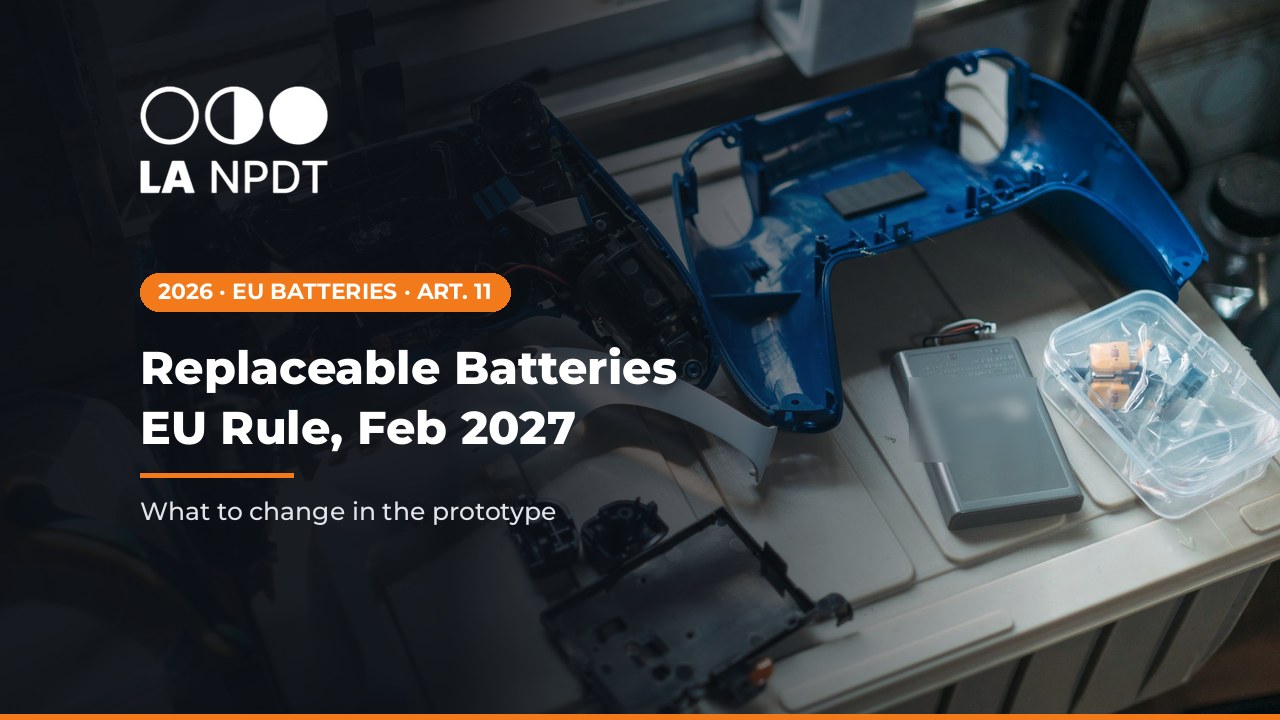
- Pick the battery access strategy at concept stage. Choose between a tool-free door, a screwed cover that opens with a standard screwdriver, or a professional-only design that you can justify under a specific derogation. Write the choice and the reason into the product brief, because it changes the enclosure, the sealing and the industrial design.
- Design out glue, heat and solvents. Article 11 rules out thermal energy and solvents for end-user removal. Replace adhesive-bonded packs with a bracket, a foam pad and a retaining clip or screw, and check the pack cannot rattle or short when the door is open. Our guide to enclosure design for electronics covers bosses, clips and gasket grooves.
- Use standard fasteners and plan for re-use. Commercially available tools include basic tools and tools the public can buy (EN 45554 categories, per the Commission guidelines). Use a common screw drive, and if a fastener is not reusable, plan to sell it as a spare part alongside the battery.
- Keep the seal after a battery swap. If the product is rated for rain or splashes, design a gasket and door that a non-expert adult can close correctly, then test the rating again after repeated swaps on the prototype. Do not assume the wet appliance derogation applies just because the product has an IP rating.
- Add a proper connector. A keyed, latching connector or spring contacts replace soldered tabs, which a user cannot handle. Add reverse-polarity and short-circuit protection on the board so a wrongly fitted compatible battery does not damage the product.
- Write firmware that accepts compatible batteries. Article 11(8) says software must not impede replacement with a compatible battery. Battery communication for safety and fuel gauging is fine, and a notice that a non-original battery is fitted is acceptable if it does not reduce any function or the user experience (Commission guidelines). Avoid serial-number pairing that locks out a replacement pack.
- Test the swap like a user. The guidelines define the end user as an adult without specific experience or qualifications. Hand alpha units and the draft instructions to people who have never seen the product, time the swap, and log what goes wrong. See hardware beta testing for how to run that round.
- Draft the instructions and the spare part plan. Products must come with instructions and safety information on battery use, removal and replacement, also kept permanently online (Article 11(1)). Budget for battery spares for at least five years after the last unit of the model is placed on the market; the guidelines point to the five working day delivery used in ecodesign rules as a reference.
Wearables, AI devices and the new derogation
Wearables are the group most affected by the October 2026 act.
A fitness tracker, smartwatch or pair of smart glasses can use the professional-only route only if user access would compromise safety, durability or water resistance, and the device is too small for a safe user swap or relies on a compact sealed enclosure, for example for dust and shock protection (Delegated Regulation (EU) 2026/1770).
That is a design argument you will need to document, not a blanket exemption. Keep the evidence from your prototype work: sealing tests, drop tests and why the form factor cannot take a door.
If you are building an AI health wearable, read this together with our article on the FDA general wellness guidance for AI wearables.
Products that run AI on the device often need a larger battery to cover the power budget, which makes battery access a bigger part of the industrial design. See edge AI hardware prototyping in 2026.
Founder checklist
- List every battery in the product, including coin cells for clocks or memory, and note which ones the end user must be able to replace.
- Check whether the product falls into one of the eight groups in Article 11(2), the full derogation in Article 11(3), or is itself a portable battery such as a power bank.
- If you plan to use a derogation, write down why user replacement would compromise safety and keep the test evidence from your prototypes.
- Freeze the battery door, fasteners, connector and seal design before enclosure tooling. Our DFMEA for prototypes shows how to add a "user replaces battery" failure mode list.
- Confirm firmware does not pair or lock batteries and that a compatible pack works.
- Put 18 February 2027 on the roadmap, and watch for the final Omnibus VIII text.
- Get qualified regulatory advice before launch.
Frequently asked questions
When does the EU replaceable battery rule apply?
Article 11 of Regulation (EU) 2023/1542 applies from 18 February 2027 to products placed on the EU market that incorporate portable batteries (Commission guidelines). A June 2026 Council position proposes an 18-month postponement for certain product categories, but it is not adopted.
Can I glue the battery in if I supply a repair guide?
Not for the default rule. A battery is only readily removable by the end user if it comes out without proprietary tools, thermal energy or solvents, and any specialised tool needed must be supplied free with the product (Article 11; Commission guidelines). Adhesives that need heat or solvent to release do not meet that test.
Are wearables exempt now?
Some are, under conditions. Delegated Regulation (EU) 2026/1770 lets wearables use replacement by independent professionals when user access would compromise safety, durability or water resistance, and the device is too small for a safe user swap or relies on a compact sealed enclosure. The battery must still be replaceable by a professional with commercially available tools.
Does a waterproof product automatically qualify for the wet appliance derogation?
No. The guidelines map splashing water to IPX4, water streams to IPX5 and IPX6, and immersion to IPX7, but say an IP rating alone is not enough. The appliance must be designed to work mainly in that environment, be washable or rinseable, and the documentation must show that user replacement would compromise safety and that a redesign is not possible.
Can my firmware check that a battery is original?
Software can communicate with the battery for safety and correct function, and can tell the user a non-original battery is fitted, as long as that does not reduce any function or the user experience. Software must not impede replacement with a compatible battery, and the guidelines name parts-pairing as an example of what to avoid.
How long do I need to stock replacement batteries?
At least five years after the last unit of the equipment model is placed on the market, at a reasonable and non-discriminatory price for independent professionals and end users (Article 11(7), as explained in the Commission guidelines).
Designing a battery-powered product for the EU?
Talk with an engineer about battery access, sealing and firmware before your enclosure is tooled. Stage 1: Review/Analysis + Plan is a fixed $800. Book a free 20-min call with LA New Product Development Team or call +1 318-200-0526.
Sources
- Regulation (EU) 2023/1542 (Batteries Regulation), EUR-Lex: Read more on Europa
- Commission Delegated Regulation (EU) 2026/1770 of 14 July 2026 (OJ L, 22 October 2026), EUR-Lex: Read more on Europa
- European Commission, "Commission adds exemptions to rules on removability of portable batteries" (14 July 2026): Europa: commission adds exemptions portable battery removal rules 07 14 en
- European Commission, Guidelines on the removability and replaceability of portable and LMT batteries, C/2026/5032 (published 14 July 2026): Europa: guidelines facilitate harmonised application provisions removability and replaceability portable and en
- European Commission, Delegated Regulation for the removability and replaceability of portable batteries (adopted text, 14 July 2026): Europa: delegated regulation removability and replaceability portable batteries en
- Council of the EU, "Simplification: Council agrees negotiating stance to simplify and streamline environmental rules" (24 June 2026): Europa: simplification council agrees negotiating stance to simplify and streamline environmental rules
- CDX, "EU Batteries Regulation: Key Simplifications Agreed Under Omnibus VIII" (30 June 2026): Cdxsystem: eu batteries regulation key simplifications agreed under omnibus viii
Services related to this guide
- Electronic design servicesSchematic, PCB layout, firmware and bring-up, through to production handoff.
- Rapid prototypingWorking prototypes in days, from 3D printing to vacuum casting.
- Product design servicesIndustrial design and CAD taken all the way to manufacturable files.
- Product development examplesReal projects we designed, prototyped and shipped.