Innovation Consulting Services: What They Deliver and What They Cost
What innovation consulting services deliver for physical-product teams, how engagements are scoped and priced, and when to hire instead of building in-house.
September 16, 20258 min read

Written by Konstantin Dolgan, Ph.D., NPDP
Founder & CEO, Product Development Engineer
Published September 16, 2025Updated September 2, 2026
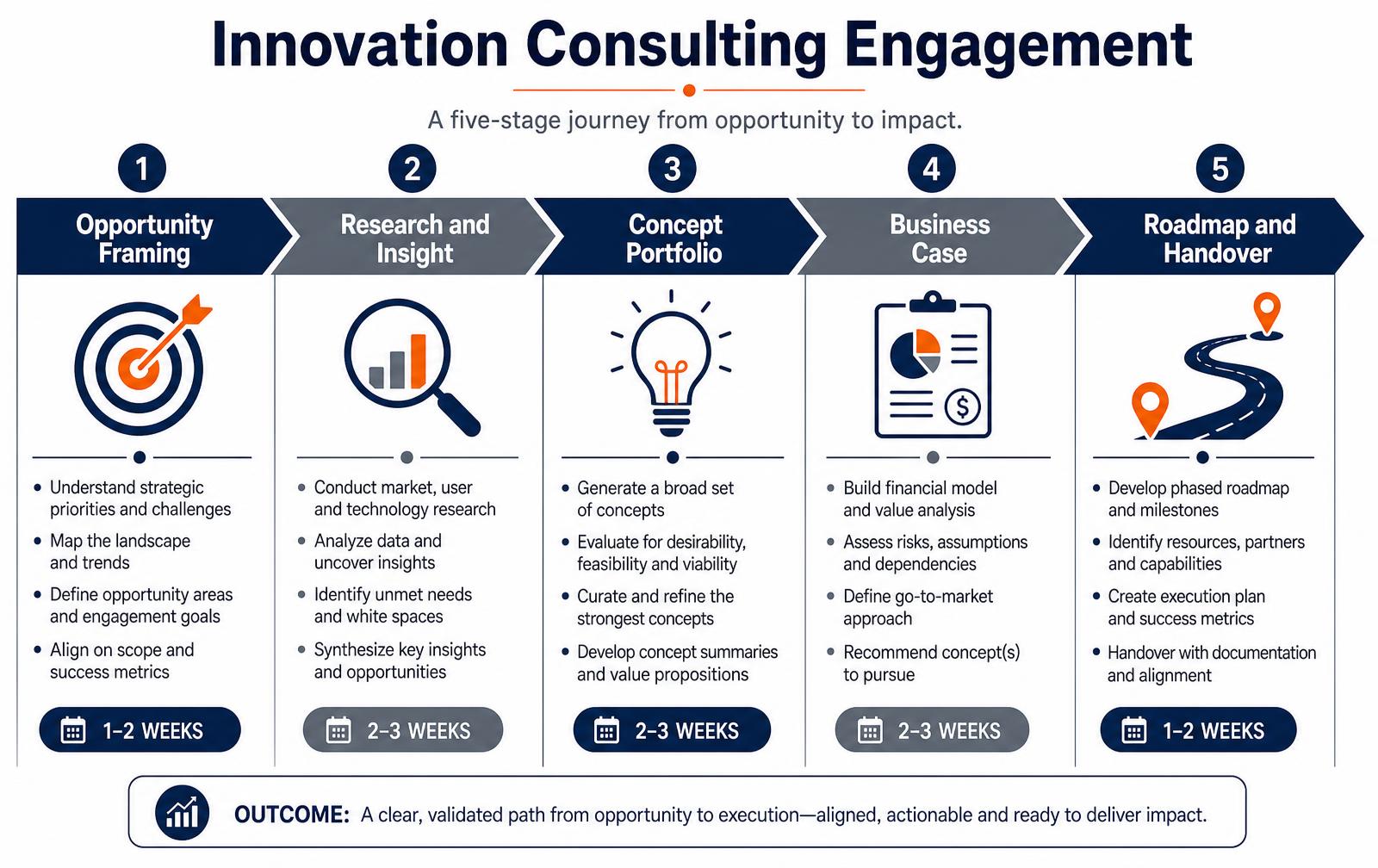
Innovation consulting earns its fee when it ends in a decision, not a workshop. The useful version produces a shortlist of concepts with evidence behind them, a business case someone will sign, and a roadmap the engineering team can start on Monday. The unhelpful version produces a deck. This guide sets out the five stages of a real engagement, the deliverable each one owes you, and what the whole thing costs.
The five stages and what each owes you
Stage | Duration | Deliverable | Typical fee |
|---|---|---|---|
Opportunity framing | 1-2 weeks | Scope, success metrics, decision criteria | $6k-$15k |
Research and insight | 2-3 weeks | User, market and technology findings with unmet needs | $12k-$35k |
Concept portfolio | 2-3 weeks | Scored concepts with feasibility and differentiation notes | $15k-$40k |
Business case | 2-3 weeks | Cost model, pricing, volume scenarios, risk register | $12k-$30k |
Roadmap and handover | 1-2 weeks | Phased plan, resourcing, gate criteria, documentation | $8k-$20k |
When innovation consulting is worth it
- The category is unfamiliar. Entering a new market where your internal assumptions have never been tested against buyers.
- The portfolio has stalled. Every proposal is an incremental line extension and nobody can articulate the next platform.
- Internal disagreement is blocking a decision. Independent evidence resolves arguments that seniority alone will not.
- Capacity, not capability, is missing. The team knows what to do but is fully consumed by shipping the current product.
- A board or investor needs a defensible case. Structured evidence beats conviction when capital is being allocated.
How to hire without buying a deck
Ask three questions before signing. First: what is the physical or commercial artefact at the end of each stage, and who owns the IP? Second: which named people do the work, and are they the ones in the pitch?
Third: can the same firm carry a concept into engineering, or does the work stop at the recommendation? Firms that also build products tend to produce concepts that survive contact with tooling, because they carry the consequences.
Structure the engagement in stage gates so you can stop after research if the opportunity does not hold up.
See our product development consulting service and the development process that follows a validated concept.
What innovation consulting actually costs
Engagement | Scope | Typical fee | Output you should demand |
|---|---|---|---|
Opportunity scan | Market and technology landscape | $10k-$30k | Ranked opportunity list with sizing |
Concept sprint | Ideation to three vetted concepts | $20k-$60k | Sketch models and a feasibility memo |
Feasibility and costing | Technical risk and BOM modeling | $25k-$75k | Target cost model with assumptions |
Full development handoff | Concept through production-ready design | $150k-$500k+ | Tooling-ready CAD and validated pilot build |
Signals you are buying slideware
- No engineer in the room during scoping conversations.
- Deliverables described as frameworks and workshops with no physical or costed output.
- No named kill criteria at any gate, so the project can never fail early.
- Refusal to give a target BOM cost even as a range with stated assumptions.
- IP terms left to a later agreement. Settle ownership before kickoff.
Structuring the engagement so it produces decisions
The failure mode of innovation consulting is a beautiful report that changes nothing. It happens when the engagement is scoped around activities rather than decisions. Workshops, interviews and trend scans are inputs; they are not deliverables.
Before signing, write down the specific decisions the work must enable: which concept to fund, whether the target cost is achievable, which technology to license versus build, whether to enter a category at all. Then require that each phase end with the evidence needed to make one of those decisions.
This changes the shape of the work. Instead of a broad landscape study, you get a focused test of the two or three assumptions that would kill the idea. Instead of thirty concepts, you get three with rough cost models attached. Instead of a recommendation, you get a memo that states what is now known, what remains uncertain, and what the next decision costs to inform.
It also changes who does the work. Decision-grade output requires people who can build and cost things, not only researchers. If the team cannot produce a BOM estimate, a manufacturing process recommendation and a rough tooling budget, they cannot answer the question you actually have.
Kill criteria and stage gates
A stage gate without written kill criteria is a status meeting.
Define, at the start of each phase, the numeric conditions under which the project stops: a landed cost above a stated ceiling, a technical result outside a required range, a regulatory pathway longer than the funding runway, or an addressable market below a threshold.
Write them before you have emotional investment in the answer, because after three months of work nobody wants to be the person who says stop.
Good kill criteria are specific and falsifiable. "The market seems small" is not one. "Fewer than 40,000 units per year at a $79 retail price in the U.S. specialty channel" is. "The technology is risky" is not one. "The sensor cannot hold plus or minus two percent accuracy across zero to fifty degrees Celsius using components under $4" is.
The point is not pessimism. It is that killing a weak concept in month two frees the budget to develop a strong one, while carrying it to month twelve consumes the capital that the good idea needed. The consultancies worth hiring will help you write these criteria and will tell you plainly when one is met, even though it ends their engagement early.
- Cost gate: a modeled landed cost with stated volume, tooling amortization and freight assumptions.
- Technical gate: one measured result from a rig or prototype, not a simulation alone.
- Regulatory gate: a named pathway, its estimated duration and its cost.
- Market gate: a unit volume and price point sourced from channel conversations, not survey intent.
- Team gate: a named owner for the next phase who has done it before.
Our product development consulting engagements are structured exactly this way, starting with product discovery to test the assumptions that decide the program, and moving into full development only once the gate is genuinely passed.
Owning the output after the engagement ends
An innovation engagement is worth little if the knowledge leaves with the consultants. Specify the handoff in the contract, not at the end.
You want native CAD with an intact feature tree rather than dead geometry, firmware source with a documented build environment, the test data behind every claim, the cost model as a spreadsheet with editable assumptions, and a written list of the open risks with an owner for each. Anything delivered only as a PDF is a summary of work you paid for, not the work itself.
Settle intellectual property before kickoff. Who owns background IP the consultancy brings, who owns the foreground IP created during the project, and what happens to jointly developed material if you part ways mid-program. Ambiguity here is what turns a routine vendor change into a legal problem at the worst moment, usually right before a funding round when clean ownership is being diligenced.
Finally, plan the transition. If your internal team will carry the product forward, schedule overlap where they work alongside the consultants rather than receiving a package at the end. Two weeks of shared work transfers more than a hundred pages of documentation, and it surfaces the undocumented reasoning behind decisions that would otherwise be reversed by the next engineer who does not know why they were made.
Measuring whether the engagement worked
Judge an innovation engagement by decisions made and risk removed, not by output volume. Six months after it ends, ask three questions. Did the work let you commit or walk away from something you were previously stuck on? Is your estimate of cost, schedule and technical risk now narrower than it was, and did later evidence prove it roughly right? Can your own team explain and defend the reasoning without calling the consultants?
If the answers are yes, the engagement earned its fee even if the recommendation was to stop. If the answers are no, more research will not fix it; the problem is that the work was never scoped around a decision in the first place. That diagnosis is worth making early, at the first gate, when you can still restructure the engagement rather than absorb another quarter of expensive uncertainty.
Signals of a Weak Fit
Walk away from a firm that quotes a fixed price before understanding your volume and cost target, that cannot show physical products it took to production, or that treats manufacturability as a later phase.
Also be wary of engagements with no defined stopping point: consulting that never reaches a design freeze is a subscription, not a program. The best partners are comfortable telling you the idea is not viable in phase one and returning the rest of the budget.
Questions Buyers Ask Before Engaging
What does innovation consulting actually cost?
A focused discovery sprint typically lands in the low tens of thousands of dollars. Full development of a moderately complex device runs materially higher and is best budgeted per phase rather than as one number, because scope changes as risks retire. Ask any prospective partner to price phase one precisely and phase two as a range, and to explain what would move that range.
Who owns the intellectual property?
On a well-written agreement, you do, including background improvements made specifically for your program. Confirm it in the contract rather than assuming it, and confirm whether the firm retains rights to reuse generic methods or tooling designs.
Should we hire in-house instead?
If you will run continuous development for years, in-house is usually cheaper per hour. If you have one program, or a program that needs a specialty you will not need again, consulting is cheaper in total. Many companies use both: a small internal team for continuity and an outside partner for peak load and unfamiliar disciplines.
How do we know the engagement is working?
Risks should be retiring in the order the risk register promised, and each phase should end with a physical or documented artifact you can evaluate independently. If the deliverables are consistently slide decks rather than hardware, test data, or manufacturing documentation, the program is drifting.
Work with LA NPDT: if you are moving from here to execution, start with our product development consulting or talk to us about end-to-end product development.
Frequently asked questions
What is innovation consulting?
Innovation consulting is advisory work that helps an organisation identify, evaluate and plan new products, services or business models. A typical engagement frames the opportunity, runs user and market research, generates and scores a concept portfolio, builds a business case, and hands over a phased roadmap with gate criteria.
How much does innovation consulting cost?
Individual stages typically run $6,000 to $40,000 each. A full five-stage engagement covering framing, research, concepts, business case and roadmap generally lands between $55,000 and $140,000 over eight to thirteen weeks. Short diagnostic engagements of two to three weeks are common at $10,000 to $25,000.
How is innovation consulting different from product development?
Innovation consulting decides what to build and why it will pay; product development builds it. Consulting outputs are evidence, concepts, business cases and roadmaps. Development outputs are engineering documentation, prototypes, tooling and production-ready designs. The strongest results come when the same team carries a concept across both.
How Innovation Consulting Engagements Are Actually Scoped?
Engagement type Deliverable Typical range Best for Discovery sprint Opportunity map, concept set, cost targets 2-4 weeks Unclear problem or crowded market Feasibility study Bench demonstration of the riskiest function 3-6 weeks Unproven physics or novel mechanism Full development Production-intent design and DFM package 4-9 months Committed program with a launch date Transfer to manufacturing Tooling support, first articles, quality plan 2-4 months Design complete, supplier selected Retainer advisory Design reviews, supplier vetting, roadmap Ongoing Internal team needing depth on demand The most common budgeting mistake is buying full development before the riskiest assumption has been demonstrated. A short feasibility phase almost always costs less than the redesign it prevents.
What a Good Proposal Contains?
Named deliverables with file formats, not vague phases. An explicit risk register with the order in which risks get retired. Who owns the intellectual property, stated plainly. Which prototype iterations are included and what a further loop costs. Target landed cost and the volume assumption behind it. Named engineers, not a generic team description. Exit criteria for each phase, so either side can stop cleanly.
Filed under:Uncategorized
Tagged:2025
Services related to this guide
- Product design servicesIndustrial design and CAD taken all the way to manufacturable files.
- Rapid prototypingWorking prototypes in days, from 3D printing to vacuum casting.
- Electronic design servicesSchematic, PCB layout, firmware and bring-up, through to production handoff.
- Product development examplesReal projects we designed, prototyped and shipped.