Outdoor Electronics Prototype Cost in 2026: Battery Life, Sealing, Radios, and Spins
Process economics
For founders and product teams building trail cameras, GPS trackers, rangefinders, beacons and other field gear. Here is what actually moves outdoor electronics prototype cost and schedule in 2026: power architecture, waterproof enclosures, radio choice, certification path, and how many spins you budget.
October 12, 20268 min read

Written by Konstantin Dolgan, Ph.D., NPDP
Founder & CEO, Product Development Engineer
Published October 12, 2026
Short answer
In 2026, a connected outdoor electronics product (trail camera, GPS tracker, field sensor, hunting accessory with a radio) usually lands in the same planning band as other connected consumer hardware: roughly $125,000 to $250,000 from concept to market-ready design for a moderate device, with simpler products lower and regulated or multi-radio builds higher (Axon Labs summarizing Calcix, 20 July 2026).
What makes outdoor gear expensive and slow is not mystery shop rates. It is four drivers that stack: battery-life targets, waterproof sealing, radio and certification path, and the number of full prototype spins.
Plan the prototyping program as $15,000 to $150,000 across three to five rising-fidelity rounds, and treat each full spin as six to ten weeks of calendar and burn (Axon Labs; Calcix, 2026).
Video: dedicated LA NPDT explainer coming soon
Who this is for (and what "outdoor electronics" means here)
This guide is for founders and product managers building battery-powered, field-deployed electronics: trail and wildlife cameras, GPS and asset trackers, hunting rangefinders and sensors, marine or campsite beacons, and similar gear that must survive weather, vibration and long standby.
It is not a quote for your product, and it is not a clone of our broader connected device development cost overview. The outdoor difference is that power, sealing and radio decisions show up in the first prototype and keep taxing every later spin.
If you are earlier and still shaping the idea, start with a written brief (how to write a product design brief) and our outdoor and hunting product development service overview for how field buyers evaluate gear.
2026 Planning Bands (Use as Sanity Checks, not Quotes)
Published 2026 planning ranges for hardware development put concept-to-market work at roughly $75,000 to $125,000 for simple products, $125,000 to $250,000 for connected consumer devices, and $250,000 to $400,000+ when regulation deepens (Axon Labs citing Calcix, 20 July 2026).
Line items that commonly appear for a connected product include electronics and PCB at $15,000 to $75,000, mechanical at $10,000 to $60,000, prototyping at $15,000 to $150,000 across three to five rounds, tooling at $15,000 to $100,000 per mold, and certification at $10,000 to $50,000 (Axon Labs summarizing Integra Sources and Calcix, 2026). Hold at least a 25% contingency above the core estimate (Calcix via Axon Labs).
For outdoor electronics, treat the connected-consumer band as the default starting point, then add risk for cellular radios, multi-month battery targets and IP-rated housings.
A separate 2026 IoT guide (Rapid Circuitry, September 2026) quotes India-band engineering rates for connected consumer products at $25,000 to $80,000 to a production-ready design and notes a planning assumption that US and EU firms often quote roughly twice that for the same scope.
Use that only as a second reference frame, not as LA NPDT pricing. Rates matter less than spin count: a cheap team that needs five board spins usually loses to a clearer architecture that needs three.
The four cost and schedule drivers that dominate outdoor builds
1. Battery life and power architecture
Outdoor products live or die on standby time. A "six months in the field on AA cells" claim forces low-power firmware, careful regulator choice, sleep-current budgeting and temperature profiling.
Rapid Circuitry's September 2026 IoT cost guide calls aggressive battery targets one of the most commonly underestimated lines and puts the extra engineering around $5,000 to $20,000. That work has to start at architecture, not after the first enclosure is painted camo.
Founder takeaway: write battery life as a hard requirement with duty cycle, temperature range and replaceable vs rechargeable cells before schematic work. If the radio wakes often to upload 4K video or high-rate GPS, no firmware trick will save a thin power design.
2. Sealing, materials and field abuse (the enclosure)
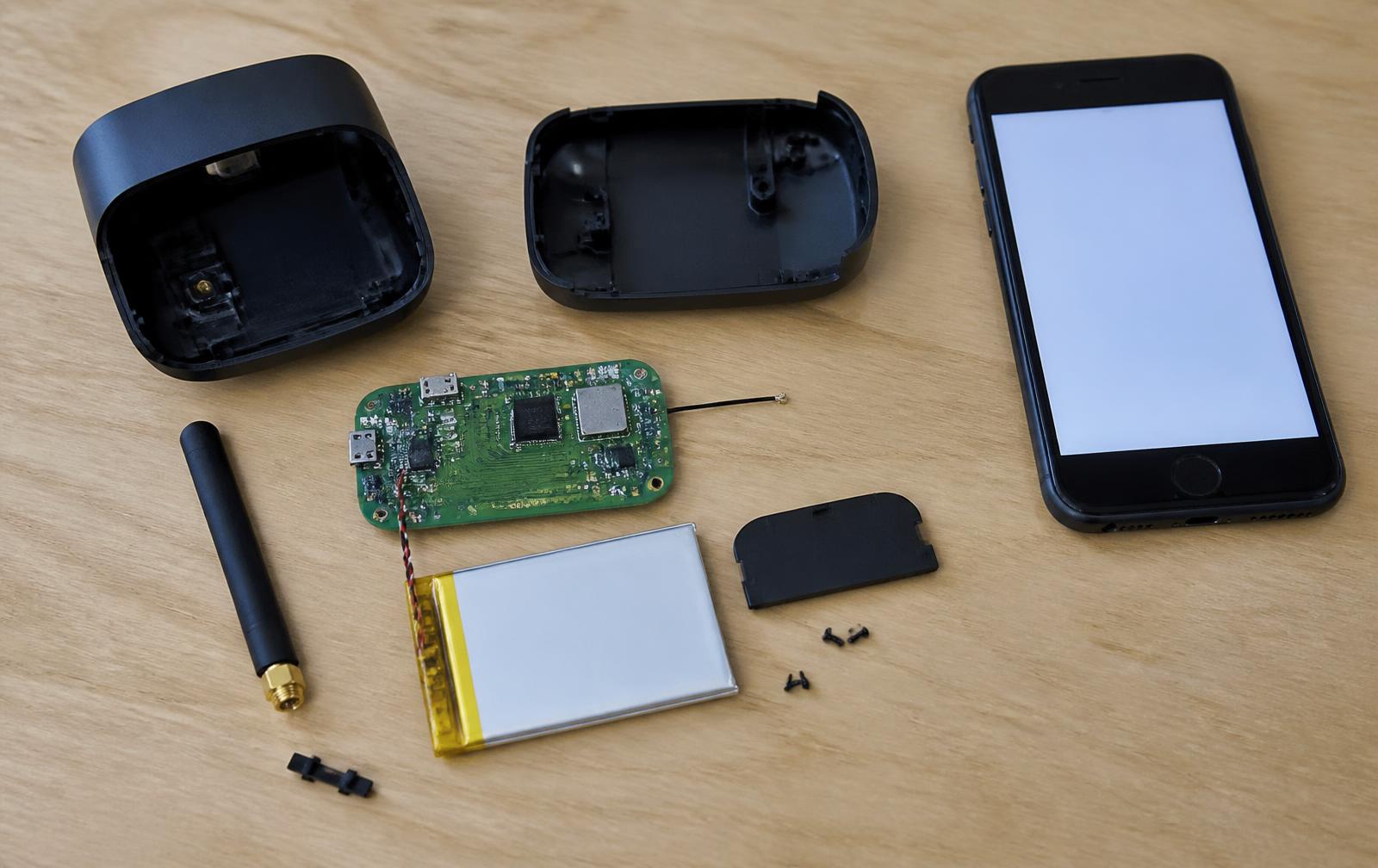
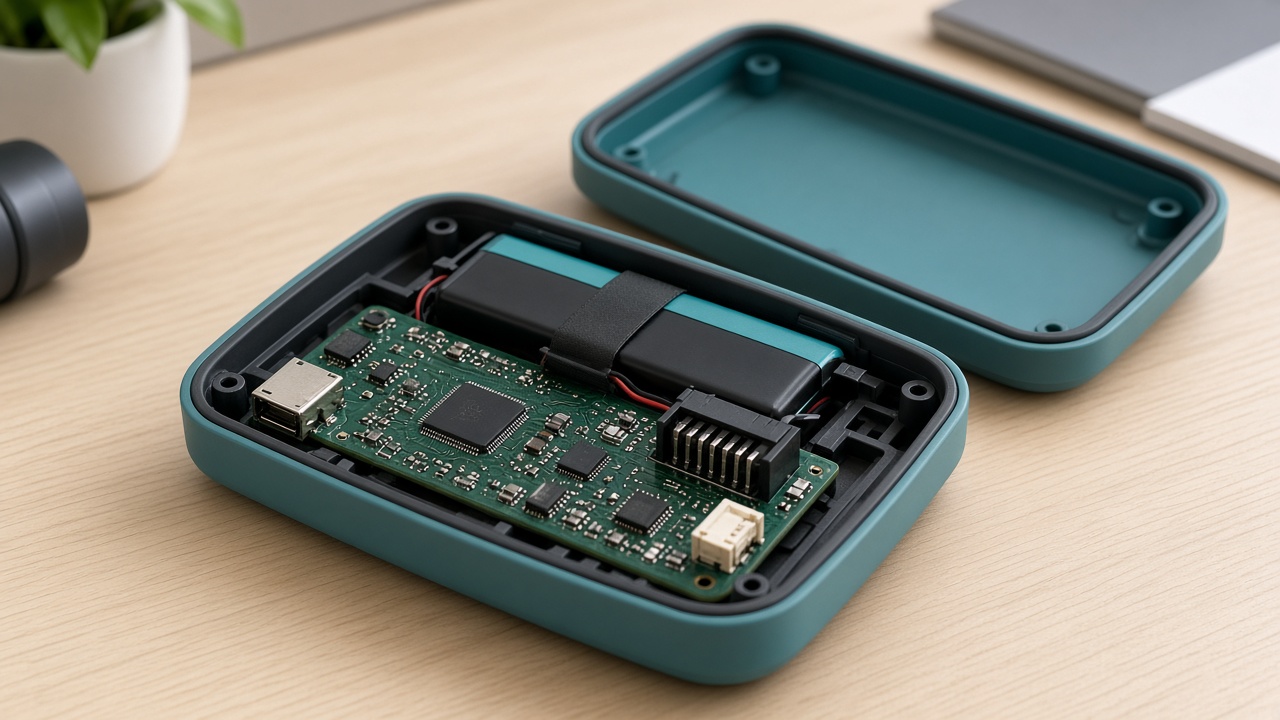
An outdoor enclosure is a system: wall thickness, gasket grooves, screw bosses, lens or antenna windows, UV-stable plastics and a path for the radio to radiate without killing the seal. Our enclosure design for electronics checklist covers the board-to-housing path. For cost, match the process to the question you are asking:
- Early fit and assembly: 3D printing is usually ~$20 to $200+ per part with hours-to-days lead time and almost no setup (Fictiv).
- Functional strength and production-grade plastics or metals: CNC is often ~$100 to $1,000+ per part (Fictiv); simple aluminum at quantity 1 is commonly cited around $60 to $180, with complex parts past $600 (Premsa Industries, 2026 CNC cost guide).
- Cosmetic and low-volume "looks molded" parts: urethane casting is typically ~$200 to $5,000+ (Fictiv).
- Production-intent plastic: injection molding carries tooling. Soft or aluminum tools are often quoted in the low thousands to about $25,000; production steel is much higher and slower (Olympus Machining; Axon Labs citing Agilian and RapidDirect). MakerVerse's 26 May 2026 cost-per-part benchmark places the practical injection-molding break-even against CNC and additive roughly between 500 and 2,000 parts for many geometries.
Do not buy steel tools to validate a gasket that still leaks. Print or machine seal trials first, then freeze geometry before hard tooling. Aluminum prototype tools are often quoted at about two to four weeks and $1,500 to $8,000. Domestic steel production tools at eight to twelve weeks and $15,000 to $120,000+, longer offshore (Axon Labs citing Agilian, 28 July 2026).
3. Radio choice and the FCC (and CE) path
For US market access, cost is driven by whether the product intentionally transmits and whether the radio is a pre-certified module. MarkReady's April 2026 FCC cost guide (still the current reference as of this writing) brackets:
- Simple digital device, SDoC: about $1,500 to $5,000, two to four weeks
- IoT with pre-certified module (for example BLE or Wi-Fi module): about $3,000 to $10,000, three to six weeks
- Custom single-band RF: about $8,000 to $20,000, six to twelve weeks
- Cellular with carrier work: about $50,000 to $200,000+, six to nine months
Hidden cost: first-pass EMC failure. MarkReady estimates roughly half of consumer electronics fail EMC on the first attempt and puts a re-test cycle at about $5,000 to $30,000 and four to twelve weeks when redesign and lab re-booking are included.
Pre-compliance work at about $3,000 to $8,000 is framed as cutting first-pass failure from about 50% to under 10%.
If you sell in the EU as well, plan a separate CE/RED campaign. Connected radios also face cybersecurity expectations under the Radio Equipment Directive (see our EU Cyber Resilience Act guide for the broader connected-hardware picture).
Before you lock logic-bearing modules, check the FCC Covered List implications for prototypes.
Founder takeaway: for the first outdoor prototype, a pre-certified module almost always wins on schedule even if the BOM is a few dollars higher. Cellular is a product decision, not a "nice to have," because carrier and PTCRB work sit on a different clock than Part 15.
4. Spin count (the real multiplier)
Axon Labs (20 July 2026) is blunt: the budget killer is iteration count, not hourly rates. Three to five full rounds is normal for a connected product; each full spin is about six to ten weeks. The difference between a three-spin and a five-spin program is months of payroll, not a 20% line-item bump.
Outdoor products add field spins: a bench-passed unit that fogs a lens, drains overnight at freezing, or loses LTE under a tree canopy forces another round.
Run a deliberate hardware beta with a written test plan instead of shipping "friends and family" units with no pass/fail criteria. Our stages of product testing guide maps what each gate is for.
Stage table: outdoor electronics prototype economics
Stage | What you are buying | Outdoor-specific watch-outs |
|---|---|---|
Discovery and feasibility (about 4 to 6 weeks) | Architecture, risk register, cost and cert plan (Axon Labs, 28 July 2026) | Battery duty cycle, IP target, radio markets, Covered List components |
Proof of concept (about 6 to 8 weeks) | Highest-risk assumption in working hardware | Power budget and radio link in a rough enclosure before cosmetics |
EVT engineering validation (about 8 to 12 weeks; often 5 to 12 units) | Intended components, first integrated boards and housings | Seal trials, antenna vs gasket conflicts, cold-start current |
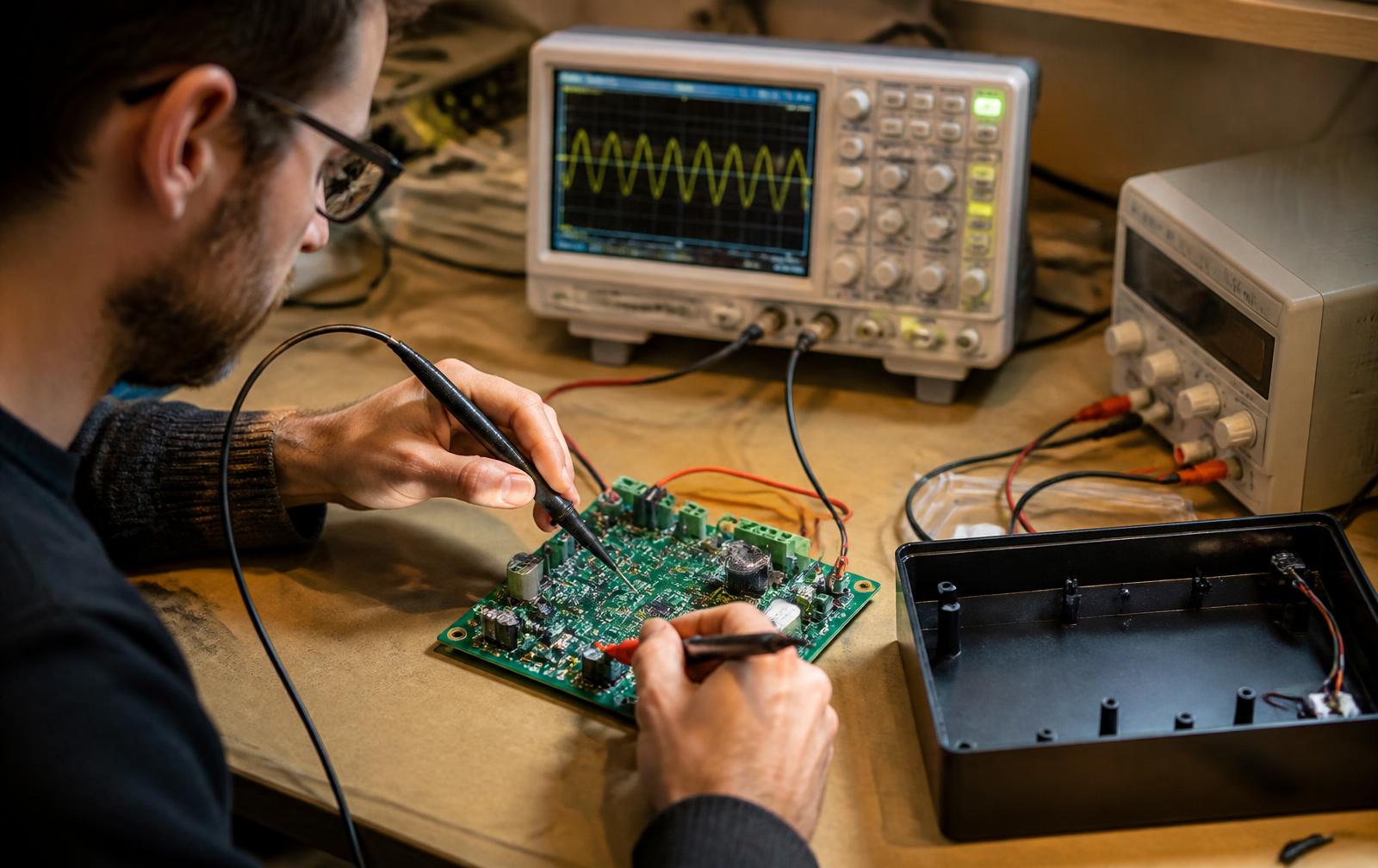
DVT design validation (about 10 to 16 weeks) | Near-final units, pre-cert and abuse testing | Formal EMC pre-scan, IP and drop tests, UV and temperature soak |
PVT production validation (about 12 to 24 weeks; often 50 to 500 units) | Tooling, fixtures, factory yield | Mold corrections, gasket tooling, packing that survives shipping |
Process choice for outdoor housings (quick decision guide)
- Still changing every week: 3D print. Cheap and fast; weak for long-term outdoor UV and seal confidence.
- Need real material, threads or heat: CNC the housing or critical inserts.
- Need 10 to 50 cosmetic units for buyer demos: urethane cast from a finished master.
- Geometry frozen and volume justifies it: bridge or production injection mold, ordered against frozen DVT geometry so tooling overlaps certification instead of following it (Axon Labs, 28 July 2026).
For electronics bring-up itself, follow the path in our electronic product prototyping guide from eval boards to a custom PCB. Run a design for manufacturing review before you commit to hard tools.
Founder checklist before you spend the next dollar
- Write the use case: temperature range, mounting, who replaces batteries, and what "dead in the field" costs the user.
- Freeze a duty cycle and battery claim you can test, not a slogan.
- Pick radio markets (US only vs US+EU) and module vs chip-down before schematic freeze.
- Set an IP and drop target, and budget physical tests, not just a drawing callout.
- Cap the number of full spins you will fund, and force architecture kills in feasibility.
- Book EMC pre-compliance before the formal lab slot.
- Do not order steel tools until seal, antenna and DFM issues are closed.
- Plan a structured field beta with written pass/fail criteria.
Frequently asked questions
How much does an outdoor electronics prototype cost in 2026?
Plan the prototyping program, not a single unit. Published 2026 ranges put prototyping at about $15,000 to $150,000 across three to five rounds for connected hardware, inside a broader concept-to-market band of roughly $125,000 to $250,000 for moderate connected consumer devices (Axon Labs summarizing Calcix, 20 July 2026). Outdoor-specific battery, sealing and cellular choices push you up the band.
Why do outdoor products cost more to prototype than indoor gadgets?
They add power architecture for long standby, waterproof and UV-capable housings, and often longer-range radios. Each of those forces extra engineering and usually extra spins when field tests disagree with the bench.
Should I 3D print or CNC the first waterproof enclosure?
Print for fit and assembly learning. Move to CNC or urethane when you need production-like materials and repeatable gasket grooves. Delay injection-mold tooling until geometry is frozen; MakerVerse (26 May 2026) places many molding break-evens between about 500 and 2,000 parts.
Is a pre-certified radio module worth it for a trail camera or tracker?
Usually yes on the first product. MarkReady (18 April 2026) puts host testing with a pre-certified module around $3,000 to $10,000 and three to six weeks, versus $8,000 to $20,000 and six to twelve weeks for custom RF, before cellular carrier work.
How long does outdoor electronics development take?
For a connected product, 12 to 24 months from discovery to production validation is a common planning range, with PVT alone often three to six months (Axon Labs, 28 July 2026). Field failure loops are the usual reason outdoor programs slip past indoor schedules.
Can I get a fixed quote from a blog post?
No. These figures are published planning ranges from 2026 sources, not a bid. A real estimate needs your battery claim, IP target, radio markets and how many units you need at each gate.
Bottom line
Outdoor electronics prototyping in 2026 is still hardware economics: labor, tooling, lab time and spins.
The outdoor premium is concentrated in four places you can manage early: honest battery requirements, seal-capable enclosure processes, a radio path that matches your market, and a hard cap on how many full spins you will fund.
Treat published dollar bands as sanity checks, force the risky assumptions into the first proof of concept, and do not buy steel tools to learn what a gasket trial could have taught you.
Soft CTA
If you are building outdoor or hunting electronics and want a team that designs, prototypes and tests in-house in the US, book an initial consultation with LA New Product Development Team: https://calendly.com/lanpdt/lanpdt-initial-consultation or call +1 318-200-0526.
Sources
- Axon Labs, "How Much Does It Cost to Develop a Hardware Product in 2026?" (20 July 2026): Axonlabs: hardware product development cost
- Axon Labs, "How Long Does Hardware Product Development Take? A Phase-by-Phase Timeline" (28 July 2026): Axonlabs: hardware development timeline
- MarkReady, "FCC Certification Cost (2026)" (updated 18 April 2026): Markready: fcc certification cost
- Fictiv, "How Much Does a Prototype Cost? Process Pricing Explained": Fictiv: prototyping cost process pricing
- MakerVerse, "Cost-Per-Part Benchmark 2026: CNC, SLS, MJF & Moulding" (26 May 2026): Makerverse: cost per part
- Rapid Circuitry, "IoT Product Development Cost Guide 2026" (updated September 2026): Rapidcircuitry: iot development cost guide
- Premsa Industries, "CNC Prototype Cost in 2026": Premsaindustries: how much does a cnc prototype cost
- Olympus Machining, "Rapid Prototyping: CNC vs 3D Printing vs Molding" (2026 ranges): Olympusmachining: rapid prototyping guide
Tagged:ElectronicsPrototyping
Services related to this guide
- Free prototype cost calculatorFive to eight questions, an instant cost range for a first prototype.
- Prototype designLooks-like, works-like or pre-production: what each proves and what it costs.
- Rapid prototypingWorking prototypes in days, from 3D printing to vacuum casting.
- Best product development companiesHow the leading US firms compare, and which one fits your stage and budget.