New Invention Ideas: How to Find, Validate and Develop One
Where new invention ideas come from, a prior-art check you can run yourself, a 20-buyer validation script and real development costs.
September 9, 20206 min read

Written by Konstantin Dolgan, Ph.D., NPDP
Founder & CEO, Product Development Engineer
Published September 9, 2020Updated September 2, 2026
Good invention ideas are not lightning strikes. They are problems you already live with, written down and checked against what exists. The gap between an idea and a product is validation and money, and both can be tested cheaply before you commit. This guide covers where workable ideas come from, how to run a prior-art check yourself, how to validate demand with twenty buyers, and what each development stage actually costs.
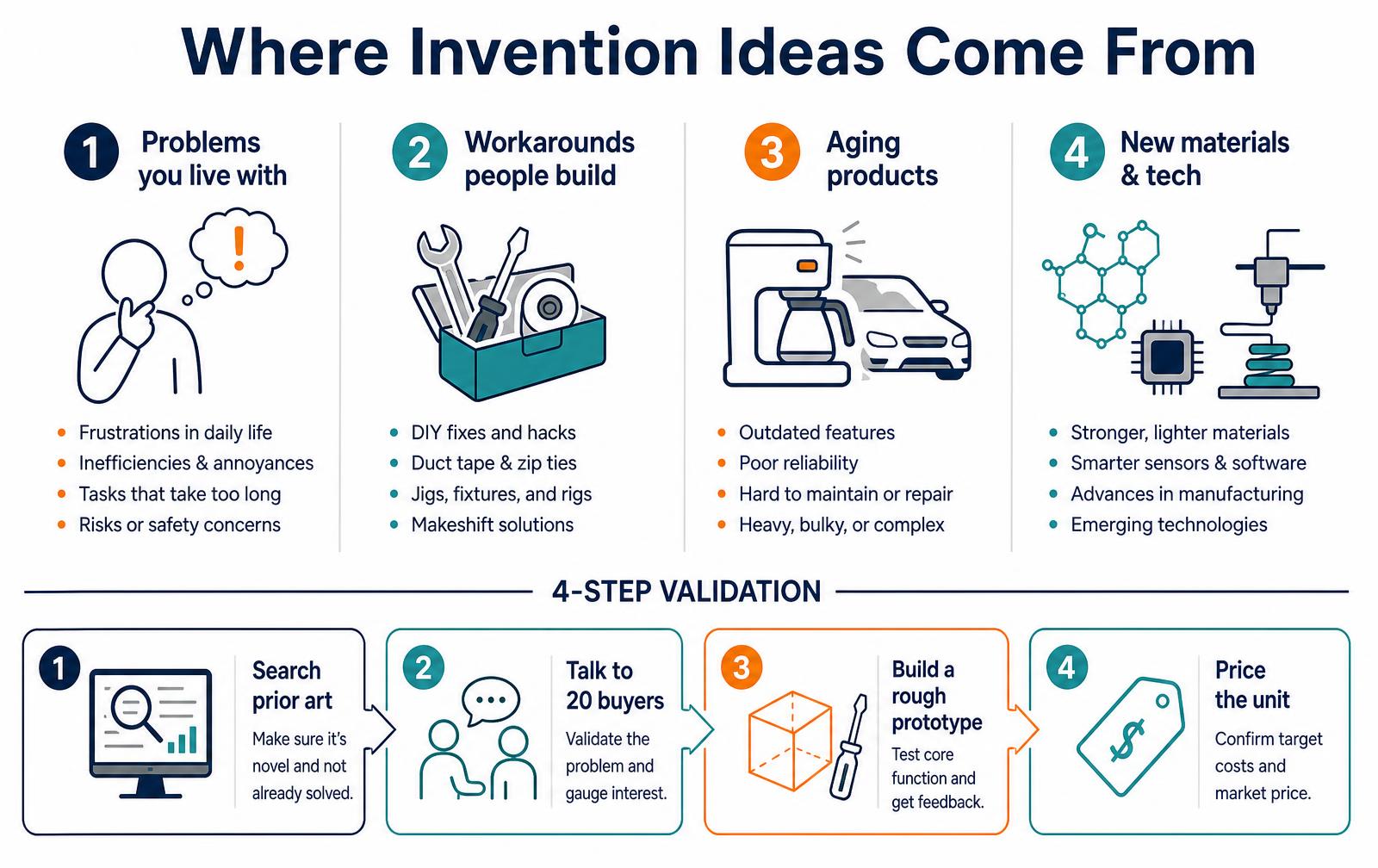
Where usable invention ideas come from
- Problems you live with - the friction you have stopped noticing is the richest source, because you can describe the failure precisely.
- Workarounds people build - duct tape, jigs and hacks in a workshop or kitchen are unbuilt products with proven demand.
- Aging products - categories that have not changed in a decade usually carry cost, weight or reliability slack.
- New materials and technology - cheaper sensors, better batteries and new polymers make old ideas suddenly viable.
Score an idea before you spend money
Test | Pass looks like | Fail looks like |
|---|---|---|
Problem frequency | Target user hits it weekly or more | Once a year annoyance |
Willingness to pay | Buyers name a price without prompting | "I would use it if it were free" |
Prior art | No granted patent covering your claim | Identical product on Amazon |
Unit economics | Landed cost under 25-33% of retail | Cost equals retail |
Channel | You can name where it sells | "Everyone would buy it" |
Run your own prior-art check
- Search Google Patents and USPTO Patent Full-Text search with three different phrasings of the function, not the product name.
- Search Amazon, AliExpress and Kickstarter - commercial prior art kills novelty just as effectively as a patent.
- Check expired patents: a lapsed patent means the idea is public domain and you can build it, but you cannot own it.
- Save every hit with a date and note. If you later hire a patent attorney, this cuts one to three billable hours.
Validate with twenty buyers
- Show a one-page concept sketch and a price, not a pitch.
- Ask what they use today and what it costs them in time or money.
- Ask them to pre-order or join a waitlist with an email - intent that costs nothing measures nothing.
- Stop at twenty. If fewer than five would pay your target price, change the concept or the buyer.
What it costs to develop an invention idea
Stage | Typical cost | Timeline |
|---|---|---|
Concept sketches and feasibility | $1,500-$8,000 | 1-3 weeks |
Industrial design and CAD | $6,000-$30,000 | 3-8 weeks |
Functional prototype | $3,000-$25,000 | 2-6 weeks |
Engineering for manufacture | $10,000-$60,000 | 6-14 weeks |
Provisional patent | $2,000-$5,000 | 1-3 weeks |
Tooling and first production run | $8,000-$150,000 | 8-20 weeks |
Common ways invention ideas die
- Building the full product before testing the one risky function.
- Filing a full utility patent before knowing anyone will buy it.
- Designing a part that no process can make at your volume.
- Paying an invention promotion firm for "submission to manufacturers".
Screening an idea before you spend money
Most invention ideas die of the same three causes, and all of them are detectable in a week of desk work. Somebody already sells it, the patent landscape is crowded enough that a workaround costs more than the market is worth, or the retail price the category supports cannot cover a realistic cost of goods.
Run those checks in that order and in that spirit: search Amazon, Alibaba and retail shelves before patent databases, because a product that exists but was never patented kills novelty just as effectively.
Only after an idea survives all three is a prototype a reasonable expense rather than an expensive way to learn something a search would have told you.
What each validation step costs
Step | Typical cost | Time | What it tells you |
|---|---|---|---|
Market and marketplace search | Free to $500 | 2-5 days | Whether the product already exists in some form |
Patentability search | $1,000-$3,000 | 1-3 weeks | Whether a claim is plausible and where the crowding is |
Provisional patent application | $2,000-$5,000 | 1-2 weeks | Twelve months of priority while you test |
Concept sketches and CAD | $2,000-$8,000 | 2-4 weeks | Whether the idea is buildable and what it looks like |
Functional prototype | $5,000-$25,000 | 4-10 weeks | Whether it works and what it will cost to make |
Questions to answer before building anything
- Who buys this, specifically? A named customer type, not a demographic.
- What do they use today, and what would they have to give up to switch?
- What can it retail for, and does a 4-5x markup over cost still land there?
- What is the annual volume at that price, honestly estimated?
- Is there a defensible position: utility claim, design patent, brand, channel or cost?
- What is the single riskiest assumption, and what is the cheapest test of it?
Licensing or launching: two very different paths
An inventor with a validated idea faces a fork that shapes every decision after it.
Licensing trades upside for speed and low capital exposure: a typical royalty runs three to six percent of wholesale, the manufacturer carries tooling and inventory risk, and the inventor needs a strong patent position plus a working prototype to get a meeting at all.
Launching keeps the margin but requires financing tooling, inventory, packaging and marketing, which for a modest consumer product commonly means fifty to two hundred thousand dollars before the first sale. Neither is better; they suit different risk tolerances and different products. Deciding early matters because the evidence each path demands is different.
- Licensing favours ideas with a strong utility claim in a category dominated by a few large manufacturers.
- Launching favours products with a clear niche audience you can reach directly and a healthy margin.
- Both require a working prototype; renderings alone rarely open either door.
- Keep patent filings alive either way, and never disclose publicly before filing.
- Model the money for each path before choosing, including the years to first meaningful revenue.
Key takeaways
Good invention ideas are common; ideas that survive a market check, a patent check and the retail arithmetic are rare. Do the cheap work first, protect the concept with a provisional while you test, and treat the prototype as the step that answers cost and manufacturability rather than the step that proves the idea is worth pursuing.
Where usable invention ideas actually come from
Ideas that survive validation rarely arrive as flashes of insight. They come from watching people work around a problem, from a regulatory or component change that makes something newly possible, or from an adjacent industry solving the same problem differently.
Source | How to work it | Typical yield |
|---|---|---|
Your own occupation | Log every workaround you use for a month | High — you know the buyer |
Observation of frustrated users | Ten site visits, note improvised fixes | High, needs fieldwork |
Component or cost change | Watch sensor, battery and motor pricing | Medium, timing sensitive |
Expired patents | USPTO full-text search on lapsed filings | Medium, crowded categories |
Adjacent industry transfer | Apply a medical or aerospace method elsewhere | Medium-high, defensible |
Complaint and review mining | Read one-star reviews in a category | High volume, low differentiation |
Screening ideas before you fall in love with one
- Frequency: does the problem occur weekly or yearly? Weekly problems get paid for.
- Existing spend: is anyone already spending money on a worse solution?
- Reachability: can you name three places the buyer can be found?
- Physics and cost: is a plausible bill of materials under a quarter of the likely retail price?
- Freedom to operate: does a twenty-minute patent search turn up an active blocker?
- Regulatory scope: does it touch skin, food, children, medicine, radio or the road?
A four-week validation sprint
Week | Work | Cost | Kill criterion |
|---|---|---|---|
1 | 20 customer conversations, problem framing | $0–$500 | Fewer than 8 confirm the problem |
2 | Patent and market landscape | $0–$1,500 | An active patent blocks the core claim |
3 | Rough prototype or mock-up | $300–$4,000 | The mechanism does not work at all |
4 | Price and cost sanity check, provisional filing | $1,000–$3,500 | No margin at a plausible retail price |
Protecting the idea without overspending
A provisional patent application costs a few hundred dollars in fees plus attorney time and buys twelve months to test the market before the expensive non-provisional decision.
File before public disclosure, keep dated records of conception and testing, and use NDAs with vendors — though most reputable manufacturers will sign a mutual one without argument.
Spending five figures on patents before anyone has confirmed they would buy the product is the single most common way inventors run out of money.
Our consulting team runs validation sprints like this, and rapid prototyping covers the week-three build.
Frequently asked questions
Where credible invention ideas come from
How do I know if my invention idea is original?
Good invention ideas are rarely lightning strikes. They come from repeated, documented exposure to a problem: a job you have done, a process you have watched fail, or a workaround people pay to avoid. The strongest filter is whether someone is already spending money badly on the problem - budget that already exists is easier to redirect than budget that must be created.
Run a prior-art search across Google Patents, USPTO full text and live marketplaces using functional phrasing. Originality for a patent means no single prior reference teaches your combination of features; originality for a business only means nobody sells it well today.
Idea source | Signal strength | How to mine it | Common failure |
|---|---|---|---|
Your own trade or job | High | Log every workaround you improvise for 30 days | Assuming everyone shares your workflow |
Customer complaints in reviews | High | Read one-star reviews of the current leader | Fixing a complaint nobody pays to solve |
Expired patents | Medium | Search patents lapsed 20+ years for revived materials | Reviving something that failed for market reasons |
Regulatory change | High | Track new standards forcing product redesign | Timing the rule change wrong |
Adjacent-industry transfer | Medium | Apply a mature technique to a new sector | Underestimating certification differences |
Should I patent an invention idea before developing it?
A five-gate validation sequence before you spend on tooling
File a provisional application once the concept is concrete enough to describe and enable, usually after the first working prototype. It costs $2,000-$5,000 with counsel, holds a priority date for twelve months and buys time to validate demand before the far larger utility filing.
- Gate 1 - Problem evidence: 10 unscripted interviews with people who have the problem this quarter.
- Gate 2 - Prior art: a patentability search and a commercial search; if it exists and failed, learn why.
- Gate 3 - Technical feasibility: one proof-of-principle rig that tests the riskiest assumption only.
- Gate 4 - Unit economics: a target landed cost and a retail price the interviews support.
- Gate 5 - Willingness to pay: pre-orders, letters of intent, or a paid pilot - not survey enthusiasm.
How much does it cost to turn an invention idea into a product?
Budget by stage so you fail cheaply
Most consumer products reach a production-ready design for $25,000-$120,000 in engineering, plus tooling. Simple mechanical items land at the low end; anything with electronics, an app or regulatory testing lands higher.
Stage | Typical spend | Duration | Kill criterion |
|---|---|---|---|
Discovery and prior art | $1,500-$6,000 | 2-4 weeks | Blocking patent or no paying user |
Proof of principle | $5,000-$25,000 | 4-10 weeks | Core physics does not work |
Looks-like / works-like prototype | $20,000-$80,000 | 2-4 months | Cost target unreachable |
Design for manufacture | $40,000-$150,000 | 3-6 months | No manufacturer will quote it |
Tooling and pilot run | $50,000-$300,000 | 3-6 months | Pilot quality or yield fails |
Can I sell or license an invention idea?
Protecting the idea without over-spending
Companies license proven products, not raw ideas. A licensable package is a granted or pending patent, a working prototype and evidence of demand. Typical royalties run 2-6% of wholesale.
A provisional patent application buys 12 months of priority for a few hundred dollars in fees plus drafting, and it is the right instrument while validation is running. Convert to a non-provisional only when Gates 4 and 5 have passed. In parallel, keep a dated invention notebook, use mutual NDAs with suppliers, and file trademarks on the brand name early - names are cheap to protect and expensive to change after packaging is printed.
Related reading: how to validate a business idea, how to patent an idea and our product development services.
Have an invention idea you want validated before spending real money?
Work with LA NPDT: if you are moving from here to execution, start with our product discovery for inventors or talk to us about prior art search.
Filed under:EducationInspirationNews
Services related to this guide
- Product design servicesIndustrial design and CAD taken all the way to manufacturable files.
- Rapid prototypingWorking prototypes in days, from 3D printing to vacuum casting.
- Electronic design servicesSchematic, PCB layout, firmware and bring-up, through to production handoff.
- Product development examplesReal projects we designed, prototyped and shipped.