Product Discovery Process
Learn what product discovery is, how it works, key steps, questions, templates, and frameworks for digital product teams.
August 14, 202531 min read

Written by Konstantin Dolgan, Ph.D., NPDP
Founder & CEO, Product Development Engineer
Published August 14, 2025Updated September 2, 2026
read 23 mins
Learn what product discovery is, how it works, key steps, questions, templates, and frameworks for digital product teams.
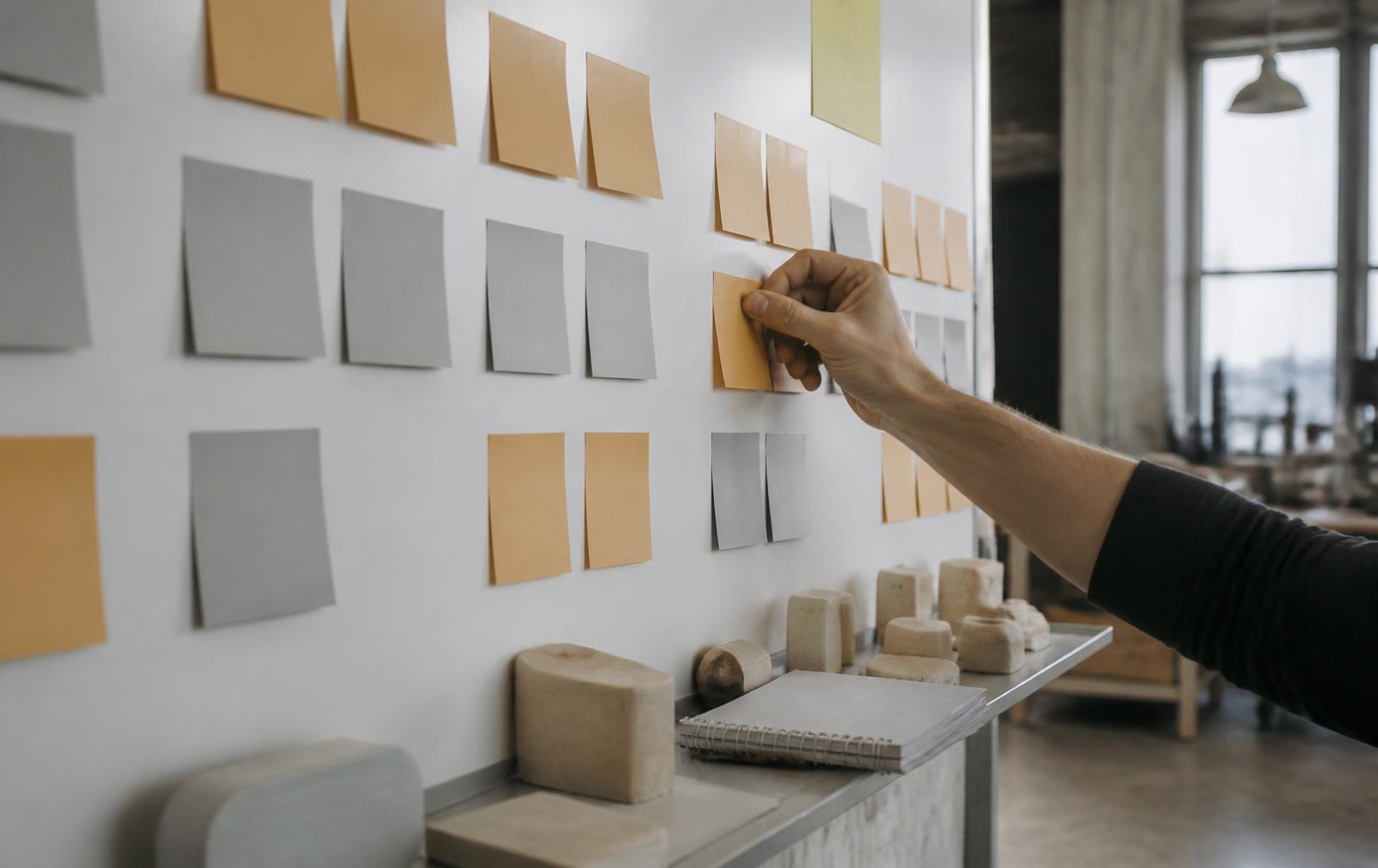
Product discovery process, when done right, is where game-changing products begin. It’s how startups avoid burning through cash building the wrong thing, and how product teams make sure they’re solving the right problem in the right way, for the right people.
Whether you’re a solo founder shaping your first invention, or a product team inside a growing SaaS company, discovery helps you define what to build, why it matters, and how to make it work.
This guide breaks down the complete product discovery process, along with templates, frameworks, questions, and common pitfalls to avoid.
- Product Discovery reduces uncertainty and de-risks development.
- It’s not a phase, it’s a mindset and a continuous practice.
- Aligns teams, validates ideas, and creates a clear product direction.
- Use frameworks, templates, and structured questions to guide learning.
What Is Product Discovery?
Product Discovery?
Product Discovery is the structured process of turning vague ideas, hypotheses, or assumptions into validated product concepts that are ready to move forward with confidence. It’s about asking the right questions before investing in design, engineering, or development, minimizing wasted effort and maximizing the chances of building something that people actually want and can use.
Instead of starting with wireframes or 3D models, discovery starts with learning. That learning may involve talking to users, running market analyses, exploring patents and competitor products, or testing whether your product idea is even technically feasible or manufacturable.
Example:
Imagine you’re developing a wearable fitness device. You might believe that your target audience wants hydration tracking. But through user interviews, you discover that most are more concerned about battery life and accurate step tracking. Discovery helped you avoid investing in the wrong feature set, and gave you a clearer, stronger direction to move forward.
“Discovery reduces waste. It prevents you from building the wrong thing beautifully.”
Why Product Discovery Matters
Matters
Skipping discovery is like building a house without a blueprint. Youmightget lucky, but more often, you’ll end up tearing down walls later, redoing work, or failing to finish at all.
Skipping discovery is like building a house without a blueprint. You
might
get lucky, but more often, you’ll end up tearing down walls later, redoing work, or failing to finish at all.
Here’s why discovery is essential:
Example:
Imagine you’re developing a wearable fitness device. You might believe that your target audience wants hydration tracking. But through user interviews, you discover that most are more concerned about battery life and accurate step tracking. Discovery helped you avoid investing in the wrong feature set, and gave you a clearer, stronger direction to move forward.
It reduces risk.
Instead of guessing, you’ll validate. Every assumption tested early prevents costly rework later, especially if you’re launching a startup or applying for grants like SBIR or NSF.
It saves time and money.
Product development can be resource-intensive. Discovery ensures you’re not wasting cycles on features no one wants, or solving problems that don’t really exist.
It sharpens your value proposition.
By speaking directly to users and analyzing the landscape, you can pinpoint what makes your product truly valuable, and why someone should care.
It creates Alignment.
Teams often have competing ideas. Discovery creates a shared understanding of the problem and the strategy to solve it, so everyone pulls in the same direction.
It builds confidence.
Whether you’re talking to investors, stakeholders, or partners, you’ll be able to speak with clarity about why your product matters, what makes it viable, and how you’ll bring it to life.
The Product Discovery Process (Step-by-Step)
Process (Step-by-Step)
The product discovery process is often visualized as a loop rather than a line. It’s iterative, flexible, and non-linear, but it still follows a structure. At its core, it’s about learning before building.
Here’s a step-by-step breakdown of the process, with real-world examples and best practices for each stage.
1. Align on the Problem and Vision
Before conducting research, your team needs a unified understanding of the problem you’re solving and who you’re solving it for. This step ensures that everyone, from founders to designers to engineers, shares the same direction.
EXAMPLE: A founder might believe they’re building a product for “busy parents.” But after initial discussions, it becomes clear that their solution is actually more relevant to caregivers for elderly parents. Clarifying this early prevents building for the wrong audience.
Key Tip: Create a one-paragraph product vision statement and user problem description before proceeding.
Key Tip:
2. Define Learning Objectives
Now that you’re aligned, it’s time to identify what you still don’t know. This step involves surfacing your biggest assumptions and unknowns, and setting clear goals for discovery.
ASK: “What must be true for this product to succeed?” If you don’t have data to support an answer, it’s a candidate for discovery.
ASK: “What must be true for this product to succeed?” If you don’t have data to support an answer, it’s a candidate for discovery.
COMMON OBJECTIVES:
- What specific pain point does this solve?
- Who are our most likely early adopters?
- How do users currently solve this problem?
3. Identify Your Assumptions
Not every assumption is risky, but the wrong one can sink your product. By mapping out your assumptions, you can figure out what needs testing through user interviews, market research, or technical experiments.
ASK: “What must be true for this product to succeed?” If you don’t have data to support an answer, it’s a candidate for discovery.
ASK: “What must be true for this product to succeed?”
If you don’t have data to support an answer, it’s a candidate for discovery.
- Desirability:Do people want this?
- Feasibility: Can we build it?
- Viability:Will it make business sense?
TOOL SUGGESTION:Use a product discovery template like aRisk MatrixorAssumption Mapping Boardto rank and prioritize assumptions.
TOOL SUGGESTION:
Use a product discovery template like a
Risk Matrix
Assumption Mapping Board
to rank and prioritize assumptions.
4. Choose Your Discovery Methods
Once you’ve identified what you need to learn, select the right research tools and tactics. These can be qualitative (interviews, surveys, observational studies) or quantitative (market size analysis, pricing studies, usability testing).
EXAMPLE:A startup considering a smart kitchen appliance might conduct interviews with home chefs, research competitor patents, and test design sketches for feedback, all within one 2-week sprint.
A startup considering a smart kitchen appliance might conduct interviews with home chefs, research competitor patents, and test design sketches for feedback, all within one 2-week sprint.
Popular Methods in Digital Product Discovery:
- Customer discovery interviews
- Competitor and prior-art analysis
- Jobs-to-be-done (JTBD) mapping
- Concept testing
- Design sprints
- Wireframe or CAD prototype evaluations
5. Run Lean Learning Sprints
Use short, focused sprints to quickly test and learn. Each sprint should have a hypothesis, a method, and a conclusion. Agile discovery works best when small experiments feed into quick decisions.
Discovery is not about running long-term studies, it’s about collecting just enough insight to move forward smartly.
Example Sprint:
- Hypothesis: “Users will trust our wearable more if it integrates with Apple Health.”
- Method: Survey and quick clickable prototype
- Result: 70% positive response → move forward
6. Synthesize Your Findings
Raw data is only as useful as your ability to make sense of it. After each learning sprint, analyze the results, identify patterns, and update your assumptions. Look for surprises, contradictions, and areas of clarity.
PRO TIP:Visual synthesis tools like affinity mapping or customer journey mapping can help make insights easier to share across teams.
PRO TIP:
Visual synthesis tools like affinity mapping or customer journey mapping can help make insights easier to share across teams.
7. Update the Concept and Direction
Discovery isn’t just about validating, it’s about evolving. Use what you’ve learned to revise the product’s value proposition, feature set, or design direction.
STORY: One LA NPDT client initially imagined a suction-based wellness product. During discovery, it became clear that a discreet design was more important than suction power. The product pivoted, leading to a completely different, and more effective, concept.
8. Share Learnings and Align
Once your discovery loop completes (for now), compile your findings into a Product Discovery Brief. This should summarize:
- Your updated concept
- Key findings
- Open questions
- Next steps
Common Product Discovery Frameworks
Frameworks
There’s no one-size-fits-all approach to product discovery, but several battle-tested frameworks can help guide teams through structured, repeatable processes. Whether you’re part of a startup team or working inside a larger product org, these discovery frameworks provide the structure needed to reduce ambiguity and make faster, more informed decisions.
Below are some of the most effective discovery models used by real teams, and how they map onto your workflow.
1. The Double Diamond Framework
Originally developed by the UK Design Council, the Double Diamond is one of the most widely recognized product discovery frameworks. It visualizes discovery and design as two distinct phases: divergence (exploring the problem) and convergence (defining the solution).
Stages:
- Discover: Explore the problem space (research, interviews, observation)
- Define: Narrow the findings into a clear problem to solve
- Develop: Explore possible solutions (ideation, prototyping)
- Deliver: Finalize the chosen solution for implementation
Use Case:
A healthcare startup used the Double Diamond to uncover that their users were overwhelmed not by the treatment process but by scheduling, helping them pivot to a simple mobile-first calendar app instead of a complex EMR tool.
- Best for: Design-heavy teams and multidisciplinary discovery efforts
- Tool Suggestion: Use it alongside a visual whiteboard like Miro or FigJam
2. Lean UX Canvas
The Lean UX Canvas, created by Jeff Gothelf, helps teams break large discovery efforts into clear, hypothesis-driven blocks. It’s ideal for cross-functional teams looking to test ideas quickly and adjust often.
Canvas Elements:
- Business problem
- Users & needs
- Solution ideas
- Hypotheses
- Assumptions
- Experiments
- Results
Use Case:
A B2B SaaS startup used the Lean UX Canvas to rapidly test three different value propositions in parallel, landing on the one with the highest resonance through LinkedIn polls and prototype demos.
- Best for: Agile teams, early-stage product teams, iterative testing
- Tool Suggestion: Lean UX Canvas Template (PDF) (note: insert own template link for SEO value)
3. Assumption Mapping
Assumption Mapping is a fast, simple way to prioritize what to validate first. This discovery technique categorizes your beliefs about a product into four quadrants: Known Knowns, Known Unknowns, Unknown Knowns, and Unknown Unknowns.
You then map assumptions by:
- Risk (how dangerous is the assumption?)
- Evidence (how confident are we about it?)
Use Case:
A founder developing a new wearable device used assumption mapping to realize their belief about user trust in data accuracy was both high-risk and unvalidated, leading to a prototype built around real-time feedback.
- Best for: Risk-based prioritization, MVP planning
- Tool Suggestion: Works great as a warm-up exercise with non-technical stakeholders.
4. Realizr™ by LA NPDT
Realizr™ is our proprietary 3D ideation framework built for founders and early-stage startups. It combines creative thinking, constraint analysis, and strategic framing to guide you from “I have an idea” to a well-shaped, investor-ready concept.
Realizr Covers:
- 360° exploration of the problem space
- Technical, user, and economic feasibility
- Ideation and design strategy
- Early-stage visuals and concept refinement
Use Case:
A solo founder came to LA NPDT with a vague concept for a posture-support product. Using Realizr, we shaped the idea into a viable, differentiable design, which later became a pitch-ready concept used to raise funding.
- Best for: Founders, first-time inventors, product teams without internal R&D
- Tool Suggestion: Realizr Product Ideation Tool
Comparison Table: Discovery Frameworks at a Glance
Comparison Table:
Framework
Best For
Primary Focus
Ideal Team Size
Double Diamond
Design-centric teams
Problem & solution shaping
3–8
Lean UX Canvas
Agile / cross-functional teams
Rapid iteration & testing
2-6
Assumption Mapping
Risk-aware validation
Prioritizing uncertainty
1–10
Realizr™
Startups, solo founders
Ideation, feasibility, concept design
1-5
Comparison Table: Discovery Frameworks at a Glance
Comparison Table:
FRAMEWORK: Double Diamond
Design-centric teams
Problem & solution shaping
3-8
FRAMEWORK: LeaN UX Canvas
Agile / cross-functional teams
Rapid iteration & testing
2-6
FRAMEWORK: Assumption Mapping
Risk-aware validation
Prioritizing uncertainty
1-10
FRAMEWORK: Realizr™
Startups, solo founders
Ideation, feasibility, concept design
1-5
Product Discovery Template (Simple Starter)
Template
Section
What to Include
Vision
One-sentence summary of product goal
Problem Statement
Clear articulation of the user problem
Target Users
Who you’re solving this for
Hypotheses
What you believe is true, but need to test
Research Plan
Methods, participants, timeline
Findings
Summary of what you learned
What to refine, test, or build next
Product Discovery Template (Simple Starter)
Template
SECTION: VISION
One-sentence summary of product goal
SECTION: Problem Statement
Clear articulation of the user problem
SECTION: Target Users
Who you’re solving this for
SECTION: Hypotheses
What you believe is true, but need to test
SECTION: Research Plan
Methods, participants, timeline
SECTION: Findings
Summary of what you learned
SECTION: Next Steps
What to refine, test, or build next
Product Discovery Questions to Ask
Questions to Ask
At the heart of every strong product discovery process is one thing: great questions. The right questions uncover unmet needs, expose faulty assumptions, and shape your idea into something the market will actually want, and use.
Whether you’re running interviews, filling out a product discovery template, or building your product discovery framework, these questions are your go-to decision-making tools.
Strategy & Problem-Space Questions
Questions
Before you design a solution, make sure you fully understand the problem.
Question
Why It Matters
What real-world problem does this solve?
Helps ensure the idea is rooted in user needs, not assumptions.
Who experiences this problem, and how often?
Determines market size and urgency.
What’s currently used as a workaround or alternative?
Reveals competitors and opportunity gaps.
Who experiences this problem, and how often?
Determines market size and urgency.
Why Now?
Validates timing and market readiness.
What will happen if this problem goes unsolved?
Clarifies stakes and user motivation.
QUESTION: WHAT REAL-WORLD PROBLEM DOES THIS SOLVE?
Helps ensure the idea is rooted in user needs, not assumptions.
QUESTION: Who experiences this problem, and how often?
Determines market size and urgency.
QUESTION: What’s currently used as a workaround or alternative?
Reveals competitors and opportunity gaps.
QUESTION: Why now?
Validates timing and market readiness.
QUESTION: What will happen if this problem goes unsolved?
Clarifies stakes and user motivation.
User & Market Questions
User & Market
These help you understandwhoyou’re building for, and how they currently behave.
These help you understand
who
you’re building for, and how they currently behave.
Question
Why It Matters
Who is the primary user, and what’s their job-to-be-done?
Grounds the concept in real-life behavior.
What pain points or friction do users face?
Points toward differentiators.
How do users currently solve the problem?
Establishes baseline expectations and context.
What are users willing to pay (or do) to solve it?
Begins forming the business model.
User & Market Questions
User & Market
These help you understandwhoyou’re building for, and how they currently behave.
These help you understand
who
you’re building for, and how they currently behave.
QUESTION: Who is the primary user, and what’s their job-to-be-done?
Grounds the concept in real-life behavior.
QUESTION: What pain points or friction do users face?
Points toward differentiators.
QUESTION: How do users currently solve the problem?
Establishes baseline expectations and context.
QUESTION: What are users willing to pay (or do) to solve it?
Begins forming the business model.
Feasibility & Risk Questions
Feasibility & Risk
These help you avoid over-investing in ideas that can’t be built, or shouldn’t be built yet.
Question
Why It Matters
Can this be built with existing tech and tools?
Assesses engineering feasibility.
Are there regulatory or compliance hurdles?
Important in healthcare, finance, hardware, etc.
Are there known competitors or IP barriers?
Early patent or prior-art searches can save months.
How much would it cost to build an MVP?
Sets realistic investment expectations.
What critical assumption, if wrong, would sink this idea?
Identifies “red flag” risks early.
Feasibility & Risk Questions
Feasibility & Risk
These help you avoid over-investing in ideas that can’t be built, or shouldn’t be built yet.
QUESTION: Can this be built with existing tech and tools?
Assesses engineering feasibility.
QUESTION: Are there regulatory or compliance hurdles?
Important in healthcare, finance, hardware, etc.
QUESTION: Are there known competitors or IP barriers?
Early patent or prior-art searches can save months.
QUESTION: How much would it cost to build an MVP?
Sets realistic investment expectations.
QUESTION: What critical assumption, if wrong, would sink this idea?
Identifies “red flag” risks early.
Validation & Experimentation Questions
Validation & Experimentation
These guide you toward action, building something to test and learn from.
Question
Why It Matters
What is the smallest thing we can build to test this?
Helps define the minimum viable test.
What signal would tell us we’re on the right track?
Clarifies success metrics and learning goals.
Where can we find early users to test with?
Speeds up the learning loop.
What would make this product fail in the market?
Proactively uncovers weak points.
Validation & Experimentation Questions
Validation & Experimentation
These guide you toward action, building something to test and learn from.
QUESTION: What is the smallest thing we can build to test this?
Helps define the minimum viable test.
QUESTION: What signal would tell us we’re on the right track?
Clarifies success metrics and learning goals.
QUESTION: Where can we find early users to test with?
Speeds up the learning loop.
QUESTION: What would make this product fail in the market?
Proactively uncovers weak points.
QUESTION: What critical assumption, if wrong, would sink this idea?
Identifies “red flag” risks early.
Bonus: 3 Discovery Questions for Internal Teams
Bonus:
If you’re a company spinning off a new idea or building internal tools:
1. How will this solution improve our operations or customer experience?
2.What’s the expected ROI in time, cost, or resources saved?
3.Who will own this product post-launch?
Free Download: Product Discovery Questions Template (PDF)
Want a printable or shareable version of these questions?
Download our Product Discovery Questions Checklist →
Key Takeaway
Don’t start building. Start asking.
The best discovery processes begin with better questions, and keep asking them throughout the journey.
Don’t start building. Start asking.
The best discovery processes begin with better questions, and keep asking them throughout the journey.
Digital Product Discovery
Discovery
While the principles of product discovery are universal, the approach looks a little different when you’re building digital products, like SaaS platforms, mobile apps, or AI-powered tools.
Digital product discovery is typically faster, more iterative, and more collaborative than its hardware counterpart. This is largely thanks to low-cost tools, faster build-test cycles, and easier user testing.
Let’s walk through how digital product discovery works, how it differs from physical product discovery, and what tools and methods teams use to build successful apps, platforms, and experiences.
What Makes Digital Product Discovery Unique?
Unique?
Key Aspect
Digital Discovery
Hardware Discovery
Iteration Speed
Rapid, minutes to days
Slower, days to weeks
Prototyping Tools
Low-code/no-code, UI mockups
CAD, 3D printing, physical builds
User Testing
Can start with just a clickable prototype
Often requires functioning components
Metrics & Analytics
Easy to track behavior and engagement
Harder to measure usage early
Development Flexibility
Easier to pivot or patch
Costlier to modify
What Makes Digital Product Discovery Unique?
Unique?
KEY ASPECT: ITERATION SPEED
Rapid, minutes to days
Slower, days to weeks
KEY ASPECT: Prototyping Tools
Low-code/no-code, UI mockups
CAD, 3D printing, physical builds
KEY ASPECT: User Testing
Can start with just a clickable prototype
Often requires functioning components
KEY ASPECT: Metrics & Analytics
Easy to track behavior and engagement
Harder to measure usage early
KEY ASPECT: Development Flexibility
Easier to pivot or patch
Costlier to modify
Common Use Cases for Digital Product Discovery
- Startups: developing a SaaS platform, AI tool, or mobile app
- Internal product teams: planning a new feature rollout
- Founders: validating a business idea before hiring developers
- Agencies: building MVPs for clients
Tools for Digital Product Discovery
Here are some of the most popular tools digital product teams use during discovery:
Purpose
Tools
User Research
Typeform, Hotjar, Maze, User Interviews
UI/UX Prototyping
Figma, Adobe XD, ProtoPie
Roadmapping
Productboard, Notion, Miro
Analytics & Feedback
Mixpanel, FullStory, Google Analytics
No-code MVPs
Webflow, Glide, Bubble, Softr
Surveys & Idea Validation
Google Forms, Pollfish, Askable
Tools for Digital Product Discovery
Here are some of the most popular tools digital product teams use during discovery:
PURPOSE: USER RESEARCH
Typeform, Hotjar, Maze, User Interviews
PURPOSE: UI/UX Prototyping
Figma, Adobe XD, ProtoPie
PURPOSE: Roadmapping
Productboard, Notion, Miro
PURPOSE: Analytics & Feedback
Mixpanel, FullStory, Google Analytics
PURPOSE: No-code MVPs
Webflow, Glide, Bubble, Softr
PURPOSE: Surveys & Idea Validation
Google Forms, Pollfish, Askable
Tip:Many successful digital startups launch MVPs using no-code tools first, then rebuild for scale once they validate demand.
Tip:
Many successful digital startups launch MVPs using no-code tools first, then rebuild for scale once they validate demand.
Example: Discovery for a Mobile Wellness App
A solo founder had an idea for a mindfulness app targeting parents of toddlers. They weren’t sure which features (breathing guides, audio stories, or journaling) would matter most.
Here’s how digital product discovery helped:
- Ran a survey using Typeform to gauge feature demand
- Prototyped 3 screens in Figma
- Tested with 12 users using Maze (clickable walkthrough)
- Tracked engagement with screen recordings
- Discovered that short audio meditations outperformed all other features
- Used that insight to guide MVP scope
Key Differences in Discovery Mindset
Differences
With digital products, it’s easy to confuse building fast with discovering fast. But discovery still requires intentional learning, not just shipping code.
Good digital product discovery means:
- Talking to users, not just looking at dashboards
- Testing ideas before building features
- Prioritizing learning over delivery
Key Digital vs Physical: Which One Is Easier?
Digital vs Physical:
While digital product discovery moves faster, it still faces challenges like:
- Feature creep
- Misunderstood pain points
- Internal misalignment
The key difference is that digital teams can test and learn faster, if they resist the temptation to skip discovery altogether.
Pro Insight:Even apps need early-stage discovery. The best startups don’t wait until UX design or dev sprints to validate ideas, they start at the concept level.
Pro Insight:
Even apps need early-stage discovery. The best startups don’t wait until UX design or dev sprints to validate ideas, they start at the concept level.
Organizing Discovery Learning on Product Teams
Discovery Learning
Product discovery is a team sport. Whether you’re a founder working with consultants or a large product organization managing multiple verticals, how you organize discovery learning can make or break your process.
This section walks through key principles, structures, and real-world strategies for managing product discovery effectively across teams, from lean startups to enterprise orgs.
Key Who Owns Product Discovery?
Who Owns
While product managers often take the lead, discovery works best when cross-functional teams share ownership. This includes:
- Product Managers (PMs): Define goals, prioritize problems, align stakeholders.
- Designers/UX Researchers: Lead user interviews, test prototypes, and synthesize findings.
- Engineers: Advise on feasibility, technical constraints, and quick validation experiments.
- Marketing/Customer Success: Provide voice-of-the-customer insights and market context.
Best Practice:Discovery doesn’t start when the build starts, involve engineers early to avoid feasibility surprises later.
Best Practice:
Discovery doesn’t start when the build starts, involve engineers early to avoid feasibility surprises later.
Creating Discovery Loops
Creating
Rather than one big discovery phase, continuous discovery uses tight feedback loops to validate learning on a rolling basis.
The Discovery Loop:
- 1. Align: Identify what needs to be learned
- 2. Design: Choose method (interview, survey, test)
- 3. Execute: Collect data
- 4.Synthesize: Spot trends and patterns
- 5.Decide: Act, pivot, or refine
Discovery Cadence in Agile Teams
Cadence
In agile environments, many teams embed discovery work into sprints. Others run a parallel discovery track alongside delivery.
Common Patterns:
Approach
Description
Dual-Track Agile
One track for discovery, one for delivery. PM and design validate while devs build validated features.
Sprint 0 or Spike Sprint
Teams block time for focused discovery (e.g., Sprint 0 before a new initiative).
Ongoing, Lightweight Discovery
Teams validate small assumptions every sprint via quick experiments.
Discovery Cadence in Agile Teams
Cadence
In agile environments, many teams embed discovery work into sprints. Others run a parallel discovery track alongside delivery.
Common Patterns:
APPROACH: DUAL-TRACK AGILE
One track for discovery, one for delivery. PM and design validate while devs build validated features.
APPROACH: Sprint 0 or Spike Sprint
Teams block time for focused discovery (e.g., Sprint 0 before a new initiative).
APPROACH: Ongoing, Lightweight Discovery
Teams validate small assumptions every sprint via quick experiments.
Case Study:Astartup building a new IoT device used Dual-Track Agile with a 2-week delay between tracks. This gave the devs room to code while the discovery team validated upcoming features.
Case Study:
startup building a new IoT device used Dual-Track Agile with a 2-week delay between tracks. This gave the devs room to code while the discovery team validated upcoming features.
Capture and Share Learning
Learning
Organizing discovery learning means making it accessible and usable. Raw research is only useful if the team can apply it.
Simple Ways to Share Learnings:
- Use short Loom videos to summarize user interviews
- Create an "Insights Gallery" with key quotes and takeaways
- Include discovery summaries in sprint demos
- Use tags or labels like “desirability risk” or “IP concern” for quick filtering
Real Tip:We recommend a Product Discovery Brief for summarizing key insights at each milestone, a document that captures the product’s why, what, and how based on real findings.
Real Tip:
Example: Team Roles and Learning Tracker Template
Here’s a simplified version of how a product team might organize learning.
Role
Responsibilities
Tools Used
Product Manager
Set goals, prioritize discovery, synthesize
Notion, Google Docs
UX Designer
Design tests, lead interviews, sketch ideas
FigJam, Maze
Engineer
Validate feasibility, explore quick builds
GitHub, CodePen
Marketing Lead
Research audience, assess messaging
Google Surveys
And a basic discovery tracker template:
Assumption
Method
Owner
Status
Insight Summary
Users want remote access
Survey
urvey
Sarah
Validated
87% want feature
Can be built in 2 months
Dev review
Alex
Not Valid
Will take 3–4 mo
$100 is right price point
Test Ad
Tanya
Pending
TBD
Example: Team Roles and Learning Tracker Template
Here’s a simplified version of how a product team might organize learning.
ROLE: PRODUCT MANAGER
Set goals, prioritize discovery, synthesize
Notion, Google Docs
ROLE: UX Designer
Design tests, lead interviews, sketch ideas
FigJam, Maze
ROLE: Engineer
Validate feasibility, explore quick builds
GitHub, CodePen
ROLE: Marketing Lead
Research audience, assess messaging
Google Surveys
And a basic discovery tracker template:
Assumption: Users want remote access
Survey
Sarah
Validated
87% want feature
Assumption: Can be built in 2 months
Der review
Alex
Not Valid
Will take 3-4 mo
Assumption: $100 is right price point
Test ad
Tanya
Pending
TBD
Key Takeaway:Discovery learning doesn’t happen in a vacuum, it’s a system. Define who’s responsible for what, create a cadence, and make learnings visible to the whole team.
Key Takeaway:
Building a Product Discovery Framework
Discovery Framework
A repeatable process for smart decision-making and product clarity.
A product discovery framework is a structured, repeatable approach to turning raw ideas into validated product concepts. Whether you’re building physical products or digital tools, a framework ensures your team works systematically, reducing guesswork and keeping everyone aligned.
At its core, your discovery framework should help you:
- Ask the right questions at the right time
- Involve the right people (users, stakeholders, experts)
- Organize insights and make informed decisions
- Document your findings for later stages (design, development, fundraising)
Why it matters:When teamsdon’thave a discovery process, they either rush to solutions too soon or keep circling in “idea land” without making progress. A clear framework keeps momentum without sacrificing thoughtfulness.
Why it matters:
When teams
don’t
have a discovery process, they either rush to solutions too soon or keep circling in “idea land” without making progress. A clear framework keeps momentum without sacrificing thoughtfulness.
The 4-Stage Product Discovery Framework
This simple framework helps teams organize their discovery learning process from rough idea to actionable concept. Each stage builds on the one before it.
Stage
Focus
Key Activities
1. Explore
Understand the problem and landscape
Research, stakeholder interviews, user pain points, market trends
2. Define
Narrow the scope and validate needs
Prioritize problems, segment users, define the opportunity
3. Ideate
Generate and explore possible solutions
Brainstorm, sketch concepts, compare alternatives
4. Test & Decide
Validate assumptions and pick a path
Build quick prototypes, test with users, finalize direction
The 4-Stage Product Discovery Framework
This simple framework helps teams organize their discovery learning process from rough idea to actionable concept. Each stage builds on the one before it.
STAGE: 1. EXPLORE
FOCUS:
Understand the problem and landscape
Research, stakeholder interviews, user pain points, market trends
STAGE: 2. DEFINE
FOCUS:
Narrow the scope and validate needs
Prioritize problems, segment users, define the opportunity
STAGE: 3. IDEATE
FOCUS:
Generate and explore possible solutions
Brainstorm, sketch concepts, compare alternatives
STAGE: 4. tEST & decide
FOCUS:
Validate assumptions and pick a path
Build quick prototypes, test with users, finalize direction
PRO TIP:Don’t treat discovery as a one-time phase. Even after you’ve started building, you can loop back through these stages when new insights or changes arise.
PRO TIP:
Don’t treat discovery as a one-time phase. Even after you’ve started building, you can loop back through these stages when new insights or changes arise.
Product Discovery Template (Example)
Template
Need a starting point? Here’s a basic product discovery template structure:
- 1. Problem Statement: What problem are we solving and for whom?
- 2. User Segments: Who are the target users? What are their key characteristics?
- 3. User Needs / Jobs-To-Be-Done: What outcomes are users trying to achieve?
- 4.Assumptions: What do we believe to be true that needs testing?
- 5.Market Landscape: What exists already? What gaps or opportunities do we see?
- 6.Value Proposition: Why would someone choose our product? What makes it unique?
- 7.Feasibility Check: Are there known technical, regulatory, or operational barriers?
- 8.Experiment Ideas: What can we build/test to learn quickly?
- 9.Next Steps: Based on what we know, what should we do next?
Organizing Discovery Learning on Product Teams
Product Teams
When you have multiple people involved, engineers, designers, business leads, etc., it’s crucial to structure discovery learning collaboratively.
Here’s how successful teams organize discovery work:
- Designate a discovery lead. This person is responsible for driving the process and ensuring findings are documented and shared.
- Hold weekly discovery syncs. Dedicate time to share what’s been learned, review experiments, and plan next steps.
- Use a shared tool. Miro, Notion, Airtable, or Google Docs all work. What matters is that insights are visible and centralized.
- Set learning goals. Instead of feature deadlines, set goals like “Understand our top user’s main friction point” or “Validate demand for X.”
- Build a decision archive. Track key decisions and what data led to them, this is invaluable when plans evolve.
Real-World Application: A Startup’s Framework in Action
Real-World Application:
A hardware startup working on a smart pet feeder used this 4-phase framework with LA NPDT:
- Explore: Discovered that pet owners were more concerned with freshness than feeding time.
- Define: Narrowed focus to smell-proof and moisture-lock features.
- Ideate: Developed 3 concept sketches using different sealing mechanisms.
- Test: Made rapid foam core prototypes, and ran odor-retention tests in a garage. One design stood out, and became the foundation for the full product.
Without this process, they likely would’ve over-invested in app features that weren’t high priority for users.
Mistakes to Avoid in the Product Discovery Process Discovery Framework
Mistakes to Avoid
Even the most passionate founders and product teams can trip over the same common missteps during discovery.
These mistakes often stem from a rush to build, internal biases, or unclear alignment across the team.
Avoiding them will make your product discovery process stronger, leaner, and more aligned with what your users actually need, and what your business can deliver.
1. Jumping into Design Too Early
One of the most common mistakes is skipping straight to wireframes, mockups, or CAD models before doing the necessary discovery work. You might be solving the wrong problem, or building something no one wants.
A startup began 3D modeling their wearable device before understanding the user’s actual pain points. It turned out users wanted a different form factor entirely, wasting weeks of design work.
DO THIS INSTEAD:
Start with problem definition, user needs, and feasibility constraints before visualizing or designing.
2. Skipping User Input and Real Data
Relying on internal ideas or assumptions without input from users leads to products built in a vacuum. Discovery without real feedback can steer your roadmap in the wrong direction.
EXAMPLE:
A team assumed a “smart timer” would be the killer feature for their cooking tool, until user interviews revealed that cleanup speed was the top concern.
DO THIS INSTEAD:
Run surveys, interviews, or prototype tests, even with a small group, to get data early.
3. Treating Discovery as a One-Time Phase
Many treat discovery like a check-the-box activity: “We did our research, now we’re done.” But product discovery isn’t a static stage, it’s a mindset. As new questions or constraints arise, you should cycle back into discovery.
After getting early funding, a founder ignored new market data and didn’t revisit their assumptions. The product missed key trends and lost relevance quickly.
DO THIS INSTEAD:
Use the discovery framework continuously, especially at decision points or major pivots.
4. Working in Silos Without Team Buy-In
Discovery isn’t just a task for the “product person.” If engineers, designers, and business leads aren’t looped in early, misalignment is guaranteed, leading to delays and rework.
A solo founder worked with a designer to plan features without consulting the development team. Later, the devs revealed the features were too complex for their timeline and budget.
DO THIS INSTEAD:
Involve your full team, or trusted development partners, early in the discovery learning process.
5.Focusing Only on What’s Feasible (Not What’s Valuable)
It’s easy to get stuck asking “can we build this?” without asking “should we?” Technical feasibility is just one side of the coin, business value and user outcomes are equally important.
A hardware concept passed all engineering tests, but users didn’t find it valuable enough to pay for, resulting in poor market fit.
DO THIS INSTEAD:
Evaluate desirability, viability, and usability, not just feasibility.
Quick Recap: What to Avoid
What to Avoid
Mistake
Why It’s Risky
Better Approach
Jumping into design
Solving the wrong problem
Define and validate first
No user input
Builds on guesses
Use research and testing
One-and-done discovery
Misses new insights
Revisit as needed
Working in silos
Causes rework
Include full team early
Prioritizing feasibility only
May miss product-market fit
Balance feasibility with value
Quick Recap: What to Avoid
What to Avoid
MISTAKE: Jumping into design
WHY IT’S RISKY:
Solving the wrong problem
BETTER APPROACH:
Define and validate first
MISTAKE: No user input
WHY IT’S RISKY:
Builds on guesses
BETTER APPROACH:
Use research and testing
MISTAKE: One-and-done discovery
WHY IT’S RISKY:
Misses new insights
BETTER APPROACH:
Revisit as needed
MISTAKE: Working in silos
WHY IT’S RISKY:
Causes rework
BETTER APPROACH:
Include full team early
MISTAKE: Prioritizing feasibility only
WHY IT’S RISKY:
May miss product-market fit
BETTER APPROACH:
Balance feasibility with value
FAQs About Product Discovery
Product Discovery
Still have questions? Here are the answers to the most common ones we hear from founders, startups, and product teams exploring Product Discovery for the first time.
1. What is product discovery, and why is it important?
Product Discovery is the process of turning a raw idea into a refined, validated, and feasible concept. It helps identify the real problem you’re solving, understand your user, test assumptions, and determine if the product is worth building. Without discovery, you risk wasting time and money building the wrong thing.
2. What happens during the product discovery process?
The discovery process typically includes:
Understanding your users and their needs
- Analyzing the market and existing solutions
- Exploring technical and regulatory feasibility
- Creating early visuals and product strategy
- Evaluating risks and estimating development cost and time
The goal is to build confidence in your direction, before investing in full design or prototyping.
3. How long does Product Discovery take?
Discovery timelines vary based on the complexity of your idea, but most engagements take 3–6 weeks. Some highly complex or technical products may require more time for feasibility studies or user research.
4. Who should be involved in Product Discovery?
Ideally, the people responsible for product success, including founders, product managers, engineers, designers, or external consultants. Including cross-functional input early reduces misalignment later in the process.
5. Is Product Discovery only for software and digital products?
No, digital product discovery and physical product discovery share many principles. Whether you’re building an app, a wearable device, or a smart tool, the process helps you shape a concept based on real needs, constraints, and opportunities.
6. Can I use a product discovery template or tool to do it myself?
You can get started with free tools and templates (like the one we offer), but experienced guidance helps tremendously. Many people find value in working with a team that knows how to ask the right questions, spot blind spots, and connect discovery insights to product design.
7. Do I need a prototype before starting Product Discovery?
Not at all. Discovery is what happens before you build. It helps determine what kind of prototype (if any) you should build, and what you need to learn from it. In fact, skipping discovery and jumping into prototyping is a common, and costly, mistake.
8. What kind of deliverables do I get from a discovery engagement?
Typical outputs include:
A validated product concept
- Market and competitor insights
- Prior art and IP review
- Technical feasibility findings
- Product development roadmap
- CAD models, visuals, and documentation (if included)
These materials help you make informed decisions, present to stakeholders, and start development on solid footing.
9. What does Product Discovery cost?
At LA NPDT, Product Discovery engagements typically range from $10K to $20K depending on scope. This investment can save tens of thousands down the road by avoiding unnecessary development cycles or failed prototypes.
10. How do I know if I’m ready for Product Discovery?
We built a quiz just for that.
👉 Take the “Is Product Discovery Right for Me?” Quiz
If your idea is still unshaped, if you lack clarity, or if you’re unsure what the next step is, Discovery is likely the right move.
When to Start Product Discovery
Start
You should start Product Discovery as soon as you have an idea, even if it’s still vague, incomplete, or rough around the edges. The earlier you begin discovery, the more value you’ll get from it.
Waiting too long (or skipping it entirely) often leads to wasted development time, costly pivots, or launching a product that misses the mark.
The Ideal Time to Begin Product Discovery:
- You have a product idea, but you’re not sure what the actual product needs to be
- You’re preparing to raise funding, file a patent, or apply for a grant
- You’re unsure what your product would cost to make, or whether it can be made at all
- You need a clear, strategic roadmap to move from idea to market
- You’re planning to invest in design or prototyping and want to do it right
- You’re building your first product or starting a new product line
- You want to reduce risk before committing more time or capital
What Product Discovery Helps You Avoid
Helps You Avoid
Without Discovery
With Discovery
Building features nobody needs
Aligning features with real user needs
Starting design with guesswork
Designing based on research and strategy
Development delays and scope creep
A roadmap grounded in reality
Weak investor pitches
Confidence through data, visuals, and clarity
Real-World Trigger Points
“I have a great idea, but I’m not sure what to do next.”
Start discovery →
“Investors are asking for a concept, not just an idea.”
→ Start discovery.
“We need to know if this can actually be built before we spend more.”
→ Start discovery.
“We’re applying for SBIR or NSF funding and need supporting materials.”
→ Start discovery.
In short: If you’re unsure how to proceed, what to build, or how to make the idea work, it’s time. Discovery gives you the answers, insights, and confidence to move forward strategically.
In short:
Ready to Discover What Your Product Could Be?
Could Be?
Whether you’re shaping a new idea, validating a concept, or preparing to pitch investors, our Product Discovery services are designed to help you move forward with clarity, confidence, and strategy.
We only take on a small number of discovery clients at a time, so every project gets senior-level focus, honest feedback, and expert attention.
Apply to Partner with Us
→ Start discovery
We’ll review your idea, goals, and resources to see if we’re the right fit, and if Product Discovery is the right next step.
Conclusion
Whether you’re shaping a new idea, validating a concept, or preparing to pitch investors, our Product Discovery services are designed to help you move forward with clarity, confidence, and strategy.
We only take on a small number of discovery clients at a time, so every project gets senior-level focus, honest feedback, and expert attention.
Subscribe
Dive deep into the dynamic world of new product development with LA NPDT Insights Blog.
Recent Posts
Geopolitical Risk in New Product Development
Component Lifecycle Management: Designing for Obsolescence
Material Qualification Strategy: Reducing Risk Before Production
Bridging Digital and Physical Prototyping
Systems Thinking in Hardware Development
You used Chatgpt to develop a product idea. Now what?
Subscribe
Dive deep into the dynamic world of new product development with LA NPDT Insights Blog.
Recent Posts
Geopolitical Risk in New Product Development
Component Lifecycle Management: Designing for Obsolescence
Material Qualification Strategy: Reducing Risk Before Production
Bridging Digital and Physical Prototyping
Systems Thinking in Hardware Development
You used Chatgpt to develop a product idea. Now what?
Benefits of Product Discovery
Benefit | Description |
|---|---|
Reduces Risk | Validates assumptions early, preventing costly rework. |
Saves Time and Money | Avoids wasting resources on unwanted features. |
Sharpens Value Proposition | Identifies what makes the product truly valuable. |
Creates Alignment | Builds shared understanding within the team. |
Builds Confidence | Provides clarity for investors, stakeholders, and partners. |
Sources and standards
- USPTO — patent basics — Official guidance on provisional and non-provisional filings for new products.
- NIST Manufacturing Extension Partnership — Federal program supporting US small and mid-size manufacturers.
- ISO 9001 quality management — The quality-system standard most contract manufacturers are audited against.
What discovery costs and produces
Discovery is cheap relative to what it prevents. Its job is to convert an idea into a written set of decisions — who the buyer is, what the product must do, what it can cost to build, and whether the business case survives contact with reality — before anybody commits engineering hours or tooling money.
Discovery activity | Deliverable | Typical cost | Duration |
|---|---|---|---|
Stakeholder and problem framing | Problem statement, success criteria | $3k-$8k | 1 week |
User research and interviews | Interview findings, jobs-to-be-done map | $8k-$25k | 2-4 weeks |
Competitive and patent landscape | Landscape map, freedom-to-operate flags | $5k-$15k | 1-3 weeks |
Technical feasibility study | Architecture options, risk register | $10k-$30k | 2-4 weeks |
Concept sketching and selection | 3-5 concepts, scored selection matrix | $8k-$20k | 2-3 weeks |
Target cost and volume modelling | COGS model, price and margin scenarios | $5k-$15k | 1-2 weeks |
Requirements document | Product requirements with acceptance criteria | $5k-$12k | 1-2 weeks |
Full discovery engagement | All of the above plus a go/no-go recommendation | $35k-$95k | 6-12 weeks |
Caption: indicative US ranges for a physical product program of moderate complexity.
The five steps, in order
- Frame the problem in the customer's words, with a measurable definition of success — not a feature list.
- Research the user and the buyer separately; in B2B and medical they are rarely the same person.
- Map the landscape: competitors, substitutes, patents and regulatory obligations that constrain the solution space.
- Test feasibility on the two or three riskiest technical assumptions, with a bench experiment where possible.
- Model the economics — target COGS, volume, channel margin — and write the requirements the design must satisfy.
Questions discovery must answer before engineering starts
- Who pays, who uses, and who can block the purchase?
- What does the product have to do that existing options do not?
- What is the maximum unit cost that leaves a viable margin at realistic volume?
- Which technical assumption, if wrong, kills the program — and has it been tested?
- What regulatory or certification path applies, and what does it cost in time and money?
- What is the minimum feature set that a first customer will actually pay for?
Go / no-go checklist
- A written requirements document exists and the stakeholders have signed it.
- The riskiest technical assumption has been demonstrated at bench scale.
- Target COGS is modelled from a real bill of materials, not a percentage of price.
- At least five target customers have described the problem in their own words.
- The regulatory pathway and its budget are known.
- The team can name what would make them stop — and it is not "running out of money".
This is the work behind our product discovery engagement. The requirements it produces feed directly into product engineering and, where needed, rapid prototyping for the assumptions that only a physical part settles.
Frequently asked questions
What is the product discovery process?
A structured pre-engineering phase that turns an idea into validated decisions: who the customer is, what the product must do, what it can cost, which technical risks are real, and whether the business case justifies development.
How long does product discovery take?
For a physical product, six to twelve weeks is typical. Compressing it below four weeks usually means skipping feasibility testing, which reappears later as a redesign.
How much does product discovery cost?
A complete engagement generally runs $35k-$95k depending on research depth, regulatory complexity and how much bench feasibility work is required. Individual activities can be bought separately.
What are the deliverables of product discovery?
A problem statement with success criteria, user research findings, a competitive and patent landscape, a technical risk register with feasibility results, scored concepts, a target cost model and a signed requirements document. Work with LA NPDT: if you are moving from here to execution, start with our product development consulting or talk to us about end-to-end product development .
Filed under:Uncategorized
Tagged:2025
Services related to this guide
- Product design servicesIndustrial design and CAD taken all the way to manufacturable files.
- Rapid prototypingWorking prototypes in days, from 3D printing to vacuum casting.
- Electronic design servicesSchematic, PCB layout, firmware and bring-up, through to production handoff.
- Product development examplesReal projects we designed, prototyped and shipped.