Product Launch Readiness Checklist for Physical Products
A 90-day launch plan for a physical product - supply, channel and marketing tracks running in parallel, with the gates that decide whether the date holds.
April 24, 20235 min read

Written by Konstantin Dolgan, Ph.D., NPDP
Founder & CEO, Product Development Engineer
Published April 24, 2023Updated September 2, 2026
Product Launch Planning: A 90-Day Plan for Physical Products
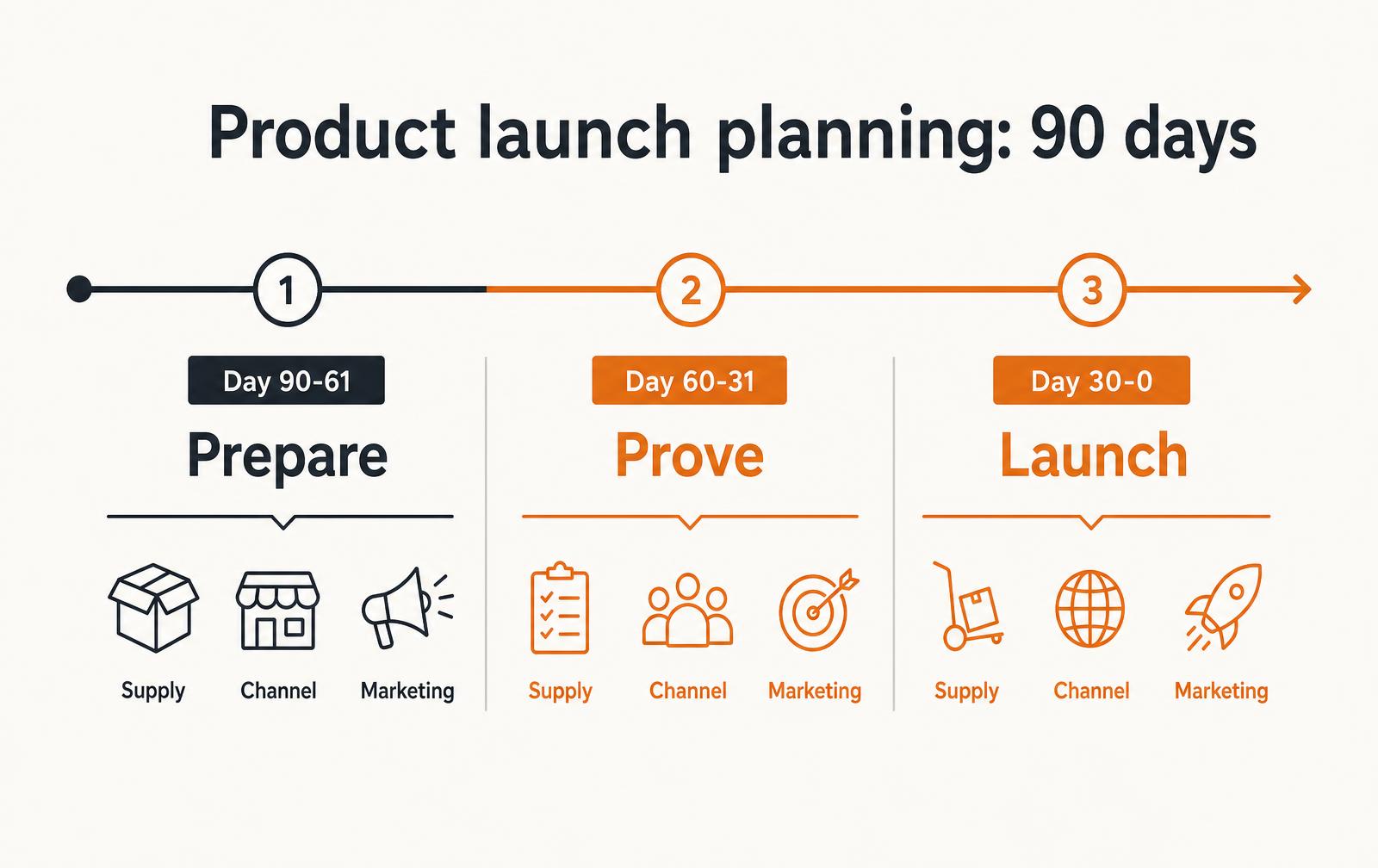
Product launch planning for a physical product runs three tracks in parallel - supply, channel and marketing - over roughly 90 days. The launch date is set by the slowest track, and for hardware that is almost always supply. Plan backwards from the date inventory is physically in the warehouse, not from the date the campaign is ready.
The 90-day structure
Phase | Days | Supply | Channel | Marketing |
|---|---|---|---|---|
Prepare | 90-61 | Pilot run, packaging approved, QC plan | Pricing and margin stack, listings drafted | Positioning, assets, launch narrative |
Prove | 60-31 | First production order placed, freight booked | Retail or marketplace accounts live, terms signed | Reviewer and beta units out, PR briefed |
Launch | 30-0 | Inventory received and counted, spares stocked | Listings live, fulfillment tested end to end | Campaign live, support scripts ready |
Supply is the critical path
A launch fails loudly when demand arrives and stock does not. Before you commit to a date, confirm the pilot run passed, the packaging is approved as artwork and as a drop-tested structure, and the freight mode is booked. Ocean freight adds four to six weeks and does not care about your campaign calendar. Keep a small air-freight buffer for the first weeks if the margin allows it.
Channel setup people forget
- GS1 barcodes and GTINs registered under your own company prefix.
- Listing copy, A+ content and photography approved for each channel.
- Returns and warranty policy written, with the reverse-logistics address live.
- Fulfillment tested with a real order, including tax and shipping edge cases.
- Distributor and retailer margin confirmed against the MSRP you published.
Marketing that fits a hardware launch
Hardware buyers need proof, not hype. Get production-intent units to reviewers and early customers 30 to 45 days out, collect usage photography from real environments, and lead with the problem the product removes. A launch page with clear specs, dimensions and shipping dates converts better than a countdown timer. Pair this with your wider product launch strategy so the message and the plan are the same document.
Launch gates
Gate | Question | Hold the date if |
|---|---|---|
T-60 | Did the pilot run pass QC at yield? | Yield is below plan or defects are unresolved |
T-45 | Is the production order in and freight booked? | No confirmed ship date from the factory |
T-30 | Is fulfillment tested end to end? | A real test order has not completed |
T-14 | Is inventory received and counted? | Stock is still in transit or in customs |
T-7 | Is support ready to answer the top 10 questions? | No scripts, no returns process, no spares |
The 90-day launch calendar
Window | Focus | Key deliverables |
|---|---|---|
Days 1-15 | Lock the offer | Final SKU list, pricing, packaging copy approved |
Days 16-30 | Supply readiness | PO placed, production schedule and ship date confirmed |
Days 31-50 | Channel setup | Listings, product photography, shipping rates, returns policy |
Days 51-70 | Demand build | Email list warm-up, early reviewer seeding, paid test budget |
Days 71-85 | Soft launch | Limited release, fulfillment dry run, fix listing gaps |
Days 86-90 | Full launch | Press and partner push, ad spend scaled, daily metrics review |
Metrics to watch in week one
- Conversion rate by traffic source. Tells you whether the problem is the offer or the audience.
- Cost per acquisition versus contribution margin. Stop scaling any channel where CPA exceeds margin.
- Add-to-cart to checkout drop-off. Usually shipping cost or trust signals, both fixable in a day.
- Fulfillment cycle time. Orders shipped within 48 hours protects reviews more than any ad.
- Defect and return reasons. Categorize every return in week one; patterns appear fast at low volume.
The 90-day launch calendar, week by week
A physical product launch fails on logistics far more often than on messaging. Inventory has to land, listings have to be live and indexed, and support has to be staffed before the first campaign dollar is spent. Working backwards from the on-sale date keeps those dependencies visible instead of surfacing them the week of launch.
Treat the calendar as a set of gates rather than a wish list. If inventory is not in the warehouse by the receiving gate, the launch date moves - and moving it deliberately costs far less than launching into a stockout, which burns paid traffic and produces the negative early reviews that suppress a listing for months.
Window | Focus | Gate to clear |
|---|---|---|
Day 90-70 | Inventory PO, packaging artwork final | Production booked and paid |
Day 70-50 | Listings, photography, copy, pricing | Assets approved |
Day 50-30 | Freight booked, customs docs, warehouse receiving | Inventory in transit |
Day 30-14 | Seeding, PR, influencer samples, email warm-up | Units received and counted |
Day 14-0 | Paid campaigns staged, support scripts, returns policy | Listings live and buyable |
Protecting your own capacity through the crunch
Launch periods break founders because everything becomes urgent at once. The practical defense is deciding in advance what is not going to happen: features that will not ship, markets that will not open, and channels that will not be tested until after launch. A written non-goals list is the only thing that reliably stops scope from expanding during the final month.
Delegate the decisions with clear thresholds - who may authorize a freight upgrade, who approves a discount, what a support agent can refund without asking. Teams that pre-authorize these calls move quickly during launch week; teams that route everything through one person stall.
- Write a non-goals list and share it with the whole team.
- Set spend and refund thresholds people can act on without approval.
- Block two recovery days immediately after launch week.
- Keep one weekly planning meeting; cancel the rest during crunch.
- Track a single launch dashboard instead of parallel status threads.
- Decide the stockout plan before you need it.
Key takeaways
- Plan the launch backwards from the on-sale date with hard gates.
- Inventory receiving is the gate that most often slips - protect it.
- Launching into a stockout costs more than delaying two weeks.
- Pre-authorize decisions so launch week does not bottleneck on one person.
- A written non-goals list is the cheapest scope control available.

Measuring the launch instead of guessing
Decide before launch which numbers determine whether it worked, and instrument them. For a physical product the meaningful set is small: sell-through rate against inventory, cost per acquired customer by channel, return rate, review velocity and rating, and contribution margin per unit after fulfillment. Vanity metrics like impressions tell you nothing about whether the second production run is justified.
Review the dashboard daily for the first two weeks and weekly after that. Early return reasons and support tickets are the highest-value data you will ever collect about the product, because they arrive while the next revision is still open.
Metric | Why it matters | Healthy early signal |
|---|---|---|
Sell-through rate | Tells you whether to reorder | 15-30% of first run in 30 days |
Cost per acquisition | Determines channel viability | Below 30% of contribution margin |
Return rate | Flags design or expectation gaps | Under 5% for most categories |
Review velocity and rating | Drives marketplace ranking | 4.3+ with steady inflow |
Contribution margin per unit | Decides whether growth is fundable | Positive after fulfillment and ads |
Frequently asked questions
How long should product launch planning take?
Ninety days is a workable window once production is proven. If the pilot run has not happened yet, plan 120 to 180 days, because the supply track cannot be compressed the way a campaign can.
What should a product launch plan include?
A dated plan across three tracks - supply, channel and marketing - with named owners, explicit gates, an inventory forecast, a pricing and margin stack, a support plan and a defined rollback if stock slips.
How much inventory should you launch with?
Enough to cover eight to twelve weeks of forecast demand at your realistic case, plus replenishment lead time. Launching with less risks a stockout during the only window you get free attention; launching with far more ties up cash before demand is proven.
Who owns the launch?
One person with authority over all three tracks. Split ownership between marketing and operations is the most common reason a launch date slips silently until it cannot be recovered.
The readiness review that stops bad launches
A product launch readiness checklist only works if someone can fail it. The teams that ship cleanly hold a formal go/no-go review at a fixed date with named owners per area and a written exit criterion for each. Without that, launch date becomes the only forcing function and everything unfinished quietly ships anyway.
Go/no-go review areas
Area | Exit criterion | Owner |
|---|---|---|
Design | All verification tests passed and signed | Engineering lead |
Manufacturing | First article approved, process capability demonstrated | Operations |
Quality | Inspection plan in place, defect escapes defined | Quality |
Compliance | Certificates in hand, labels correct on real units | Regulatory |
Supply | Launch quantity in hand plus reorder placed | Supply chain |
Channel | Listings live, pricing and returns policy set | Commercial |
Support | Documentation, FAQs and ticket routing ready | Support |
Any red item requires either a fix or an explicit, written acceptance of the risk by a named person. That single rule converts a checklist from a formality into a decision, and it is the cheapest quality control step in the entire program.
Running the review
- Hold it two to three weeks before shipping, not the day before.
- Require evidence, not verbal assurance, for each green status.
- Give one person authority to call a delay.
- Record accepted risks with an owner and a mitigation date.
- Re-run the failed items in a short follow-up, not the full review.
Key takeaways
- A readiness checklist matters only if failing it can delay the launch.
- Require evidence per area and a named owner for every accepted risk.
- Hold the review with enough runway to actually fix what it finds.
Want help getting a product launch-ready on schedule?
Work with LA NPDT: if you are moving from here to execution, start with our product development consulting or talk to us about end-to-end product development.
Filed under:Uncategorized
Services related to this guide
- Product design servicesIndustrial design and CAD taken all the way to manufacturable files.
- Rapid prototypingWorking prototypes in days, from 3D printing to vacuum casting.
- Electronic design servicesSchematic, PCB layout, firmware and bring-up, through to production handoff.
- Product development examplesReal projects we designed, prototyped and shipped.