Outsourced Product Development: Models, Costs and How to Keep Control
Outsourcing works when you rent capability, and fails when you outsource judgment. Compare the three models, the rates and the contract terms that protect you.
December 5, 20255 min read

Written by Onega Ulanova, IRCA Lead Auditor, MS Eng. & Tech. Management, Executive MBA
Co-Founder, Quality Management Executive & Lead Auditor
Published December 5, 2025Updated September 2, 2026
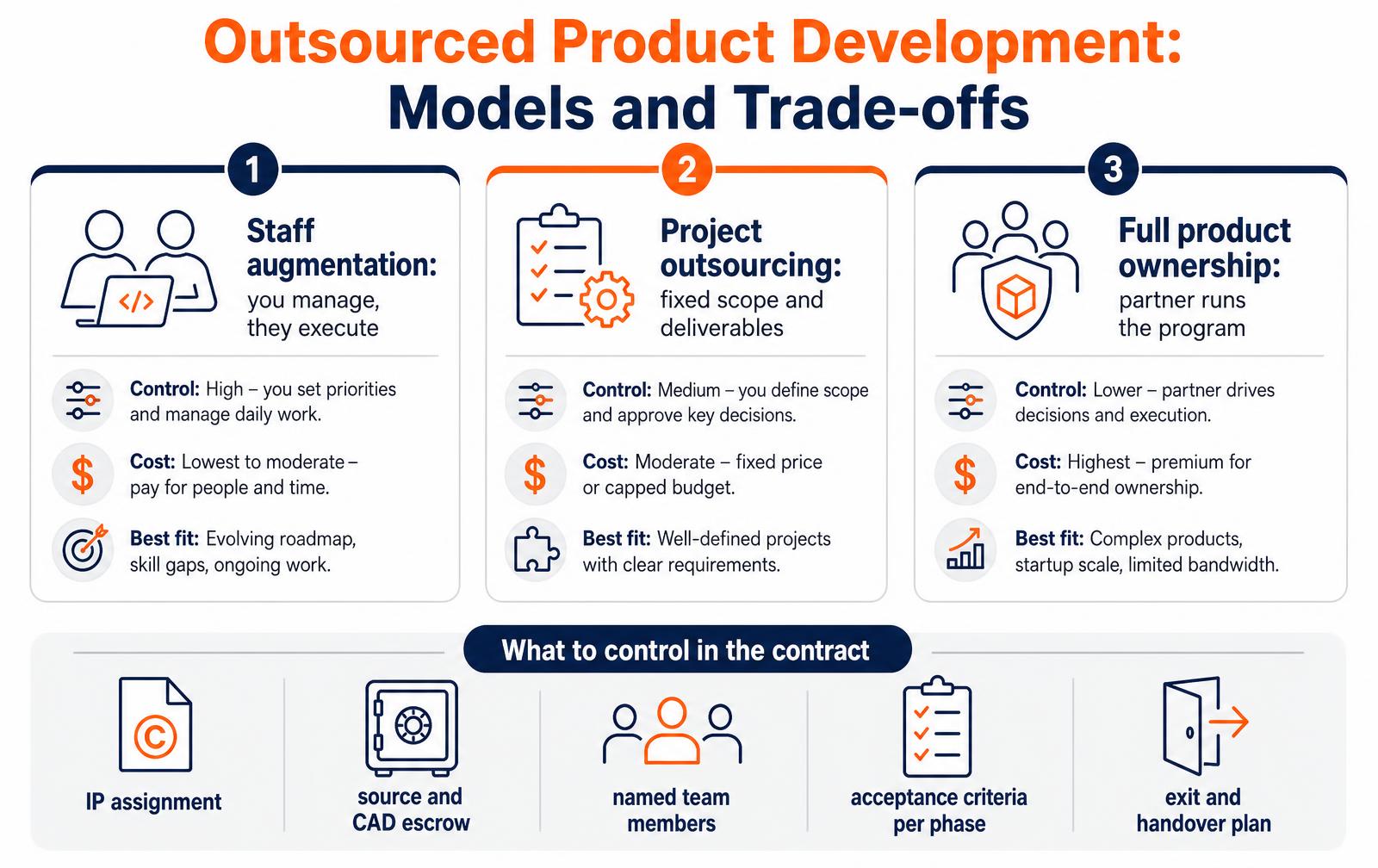
Outsourced product development works when you rent capability you genuinely do not have, and fails when you outsource judgment. The difference is not the vendor's skill — it is how the engagement is structured, who owns decisions, and what the contract says about files, people and exits.
The three engagement models
Model | You provide | Typical cost | Best fit |
|---|---|---|---|
Staff augmentation | Requirements, direction, daily management | $40-$120/hr per person | A clear roadmap and an internal lead with capacity to run it |
Project outsourcing | Scope, acceptance criteria, review at each gate | $50k-$250k fixed per phase set | A defined deliverable such as a working prototype or a DFM release |
Full product ownership | Business goals, budget, decision authority at gates | $150k-$500k+ per program | No internal engineering org and a product that must ship |
The common mistake is choosing staff augmentation for cost reasons without anyone internal able to manage it. Rented engineers with no decision-maker produce activity, not progress.
What to lock down in the contract
- IP assignment on creation, not on final payment, covering CAD, schematics, firmware and documentation
- Source and CAD escrow or weekly delivery so a dispute never leaves you without your own design
- Named team members with a notice requirement before substitutions
- Acceptance criteria per phase, written before the phase starts, in measurable terms
- An exit and handover plan: file formats, documentation standard, and a paid transition window
Onshore, nearshore or offshore
Location | Blended rate | Trade-off |
|---|---|---|
Onshore US | $120-$220/hr | Highest rate, same timezone, easiest for regulated and physical products |
Nearshore Latin America | $45-$90/hr | Overlapping hours, strong software depth, thinner hardware and test capability |
Offshore Eastern Europe / Asia | $25-$70/hr | Lowest rate, requires tight specs and an internal owner to avoid rework |
For physical products the calculus is different from software: someone has to hold the prototype, sit in the factory, and argue about a tolerance. Rate savings evaporate quickly when nobody on your side of the world can inspect a part. That is why many teams keep DFM and prototyping close and outsource execution work further out.
How to run the engagement so it does not drift
- One named decision-maker on your side who can approve or reject at each gate
- A weekly demo of something real — a part, a build, a test result — never a status slide
- Requirements kept in one living document that both sides edit and version
- A change-order process with a price and a schedule impact attached to every change
- A risk list reviewed every gate, with the top three risks having active mitigations
Frequently asked questions
What is outsourced product development?
It is contracting an external team to design, engineer and prepare a product for production instead of building that capability in-house. It ranges from renting individual specialists to handing a partner full responsibility for the program from concept through manufacturing transfer.
How much does outsourced product development cost?
Blended rates run roughly $25-$70 per hour offshore, $45-$90 nearshore and $120-$220 onshore. On a project basis, a defined phase such as prototype development is commonly $50,000-$250,000, and a full program from concept to production-ready design is typically $150,000-$500,000.
How do I protect my IP when outsourcing?
Sign an NDA before disclosure, assign IP on creation rather than on payment, file a provisional patent before wide disclosure, take weekly delivery of native files, and keep the most differentiating subsystem in-house or split across vendors so no single party holds the whole design.
When is outsourcing the wrong choice?
When the work is the core of your competitive advantage and will be iterated forever, when nobody internally can make decisions at the pace the vendor needs them, or when requirements are genuinely unknown and will only emerge through daily experimentation.
Pick the engagement model before you pick the vendor
Most disappointing outsourced product development engagements are not vendor-quality failures. They are model mismatches: a team that needed embedded engineers bought a fixed-price project, or a team that needed a turnkey programme bought hourly contractors and then had nobody to own the schedule.
Decide which of the three models fits your internal bandwidth first, then shortlist firms that genuinely run that model rather than the one they wish you would buy.
Model | Who owns the plan | Commercial shape | Where it breaks |
|---|---|---|---|
Staff augmentation | You | Hourly or monthly per person | No internal manager to direct daily work |
Project outsourcing | Shared | Fixed price per phase, defined deliverables | Requirements still moving when you sign |
Full product ownership | Partner | Phase fees plus milestone payments | You disengage entirely and lose domain knowledge |
Hybrid (your PM, their team) | You, with partner leads | Retainer plus scoped phases | Two project managers, one plan, no tiebreaker |
What outsourced engineering actually costs
Region | Mechanical / industrial design | Electronics and firmware | Practical caveat |
|---|---|---|---|
US onshore | $110-$185 per hour | $130-$210 per hour | Fewer timezone and spec-translation losses |
Eastern Europe | $45-$85 per hour | $55-$95 per hour | Strong EE talent; verify export and IP terms |
Latin America | $50-$95 per hour | $60-$110 per hour | Overlapping hours with US teams |
South and Southeast Asia | $25-$60 per hour | $30-$70 per hour | Best for well-specified, low-ambiguity work |
China (near factory) | $35-$75 per hour | $40-$85 per hour | Fast DFM iteration, weakest IP posture |
Blended rate is the wrong comparison. A $60 per hour team that needs three iterations to reach a releasable drawing package costs more than a $150 per hour team that reaches it in one, and it costs far more once tooling is cut from the weaker package. Compare cost per released deliverable — a validated CAD package, a passing EMC pre-scan, a working DVT build — not cost per hour.
The hidden costs nobody quotes
- Specification translation. Budget 10-15% of the engagement for writing requirements clearly enough that a team outside your building can act on them.
- Review load on your side. Someone internal spends 5-10 hours per week reviewing, deciding and unblocking. That person is not free.
- Rework from timezone lag. A question that waits 18 hours for an answer becomes an assumption, and assumptions become change orders.
- Sample shipping and customs. Physical products move physical parts; $2k-$8k per programme is routine and always forgotten.
- Handover. Bringing files, test data and tribal knowledge in-house at the end is a real project, typically two to four weeks.
Protect the IP before the first invoice
- Work-for-hire and present assignment of all inventions, signed by the entity and by every named contributor.
- Native CAD, schematics, firmware source, and BOMs delivered at each phase gate — not renders and PDFs.
- Source and CAD escrow, or a repository you own with the vendor as a contributor rather than the owner.
- Named key personnel with a substitution clause requiring your written approval.
- No use of your designs in the vendor's portfolio or marketing without written consent.
- Background IP listed explicitly, so you know what stays licensed rather than owned.
A 30-day vetting sequence that filters fast
Days | Step | Pass signal |
|---|---|---|
1-5 | Paid discovery brief to two or three firms | They challenge the brief and surface risks you missed |
6-12 | Reference calls with two shipped-programme clients | References describe schedule misses honestly and how they were handled |
13-18 | Technical deep dive with the actual engineers | The people on the call are the people on the contract |
19-24 | Small paid pilot: one subsystem or one drawing package | Deliverable arrives complete, on date, in native formats |
25-30 | Contract and phase plan negotiation | Acceptance criteria per phase, exit terms, IP assignment agreed without friction |
The paid pilot is the highest-value filter in this list. Two to five thousand dollars of real work tells you more about communication cadence, documentation quality and honesty about problems than any proposal or portfolio deck.
Govern the engagement so it stays yours
- Written acceptance criteria per phase, agreed before the phase starts — not judged afterwards.
- A weekly 30-minute decision call with a running decision log; email threads are not a record.
- A single accountable owner on your side with authority to approve, not just to relay.
- Design reviews at concept, detailed design and pre-release, with your manufacturing partner present.
- Monthly IP hygiene check: are all files in your repository, in native format, with revision history?
- A written exit plan from day one, covering file handover, outstanding licences and a knowledge-transfer session.
More questions teams ask
Frequently asked questions
What is outsourced product development?
It is contracting an external firm to perform part or all of the engineering, design and development work for a product you own. Models range from embedding external engineers in your team, through fixed-scope project work, to a partner running the full programme from concept to production release.
How much does outsourced product development cost?
Rates run roughly $25-$70 per hour offshore and $110-$210 per hour onshore, but the meaningful figure is cost per released deliverable. A typical consumer hardware programme from concept to production-ready package lands between $80k and $400k depending on electronics content, certification scope and tooling complexity.
How do I protect my IP when outsourcing?
Sign work-for-hire with present assignment of inventions, require native source files at every phase gate, hold CAD and firmware in a repository you own, use escrow where the vendor insists on hosting, and name key personnel with approval rights over substitutions.
Should I outsource onshore or offshore?
Outsource offshore when the work is well specified and repeatable, and onshore when requirements are still evolving or certification and regulated documentation are involved. Many teams do both: onshore architecture and system engineering, offshore detailed design and test execution.
When is outsourcing the wrong choice?
When the technology is your core differentiator and you intend to keep developing it for years, when nobody internal has time to review and decide weekly, or when requirements are so unformed that any contract would be a guess. Fix the internal ownership gap first — outsourcing amplifies it rather than filling it. Work with LA NPDT: if you are moving from here to execution, start with our new product marketing or talk to us about market research .
Filed under:EducationUncategorized
Tagged:2025
Services related to this guide
- Low-volume manufacturingFirst production runs without full injection-mould tooling.
- Best product development companiesHow the leading US firms compare, and which one fits your stage and budget.
- Product design servicesIndustrial design and CAD taken all the way to manufacturable files.
- Order a prototypeSend a part or an idea and get a build quote back.