How to choose a prototyping partner: a 12-question checklist
Twelve questions that separate a shop that prints your file from a partner who makes your product work — with the answers you should expect to hear.
August 29, 20261 min read

Written by Konstantin Dolgan, Ph.D., NPDP
Founder & CEO, Product Development Engineer
Published August 29, 2026
The fastest way to evaluate a prototyping partner is to ask twelve specific questions and listen for vague answers. Capability lists all read the same. How a shop answers questions about iteration, IP, cost overruns and manufacturing handoff tells you what working with them is actually like.
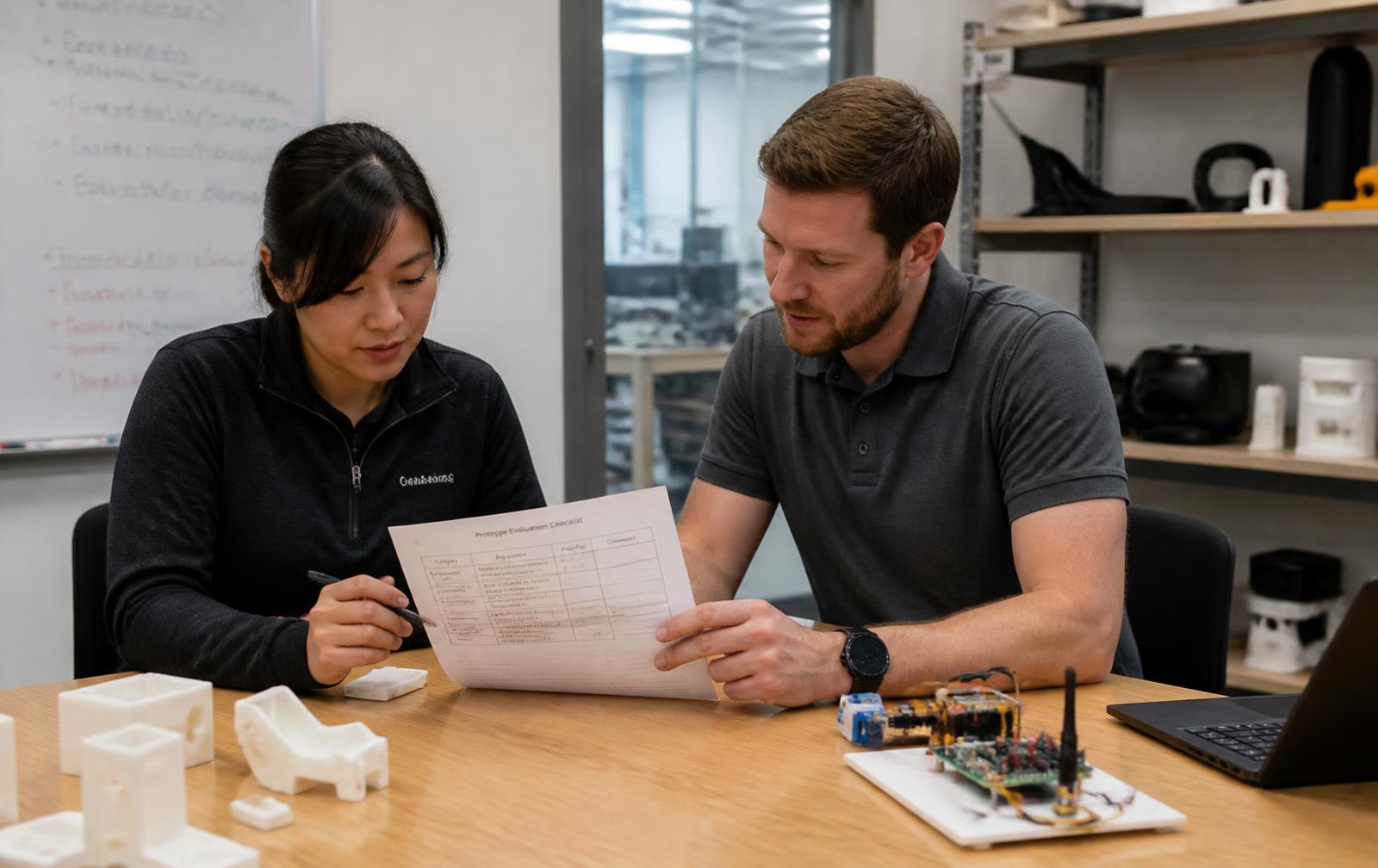
The twelve questions
Ask this | A good answer sounds like | A bad answer sounds like |
|---|---|---|
What do you build in-house versus outsource? | A specific list of machines and processes, and honesty about what they send out | Everything, always |
Who owns the CAD and the IP? | You do, on payment, with source files delivered | We retain our design files |
What happens when the first prototype fails? | Failure is expected; here is how revisions are scoped and priced | Our prototypes work |
How do you decide fidelity? | Tied to the question being answered — looks-like, works-like or both | Highest fidelity available |
Can I see a project like mine? | Named projects, with the constraints and the outcome | A gallery of renderings |
What is not included in this quote? | A clear exclusion list | Nothing, it is all-inclusive |
How do you handle tolerances and fits? | A stack-up discussion before parts are cut | Standard tolerances |
What does the manufacturing handoff include? | Drawings, BOM, tolerances, supplier package, unit-cost estimate | We will help you find a factory |
Do you have a manufacturing preference or kickback? | Independent, or a disclosed relationship | Evasion |
Who will actually do the work? | Named engineers you meet | A sales contact only |
How do you communicate progress? | A cadence, and a named point of contact | Weekly-ish updates |
What would make you decline this project? | A real answer with real limits | Nothing, we do it all |
Frequently asked questions
How much should prototyping cost?
Ranges vary with complexity and certification needs. Our prototype cost calculator narrows this for a specific project in a few minutes.
What are the warning signs?
- A fixed price quoted before anyone has asked what the product must do.
- No named engineer, only a salesperson.
- Refusal to hand over source CAD, or IP terms that keep the design with the shop.
- Renderings presented as prototypes in the portfolio.
- No mention of design for manufacturing anywhere in the proposal.
- Pressure to cut tooling early — mold cost is where uninformed money disappears fastest.
Local shop, marketplace, or full development partner?
A local machine shop is ideal when you have drawings and want to stand next to the machine. A marketplace is ideal when the design is settled and price matters most — see the comparison here. A development partner is what you want when the design itself is the open question, or when the prototype has to become a product with a bill of materials, a supplier and a unit cost.
More depth: types of prototypes explained, how prototype manufacturing works, and our prototype design service. When you are ready, the prototype development application takes about five minutes.
Proof from our own work: LEIA shows how a partner engagement handles material, tooling, and user testing as one decision set.
Services related to this guide
- Best product development companiesHow the leading US firms compare, and which one fits your stage and budget.
- Best product design companiesDesign studios compared by scope, industry and what they hand off.
- Product engineering companiesEngineering firms for physical products compared by discipline, rigor and budget.
- Consultant vs firm vs freelancerWhat each option costs, what it delivers and where to find them.