How to Write a Product Design Brief (With a Template)
A product design brief turns an idea into a set of testable requirements. Here is the structure we use, section by section, with a copyable template.
August 20, 20265 min read

Written by Konstantin Dolgan, Ph.D., NPDP
Founder & CEO, Product Development Engineer
Published August 20, 2026
A product design brief is a short document that states what the product must do, for whom, under what constraints, and how success will be measured - before anyone opens CAD. Write it in one to four pages, make every requirement testable, and agree on it in writing. A brief that cannot be tested is a wish list, and wish lists are what produce three rounds of redesign.
What a product design brief actually is
A design brief is not a marketing summary and not a specification document. It sits between them. Marketing describes the opportunity; the engineering specification describes the solution in detail. The brief is the bridge: it captures the problem, the user, the constraints and the acceptance criteria so a design team can propose solutions without guessing what you meant.
Most late-stage change requests on hardware programs trace back to something that was never written down: an assumed price point, an unstated certification, a distribution channel that dictates packaging size. The brief exists to surface those before they cost tooling money.
The ten sections of a working brief
Section | What it must answer | Typical length |
|---|---|---|
Product summary | What is it, in one paragraph a stranger understands | 3-5 sentences |
User and job | Who uses it, in what setting, to accomplish what | 1 paragraph + 1 scenario |
Problem statement | What is wrong with today's options | 3-5 bullets |
Functional requirements | Measurable performance the product must hit | Table |
Constraints | Size, weight, cost, power, materials, standards | Table |
Use environment | Temperature, moisture, drops, cleaning, storage | 5-8 bullets |
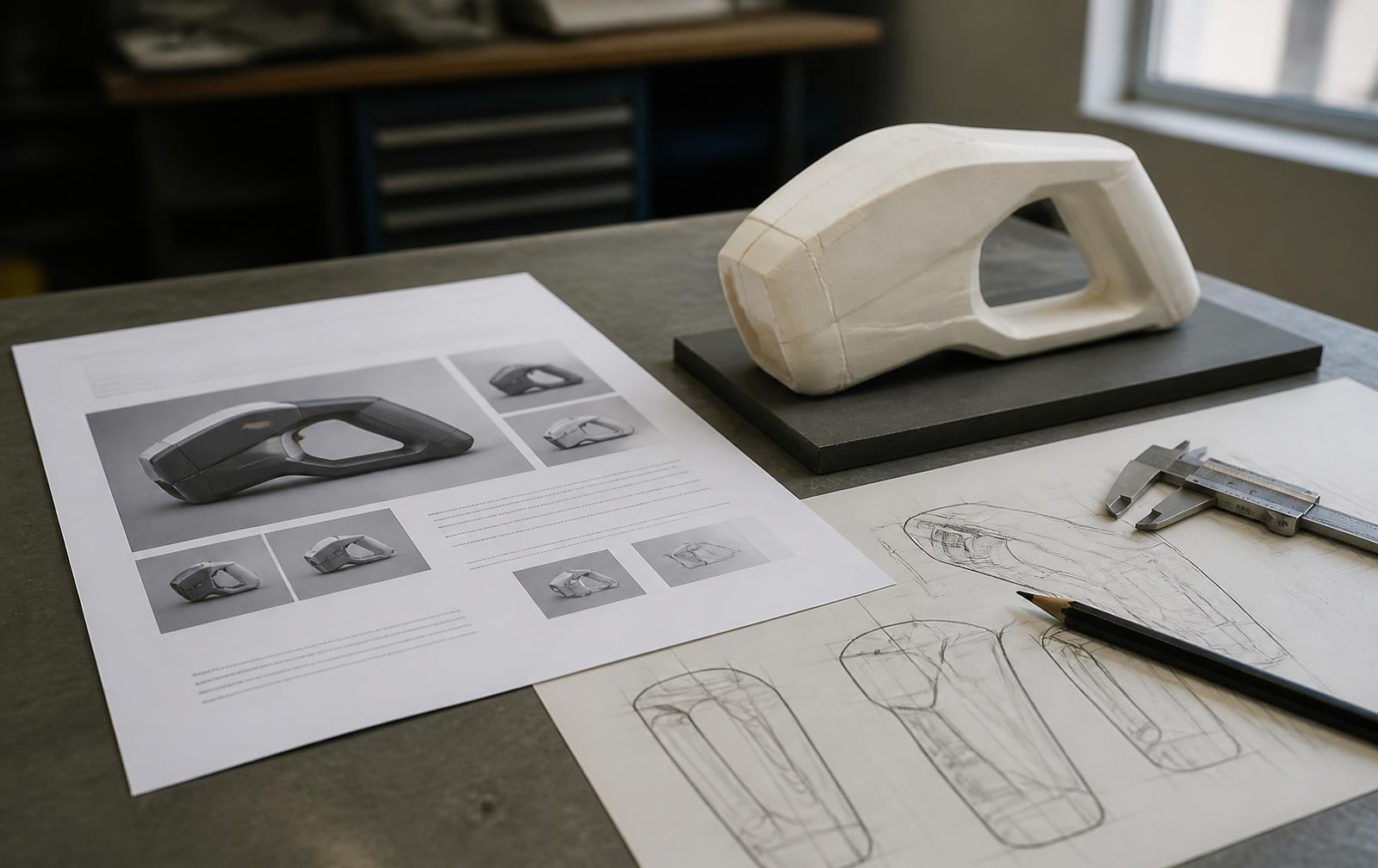
Aesthetic direction | References, brand cues, finishes to avoid | Images + notes |
Volume and cost targets | Year-one units, landed cost target, retail price | 3 numbers |
Timeline and milestones | Launch date and what it is anchored to | Dated list |
Deliverables and success criteria | What is handed over, and what proves it worked | Checklist |
Step 1: Define the user and the job before the product
Write one concrete usage scenario in plain language: who picks the product up, where they are standing, what they are wearing, what they do just before and just after. A scenario constrains geometry better than a persona does. "Used one-handed by a nurse wearing nitrile gloves, in a corridor, while holding a chart" rules out half the possible interfaces immediately, and it does so without prescribing a shape.
If more than one user touches the product - buyer, operator, installer, service technician - list each of them and what each one needs. Products usually fail the user who was left off that list.
Step 2: Turn wants into measurable requirements
Every requirement should name a quantity and a test method. If you cannot describe how you would check it, it is not a requirement yet.
Vague want | Testable requirement |
|---|---|
Should feel premium | No visible sink marks; matte texture MT-11010; assembly gaps under 0.3 mm |
Must be durable | Survives 10 drops from 1.2 m onto concrete on each face, no functional loss |
Long battery life | Minimum 14 days of standby at 20 C with a 500 mAh cell |
Easy to clean | Withstands 500 wipe cycles with 70% isopropyl alcohol, no crazing |
Waterproof | IP67 per IEC 60529, verified on three units |
Lightweight | Under 340 g including battery and packaging insert |
Step 3: Write the constraints down, including the awkward ones
- Landed cost target and the assumed annual volume - a $9 target at 2,000 units per year is a different product than at 200,000.
- Certifications and standards that apply: FCC, UL, FDA classification, CPSIA for children's products, food-contact materials.
- Existing assets you must reuse: an electronics module, a battery, a mold, a supplier relationship.
- Distribution: shelf dimensions, shipping carton limits, whether it must fit a standard parcel tier.
- Sustainability requirements: recycled content, mono-material housings, no glued assemblies.
- Intellectual property: prior filings, competitor patents to design around, brand guidelines to honor.
Step 4: State deliverables and success criteria
Name what is handed over at the end of each phase - sketch concepts, CAD, renderings, a functional prototype, a manufacturing package - and what evidence closes the phase. A useful pattern is one hard number per milestone: "three concepts, one chosen by the steering group," "a prototype that survives the 1.2 m drop test," "a quoted bill of materials under $14." Vague milestones let a program drift for a month without anyone being wrong.
If you are unsure what those phases cost or how long they take, our concept design cost and timeline page has current ranges, and how much a prototype costs to make breaks down the prototype line item.

A product design brief template you can copy
- 1. Product summary - what it is, in one paragraph.
- 2. User and job - primary user, secondary users, one written usage scenario.
- 3. Problem statement - what today's options get wrong, with evidence.
- 4. Functional requirements - a table of quantity + test method for each.
- 5. Constraints - cost, volume, size, weight, power, standards, reused assets.
- 6. Use environment - temperature, moisture, chemicals, drops, storage, cleaning.
- 7. Aesthetic direction - three reference images you like, two you do not, and why.
- 8. Cost and volume targets - landed cost, year-one units, target retail price.
- 9. Timeline - launch date and the event it is anchored to, with phase milestones.
- 10. Deliverables and acceptance - what is handed over, who signs off, what proves success.
- 11. Open questions - anything not yet decided, with an owner and a date.
Section 11 matters more than it looks. Briefs that pretend to be complete get contradicted in week three; briefs that list their own unknowns get resolved on schedule.
Five mistakes that make a brief useless
- Describing a solution instead of a problem - "a cylindrical aluminum housing" removes the option that would have been cheaper and better.
- No cost target, on the theory that it will be figured out later. It will be, badly, after the form is frozen.
- Requirements without test methods, which turn every review into an opinion contest.
- Skipping the use environment, then discovering the product lives outdoors.
- One long paragraph instead of numbered sections - nobody can review, redline or sign off on prose.
What happens after the brief is signed
The brief becomes the input to concept design: several distinct directions explored against the same requirements, then narrowed with the acceptance criteria you wrote. See the concept design process step by step for how the phases run, and product design principles for how the trade-offs get resolved when form, function and cost disagree.
If you want the brief written with an engineering team rather than handed to one, that is how our concept design services start - a working session that produces the requirement table, then concepts against it.
Sources and reference standards
- IEC 60529 IP ratings - the ingress protection scale to cite instead of "waterproof."
- CPSC regulations and standards - consumer product safety requirements in the US.
- FCC equipment authorization - required for most products with a radio or digital circuitry.
- USPTO trademark search - screen the product name before it enters the brief.
Frequently asked questions
How long should a product design brief be?
One to four pages for most hardware products. Length comes from the requirement and constraint tables, not from prose. If it runs past six pages, it has probably absorbed the engineering specification, which should be a separate, later document.
What is the difference between a design brief and a product specification?
The brief defines the problem, the constraints and the acceptance criteria before solutions exist. The specification defines the chosen solution in enough detail to build and inspect it: dimensions, tolerances, materials, finishes, test plans. The brief is written once at the start; the specification grows through the program.
Who writes the product design brief?
The product owner writes the first draft, because it encodes commercial intent - price, volume, launch date. It should then be reviewed with an engineer and a manufacturing contact, who will catch the requirements that cannot coexist. An inventor or startup founder without an in-house team usually writes it with their design partner in a single working session.
Can I write a brief before I know my manufacturing method?
Yes, and you usually should. Annual volume and cost target imply the process - a few thousand units per year rarely justifies injection mold tooling, while a hundred thousand almost always does. State the volume and the cost, and let the design phase select the process.
What should a design brief include about aesthetics?
Reference images with the reason attached. Three products whose look you want to be associated with, two you want to avoid, and one sentence each explaining what specifically you like or dislike - proportion, finish, color, detailing. Adjectives alone ("clean," "premium") are interpreted differently by every designer who reads them.
Do I need a design brief for a simple product?
The simpler the product, the shorter the brief - but still write it. A single page with a usage scenario, six measurable requirements, a cost target and a launch date prevents most of the rework that simple products still manage to generate.
Services related to this guide
- Product design servicesIndustrial design and CAD taken all the way to manufacturable files.
- Best industrial design firmsWhich studios take an idea from form to manufacturable hardware, and what they charge.
- Prototype designLooks-like, works-like or pre-production: what each proves and what it costs.
- Product development examplesReal projects we designed, prototyped and shipped.