Consumer Electronics Manufacturing: EVT, DVT, PVT and What Units Really Cost
The build stages, certification path and unit economics behind consumer electronics manufacturing — and the four things that push launch dates.
October 11, 20228 min read

Written by Konstantin Dolgan, Ph.D., NPDP
Founder & CEO, Product Development Engineer
Published October 11, 2022Updated September 2, 2026
A working prototype is roughly a third of the way to a shippable consumer electronic product. The rest is a disciplined sequence of pilot builds, certification and process control that turns one hand-assembled unit into ten thousand identical ones. This guide walks the stages, the money and the four failure modes that push launch dates.
The three pilot builds
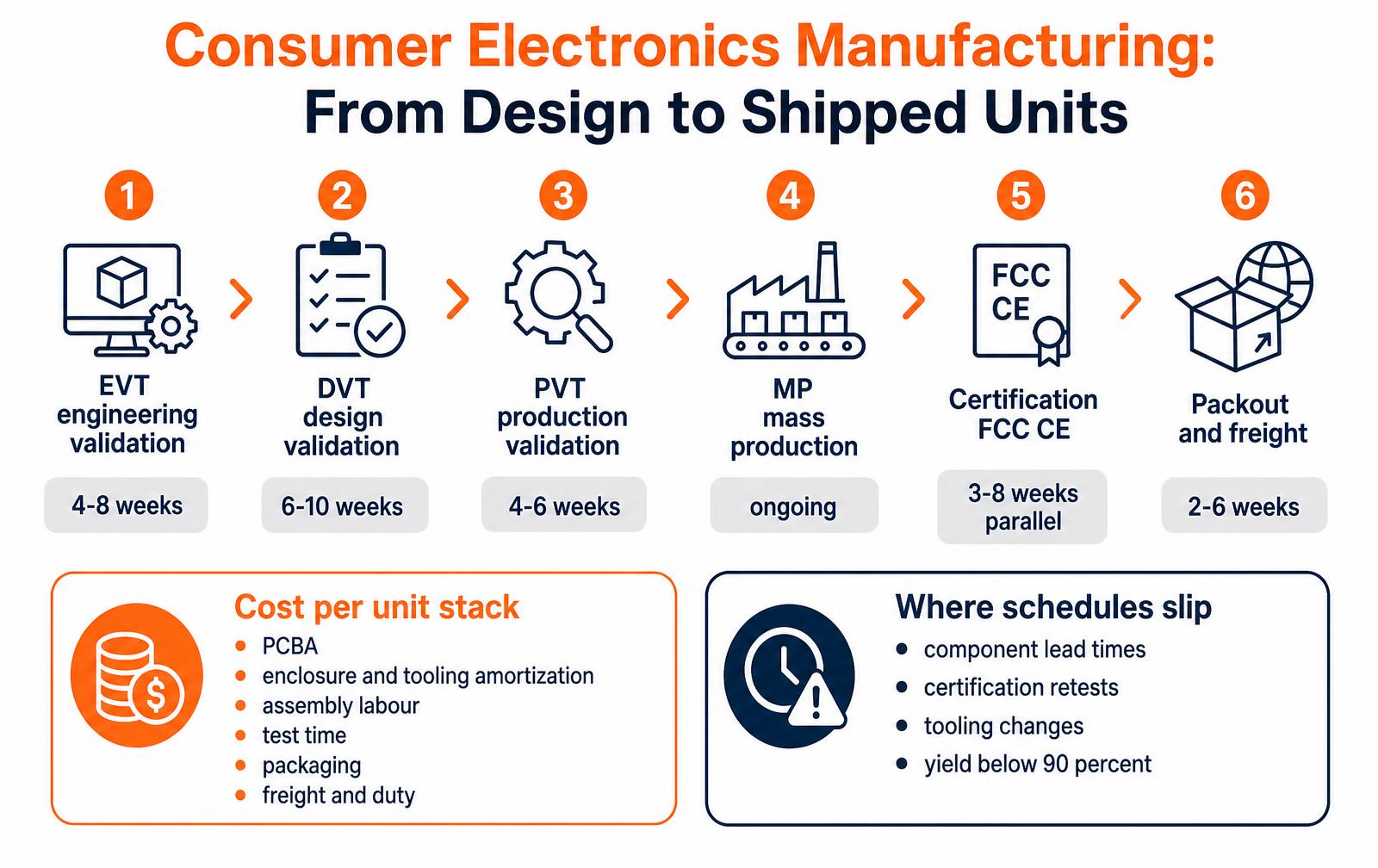
- EVT — engineering validation. 20-100 units, often on soft tooling. The question is only: does the design work? Expect schematic revisions and mechanical fit changes.
- DVT — design validation. 100-500 units on production-intent tooling and processes. Full environmental, drop, life and compliance pre-testing happens here. After DVT the design should be frozen.
- PVT — production validation. 500-2,000 units built by factory operators at line rate, with no engineers rescuing units. You are validating the process and measuring yield, not the design.
- MP — mass production. Ramp only after PVT yield holds above your target, typically 95 percent or better at final test.
Where the money goes
Cost item | Typical range | Notes |
|---|---|---|
Injection mould tooling | $8k-$60k per tool | Family tools reduce count; steel grade sets tool life |
EVT / DVT / PVT builds | $15k-$120k total | Includes scrap, rework and travel |
FCC, CE and UKCA testing | $8k-$35k | Retests after any RF-affecting change |
Safety and battery (UL, UN38.3) | $5k-$25k | Required for lithium cells and shipping |
Test fixtures and jigs | $5k-$40k | One per station; often underbudgeted |
Packaging design and drop testing | $4k-$20k | ISTA testing before the first container |
Per-unit cost stacks up from PCBA, enclosure with amortized tooling, assembly labour, test time, packaging, freight and duty. A useful rule: if your landed cost is not roughly a quarter of intended retail, the model will not survive retail margins and returns.
Certification is a schedule item, not a formality
Any product with a radio needs FCC in the United States and CE or UKCA in Europe, and labs book out weeks ahead. Lithium batteries add UN38.3 transport testing before any air freight.
The trap is sequencing: teams change an antenna, a plastic wall thickness or a supplier after testing and unknowingly invalidate the report. Freeze the RF-relevant design at DVT and book the lab slot then.
Pair this with design for manufacturing work so the frozen design is also the cheap one.
Four things that actually slip schedules
- Component lead times. One 40-week microcontroller can hold a whole build. Design in second sources during schematic, not during a shortage.
- Tooling changes. Every steel change costs one to three weeks. This is why DVT exists.
- Certification retests. Budget one retest by default.
- Yield below target. Sub-90 percent yield at final test quietly doubles labour cost and delays ramp until the root cause is found.
Where the unit cost actually goes
Cost element | Share of landed cost | What moves it |
|---|---|---|
Electronics BOM | 35-55% | Chipset choice, memory, connectivity, allocation risk |
Mechanical parts and tooling amortization | 15-30% | Part count, finish, number of cavities, annual volume |
Assembly and test labour | 8-18% | Screw count, test time, whether calibration is per unit |
Packaging and accessories | 5-12% | Retail-ready presentation, cable and adapter inclusion |
Yield loss and rework | 2-8% | Design maturity at PVT and test coverage |
Freight, duty and logistics | 5-15% | Air versus sea, tariff classification, volumetric weight |
Test strategy decides your yield
Every consumer electronics program needs three test stations defined before DVT: in-circuit or flying-probe test on the bare board, functional test after assembly, and a short burn-in or final quality gate before packing. The reason is economics rather than diligence.
A fault caught at board level costs a few dollars to rework; the same fault caught after the enclosure is ultrasonically welded costs the whole unit. Budget $15k-$60k per fixture, ask the contract manufacturer to quote test time per unit in seconds, and insist that every station writes a serial-linked record. Without that data the first field failure turns into a guess about which lot to recall.
Questions to ask a contract manufacturer
- Which of my parts are single sourced, and what is the current lead time on each?
- What is your NPI team size and will the same engineers stay on the program through mass production?
- What yield do you commit to at PVT, and what happens commercially if it is missed?
- Who owns the tooling and what does it cost to move it to another factory?
- How is engineering change handled mid-run, and what is the typical turnaround?
- What certifications do you already hold for my target markets, and which testing is subcontracted?
- Show me a serial-level traceability report from a current customer program with the names removed.
Certification timing is a gating item
Radio and safety certification has to be scheduled against a design freeze, because the samples tested must match what ships. For a wireless consumer product sold in the United States and Europe, expect FCC and CE radio testing, EMC, and any battery transport testing such as UN 38.3 for lithium cells.
Typical cost lands between $15k and $60k depending on the number of radios and markets, with four to ten weeks in the lab and a retest fee whenever the antenna, enclosure or firmware transmit behaviour changes.
The failure pattern is always the same: a last-minute mechanical change that alters the antenna environment, discovered after the certificate was issued.
- Book lab slots at DVT, not when units are ready; lead times move with the season.
- Send production-intent samples with final firmware and final enclosure materials.
- Freeze the antenna environment: any nearby metal, coating or gasket change forces a retest.
- Check target-market specifics early, including labelling, language and importer obligations.
- Keep the technical file assembled as you go so a customs or marketplace request is a same-day answer.
- Budget for one retest; the programs that do not need it are the exception.
Choosing a contract manufacturer for consumer electronics
The factory decision drives more of your outcome than any single engineering choice. A CM that is too large will not staff your program; one that is too small cannot absorb a component shortage or hold your line during a peak season. The practical target is a factory where your annual volume is meaningful but not overwhelming — roughly one to ten percent of a line's capacity.
CM profile | Typical MOQ | Unit price position | Trade-off |
|---|---|---|---|
Tier-1 global EMS | 100k+/yr | Lowest at scale | Little engineering attention below MOQ |
Mid-tier regional EMS | 5k–50k/yr | Moderate | Best balance for most startups |
Boutique / NPI house | 500–5k | Highest | Strong bring-up support, weak at scale |
Domestic US assembly | 1k–20k | 20–60% premium | Short lead times, easier travel and IP control |
Quality agreements and the documents that prevent disputes
- Approved vendor list. Named part numbers with written approval needed before substitution.
- Golden samples. Physical references for cosmetic grade, signed by both sides.
- Acceptance criteria. AQL levels per defect class, with definitions of major and minor.
- Test coverage. Which stations, what pass rate triggers a line stop, and where logs are stored.
- Change control. Notification period for process, tooling or supplier changes.
- Tooling ownership. Written statement that molds and fixtures belong to you, with a release process.
- Exit terms. What happens to inventory, WIP and tooling if you move production.
Most disputes we see trace back to a missing document rather than a bad factory. Write the quality agreement while the relationship is friendly — before the first shipment — and it becomes the reference that keeps it friendly.
Manufacturing readiness: what must be true before PVT
Most consumer electronics programs slip because a team treats PVT as a scheduling milestone rather than an evidence gate. PVT is the build that proves the factory - not the engineering team - can produce the product with its own operators, its own fixtures and its own documentation. If any of the items below are still open when PVT starts, the run measures your paperwork rather than your process.
- Design frozen with a released BOM: every line item has a manufacturer part number, an approved alternate where lead times exceed eight weeks, and a signed change log.
- Golden samples approved: one physical unit per colour and finish, signed by both sides, stored at the factory as the cosmetic reference for AQL inspection.
- Test fixtures validated: functional test coverage on every electrical interface, with pass/fail limits derived from DVT data rather than guesswork.
- Work instructions in the operators language, photo-illustrated, with torque values, ESD handling steps and cycle-time targets per station.
- Certification samples already submitted: FCC, CE and battery shipping tests run against DVT units so PVT is not blocked by a lab queue.
- Packaging drop-tested to ISTA 3A with the final insert geometry, not a hand-cut foam mock-up.
Where the unit cost actually moves
Teams tend to negotiate assembly labour, which is usually the smallest lever on the sheet. The savings that matter come from part count, tooling amortisation and yield. Cutting a two-piece enclosure to one moulded part with a snap-fit removes a tool, an assembly station and a screw line item at the same time. Lifting first-pass yield from 88 to 96 percent removes rework labour and scrap from every unit shipped for the life of the product.
Lever | Realistic saving per unit | Where the saving comes from | Risk if pushed too far |
|---|---|---|---|
PCBA component consolidation | $1.50-$4.00 | Fewer passives, integrated regulators, single-source connectors | Loss of second-source flexibility |
Enclosure part-count reduction | $0.80-$2.50 | One tool instead of two, fewer fasteners, shorter cycle | Higher tool cost and harder service access |
Yield improvement 88% to 96% | $1.20-$3.00 | Less rework labour, less scrap, fewer retests | Slower ramp while process is tuned |
Packaging redesign | $0.40-$1.20 | Smaller carton, higher container density, cheaper insert | Damage in transit if drop testing is skipped |
Tooling amortisation over 50k vs 10k units | $1.00-$3.50 | Same tool cost spread across five times the volume | Cash tied up in inventory that may not sell |
Reading a factory quote line by line
Two quotes for the same product are rarely comparable until you normalise them. Ask every contract manufacturer to break the number into PCBA, mechanical parts, tooling, assembly labour, test time, packaging, freight and duty, and to state the volume assumption behind each line.
Then ask what is not included - certification management, engineering change orders, NRE for fixtures, and the cost of a failed lot - because those are the lines that turn a $38 quote into a $46 landed cost.
- Ask for the yield assumption in writing; a quote priced at 98% yield is a different product from one priced at 90%.
- Confirm who owns the tooling and where it physically sits, in the contract, before the first deposit.
- Require a lead-time table per long-lead component, with the reorder trigger the factory will actually use.
- Agree the cost of an engineering change order up front - per-change fees quietly become the biggest post-launch line item.
Programs that hold these three disciplines - a real readiness gate, cost levers picked before tooling is cut, and quotes normalised to the same assumptions - land inside ten percent of their target unit cost. Programs that skip them usually discover the gap after the first container has already shipped.
Key takeaways
Frequently asked questions
What are EVT, DVT and PVT in consumer electronics manufacturing?
They are three escalating pilot builds. EVT proves the engineering works, DVT proves the production-intent design passes all testing, and PVT proves the factory process can build it repeatably at line rate. Mass production starts only after PVT yield is acceptable.
How long does it take to manufacture a consumer electronic product?
From frozen design to first shipped container is typically six to twelve months: four to eight weeks for EVT, six to ten for DVT, four to six for PVT, plus certification and tooling lead times that often run in parallel.
What is a realistic minimum order quantity?
Most contract manufacturers want 3,000-10,000 units a year to justify setup. Smaller runs are possible with domestic or low-volume assemblers, but unit cost rises sharply because tooling and setup amortize over fewer units.
Should I manufacture in Asia or domestically?
Asia still wins on unit cost at volume for mature electronics. Domestic assembly wins on communication speed, IP control, tariff exposure and small runs. Many programs split it: PCBA offshore, final assembly and test onshore.
Work with LA NPDT: if you are moving from here to execution, start with our low-volume manufacturing or talk to us about design for manufacturing . Looking for the Annabel Wolman story? Her Fashionit success story now lives at Annabel Wolman, Fashionit .
Filed under:Education
Services related to this guide
- Product design servicesIndustrial design and CAD taken all the way to manufacturable files.
- Rapid prototypingWorking prototypes in days, from 3D printing to vacuum casting.
- Electronic design servicesSchematic, PCB layout, firmware and bring-up, through to production handoff.
- Product development examplesReal projects we designed, prototyped and shipped.