Custom Machine Building: Process, Cost and Timeline
Custom machine building end to end - requirements, design, fabrication, controls, integration and acceptance testing - with cost and timeline ranges.
August 1, 20255 min read

Written by Konstantin Dolgan, Ph.D., NPDP
Founder & CEO, Product Development Engineer
Published August 1, 2025Updated September 2, 2026
Custom industrial equipment is a one-off build with no prior unit to learn from, which is exactly why so many projects overrun. There is no second article to fix the mistakes of the first. Success depends almost entirely on how tightly the specification and acceptance criteria are written before fabrication starts. This guide walks the five stages, what drives cost, and where schedules slip.
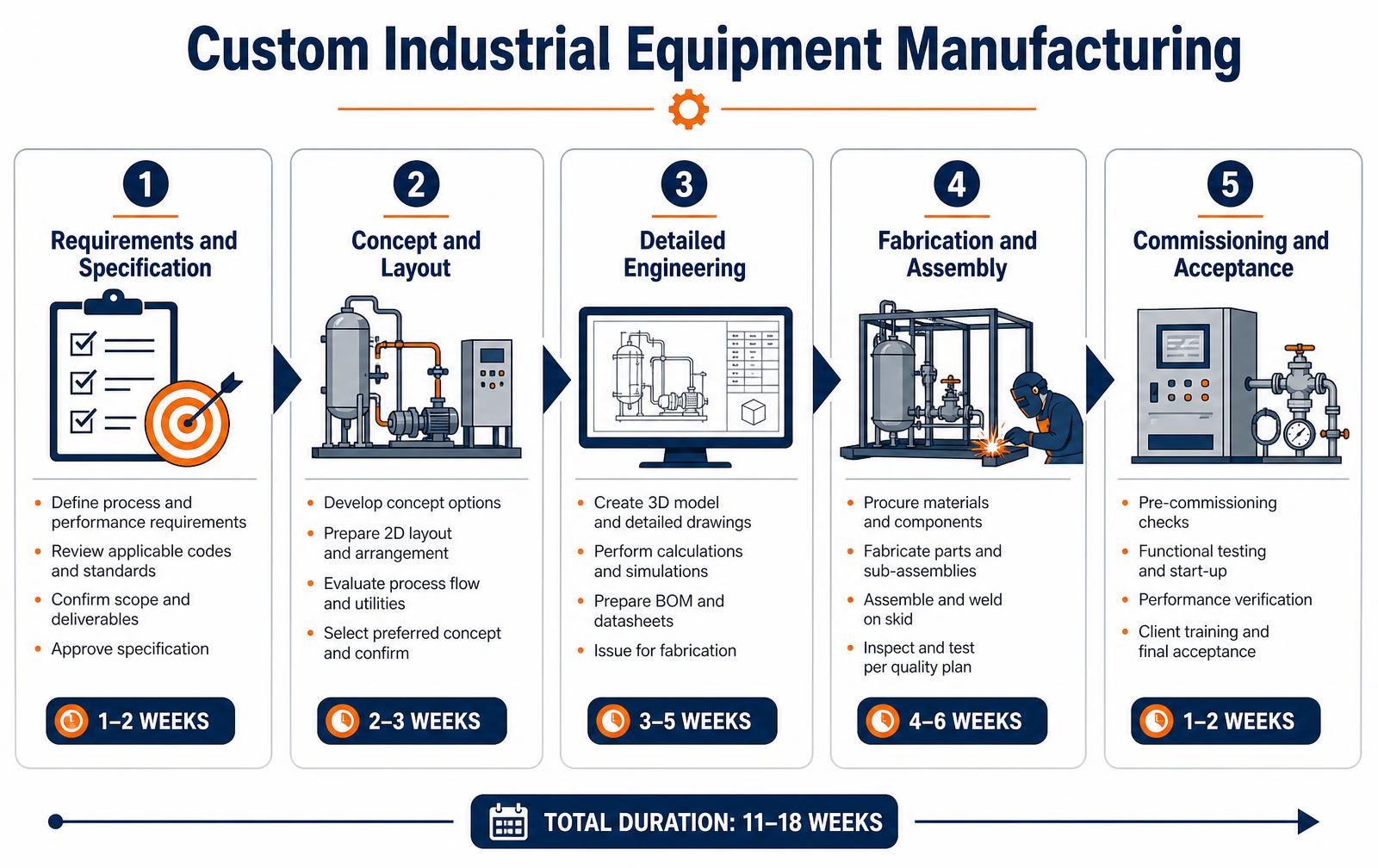
The five stages
- Requirements and specification. Throughput, cycle time, tolerances, utilities, footprint, applicable standards and, critically, the acceptance test that will prove the machine works.
- Concept and layout. Two or three arrangements, process flow, ergonomics and maintenance access. Cheap to change here, expensive later.
- Detailed engineering. 3D model, structural and thermal calculations, controls architecture, safety assessment, bill of materials and fabrication drawings.
- Fabrication and assembly. Long-lead procurement, machining and welding, mechanical and electrical assembly, and in-house dry running before shipment.
- Commissioning and acceptance. Factory acceptance test, installation, site acceptance test against the agreed criteria, operator training and documentation.
What custom equipment costs
Equipment type | Typical cost | Lead time | Main cost driver |
|---|---|---|---|
Manual work cell or fixture | $15k-$60k | 6-10 weeks | Fabrication hours |
Semi-automated test or assembly station | $60k-$180k | 12-20 weeks | Controls and instrumentation |
Fully automated single-process machine | $180k-$500k | 20-32 weeks | Motion system and integration |
Multi-station automated line | $500k-$2m+ | 30-52 weeks | Interfaces between stations |
Regulated or hygienic equipment | Add 20-40% | Add 6-12 weeks | Validation and documentation |
Where these projects go wrong
- A specification written as a wish list. If throughput is not stated as a number under stated conditions, it cannot be tested and it will be disputed.
- Product variation nobody disclosed. The machine is built for the nominal part and then meets the real distribution of parts on day one.
- Long-lead items ordered late. Drives, servo motors, gearboxes and control hardware can carry twelve to thirty week lead times and quietly set the schedule.
- No factory acceptance test. Discovering problems on your floor instead of the builder floor multiplies the cost of every fix.
- Spares and documentation as an afterthought. A machine nobody can maintain becomes a bottleneck within a year.
Related reading: robotics and computer-integrated manufacturing and design for manufacturability.
Frequently asked questions
What is custom industrial equipment manufacturing?
Custom industrial equipment manufacturing is the engineering and build of machinery designed for one operation or facility rather than sold as a catalogue product. It covers specification, concept layout, detailed mechanical and controls engineering, fabrication and assembly, and commissioning against agreed acceptance criteria.
How much does a custom machine cost?
A manual work cell or fixture typically costs $15,000 to $60,000. A semi-automated station runs $60,000 to $180,000, a fully automated single-process machine $180,000 to $500,000, and a multi-station line $500,000 upward. Regulated or hygienic applications add roughly 20 to 40 percent for validation and documentation.
How long does it take to build custom equipment?
Simple fixtures take six to ten weeks. Most automated single-process machines take twenty to thirty-two weeks from approved specification to site acceptance, and multi-station lines can run thirty to fifty-two weeks. Long-lead control and motion components are usually the constraint, so order them during detailed engineering rather than after it.
Write the acceptance test before you write the specification
Every custom machine building dispute traces back to the same gap: the buyer expected a performance level that was never written as a testable number. Start from the factory acceptance test. If you can describe exactly what will be measured, under what input conditions, for how long, and what result constitutes a pass, the specification writes itself and the quotes you receive become comparable.
Acceptance parameter | Weak wording | Testable wording |
|---|---|---|
Throughput | High speed operation | 480 parts per hour sustained over 4 hours on part number 1042 |
Uptime | Reliable | 95% availability across a 40-hour witnessed run, excluding material starvation |
Quality | Accurate placement | Cpk 1.33 on the 0.15 mm position tolerance, 50-part sample |
Changeover | Quick tool change | Under 12 minutes by one operator, no hand tools beyond the supplied kit |
Scrap | Minimal waste | Under 0.5% of parts run during the acceptance run |
Noise and safety | Meets standards | Under 80 dBA at 1 m; risk assessment to ISO 12100 with residual risks documented |
Cost structure of a one-off machine
Cost element | Share of project | Notes |
|---|---|---|
Mechanical design | 12-18% | Higher on first-of-kind processes with no reference build |
Controls and software | 15-25% | Rises sharply with vision, recipe management or MES integration |
Purchased components | 25-35% | Robots, drives, vision, safety hardware, pneumatics |
Fabrication and machining | 15-22% | Weldments, frames, custom tooling plates |
Assembly and debug | 12-20% | The line most often underestimated in a low bid |
Installation and training | 5-10% | Site conditions and utilities drive the variance |
When a quote comes in 30% below the others, the discount is almost always taken out of assembly and debug. That is the phase where a machine actually becomes a machine, and it is the phase you cannot skip — you can only defer it to your own floor at your own cost.
Timeline reality by machine class
Machine class | Design | Procurement | Build and debug | Total |
|---|---|---|---|---|
Manual work cell / fixture | 2-3 weeks | 2-4 weeks | 2-3 weeks | 6-10 weeks |
Semi-automated test station | 4-6 weeks | 5-8 weeks | 4-6 weeks | 13-20 weeks |
Robotic assembly cell | 6-9 weeks | 8-14 weeks | 6-10 weeks | 20-33 weeks |
Full automated line | 10-16 weeks | 12-20 weeks | 12-20 weeks | 34-56 weeks |
Procurement, not engineering, is the schedule driver in most builds. Long-lead items — servo drives, safety controllers, certain vision cameras, large weldments — should be released as soon as the concept layout is frozen, well before detailed design finishes. A build that waits for a complete drawing set before ordering anything adds six to ten weeks for no engineering benefit.
Integration requirements to settle up front
- Utilities. Voltage, phase, amperage, compressed air pressure and flow, exhaust and drainage — measured at the actual install location, not assumed from the building spec.
- Footprint and access. Door widths, floor loading, crane or forklift access, and the maintenance clearance the operator will actually need.
- Data. Which signals go to the MES or historian, in what protocol, and who writes the integration on each side.
- Part presentation. How raw material arrives and how finished parts leave; the upstream and downstream interfaces cause more delay than the machine itself.
- Spares and support. Recommended spares list, response-time commitment, and whether remote access is permitted by your IT policy.
Payment and acceptance milestones that protect both sides
Milestone | Typical payment | What it should release |
|---|---|---|
Contract signature | 20-30% | Long-lead procurement begins |
Design review approval | 15-20% | Frozen layout, approved drawing package |
Mechanical build complete | 20-25% | Photographic evidence, powered-up frame |
Factory acceptance test pass | 20-25% | Witnessed run against written criteria |
Site acceptance test pass | 10-15% | Production run at your facility, training delivered |
Hold at least 10% until the site acceptance test passes on your floor with your material and your operators. A machine that runs at the builder's shop with hand-picked parts is not the same machine running on your line at 6am.
More questions teams ask
What does custom machine building cost?
A simple manual work cell or fixture typically runs $15k-$60k, a semi-automated test or assembly station $60k-$180k, a robotic cell $150k-$450k, and a full automated line $400k upward. Purchased components and controls software usually account for around half the total.
How long does a custom machine take to build?
Six to ten weeks for a simple cell, thirteen to twenty for a semi-automated station, twenty to thirty-three for a robotic cell, and thirty-four to fifty-six weeks for a full line. Long-lead component procurement, not engineering, is usually the critical path.
What is the Difference Between a Fat and a Sat?
A factory acceptance test is run at the builder's facility against written criteria before shipment. A site acceptance test repeats the demonstration at your plant with your utilities, your material and your operators. Both should be defined in the contract, with payment tied to each.
Who owns the design of a custom machine?
It depends entirely on the contract. Many builders retain rights to their standard modules and grant you a licence to use and maintain the machine. If you need the right to have a second unit built elsewhere, negotiate design ownership and drawing delivery explicitly before signing.
How do I compare quotes fairly?
Normalise them against the same acceptance test, the same spares list, the same controls platform and the same training scope. Then compare the assembly-and-debug hours line specifically — that is where low bids hide risk.
Need equipment designed around your process?
We specify, engineer and manage custom equipment builds through acceptance testing.
What drives the cost of a custom machine
Cost driver | Low-cost choice | High-cost choice | Effect on total |
|---|---|---|---|
Part feeding | Manual load by operator | Vibratory bowl or robotic bin picking | 20-40% of build cost |
Cycle time target | Above 10 seconds per part | Under 2 seconds per part | Doubles mechanism and controls cost |
Inspection | Sample check offline | In-line vision with reject | Adds 15-30% |
Changeover | Single part number | Multiple SKUs with tooling swap | Adds 10-25% |
Safety rating | Guarded cell, e-stop only | Category 3 light curtains and safety PLC | Adds 5-15% |
Data and traceability | None | Per-unit logging to plant system | Adds 5-12% |
A realistic build timeline
Phase | Typical duration | What must be finished to move on |
|---|---|---|
Requirements and concept | 2-4 weeks | Signed cycle time, part tolerances, SKU list, safety scope |
Detailed design | 4-8 weeks | Mechanical release, electrical schematics, bill of materials |
Procurement | 4-10 weeks | Long-lead items ordered; servo and PLC lead times confirmed |
Fabrication and assembly | 4-8 weeks | Frame, stations and panel built and wired |
Controls and integration | 3-6 weeks | Sequence runs dry with dummy parts |
Factory acceptance test | 1-3 weeks | Rate and yield demonstrated on your real parts |
Install and site acceptance | 2-4 weeks | Machine hits rate on your floor with your operators |
Specifying the machine so the quote means something
- State throughput as good parts per hour at a stated yield, not as raw cycle time.
- Supply real parts, including the worst parts your process produces, not nominal prototypes.
- Define uptime expectations and who owns spares for wear items.
- Name the acceptance criteria for the factory test and the site test separately.
- Specify who trains operators and maintenance, and for how long.
- Decide up front whether the integrator or your team owns the PLC code and documentation.
When a custom machine pays for itself
Choosing an integrator you can work with
- Ask for two references on machines that have run in production for at least a year.
- Confirm who does the controls work in house versus subcontracted.
- Agree on spare parts strategy and lead times for wear items before purchase.
- Require a factory acceptance test on your parts, at your rate, before shipment.
- Hold a meaningful payment milestone until site acceptance is signed.
Work with LA NPDT: if you are moving from here to execution, start with our low-volume manufacturing or talk to us about design for manufacturing.
Filed under:Uncategorized
Services related to this guide
- Free prototype cost calculatorFive to eight questions, an instant cost range for a first prototype.
- Prototype designLooks-like, works-like or pre-production: what each proves and what it costs.
- Rapid prototypingWorking prototypes in days, from 3D printing to vacuum casting.
- Best product development companiesHow the leading US firms compare, and which one fits your stage and budget.