Silicone prototypes for market testing
Silicone Prototyping: Clean Fingers Shellfish Eating Glove
- CONCEPT DESIGN
- ERGONOMIC DESIGN
- MATERIAL SELECTION
- 3D PRINTING
- SILICONE MOLDING
- PROTOTYPE TESTING

Written by Ralph Hill, Mechanical & electrical systems, 3D manufacturing
Prototyping Engineer
Published August 30, 2026
Silicone prototyping is the process of producing working parts in cast elastomer — usually from 3D printed or machined molds — so a soft, stretchy or skin-contact product can be worn, handled and tested before any production tooling is cut. It is how you find out whether a flexible product actually feels right, which a rigid 3D print cannot tell you.
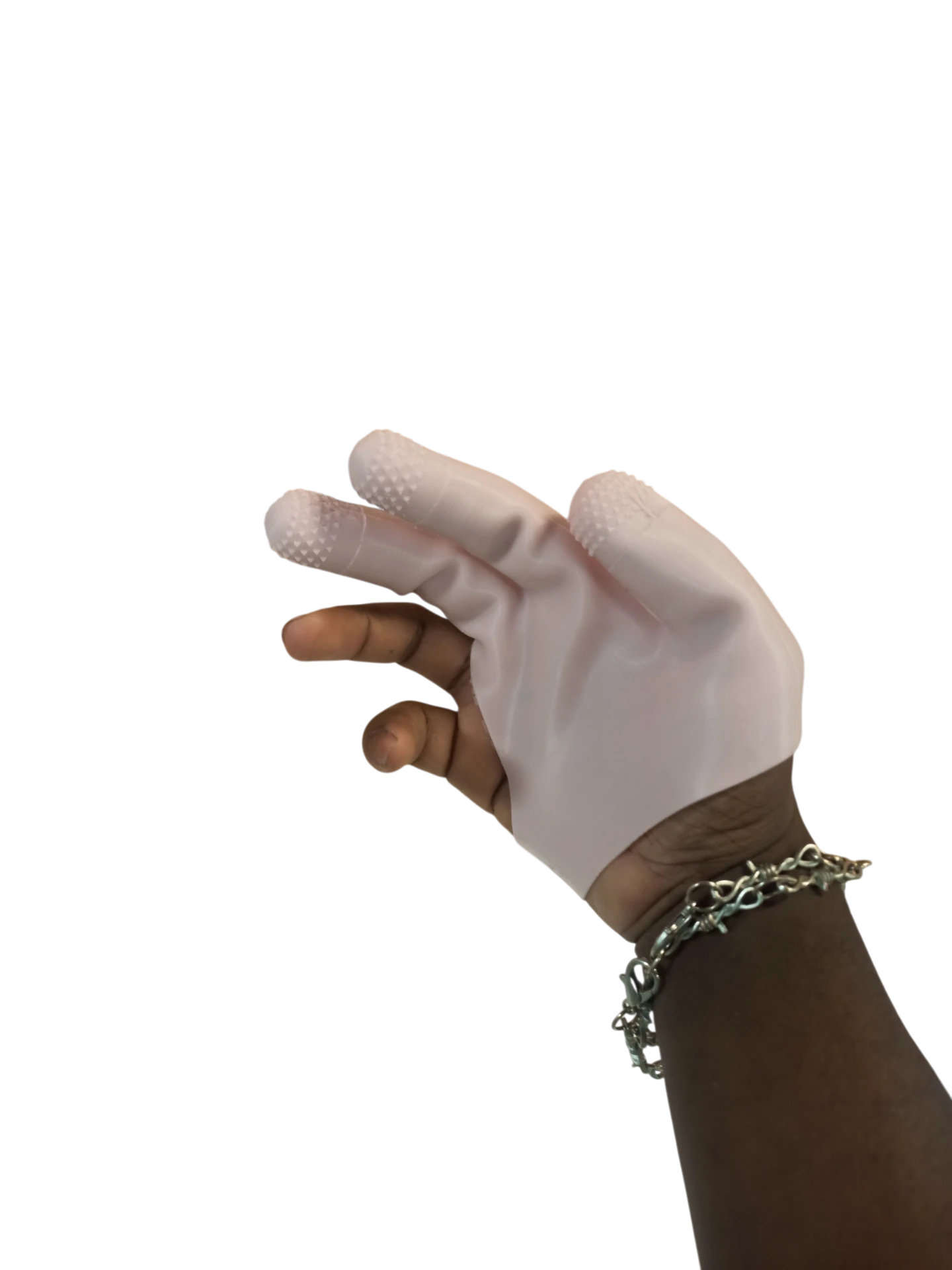
Clean Fingers is a three-finger sleeve that keeps the thumb, index and middle fingers clean while eating crawfish, shrimp and other shellfish. LA NPDT took inventors Megain and Tineaia Comanche from idea to functional cast-silicone prototypes: ergonomic design, material and durometer selection, a single-piece moldable geometry, and wearable units they could test with real users.
Project at a glance
- Client
- Megain & Tineaia Comanche, inventors of Clean Fingers (Louisiana)
- Product
- Reusable three-finger sleeve for eating crawfish, shrimp and other shellfish
- Starting point
- An idea only — no CAD, no prototype
- Program focus
- Feasibility and proof of concept, prioritized for speed
- What we delivered
- Ergonomic design and CAD, material and durometer selection, 3D printed form studies, printed molds, cast silicone functional prototypes
- Methods
- 3D printing, silicone rubber molding, iterative wear testing
- Stage reached
- Functional prototypes delivered for user testing and market validation
- Where it is headed
- The inventors are taking the validated prototype toward a consumer launch
What the client said
★★★★★
“My sister and I invented Clean Fingers (soon to hit the consumer market). When we began our journey with our invention we thought we had everything we needed; we quickly found out we needed a GOOD prototype. We are so fortunate to work with LA NPDT's team, specifically Konstantin D.
We had an idea of what we wanted our prototype to look like, however the LA NPDT team and Konstantin have delivered something much more. Konstantin is such a pleasure to work with, his professionalism is A1, more importantly he is very thorough while working with you on your invention, very knowledgable of what it takes to develop your prototype, and communicates 100% via email, text, phone calls and Zoom meetings with regard to improvements, changes or general information.
If you are looking for a company to help bring an idea to life and/or help create a prototype this is the company you should hire, you will not regret it.”
 Megain & Tineaia ComancheInventors, Clean FingersGoogle review
A three-finger sleeve taken from a Louisiana inventor's idea to functional silicone prototypes ready for user testing.
The client
The challenge
- Only three fingers. The thumb, index and middle fingers do the peeling; covering the other two adds bulk and heat for nothing.
- Dexterity has to survive. The wearer still needs to feel the shell and find the seam, so the wall had to be thin and the material soft.
- Grip on a wet shell. Shellfish are slick, so the fingertips needed texture rather than a smooth molded surface.
- One size has to fit most hands. A consumer product sold at retail cannot ship in six sizes on day one.
- Reusable and washable. The whole point is that it is not another box of disposables.
- Cheap to make. The retail price this product can carry is small, so the part had to be manufacturable in one piece.
Our solution
Designing for Hands Is Harder Than It Looks
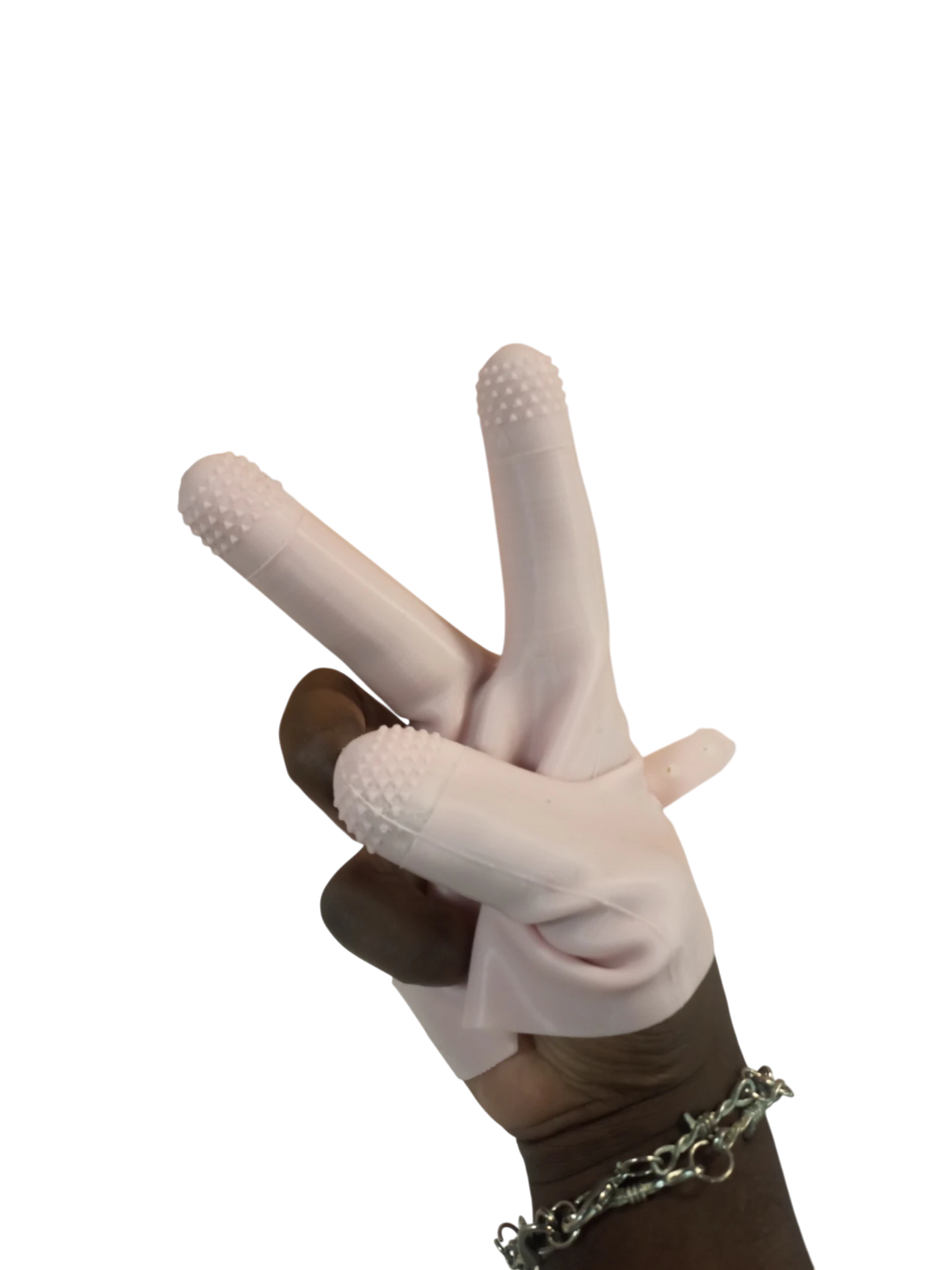
Material and Process Selection
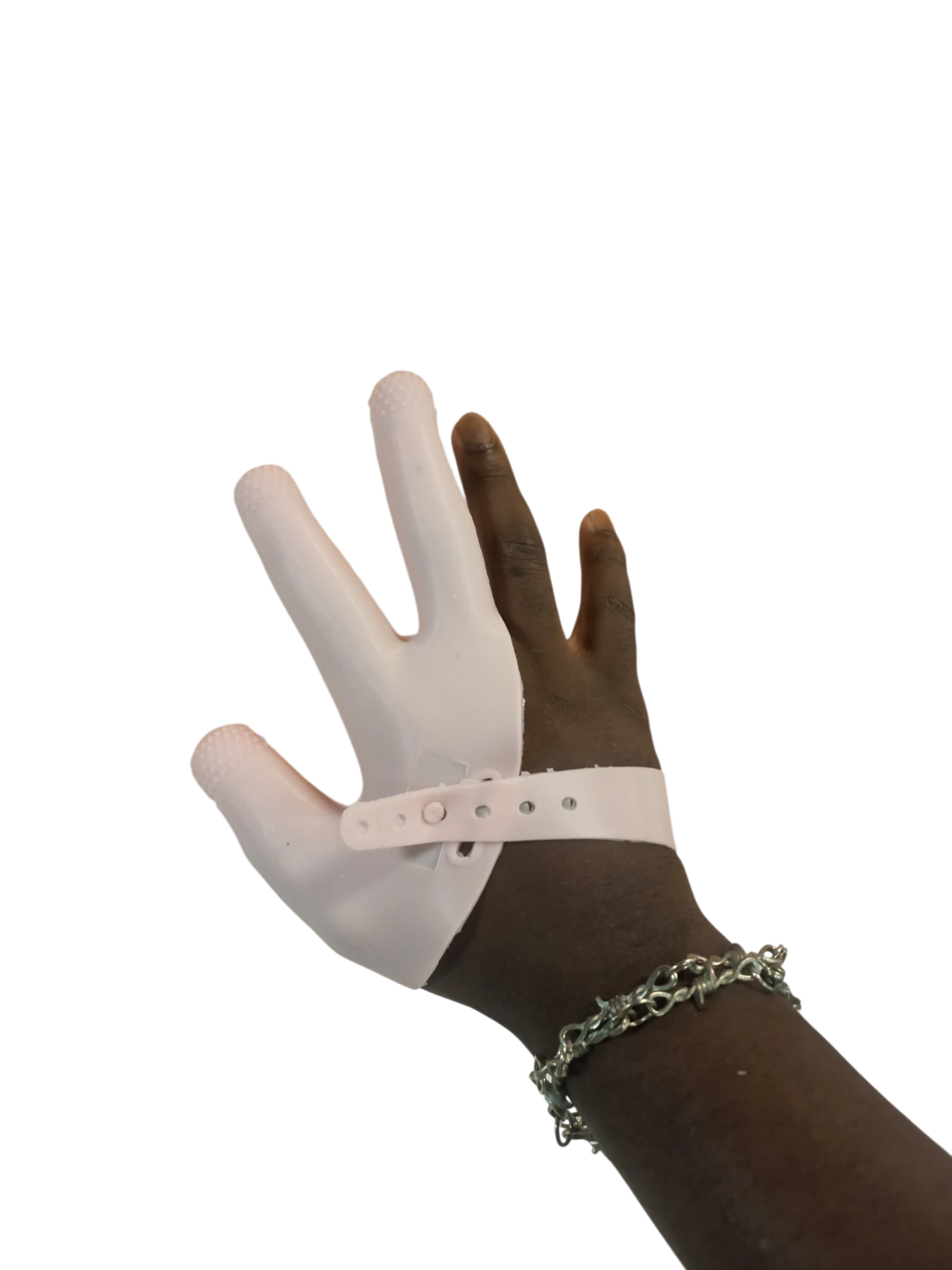
- 3D printed form studies. Fast, cheap checks on finger length, web geometry and strap placement before committing to a mold.
- Printed molds, cast silicone. Molds were printed and finished in-house, then filled with platinum-cure silicone to produce functional units in days rather than weeks.
- Durometer selection. Several hardnesses were evaluated against the tension-versus-comfort trade-off; too soft tears at the web, too firm fights the hand. Hardness is measured on the ASTM D2240 Shore A scale, and a few points either way changes how the part feels on the hand.
- Food-contact material. Because the product touches food, the material path was chosen from silicones that can meet FDA food-contact substance requirements at production.
- Single-piece geometry. The sleeve, the fingertip texture and the strap features were designed to come out of one mold, with no assembly and no secondary operations — the single biggest lever on unit cost at volume.
Iterating to Functional Prototypes
The result
- Ergonomic industrial design and production-intent CAD for the three-finger sleeve
- Material and durometer selection, including a food-contact-capable path to production
- Single-piece, moldable geometry with integrated fingertip texture and strap features
- 3D printed form studies across several iterations
- Printed molds and cast silicone functional prototypes in multiple rounds
- Wearable units delivered for the inventors' own user testing and market validation
Capabilities used on this project
Rapid prototyping services
3D printing, CNC machining, urethane casting and functional prototype builds with published materials, tolerances and lead times.
Concept design
Sketch exploration, form studies and CAD concepts that turn an idea into a buildable direction.
How a wearable silicone product gets prototyped
The path from a soft-product idea to a part someone can actually wear, in the order the decisions have to be made.
1. Define the product around the hand in use
Wearables are designed in the position they are used in, not the position they are easiest to draw in. Clean Fingers was modelled around a closed, pinching hand — the posture of peeling a crawfish — so the sleeve stays taut where it does work and slack where the hand needs to flex.
2. Solve fit before you solve form
Finger length, diameter, web spacing and knuckle position vary enormously between people. One size fits most is achieved with a stretch-and-recover material plus an adjustable strap that lets the wearer set tension, not by averaging dimensions across a size chart.
3. Print the shape, cast the product
3D printed studies answer geometry questions in hours and cost almost nothing. Only a cast elastomer answers the questions that decide whether the product works: softness, stretch, grip, recovery and comfort over a whole meal.
4. Choose durometer against the comfort trade-off
Too soft and the part tears at the finger webs; too firm and it fights the hand and gets taken off. Several silicone hardnesses were made up and worn before one was selected, which is only affordable because printed molds are cheap.
5. Design for one-piece molding from day one
Consumer products at this price point cannot absorb assembly. The sleeve, the fingertip grip texture and the strap features were all designed to come out of a single mold with no secondary operations — the largest single lever on unit cost at volume.
6. Put wearable units in real users' hands
The deliverable of a proof of concept is evidence, not a part. The Comanche sisters received functional prototypes they could wear at an actual crawfish boil and hand to potential customers for feedback before committing to tooling.
| Option | Dexterity & feel | Cleanliness | Reusable | Cost per use |
|---|---|---|---|---|
| Bare hands | Best | None | n/a | Free |
| Disposable gloves | Poor — bulky and slippery | Full hand | No | Low but recurring |
| Full reusable glove | Fair — warm, covers everything | Full hand | Yes | Moderate |
| Three-finger silicone sleeve | Good — thin wall, textured tips | The three fingers that do the work | Yes, washable | Lowest over time |
Questions about this project
Straight answers from the engineers who ran the build. Have a different question? Ask us directly.
Talk to an engineerHow is a silicone prototype actually made?
The part is designed in CAD, a mold is 3D printed or machined from that CAD, and platinum-cure silicone is poured or injected into the mold and demolded once cured. Because the mold itself is printed, a new revision can be in hand in days instead of the weeks production tooling takes.
What does silicone prototyping cost?
For a small consumer part like this, expect roughly $2,000 to $8,000 across several iterations, depending on part size, how many hardnesses you evaluate and how many rounds it takes to get the fit right. That is a fraction of the cost of cutting a production mold and discovering the fit is wrong.
How do you make a wearable product fit everyone?
You do not size it, you make it adapt. A material that stretches and recovers absorbs a wide band of finger and hand sizes, and an adjustable strap lets each wearer set their own tension. Sizing only becomes worthwhile once sales volume justifies multiple molds.
Can a silicone prototype be used with food?
Yes, if the material is chosen for it. We specify silicones with a path to FDA food-contact compliance so the prototype behaves like the production part and the production material is not a surprise later.
How long does a proof-of-concept prototype take?
For a product of this complexity, a first wearable part typically lands within a few weeks of kickoff, with each following iteration measured in days — because design, engineering and prototyping all happen in our Ruston, Louisiana shop rather than across three vendors.
Industries this project belongs to
See how we approach development in each of these categories, and the other products we have taken from sketch to production there.