Concept Design for Hardware Products: A Beginner's Guide
What happens before detailed engineering: requirements, architecture, three or more concepts, feasibility testing, and one selected concept with a written rationale.
June 20, 20257 min read

Written by Konstantin Dolgan, Ph.D., NPDP
Founder & CEO, Product Development Engineer
Published June 20, 2025Updated September 2, 2026
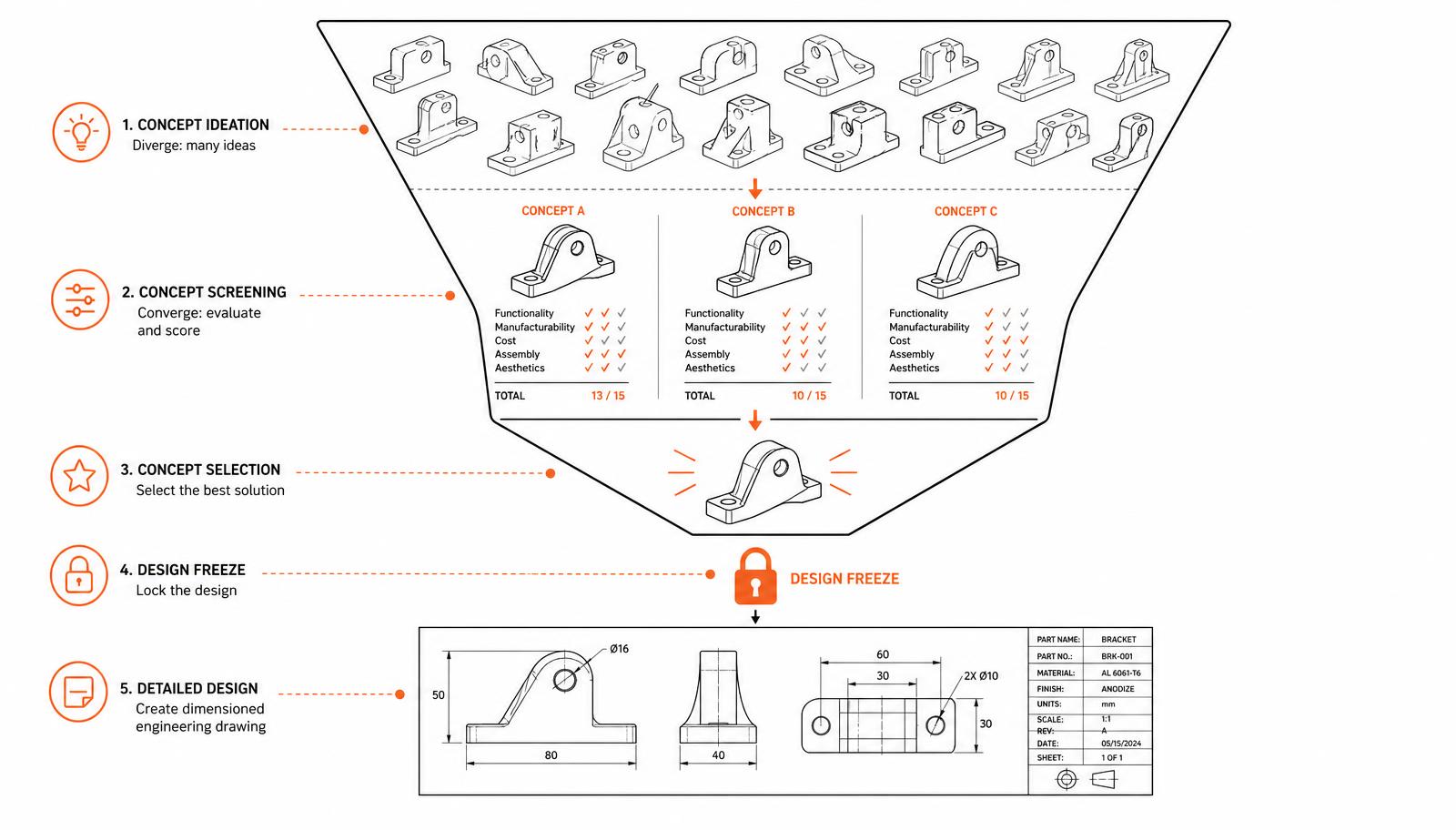
Concept design is the phase that turns a hardware idea into a chosen, justified approach: requirements written down, several architectures explored, the riskiest assumptions tested, and one concept selected before anyone starts detailed engineering. Done properly it takes two to six weeks and costs a fraction of what it saves, because every decision made here is one you are not paying to unmake during tooling.
If you are about to engage a design firm and wondering what actually happens first, this is it. This guide covers what concept design services deliver, how the phase runs week by week, what you should receive at the end, and how to tell good work from expensive sketching.
What concept design services actually include
The term covers a defined package of work, not a mood board. A credible engagement produces all six of the following. If a proposal is missing the last two, you are buying renderings, not engineering.
Deliverable | What it contains | Why it matters |
|---|---|---|
Product requirements document | Function, users, environment, cost target, size, compliance needs | Every later argument is settled against this document |
System architecture | Block diagram of subsystems and their interfaces | Defines who owns what and where integration risk sits |
Three or more concepts | Genuinely different approaches, not styling variants | One concept is a decision already made without evidence |
Feasibility analysis | Rough power, thermal, force, cost and size calculations | Kills unworkable ideas in days rather than months |
Selection rationale | Scored comparison with the reason each concept lost | Stops the team relitigating the decision six months later |
Risk register and next steps | Open unknowns, how each will be retired | Turns unknowns into scheduled work instead of surprises |
Before anything: the product requirements document
Most projects that go badly went wrong here. Clients often ask for a quote from a paragraph of description, and no honest firm can give one, because a handheld device that runs 8 hours off a battery is a different product from the same device with a wall adapter.
A workable PRD answers, in writing: what the product must do, who uses it and in what environment, the target landed cost per unit, the volume in year one, the physical envelope, the power source, the certifications it must pass, and the date that matters. Ranges are fine. Silence is not.
A requirement that is not written down is not a requirement. It is a preference that will surface as a change order after tooling.
How the concept phase runs
Stage | Typical duration | Output |
|---|---|---|
Requirements and constraints workshop | 3 to 5 days | Signed PRD, open questions list |
Architecture and partitioning | 1 week | Block diagram, hardware and software split, make-or-buy list |
Concept generation | 1 to 2 weeks | Sketches, rough CAD, breadboards, layout studies |
Feasibility and risk testing | Runs in parallel | Power budget, thermal check, force or flow calcs, bench tests |
Screening and selection | 2 to 3 days | Scored matrix, one selected concept with rationale |
Concept review and freeze | 1 day | Approved concept, cost estimate, plan for detailed design |
Two to six weeks is normal for a consumer or light industrial product. Products with custom electronics, regulated use or unusual physics run longer, and should. What follows is a different discipline entirely, covered in our comparison of concept design versus detailed design.
Partitioning: the decision that shapes everything else
Hardware projects are cross-disciplinary by nature: mechanical, electronics, firmware, industrial design, sometimes optics or fluidics. The architecture step decides how the product divides into modules and, critically, what is solved in hardware versus in software.
- Each module gets one clear job. If you cannot state a subsystem's purpose in a sentence, the boundary is in the wrong place.
- Interfaces are defined before internals. Connector, protocol, mounting, tolerance and power at every boundary, written down.
- Each module must be testable alone. Otherwise the first integration becomes a week of guessing.
- Do not partition hardware and software too early. Decide once you know what the silicon and the mechanics actually cost you; a firmware fix is far cheaper than a board respin.
- Reuse proven blocks. A reference design you trust removes an entire class of bring-up risk.
Feasibility work that earns its keep
Concept-phase analysis is deliberately rough. Order-of-magnitude answers, done in hours, are worth more here than precise ones done in weeks. The point is to find the thing that will not work.
- Power budget. Current draw per state against battery capacity and target runtime. This one number kills more concepts than any other.
- Thermal check. Watts dissipated versus available surface area and airflow, before an enclosure exists.
- Load path. Where forces enter, where they go, and whether anything is a hinge waiting to fail.
- Cost roll-up. Major components, enclosure, PCBA and assembly labor at target volume, compared against the price the market will pay.
- Long-lead and obsolescence. Any part with a 40-week lead time is an architecture decision, not a purchasing detail.
Prototypes in the concept phase
Concept prototypes are not small versions of the product. They are single-question experiments: a cardboard block to check whether the grip works, a printed mechanism to see whether the linkage clears, a dev board and off-the-shelf sensor to prove the measurement is even possible. Each one should be built to answer one question and thrown away.
A finished hardware product later combines four parts, enclosure, electronics, firmware and companion software, and each carries its own risk. Retiring the worst of those risks with a rough build now is what makes the later, expensive rapid prototyping stage predictable.
Design for manufacturing starts here, not later
Manufacturing constraints belong in concept selection, because they eliminate options for free at this stage and cost tooling money at the next one. A concept that needs an undercut in every direction, a five-axis machined housing at a $20 target cost, or a part count of 90 where 30 would do is not a concept problem to solve later; it is a concept to reject now.
- Which process makes the housing: injection molding, sheet metal, casting or additive at launch volume?
- How many unique parts, and how many fasteners, does the assembly need?
- Can it be assembled in one direction, without fixtures a factory does not have?
- Are the tolerances achievable by the intended process, or do they assume machining?
- What does the tooling cost, and when must it be ordered to hit the launch date?
How to judge the output
At the concept review, you should be able to point at the selected concept and hear a specific answer to each of these. Vague answers here become change orders later.
- Why did this concept win, and what specifically made the others lose?
- What is the riskiest remaining assumption, and how will it be tested?
- What does it cost to build at our target volume, with what confidence?
- Which requirements are still unresolved, and who owns each?
- What would have to be true for us to change this decision later?
Frequently asked questions
What are concept design services?
Concept design services are the early engineering phase in which a firm turns your requirements into several candidate solutions, tests their feasibility with rough analysis and prototypes, and selects one with a documented rationale. Deliverables typically include a requirements document, system architecture, concept alternatives, feasibility findings, a cost estimate and a risk register.
How long does concept design take for a hardware product?
Two to six weeks is typical for a consumer or light industrial product. Custom electronics, regulatory requirements or novel physics extend it. The phase ends when one concept is selected, its riskiest assumption has been tested and an order-of-magnitude cost estimate lands inside the target.
What should I prepare before hiring a concept design firm?
Write down what the product must do, who uses it and where, your target unit cost and first-year volume, the size envelope, the power source, any certifications it must meet, and the date that matters. Ranges are acceptable. This is what allows a firm to quote accurately instead of guessing.
Why generate multiple concepts instead of refining one?
Because the first idea is rarely the best one, and comparison is what makes a decision defensible. Three genuinely different approaches expose the trade-offs, cost, size, manufacturability, risk, that a single concept hides. Alternatives are cheap to compare at low fidelity and expensive to discover after detailed design begins.
What is the difference between concept design and industrial design?
Industrial design shapes the user experience, form, ergonomics and appearance. Concept design is broader: it includes industrial design work but also architecture, feasibility analysis, cost and manufacturability, and it ends with an engineering decision rather than a visual direction.
Starting your own concept phase
If your project is already in CAD but nobody can state why this approach beat the alternatives, the concept phase has been skipped rather than completed. That is recoverable, and cheaply, with a short concept review before detailed engineering locks the geometry in. Our concept design services run exactly the sequence described above.
Costing a hardware product design while it is still a concept
The concept phase is where most of the unit cost gets committed, yet it is also when teams have the least cost data. A rough cost model built during hardware product design is imprecise but directionally correct, and it prevents the situation where a beautiful concept turns out to be twice the target price after tooling quotes arrive.
Concept-stage cost model
Cost element | How to estimate early | Typical share of unit cost |
|---|---|---|
Housing and structure | Volume x resin cost x 1.6 factor | 15-25% |
Electronics | Reference design BOM plus 20% | 25-40% |
Battery and power | Cell cost plus protection circuitry | 5-15% |
Assembly labor | Estimated minutes x regional rate | 8-15% |
Packaging | Comparable retail package quote | 3-8% |
Test and yield loss | 2-5% of build cost | 2-5% |
Freight and duty | Weight and volume based | 5-10% |
Update the model at every concept review. A cost estimate that only exists once is a document; one that gets revised as decisions land becomes the tool that keeps the design inside its business case.
Concept costing checklist
- Set a target unit cost before generating concepts.
- Estimate each concept, not just the favorite.
- Include freight, duty and yield loss from the start.
- Flag any component with a single source or long lead time.
- Re-cost after every significant architecture change.
Key takeaways
- Most unit cost is committed during concept, before real quotes exist.
- Estimate every concept against a target, not only the preferred one.
- Re-cost after each architecture change so the business case stays honest.
Hardware product design: cost and schedule by product class
Concept work looks similar across categories, but what follows it does not. The table below shows what a first-time team should plan for between an approved concept and a saleable unit.
Simple accessory (no electronics) | 5 – 8 months | $25k – $60k | $8k – $30k | Minimal |
|---|---|---|---|---|
Battery-powered consumer device | 9 – 14 months | $90k – $250k | $35k – $120k | FCC, UL, CE |
Connected home product | 12 – 18 months | $150k – $400k | $60k – $180k | FCC/BT SIG, UL |
Industrial instrument | 14 – 24 months | $200k – $600k | $40k – $150k | UL, IEC |
Material and process selection cheat sheet
Under 250 | 3D print or urethane cast | Labor and finishing | $0 – $6k |
|---|---|---|---|
250 – 3,000 | Aluminum tooling injection molding | Cycle time | $6k – $20k |
3,000 – 50,000 | Steel family tool | Resin and cycle | $25k – $90k |
Above 50,000 | Multi-cavity hardened tool | Resin | $90k – $250k |
Concept selection criteria that hold up later
- Score every concept against manufacturability, landed cost, certification burden, and serviceability — not just appearance.
- Weight the criteria before you see the concepts; weighting afterwards is how a favourite gets rationalised.
- Any concept that cannot be described in one sentence to a buyer is not a concept, it is a collection of features.
- Carry two concepts one step further than feels comfortable; the second one is the insurance policy.
Beginners tend to treat hardware product design as a styling exercise followed by engineering. In practice the constraints that determine cost — wall thickness, part count, fastening strategy, sealing, and assembly sequence — are all set during concept selection, long before any drawing is released.
Need a concept that hits its cost target?
Work with LA NPDT: if you are moving from here to execution, start with our rapid prototyping services or talk to us about prototype design.
Filed under:Uncategorized
Services related to this guide
- Product design servicesIndustrial design and CAD taken all the way to manufacturable files.
- Best industrial design firmsWhich studios take an idea from form to manufacturable hardware, and what they charge.
- Prototype designLooks-like, works-like or pre-production: what each proves and what it costs.
- Product development examplesReal projects we designed, prototyped and shipped.