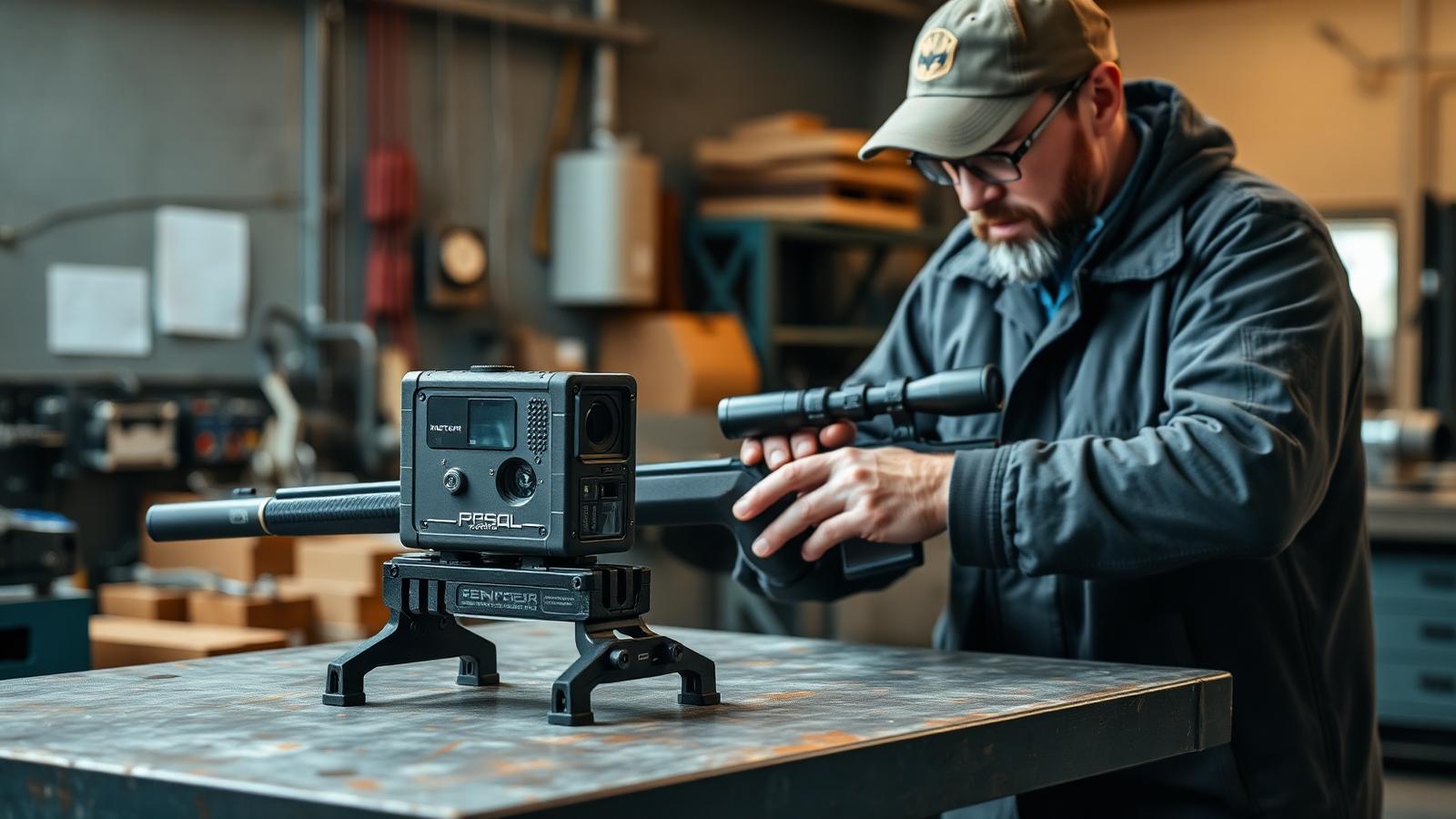
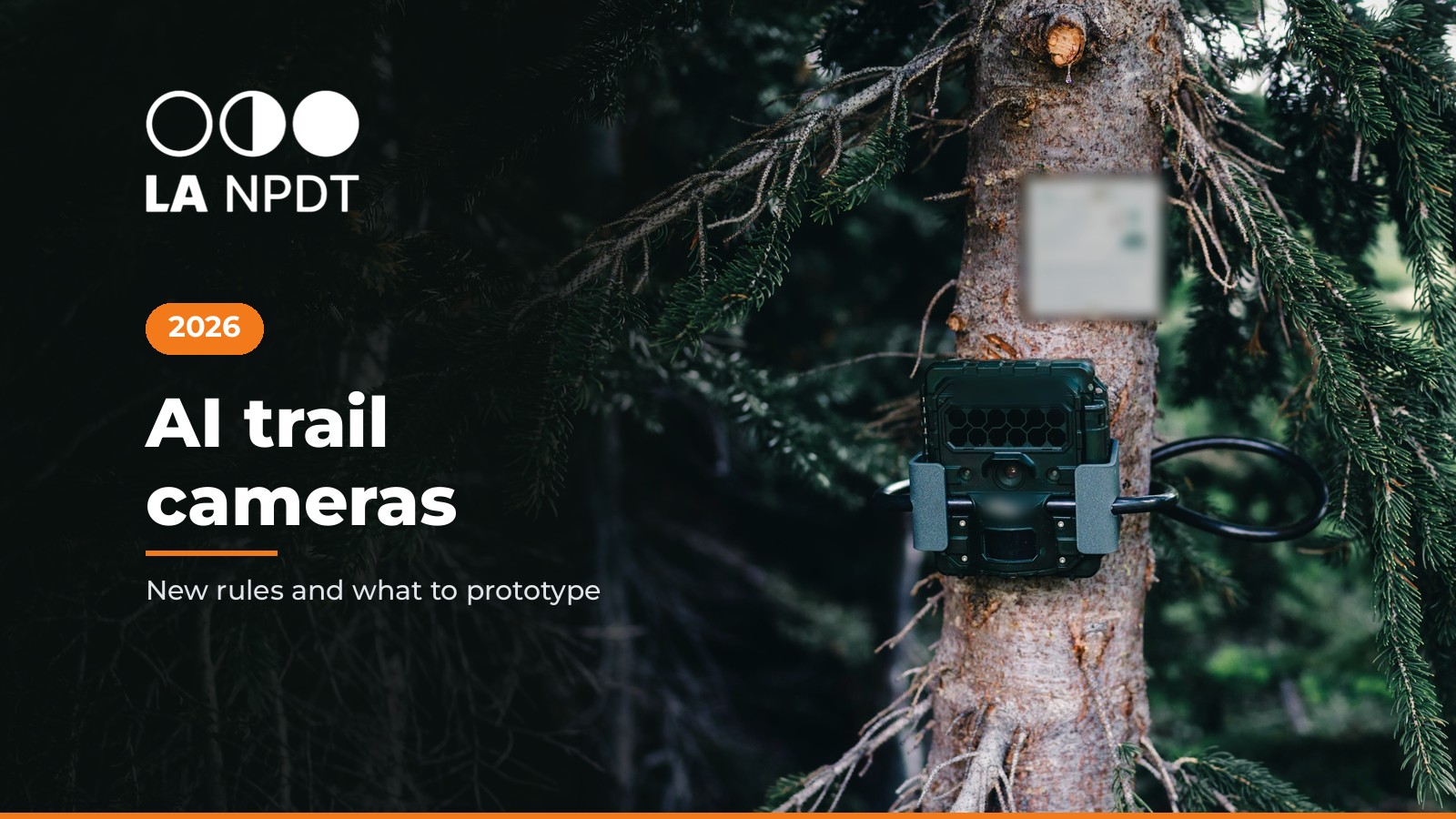
AI trail cameras in 2026: new state rules and what to build into your prototype
For founders and product teams building trail cameras, game cameras, and other connected hunting and wildlife gear. In 2026, states drew sharper lines around transmitting cameras, and species recognition moved onto the camera itself. Here is what that changes in the design, firmware, and test plan.
November 19, 20268 min read

Written by Konstantin Dolgan, Ph.D., NPDP
Founder & CEO, Product Development Engineer
Published November 19, 2026
This article explains public rules for product planning. It is not legal advice. Rules change every season, so check the current state regulations for every market you plan to sell into.
What changed for trail cameras in 2026
Idaho made transmitting cameras a seasonal issue on public land. Idaho Fish and Game says the Legislature passed House Bill 939 in 2026. Between Aug. 30 and Dec.
31, 2026, it is unlawful to use transmitting trail cameras on federal, state, or local government land for hunting or scouting deer, elk, pronghorn, mountain goat, bighorn sheep, moose, black bear, and game birds, with exceptions such as predator hunting and trap monitoring.
The same law covers thermal imaging, night vision, and drones (Idaho Fish and Game, Sept. 17, 2026).
Iowa banned all trail cameras on game management areas, starting in 2027. The Iowa Natural Resource Commission adopted the rule on Aug. 13, 2026, effective Feb. 1, 2027.
It defines a trail camera as any remote motion-activated or infrared camera triggered by sound, proximity, radio, or a self-timer, and it applies to card-based cameras too, unless used by the department or under a permit.
The commission received 102 public comments: 59 in support, 35 opposed, and 8 asking for a modified ban (Iowa Administrative Rules, ARC 0557D).
Iowa DNR's Chris Ensminger told Radio Iowa that cellular cameras are already not legal while actively hunting, on private or public land (Radio Iowa, June 18, 2026).
Older rules in the West set the pattern. Utah prohibits all trail cameras on public land from July 31 to Dec.
31, and allows only non-transmitting cameras with internal storage for taking wildlife on private land (Utah DWR).
Nevada restricts trail cameras on a seasonal basis and starts a month earlier, on July 1, for devices that transmit or are capable of transmitting images, video, or location data of wildlife (NAC 503.1485).
Arizona bars using a trail camera or its data to take or locate wildlife for taking (Ariz. Admin. Code R12-4-303).
At the same time, AI moved into the camera. GardePro launched the X66 Pro Max in January 2026 with on-device species recognition for 8 categories (buck, doe, bear, turkey, coyote, wild boar, human, vehicle).
Its Smart Capture mode sends only target species over the cellular network and keeps the rest on the camera (GardePro, Jan. 19, 2026).
The product page lists it from $99.99 and calls the feature Beta, noting that accuracy varies with lighting, angle, distance, infrared night images, and background (GardePro product page).
GardePro added the same edge AI to its X66 3.0 Ultra in August 2026 (GardePro, Aug. 24, 2026).
ZEISS takes the app route: its Secacam line offers AI animal recognition with Smart Filters inside paid app subscription packages (ZEISS, Jan. 27, 2026).
Trail camera laws: what each rule means for the product
State (source) | What the rule targets | Product question it raises |
|---|---|---|
Idaho, HB 939 (2026) | Transmitting cameras on government land, Aug. 30 to Dec. 31, for most big game and game birds | Can a buyer clearly run the camera as non-transmitting during the season? |
Iowa, ARC 0557D (effective Feb. 1, 2027) | All trail cameras on state game management areas, card-based included, unless permitted | Is the product's market mostly private land, or does it need a permit or research use case? |
Utah, DWR | All cameras on public land July 31 to Dec. 31; only non-transmitting cameras for take on private land | Do you need a card-only SKU for hunting buyers? |
Nevada, NAC 503.1485 | Seasonal limits, earlier for devices capable of transmitting images, video, or location data | Does a firmware switch change "capable", or does the radio have to be absent or removable? Ask counsel. |
Arizona, R12-4-303 | Using a camera or its data to take or locate wildlife for taking | Is your marketing built on hunting, or on wildlife viewing, property, and research uses? |
The pattern for a product team: AI is not what the rules regulate. Transmission, location data, timing, and land type are. That puts the radio, the GPS, and the marketing claims at the center of the design review.
What to build into an AI trail camera prototype
1. Decide the uses and SKUs first. List who buys the camera and where it runs: private-land hunting, public-land scouting outside the season, wildlife research, farm and livestock monitoring, or property security.
Utah and Nevada carve out research, agency, and some private-land or agricultural uses, so a non-hunting market can be real. If one model must serve several of these, plan the variants before the schematic, because a card-only model and a cellular model can differ in board, antenna, enclosure, and certification.
2. Treat "transmitting" as a hardware question. Nevada's wording covers devices "capable of transmitting." Whether a firmware toggle is enough is a legal question for your counsel, not something to settle in a spec.
If the answer is uncertain, prototype a version with no modem or a removable modem module and compare cost and enclosure impact.
The same goes for GPS: ZEISS sells GPS anti-theft tracking as a feature (ZEISS), and some rules mention location data, so decide early what location the device reports and when.
3. Put AI where it saves power and data. GardePro's pitch for on-device AI is fewer empty uploads, longer battery life, and a smaller data bill. That is the right test for your design too: measure how much energy the classifier costs per trigger against how much modem time it saves. For chip choices (NPU microcontrollers, toolchains), see our edge AI hardware prototyping guide.
4. Build the dataset with your own camera. Your lens, infrared illuminator, and mounting height decide what the model sees, especially at night.
Open tools help: Google's SpeciesNet, open-sourced under Apache 2.0, classifies 2,498 animal categories and, per Google, finds 99.4% of images that contain animals on its held-out test set.
It runs about 30,000 images a day on a standard laptop (Google Research, March 6, 2026; GitHub).
Idaho Fish and Game uses it as a first pass, then has people verify the labels. Do the same: let the open model pre-label your field images, have a person check them, and use that set to train and test the smaller model that fits on the camera.
5. Plan model updates and claims. GardePro says more species may come in future firmware updates. If your camera will learn new classes, design the firmware for safe over-the-air model updates and a way to roll back. Keep marketing claims as careful as the model: say "Beta" or give tested accuracy conditions, the way GardePro does.
6. Do not let AI hide the basics. The hard field problems are still power in the cold, sealing, infrared windows, condensation, and theft. See enclosure design for electronics, our outdoor electronics prototype cost guide for battery, sealing, and radio choices, and sodium-ion vs lithium-ion for cold-weather power.
AI trail camera prototype checklist
- Write down target buyers, land types, and states, and check each state's current trail camera rules.
- Decide the SKUs (card-only, cellular, non-hunting) and which hardware differs between them.
- Ask counsel whether a firmware "no transmit" mode is enough for your target states, or whether the radio must be absent or removable.
- Decide what location data the device stores and sends, and when.
- Choose on-device AI, app or cloud AI, or both; measure energy per trigger against modem time saved.
- Collect day and infrared night images with your own optics; pre-label with an open model, then verify by hand.
- Test species accuracy by lighting, distance, angle, and background, and record the conditions you will claim.
- Design over-the-air model updates with rollback, then field test through a real season.
- Run cold, rain, and condensation tests on the sealed enclosure with the battery you plan to ship.
How we help hunting and outdoor tech founders
We design and prototype outdoor and hunting products, from mechanical gear like the Droptine scent dispenser to connected devices like a GPS tracking bracelet. For a connected trail camera, the early risks are the radio and SKU plan, power, sealing, and how the AI feature is trained and tested.
Stage 1, Review/Analysis + Plan, is a fixed $800 single payment: a technical feasibility analysis, the key risks, and a staged plan with the recommended next step. Stage 1 cost estimates use publicly available prices. From there, electronic design and prototyping turn the plan into a field-ready test build. See the process map and typical product development cost in 2026 by complexity.
Planning a smart trail camera?
If you are planning a smart trail camera or other hunting tech, you can book a free 20-min call with an engineer.
Sources
Frequently asked questions
What is an AI trail camera?
A trail camera that uses an AI model to recognize what triggered it, such as a buck, a turkey, a person, or a vehicle. The model can run on the camera, as on GardePro's X66 Pro Max, or in the maker's app or cloud, as with ZEISS Secacam's AI animal recognition. On-device AI can filter uploads before they use cellular data.
Are cellular trail cameras legal?
It depends on the state, the land, the season, and the use. In 2026, Idaho bans transmitting cameras on government land for most big game and game birds from Aug. 30 to Dec. 31. Utah bans all cameras on public land from July 31 to Dec. 31, and Nevada restricts cameras capable of transmitting from July 1. Check current state rules; this is not legal advice.
Does Iowa's trail camera ban cover card-based cameras?
Yes. The rule the Iowa Natural Resource Commission adopted on Aug. 13, 2026 prohibits all trail cameras on state game management areas from Feb. 1, 2027, unless used by the department or its agents or under a permit. It applies to game management areas, not to all land in the state.
How accurate is AI species recognition?
It varies with lighting, distance, angle, and background, and infrared night images are harder. Google reports that its open SpeciesNet model finds 99.4% of images with animals on its test set, and GardePro labels its on-camera recognition as Beta. Test your own model on images from your own camera before you make accuracy claims.
What does it cost to start a trail camera product with LA NPDT?
Stage 1, Review/Analysis + Plan, is a fixed $800 single payment: a technical feasibility analysis, the key risks, and a staged plan with the recommended next step. Typical later-stage costs by complexity are on the product development cost page, or book a free 20-min call first.
Tagged:AIElectronicsPrototyping
Services related to this guide
- Best prototyping companiesDevelopment firms, instant-quote bureaus and local shops: who fits which job.
- Free prototype cost calculatorFive to eight questions, an instant cost range for a first prototype.
- Prototype development companiesWhich firms take a sketch to a working prototype, and which only fabricate parts.
- Rapid prototypingWorking prototypes in days, from 3D printing to vacuum casting.