Product development cost in 2026, and what to expect in 2027
LA NPDT's 2026 product development cost classes, from a basic one-part product to a complex multi-subsystem build, and what wage, shop-rate, and component data say about 2027. The cost page remains the source for the full price tables.
November 13, 202612 min read

Written by Konstantin Dolgan, Ph.D., NPDP
Founder & CEO, Product Development Engineer
Published November 13, 2026

How much does it cost to develop a new product in 2026?
In 2026, LA NPDT develops physical products in fixed-price stages. Stage 1, Review/Analysis + Plan, is a fixed $800 single payment.
A whole program typically costs $11,300 to $36,800 for a basic one-part product, $28,300 to $66,800 for a simple product, $49,300 to $111,800 for a moderate product, and $86,800 to $175,800 for a complex product. Those ranges cover labor only, including equipment and machine time, and they are typical, not a quote. Your price may come in below or above.
A typical program takes 3 to 6 months for a basic product, 5 to 9 months for a simple product, 7 to 12 months for a moderate product, and 9 to 15+ months for a complex product. Timelines exclude tooling, certification, pilot runs, and your review time between stages. Custom circuit boards can add 3 to 7 weeks.
That short answer is taken from the live product development cost page, which remains the single source of truth for the numbers. This article is the year-stamped explainer: what those 2026 figures mean by complexity class, and what public cost data says to watch in 2027.
The full stage-by-stage labor table and the on-page calculator stay on the cost page. Product design cost covers Concept Design (stage 2) plus Technical Design & Engineering (stage 5) on their own.
LA NPDT product development cost classes
LA NPDT product development cost classes group physical products into four complexity bands, A through D. The class is the strongest driver of development cost, because it sets how many disciplines, prototype rounds, and integration problems the program has to carry. A "whole program" on the cost page is stages 1, 2, 3, 5, 6, 7, and 9, labor only.
The table below quotes the 2026 whole-program labor ranges and timelines as they appear on the product development cost page. Definitions match the live cost page and the class band on the homepage. Ranges are typical, not a quote.
Class | Definition | Whole-program labor (2026) | Typical timeline |
|---|---|---|---|
A Basic | One part, no moving parts, no electronics | $11,300 to $36,800 | 3 to 6 months |
B Simple | One mechanism or simple electronics | $28,300 to $66,800 | 5 to 9 months |
C Moderate | Several mechanisms, medium electronics and firmware | $49,300 to $111,800 | 7 to 12 months |
D Complex | Multi-subsystem, firmware, hydraulics, app or custom tech | $86,800 to $175,800 | 9 to 15+ months |
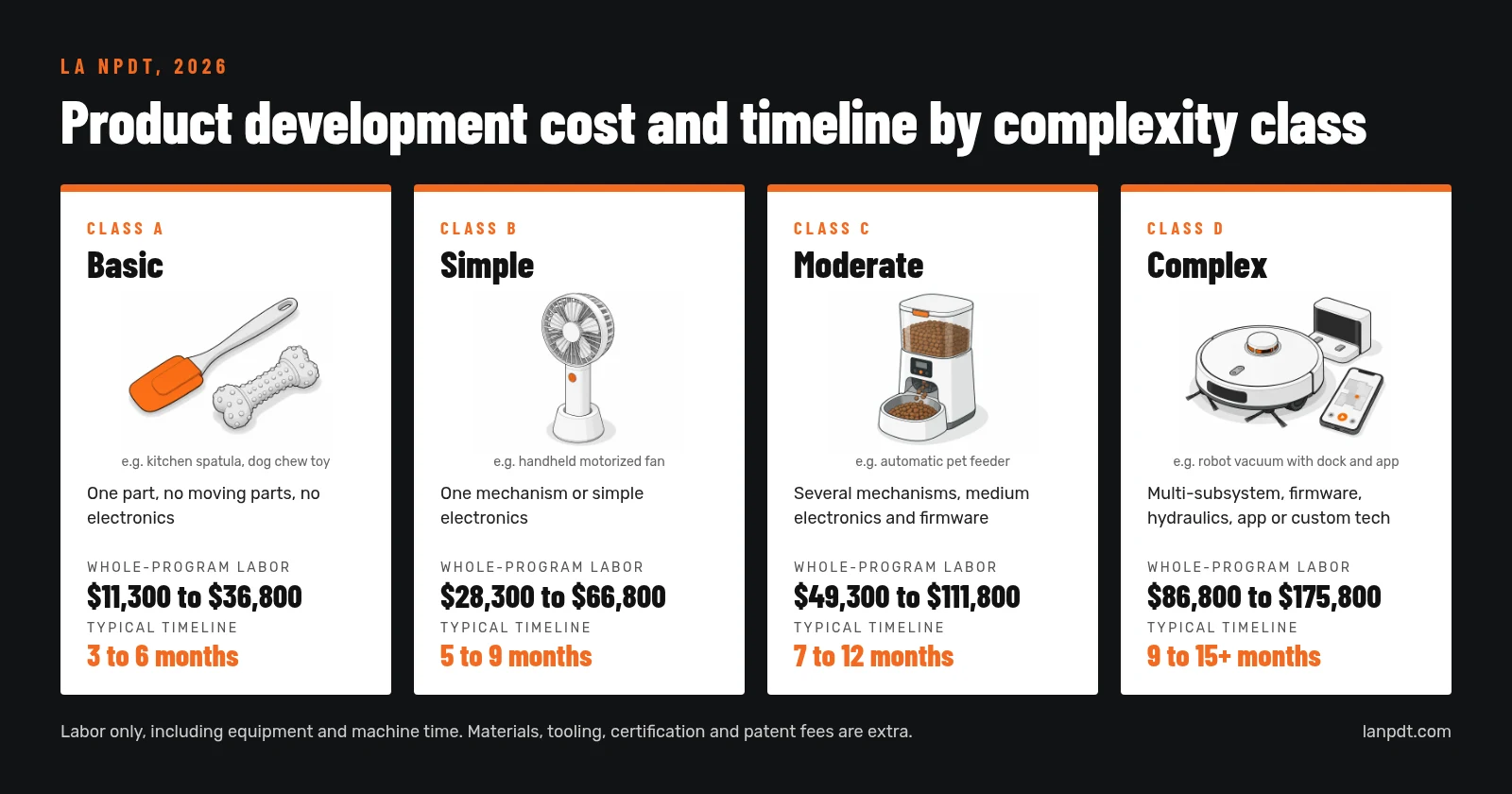
Labor only, including equipment and machine time. Materials, tooling, certification, patent fees, and app or cloud software are extra. Large automated systems and regulated medical devices often run above Class D.
Class A, Basic
Class A is one part, with no moving parts and no electronics. On the homepage this is described as a single static piece, such as a molded, cast, or printed part, where design focuses on shape, material, and a part that is cheap to make. Whole-program labor typically runs $11,300 to $36,800, over 3 to 6 months.
Examples on the site: Scratch Square, LEIA Menstrual Cup, and Gelato for Your Face.
Class B, Simple
Class B adds one mechanism or simple electronics. The homepage description is: adds one moving mechanism or a basic circuit, such as a switch, battery, and buzzer, and design covers how that one function works and holds up. Whole-program labor typically runs $28,300 to $66,800, over 5 to 9 months.
Examples on the site: Easy-Peezy Boxes, T-Rex Tape Cutter, and Bow2Tie Alarm.
Class C, Moderate
Class C is several mechanisms, medium electronics, and firmware. The homepage description is: several mechanisms working together, or a custom circuit board with firmware, and design spans mechanical, electronics, and firmware engineering. Whole-program labor typically runs $49,300 to $111,800, over 7 to 12 months.
Examples on the site: GoNutz Groomer, QMS2GO Voice Recorder, and Apollo 11 Multi-tool.
Class D, Complex
Class D is multi-subsystem work: firmware, hydraulics, an app, or custom tech. The homepage description is: multiple subsystems that must work as one, and design needs full systems engineering and integration testing. Whole-program labor typically runs $86,800 to $175,800, over 9 to 15+ months.
Examples on the site: Venthalpy IoT Probes and App, BARS Pizza Machine, and GPS Tracking Bracelet.
Regulated medical devices, connected products with app and cloud backends, and large automated or industrial systems often run above Class D, because certification, regulatory documentation, and software sit outside these ranges. Those programs are quoted stage by stage after Stage 1. For a connected-device planning view that includes firmware, app, cloud, and certification as separate lines, see what it costs to develop a connected hardware product.
What the 2026 ranges include, and what they leave out
The class ranges are labor only, including equipment and machine time. They are not a turnkey "idea to store shelf" total. The cost page lists what is not included:
- Materials and parts (billed at cost)
- Production tooling
- Certification and lab fees
- Patent and attorney fees (stages 4 and 8)
- Marketing materials (stage 10)
- Licensing or venturing (stage 11)
- App or cloud software
That split matters for budgeting. A Class B program quoted at $28,300 to $66,800 of labor still needs a separate materials, tooling, and (if the product is powered or regulated) certification budget.
For industry-wide phase ranges that include those kinds of lines, labeled as industry figures and not as LA NPDT quotes, see our earlier article New Product Development Cost: A Phase-by-Phase Breakdown.
For a first-build prototype number, see how much a prototype costs to make and the prototype cost calculator.
Design by itself is a subset of the whole program. With our team, product design means Concept Design (stage 2) plus Technical Design & Engineering (stage 5): typically $4,000 to $12,000 for a basic product, $10,000 to $20,000 for a simple product, $21,500 to $40,000 for a moderate product, and $30,000 to $60,000 for a complex product, after a fixed $800 Stage 1. Those figures are on the product design cost page.
How a program is priced, from Stage 1 through later stages
The process itself is set out on the new product development process map, which is the page to use when you want every stage in order, with what you get from each one.
Stage 1, Review/Analysis + Plan, is a fixed $800 single payment, paid up front. It is a technical feasibility analysis, the key risks, and a staged plan with the recommended next step. Results come within 10 business days of receiving your files and intake form. Stage 1 is optional: simple products with clear CAD, sketches, or a spec can start at stage 2, and our team sends a fixed quote within 48 hours of your call.
Every later stage gets its own fixed quote before it starts, billed 50% to start and 50% on delivery. You do not have to commit to a whole program at once. Typical labor per stage, by class, is in the table on the product development cost page. This article does not repeat that grid.
If you want an engineer to scope the next stage, book a free 20-min call.
What to expect for product development cost in 2027
LA NPDT has not published 2027 prices. The figures on the product development cost page are the current 2026 ranges, and they remain the numbers to plan against until a 2027 list is published there. Nothing in this section is a 2027 LA NPDT price, a promised increase, or a promised freeze.
What we can say about 2027 is limited to public, dated sources on the cost of labor, shop work, engineering services, electronic components, and the broader price outlook. Those inputs affect a development budget in different ways: the class ranges are labor, while materials and parts are billed at cost and sit outside the ranges.
Labor, the main line in the class ranges. The U.S. Bureau of Labor Statistics Employment Cost Index for September 2026 (news release USDL-26-1620, October 30, 2026) reported that compensation costs for private industry workers increased 3.4 percent, not seasonally adjusted, over the 12 months ending in September 2026.
Wages and salaries increased 3.1 percent, and benefit costs increased 3.9 percent over that year. For professional, scientific, and technical services, a closer match to engineering and product-development work, compensation increased 3.2 percent over the same 12 months (ECI Table 5).
If labor costs continued at a similar pace into 2027, the labor portion of a development budget would face mid-single-digit pressure. That is a planning input, not a published 2027 price.
Engineering service prices. The BLS Producer Price Index for engineering services (series PCU541330541330) stood at 207.304 in October 2025 and at a preliminary 212.422 in October 2026, a 2.5 percent increase. That is the output-price series for engineering services, and it is consistent with a modest, not a dramatic, move in professional engineering prices over the past year.
Machine-shop rates. The BLS Producer Price Index for machine shops (series PCU332710332710) stood at 208.063 in October 2025 and at a preliminary 216.191 in October 2026, a 3.9 percent increase. Prototype and early-production machining sits in this kind of shop-rate movement. It is a materials-and-process cost, often billed at cost or as machine time, not a reason to rewrite the labor class bands on our own.
Electronic components, the sharp 2026 move. The BLS Producer Price Index for electronic components and accessories (commodity series WPU1178) stood at 71.054 in October 2025 and at a preliminary 93.613 in October 2026, a 31.7 percent increase.
That is a large one-year move in a series that had been much quieter in the years just before. It applies to materials and parts on an electronics bill of materials, which the cost page bills at cost and excludes from the labor ranges.
For any Class B, C, or D product with a custom board or a heavy component buy, a BOM quoted early in 2026 should be re-quoted rather than carried forward into 2027 on the old component prices.
The broader inflation outlook. In the Federal Reserve's September 16, 2026 Summary of Economic Projections, the median projection for PCE inflation is 3.7 percent in 2026 and 2.3 percent in 2027, measured fourth quarter to fourth quarter.
The median for core PCE inflation is 3.4 percent in 2026 and 2.5 percent in 2027. That is a forecast of the general price level, not of product development fees, shop rates, or component prices.
Most FOMC participants also judged uncertainty about inflation as higher than usual, and risks as weighted to the upside, so it is a central outlook, not a guarantee.
How to use this for a 2027 budget. Keep the 2026 LA NPDT product development cost classes as the labor planning band until the cost page publishes a 2027 list. Hold a contingency for labor in the same mid-single-digit neighborhood as the latest Employment Cost Index, if you need a working assumption.
Re-quote electronics BOMs and other materials. Treat tooling, certification, and app or cloud software as their own lines, the way the cost page already separates them. When 2027 LA NPDT prices are published, they will appear on the cost page, and this article should be updated to match.
PPI figures for October 2026 are preliminary, as BLS notes on those series, and are subject to revision for several months after first publication. The index values above were read from the BLS public series on November 13, 2026.
Where to go next: pricing, process, and a manufacturing-cost estimate
If you want the numbers in more detail, start with the product development cost page: whole-program totals, typical labor per stage, the calculator, and the FAQ. For design and engineering on their own, use product design cost.
If you want the process, use the new product development process map. That is the page that sets out every stage in order, with what you get from each one, from Stage 1 through Manufacturing Planning & DFM.
If you want an early estimate of making the product, manufacturing it, the bill of materials, and cost of goods, use InventDraft. InventDraft is the AI workflow built by the LA NPDT team.
Its technical feasibility module returns a TRL score, a rough bill of materials, a manufacturing strategy, a regulatory pathway, key cost drivers, and a risk matrix, which is the early read on prototype and manufacturing cost before you commit engineering hours. That is an estimate to plan with, not a factory quote.
When the idea is ready to be scoped by the engineering team, Stage 1 is a fixed $800 single payment, and you can book a free 20-min call.
Sources
Frequently asked questions
How much does it cost to develop a new product in 2026?
LA NPDT develops physical products in fixed-price stages. Stage 1, Review/Analysis + Plan, is a fixed $800 single payment. A whole program typically costs $11,300 to $36,800 for a basic one-part product, $28,300 to $66,800 for a simple product, $49,300 to $111,800 for a moderate product, and $86,800 to $175,800 for a complex product. Ranges cover labor only and are typical, not a quote. The source for these figures is the product development cost page.
How do LA NPDT product development cost classes affect the price?
LA NPDT product development cost classes run from A to D by complexity. Class A is one part, no moving parts, no electronics. Class B is one mechanism or simple electronics.
Class C is several mechanisms, medium electronics, and firmware. Class D is multi-subsystem work, with firmware, hydraulics, an app, or custom tech. Whole-program labor and typical timelines rise with each class, as in the table above.
Products above Class D, including many regulated medical devices and large automated systems, are quoted stage by stage after Stage 1.
What is not included in the 2026 ranges?
Materials and parts (billed at cost), production tooling, certification and lab fees, patent and attorney fees (stages 4 and 8), marketing materials (stage 10), licensing or venturing (stage 11), and app or cloud software. Labor ranges include equipment and machine time. Timelines exclude tooling, certification, pilot runs, and client review time between stages.
Will it cost more to develop a product in 2027?
LA NPDT has not published 2027 prices. The 2026 ranges on the cost page are the current figures.
Public data that affects a 2027 budget includes a 3.4 percent rise in private-industry compensation over the 12 months ending September 2026 (BLS Employment Cost Index), a 3.9 percent rise in the machine-shops producer price index, and a 31.7 percent rise in the electronic-components producer price index, October 2025 to October 2026, preliminary (BLS PPI).
The Federal Reserve's September 2026 median PCE inflation projection is 3.7 percent for 2026 and 2.3 percent for 2027. None of that is a 2027 LA NPDT price list. Re-quote materials, and check the cost page for any 2027 update.
What does Stage 1 cost, and what do you get?
Stage 1, Review/Analysis + Plan, is a fixed $800 single payment, paid up front. You get a technical feasibility analysis, the key risks, and a staged plan with the recommended next step, within 10 business days of our receiving your files and intake form.
It is optional: simple products with clear CAD, sketches, or a spec can start at stage 2, with a fixed quote within 48 hours of your call. Every later stage is quoted on its own, billed 50% to start and 50% on delivery.
How can I estimate manufacturing cost, bill of materials, and cost of goods?
Use InventDraft for an early feasibility pass that includes a rough bill of materials, manufacturing strategy, and key cost drivers. That is a planning estimate, not a factory quote. The prototype cost calculator is there for a first-build prototype number. For a staged engineering plan and a fixed quote on the next stage, start with Stage 1 or book a free 20-min call.
Services related to this guide
- Free prototype cost calculatorFive to eight questions, an instant cost range for a first prototype.
- Prototype designLooks-like, works-like or pre-production: what each proves and what it costs.
- Rapid prototypingWorking prototypes in days, from 3D printing to vacuum casting.
- Best product development companiesHow the leading US firms compare, and which one fits your stage and budget.