
Cold Chain Monitoring Market Trends (2026–2030)
Cold chain monitoring: MarketsandMarkets puts the global market at about USD 8.31B in 2025 toward about USD 15.04B by 2030 at 12.6% CAGR. Market Research Future: about USD 8.32B in 2024 and about USD 9.07B in 2025 toward about USD 21.48B by 2035 at 9.01% CAGR. The Business Research Company: about USD 7.22B in 2025 toward about USD 15.96B by 2030 at 17.1% CAGR. Hardware anchors spend; software grows fastest. Product openings in validated multi-sensor loggers, reefer telematics, and pharma-grade real-time trackers.
September 15, 20266 min read

Written by Konstantin Dolgan, Ph.D., NPDP
Founder & CEO, Product Development Engineer
Published September 15, 2026
A startup-usable snapshot of the cold chain monitoring market
- ~USD 8.31B to ~USD 15.04B
- Global cold chain monitoring, 2025 to 2030, at 12.6% CAGR
- MarketsandMarkets
- ~USD 8.32B / ~USD 9.07B to ~USD 21.48B
- Global cold chain monitoring, 2024/2025 to 2035, at 9.01% CAGR
- Market Research Future
- ~USD 7.22B to ~USD 15.96B
- Global cold chain monitoring, 2025 to 2030, at 17.1% CAGR
- The Business Research Company
This report covers cold chain monitoring: hardware and software used to track and control temperature (and often humidity, shock, and location) for perishable food, biologics, vaccines, and chemicals in storage and transport. It is written for inventors, hardware startups, and product teams building sensors, loggers, gateways, and compliance-ready monitoring products.
It does not size insulated packaging, gel packs, or vacuum insulated panels as the primary market. Grand View Research estimates a separate cold chain packaging market near USD 33.73 billion in 2025, cited here only as a related category. Do not blend the two sets of numbers.
In one line: MarketsandMarkets reports about USD 8.31 billion in 2025 growing to about USD 15.04 billion by 2030 at a 12.6% CAGR. Market Research Future reports about USD 8.32 billion in 2024 and about USD 9.07 billion in 2025 toward about USD 21.48 billion by 2035 at a 9.01% CAGR.
The Business Research Company reports about USD 7.22 billion in 2025 toward about USD 15.96 billion by 2030 at a 17.1% CAGR. Name the source every time and do not average the series.
Every figure below is traceable to a named source in the Sources section. Where series disagree, we show the range and say so. Browse all of our free reports on the Market Reports index.
Market Size and Growth
MarketsandMarkets (September 2025 report)
- 2025: about USD 8.31 billion
- 2030: about USD 15.04 billion
- CAGR 2025-2030: 12.6%
- North America revenue share: 32.9% in 2024
- Frozen segment: highest CAGR at 13.8%
- Hardware is the leading offering; software is the fastest-growing offering through 2030
- Logistics: storage is expected to dominate, with transportation also critical
- Application: Food and Beverages expected to dominate size; Pharmaceuticals and Healthcare expected to grow fastest
- Hardware types in scope: sensors and data loggers, RFID devices, telematics and telemetry devices, networking devices
- Product examples cited in the MarketsandMarkets timeline: Tive Solo Pro multi-sensor tracker (April 2025), Carrier and Sensitech Lynx FacTOR SaaS (March 2025), ORBCOMM RT-8000 reefer telematics (May 2023), Controlant and SmartCAE packaging simulation partnership (October 2024)
Market Research Future
- 2024: about USD 8.317 billion
- 2025: about USD 9.067 billion
- 2035: about USD 21.48 billion
- CAGR 2025-2035: 9.01%
- Product type framing: hardware largest, software fastest-growing
- Players listed publicly: Thermo Fisher, Sensitech, Zebra, Monnit, Berlinger, Emerson, DHL Supply Chain, Controlant, ORBCOMM, LogTag
The Business Research Company
- 2025: about USD 7.22 billion
- 2026: about USD 8.5 billion
- 2030: about USD 15.96 billion
- CAGR 2026-2030: 17.1%
- IoT device growth cited as a driver
- North America largest region in 2025; Asia Pacific fastest growing, per the summary
Related but distinct: cold chain packaging
Grand View Research sizes the cold chain packaging market at about USD 33.73 billion in 2025 growing to about USD 93.15 billion by 2033 at a 13.5% CAGR (2026-2033). That series covers insulated shippers, gel packs, and vacuum insulated panels, not monitoring hardware and software. Label it as packaging whenever you quote it.
Growth Drivers
- Temperature-sensitive biologics, vaccines, gene therapies, and specialty drugs
- Regulatory pressure from FDA, USDA, EMA, and GDP or GxP documentation requirements
- Fresh and frozen food e-commerce and direct-to-consumer grocery last mile
- IoT sensors, RFID, GPS and GNSS, and cloud analytics adoption
- Food waste reduction and spoilage cost avoidance
- Cross-border pharma and perishable trade growth in Asia Pacific
Key Segments
- By offering: hardware (sensors and data loggers, RFID, telematics, networking) leads, while software on-premise and cloud grows fastest
- By temperature type: chilled is often the largest share, frozen carries the highest CAGR at 13.8% per MarketsandMarkets
- By logistics: storage (warehouses, cold containers, blast freezers) versus transportation (road, air, sea, rail)
- By application: Food and Beverages leads size, Pharmaceuticals and Healthcare grows fastest, with chemicals and other uses behind them
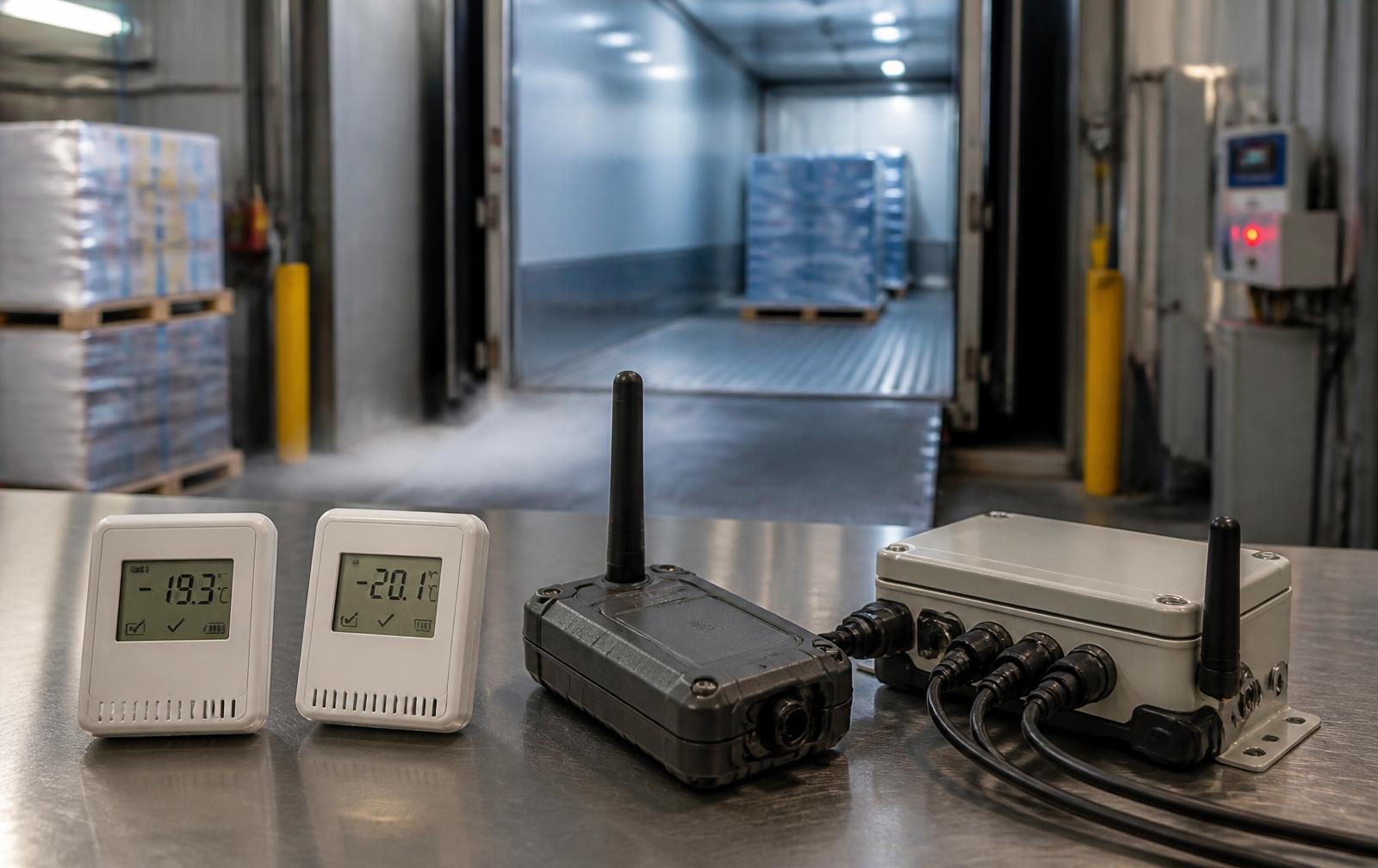
- Hardware stack for product teams: temperature, humidity, and shock sensors, disposable and reusable loggers, BLE, cellular, or satellite connectivity, enclosure IP rating, calibration, battery life, and compliance reporting UI
Teams sizing a logger or gateway often start with product design and electronic product development before locking a BOM.
Where Startups Are Building
If you are still narrowing the gap, product discovery is the usual first step. The openings we see most often:
- Multi-sensor disposable loggers with honest, validated accuracy claims
- Real-time cellular and Bluetooth trackers for biologics and dry-ice lanes
- Reefer telematics with door-open and fuel or maintenance hooks for fleets
- Cloud GxP release workflows that cut manual excursion review time
- Lower-cost monitoring kits for emerging-market food exporters
- Sensor and packaging co-design where monitoring data informs lane risk, without claiming packaging market size
Risks and Constraints
- High CapEx plus calibration and maintenance cost for smaller shippers
- Integration across IoT, WMS, ERP, and proprietary protocols
- Cybersecurity and data integrity for regulated shipments
- Connectivity gaps on long ocean and rural road lanes
- Scope confusion with cold chain packaging and insulated shippers
- Series disagreement across MarketsandMarkets, Market Research Future, and The Business Research Company, so always name the source
Product development consulting helps stress-test sensor accuracy, enclosure thermal design, radio certification, and landed cost before tooling.
From market size to a buildable product
Market size only shows the field is growing. Turning this report into a shippable monitoring product usually means discovery and requirements, product design and industrial design, prototyping, then manufacturing readiness.
Product discovery and requirements. Pick the lane (pharma real-time versus food disposable logger versus reefer telematics), then write requirements around temperature range, accuracy, logging interval, connectivity, battery life, IP rating, and compliance evidence including the GxP and 21 CFR Part 11 path when relevant. Our product discovery sprint is built for exactly this.
Product design and industrial design. Treat probe placement, gasket sealing, antenna keep-outs, battery thermal paths, and service access as first-class constraints through product design and industrial design.
Prototyping. Prove thermal chamber accuracy, drop and vibration, condensing humidity, RF range inside metal reefers, and connector durability with rapid prototyping. The prototype cost calculator and our guide to how much a prototype costs set the budget before you commit.
Manufacturing readiness. DFM for mid-volume electronics, sensor supplier qualification, a repeatable calibration process, and short-run validation through low-volume manufacturing. If you want to talk it through first, book a consultation.
- Design calibration and evidence logging from the first layout review
- Treat battery life and RF keep-outs as product features, not afterthoughts
- Pharma real-time trackers and reusable multi-sensor loggers are realistic entry points versus racing only on commodity USB stick loggers
- Enclosure sealing and probe integrity decide whether QA teams will trust you
- Connectivity, power management, and app work usually needs electronic product development alongside the mechanical stack
Key Takeaways
- MarketsandMarkets: about USD 8.31B (2025) to about USD 15.04B (2030) at 12.6% CAGR
- Market Research Future: about USD 8.32B (2024) and about USD 9.07B (2025) to about USD 21.48B (2035) at 9.01% CAGR
- The Business Research Company: about USD 7.22B (2025) to about USD 15.96B (2030) at 17.1% CAGR
- Hardware still leads spend while software is the fastest-growing offering
- North America held about 32.9% revenue share in 2024 per MarketsandMarkets, so name the series you use
Planning a product in this space? Try the prototype cost calculator or book a consultation.
You can also apply to partner with us. Related reading: portable power stations, battery energy storage, wearable medical devices, and industrial inspection drones. See also our industrial product design and product development consulting pages, or the full Market Reports index.
Sources
Key metrics at a glance
Every figure below appears in the report above. The MarketsandMarkets, Market Research Future, and The Business Research Company series use different scopes, so they are listed separately rather than blended.
| Metric | Value | Year / Period | Source |
|---|---|---|---|
| Cold chain monitoring market size | USD 8.31 billion | 2025 | MarketsandMarkets |
| Cold chain monitoring market size | USD 15.04 billion | 2030 | MarketsandMarkets |
| CAGR | 12.6% | 2025-2030 | MarketsandMarkets |
| North America revenue share | 32.9% | 2024 | MarketsandMarkets |
| Frozen segment CAGR | 13.8% | forecast | MarketsandMarkets |
| Market size | USD 8.317 billion | 2024 | Market Research Future |
| Market size | USD 9.067 billion | 2025 | Market Research Future |
| Market size | USD 21.48 billion | 2035 | Market Research Future |
| CAGR | 9.01% | 2025-2035 | Market Research Future |
| Market size | USD 7.22 billion | 2025 | The Business Research Company |
| Market size | USD 8.5 billion | 2026 | The Business Research Company |
| Market size | USD 15.96 billion | 2030 | The Business Research Company |
| CAGR | 17.1% | 2026-2030 | The Business Research Company |
| Cold chain packaging (related, distinct) | USD 33.73 billion | 2025 | Grand View Research |
Table: Key cold chain monitoring metrics, with the source behind each figure.
Cold chain monitoring market size, 2025 to 2030
Global market size in USD billion. Only the two reported endpoints are plotted; mid-year values are not published in the summary.
Source: MarketsandMarkets, Cold Chain Monitoring Market (2025).
2025 size estimates by source
Three published series for the same year. Scopes and definitions differ, so cite one series at a time and do not average them.
2025 size estimates by source (scopes may differ; do not average).
Questions founders ask about the cold chain monitoring market
What is the cold chain monitoring market size?
MarketsandMarkets puts the global market at about USD 8.31 billion in 2025. Market Research Future estimates about USD 9.07 billion in 2025. The Business Research Company estimates about USD 7.22 billion in 2025. Scopes differ, so name the source every time you quote a figure.
What is the cold chain monitoring market CAGR?
MarketsandMarkets projects 12.6% from 2025 through 2030. Market Research Future projects 9.01% from 2025 through 2035. The Business Research Company projects 17.1% from 2026 through 2030. Do not average the series.
Is cold chain monitoring the same as cold chain packaging?
No. Monitoring covers sensors, data loggers, RFID, telematics, and software. Packaging covers insulated shippers, gel packs, and vacuum insulated panels, which Grand View Research sizes near USD 33.73 billion in 2025. Keep the two sets of numbers separate.
Which offering leads the market?
Hardware (sensors and data loggers, RFID devices, telematics and telemetry devices, networking devices) is the larger offering, while software is the fastest-growing offering, per the MarketsandMarkets and Market Research Future framing.
Which applications matter most?
MarketsandMarkets expects Food and Beverages to dominate market size and Pharmaceuticals and Healthcare to grow fastest. Frozen is called out as the highest-CAGR temperature segment at 13.8%.
How does a team move from this data to a first prototype?
What hardware categories are in scope?
MarketsandMarkets counts sensors and data loggers, RFID devices, telematics and telemetry devices, and networking devices as the hardware side of cold chain monitoring.
Building hardware for this market
If this research is the front end of a product decision, these are the parts of the work we handle in house.
- Sensor and logger electronics
Low-power sensing, wireless links and battery life for shipment monitors.
- Connected device and cloud
Device, gateway and data path designed as one working system.
- Field-test prototypes
Working monitors you can run through real shipments before you commit.
Cite this report
Using these figures in a pitch deck, grant application or internal memo? Cite it as:
LA New Product Development Team (LA NPDT). "Cold Chain Monitoring Market Trends (2026–2030)." 2026. https://lanpdt.com/cold-chain-monitoring-market-trends-2025/
Every figure is attributed to its original source in the Sources list above. Please cite the original publisher for their own data.