New Product Development Cost: A Phase-by-Phase Breakdown
Most products cost $30,000 to $250,000 to develop. Here is where that money goes, phase by phase, and what drives the number up or down.
May 11, 20256 min read

Written by Konstantin Dolgan, Ph.D., NPDP
Founder & CEO, Product Development Engineer
Published May 11, 2025Updated September 2, 2026
Most new physical products cost between $30,000 and $250,000 to take from concept to production-ready, and the range is that wide because the number is driven by complexity, electronics and regulation rather than by the idea itself. A simple molded consumer accessory can be developed for well under six figures. A connected medical or industrial device rarely can.
This breakdown shows where the money actually goes, what each phase buys you, which decisions move the total the most, and how to build a budget you can defend to investors. Costs below are US-market development costs and exclude tooling, inventory and marketing unless stated. For prototype-only budgets, see our guide to how much a prototype costs.
What you are actually paying for
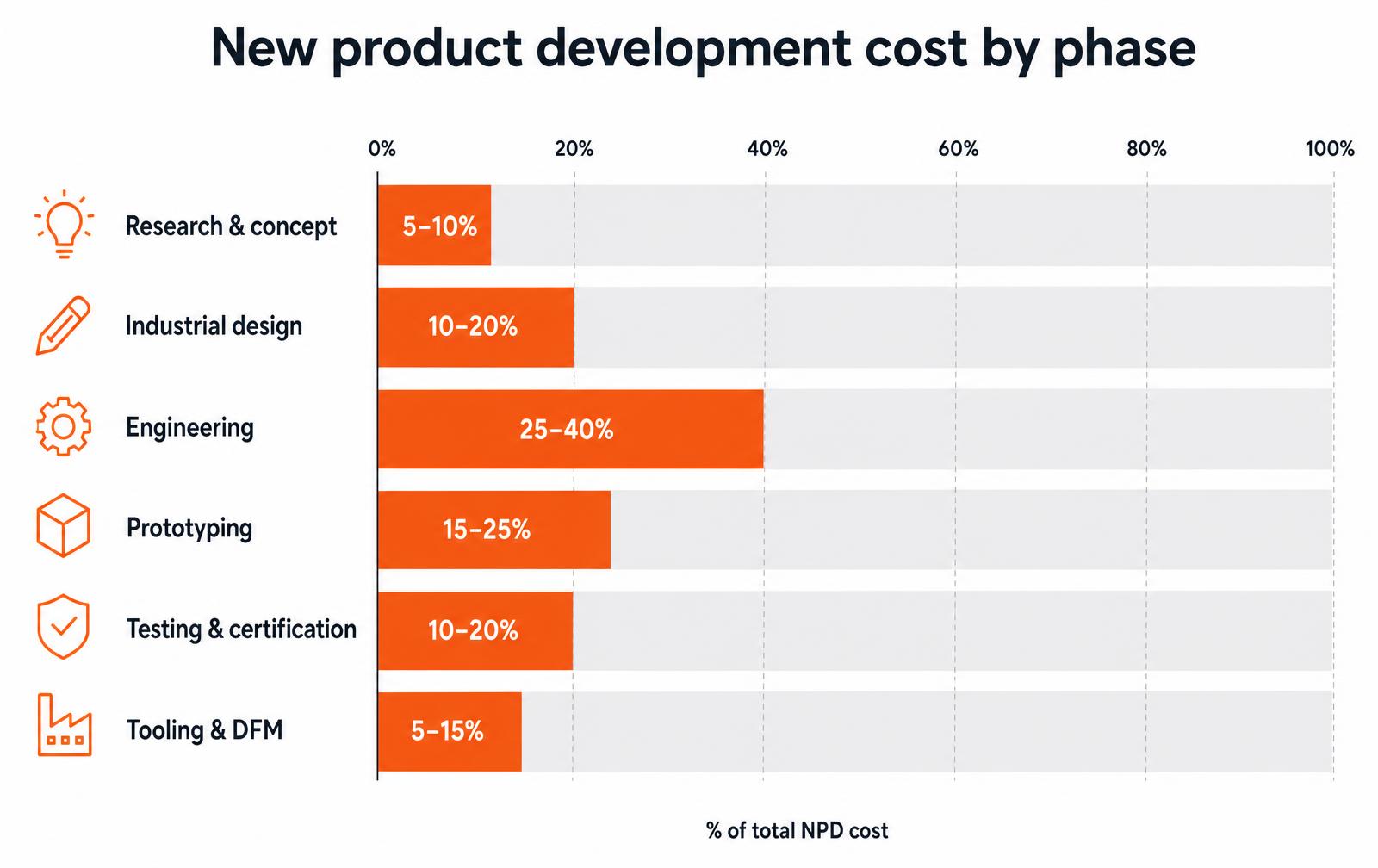
Product development cost is almost entirely expert time plus the physical parts needed to prove the design works. There is no inventory, no factory and no marketing in this number — those come after. Understanding the split matters, because founders often budget for prototypes and forget that engineering, the largest line, comes first.
Phase | Share of total | Typical range | What it buys |
|---|---|---|---|
Research and concept | 5 to 10% | $2,000 to $15,000 | Market and competitive review, requirements, concept sketches |
Industrial design | 10 to 20% | $5,000 to $40,000 | Form, ergonomics, user interaction, CMF, renderings |
Engineering and CAD | 25 to 40% | $12,000 to $120,000 | Mechanical and electrical design, tolerance analysis, production CAD |
Prototyping | 15 to 25% | $3,000 to $60,000 | Appearance models, functional prototypes, iterations |
Testing and certification | 10 to 20% | $3,000 to $80,000 | Lab testing, FCC, UL, CE, safety and compliance work |
Tooling and DFM prep | 5 to 15% | $4,000 to $50,000 in engineering | Manufacturing drawings, supplier packages, tooling review |
The cheapest product development budget is the one that does not have to be spent twice.
Cost by product type
Complexity is the single strongest predictor of cost. The table below reflects typical full-cycle development spend for a first production-ready version, excluding injection mold tooling and first inventory.
Product type | Typical development cost | Main drivers |
|---|---|---|
Simple molded accessory or housewares item | $15,000 to $50,000 | Geometry, finish, one or two parts |
Mechanical consumer product with moving parts | $40,000 to $120,000 | Mechanism design, durability testing, assembly |
Battery-powered electronic device | $70,000 to $200,000 | PCB design, firmware, enclosure, FCC testing |
Connected or app-linked device | $120,000 to $350,000 | Hardware plus software, cloud, security, certification |
Medical or regulated device | $200,000 to $1,000,000+ | Design controls, documentation, biocompatibility, FDA pathway |
Industrial equipment or machinery | $150,000 to $600,000 | Structural engineering, safety standards, low-volume manufacturing |
Research and concept: cheap, and the highest leverage money you will spend
This is the phase founders most often skip and most often regret. A few thousand dollars of market and competitive review, a written requirements document and a handful of concept directions routinely prevent tens of thousands of dollars of engineering aimed at the wrong product. If a competitor already sells your idea at a price you cannot match, you want to know that in week two, not month nine.
- Competitive teardown and pricing analysis so the target cost is grounded in reality.
- A one-page requirements document that becomes the contract for everything downstream.
- Regulatory scoping — knowing early that a product needs FCC, UL or FDA involvement changes the whole budget.
- Two to four concept directions, evaluated against cost and feasibility rather than taste.
Industrial design: what the customer actually buys
Industrial design defines form, proportion, ergonomics, materials and finish. Its cost scales with the number of concept rounds and the level of refinement, not with the size of the product. A design that is developed with manufacturing in mind also lowers cost later; a beautiful shape with impossible undercuts pays for itself in tooling problems.
Deliverable | Typical cost | Notes |
|---|---|---|
Concept sketches and directions | $1,500 to $6,000 | Two to four directions, one refinement round |
3D concept modeling | $3,000 to $12,000 | Surfacing the chosen direction |
Photoreal renderings | $800 to $4,000 | For investors, crowdfunding and retail pitches |
CMF specification | $1,000 to $5,000 | Color, material and finish for manufacturing |
Engineering: the largest and least compressible line
Engineering turns a shape into a manufacturable product: wall thicknesses, ribs and bosses, fastening strategy, tolerance stacks, material selection, thermal and structural analysis, and — for electronics — schematic design, PCB layout, component selection and firmware. It is the line most likely to be underestimated, because the visible output is files rather than objects.
Engineering scope | Typical cost | When you need it |
|---|---|---|
Mechanical design, simple product | $8,000 to $30,000 | Few parts, no electronics |
Mechanical design, complex assembly | $30,000 to $90,000 | Mechanisms, seals, multiple materials |
Electrical design and PCB layout | $15,000 to $70,000 | Any powered product |
Firmware and embedded software | $15,000 to $100,000 | Devices with logic, sensors or connectivity |
Simulation and analysis (FEA, thermal) | $3,000 to $20,000 | Loaded, heated or safety-critical parts |
Prototyping: budget for iterations, not for one build
The most common budgeting error in prototyping is planning for a single prototype. Real programs run three to five meaningful iterations, and each one costs less than the last only if the earlier ones were built to answer specific questions. Choosing the right fidelity for each question is the difference between a $6,000 prototyping line and a $40,000 one — our guide to choosing prototype materials covers the trade-offs in detail.
- Appearance model: $1,500 to $8,000 — looks like the product, does not work.
- Functional prototype: $3,000 to $25,000 — works like the product, may not look final.
- Looks-like works-like: $8,000 to $50,000 — investor and user-testing grade.
- Pilot-run units: $10,000 to $60,000 — made with production or near-production processes.
Testing, certification and the costs founders forget
Compliance is not optional and it is rarely in the first budget. Which certifications apply depends on the product and the markets you sell into, and lab time must be booked in advance. Failing a test is common on a first submission; budget for one retest.
Cost item | Typical range | Notes |
|---|---|---|
FCC testing (wireless or digital electronics) | $5,000 to $20,000 | Intentional radiators cost more |
UL or safety certification | $5,000 to $30,000 | Depends on product category |
CE marking for the EU | $3,000 to $15,000 | Often overlaps with other testing |
Durability and life testing | $2,000 to $25,000 | Cycle testing, drop, environmental |
Patent filings | $5,000 to $20,000 | Provisional is far cheaper than utility |
Packaging design and testing | $3,000 to $15,000 | Retail packaging plus transit testing |
What happens after development: tooling and first production
Development gets you a product that can be made. Making it is a separate budget. Injection mold tooling typically runs $3,000 to $15,000 per cavity for simple parts and $20,000 to $100,000 for complex multi-slide tools. First production runs, packaging, freight, duties and certification of the production units add more. Plan for development and launch as two funding events, not one.
How to keep development costs under control
- Cut scope, not quality — ship the smallest version that solves the problem and hold the rest for version two.
- Freeze the requirements that drive tooling before engineering starts; late changes are the most expensive line item in any program.
- Use off-the-shelf components wherever the design allows instead of custom parts.
- Prototype at the lowest fidelity that answers the question in front of you.
- Use one team for design, engineering and prototyping so you are not paying three vendors to learn your product.
- Get a written phase-by-phase quote with deliverables, so you can stop or adjust between phases.
How to budget product development cost as a startup
Founders usually budget for the deliverables and forget the loop.
The reliable method is to budget by decision instead: allocate money to the next question that has to be answered, hold roughly 20% of the total as contingency, and refuse to release tooling money until a functional prototype has survived the test that matters.
In practice that means splitting the program into three funded stages - prove the concept, prove the design, prove it can be made - and treating each stage gate as a genuine go or no-go rather than a formality.
- Stage 1, prove the concept. Typically 10 to 15% of total spend: research, concept work, rough functional rigs.
- Stage 2, prove the design. Roughly half the budget: industrial design, engineering, two to four prototype rounds.
- Stage 3, prove manufacturability. The rest: design for manufacturing, testing and certification, pilot parts before tooling.
- Contingency. Hold 20% unallocated. Programs that skip this stall on the third revision, which is the one that usually matters most.
Get a phase-by-phase estimate for your product
LA NPDT quotes development in phases with defined deliverables, so you always know what the next stage costs before committing to it. Send us your concept and we will scope design, engineering and prototyping against a realistic budget. Start with a project quote or a consultation.
Want a real number for your product, not a guess?
Work with LA NPDT: if you are moving from here to execution, start with our our product development process or talk to us about end-to-end product development.
Frequently asked questions
How much does it cost to develop a new product?
Most physical consumer products cost $30,000 to $250,000 to develop to production-ready files, excluding tooling and inventory. Simple molded accessories can be developed for $15,000 to $50,000, powered electronics typically run $70,000 to $200,000, and regulated medical devices commonly exceed $200,000. Complexity, electronics and regulatory requirements drive the number far more than the size of the product.
What is the biggest cost in new product development?
Engineering, usually 25 to 40 percent of total development cost. It covers mechanical and electrical design, tolerance analysis, material selection, simulation, firmware and the production documentation a factory needs. It is also the line most often underestimated, because its output is files rather than physical objects.
How do you estimate product development cost early on?
Start from complexity rather than ambition: count the parts, decide whether the product is powered, identify any regulatory requirements, and set a target retail price and volume. A development partner can then quote phase by phase. Expect an estimate range rather than a fixed number until requirements are written down, and add a contingency of 15 to 25 percent for iterations.
Is tooling included in product development cost?
No. Development ends with production-ready files and a validated design. Tooling is a manufacturing cost, typically $3,000 to $15,000 per cavity for simple injection molded parts and $20,000 to $100,000 for complex tools. Treat development and tooling as two separate budgets and two separate funding milestones.
Why do product development quotes vary so much?
Because scope definitions differ. One quote may cover concept and CAD only, while another includes engineering analysis, prototypes, certification support and manufacturing documentation. Compare deliverables line by line, ask what is excluded, and confirm how many iteration rounds are included before comparing totals.
Can you develop a product on a small budget?
Yes, by narrowing scope aggressively. Develop one product rather than a family, avoid electronics if the value does not require them, use standard components, and phase the work so each stage is funded by the results of the last. Many successful products started with a $20,000 to $40,000 first phase that produced a working prototype used to raise the rest.
Filed under:Education
Services related to this guide
- Product design servicesIndustrial design and CAD taken all the way to manufacturable files.
- Best industrial design firmsWhich studios take an idea from form to manufacturable hardware, and what they charge.
- Prototype designLooks-like, works-like or pre-production: what each proves and what it costs.
- Product development examplesReal projects we designed, prototyped and shipped.