AI Hardware Prototyping in 2026: From an AI Idea to Physical Proof
From AI-generated concepts to benchtop experiments, integrated prototypes and production trials, each build should earn the next one.
November 29, 202615 min read

Written by Konstantin Dolgan, Ph.D., NPDP
Founder & CEO, Product Development Engineer
Published November 29, 2026
An AI rendering can make a product look finished before anyone knows whether its mechanism works. The first useful prototype might look nothing like that image: a motor on a board, exposed wires and a measurement on a screen. That rough build turns an important assumption into evidence.
Hardware prototyping is the process of building and testing representations of a product to learn what works, what fails and what to change. In AI hardware prototyping, AI assists the design and engineering work around those tests. The product itself does not have to contain AI.
A prototype, in the classic textbook definition, is "an approximation of the product along one or more dimensions of interest" (Ulrich, Eppinger and Yang, Product Design and Development).
Why prototyping matters for the AI and hardware startup movement
2026 pushed many software founders and AI builders toward physical products:
- Software stocks sold off, then recovered. About $1 trillion came off the S&P 500 software and services index between January 28 and February 5, 2026, on fears of AI disruption (Reuters). The index then recovered to 2026 highs in October (Reuters, Oct 6, 2026).
- Physical AI funding rose sharply. Crunchbase counted $47.4 billion in physical AI funding in the first half of 2026, up from $26.4 billion a year earlier, although one Waymo round was nearly a third of it (Crunchbase News).
- Software investors are backing hardware. a16z announced a $1.1 billion Machine Age Fund and says hardware startups grew to "over 20%" of its deal flow (a16z).
- More startups are building physical products. One in eight companies in Y Combinator's Winter 2026 batch was building something physical (CB Insights).
For founders worried about easily copied software, hardware offers value built through engineering, integration and manufacturing knowledge. AI has made concepts cheap; physical proof is still required. The business context is covered in Hardware Development 101 for Software Engineers.
The workflow from an AI idea to a benchtop proof of concept and beyond
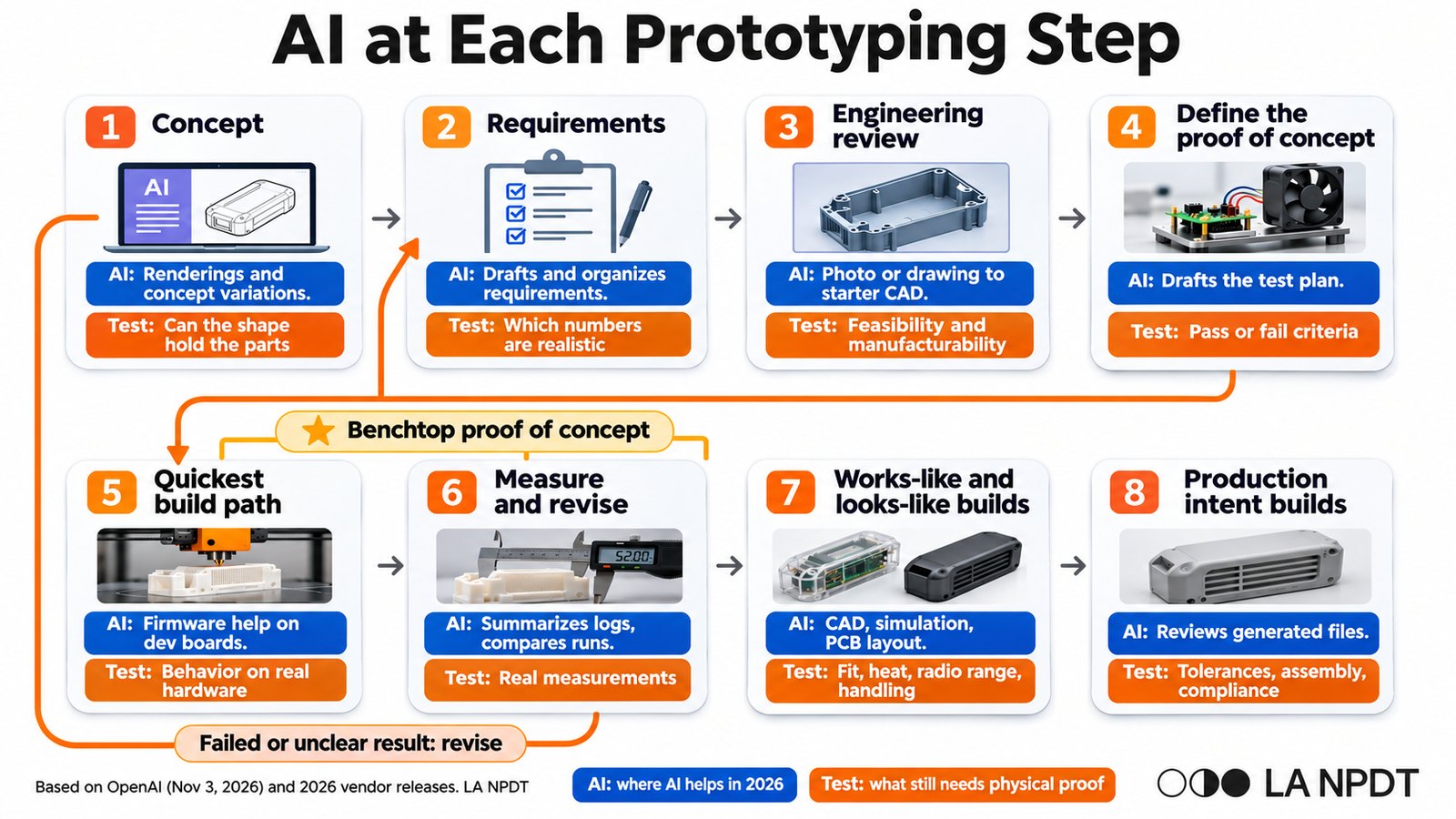
Use this sequence as a decision framework: a failed test sends you back a step, a successful one earns the next level of detail.
Step | Work to complete | Where AI helps in 2026 | What still needs physical proof or an engineer |
|---|---|---|---|
1. Describe the need | User, task, operating conditions | Renderings and concept variations | Whether the shape can hold the parts and be made |
2. Set requirements | Measurable targets and unknowns | Drafting and organizing requirements | Which numbers are realistic |
3. Review feasibility | Mechanism, parts, packaging, build options | Drawing-to-CAD and photo-to-CAD starter models | Feasibility and manufacturability judgment |
4. Define the proof | What the build must do, show and prove | Drafting a test plan | The pass or fail criteria |
5. Choose and build | Simplest suitable parts and methods | AI-assisted firmware on development boards | Behavior on real hardware |
6. Measure and revise | Record results, conditions, failures | Summarizing logs, comparing runs | The measurement and its interpretation |
7. Integrate | Function, form and user interaction together | AI CAD, simulation setup, PCB layout | Fit, heat, radio range, handling |
8. Prepare for production | Intended parts, assembly, processes | Reviewing generated files and data | Tolerances, assembly, compliance testing |
For the steps below, imagine a hypothetical powered lid mechanism. Its numbers are illustrative, not product specifications or reported test results.
1. Start with the need behind the concept
Bring the sketch, AI image or conversation, and explain who uses the product, for what task and where.
Separate intended features from assumptions. An image communicates proportions and style, not dimensions, internal space, wall thickness or how the product comes apart. AI-generated specifications can also conflict: a compact powered lid still needs room for its mechanism and power source. Our guides to AI concept feasibility and preparing an AI-generated invention for prototyping explain the handoff.
2. Turn the promises into measurable requirements
Replace "strong," "fast" and "easy to use" with conditions you can evaluate: load, movement, operating time, size limit or user task. A requirement such as "opens the specified lid within 2 seconds" gives a test a target.
An AI assistant can help organize requirements and expose missing questions; an engineer should check the assumptions where size, power, materials and cost compete. Rank the uncertainties by consequence, and mark a requirement "unknown" where you have no evidence, so an AI-generated estimate does not quietly become a design decision.
3. Review feasibility before committing to the build
Check whether the function is plausible with available mechanisms and components, and review size, materials, manufacturing approach and cost. Include high-level market and prior art checks.
AI now speeds up the starting geometry. Engineering.com reported in September 2026 that Backflip AI's drawing-to-CAD and photo-to-CAD features were live (Engineering.com, Sep 23, 2026). Generated geometry still needs engineering review: a realistic surface says little about a hidden bearing or a cable path.
The outcome is a proposed first test. For the lid, that might be whether a practical motor and linkage can move the load. If the risk is fitting a hand instead, a simple shape model is the better first build.
4. Define what the benchtop proof of concept must do, show and prove
A proof of concept (PoC) tests whether a critical idea or function is feasible. It often comes early, but it need not be the only PoC. NASA's technology readiness levels (TRL) place "analytical and experimental critical function and/or characteristic proof of concept" at TRL 3, before laboratory breadboard validation at TRL 4 (NASA TRL definitions).
Benchtop describes the setup: a build operated on a bench, with accessible parts and lab equipment. NASA's workbook describes a breadboard as "a low fidelity unit that demonstrates function only, without respect to form or fit" (NASA AIST TRL workbook).
For the hypothetical lid mechanism, write:
Requirement | Example for the first bench test |
|---|---|
Must do | Move the specified lid through its required travel |
Must show | Make the full movement and any stall visible |
Must prove | Complete 10 consecutive opening cycles within 2 seconds each, at the specified load and supply voltage |
Not established by this test | Battery runtime, final appearance, long-term durability or production readiness |
Ten cycles is a screening test, not durability qualification. Keep any constraint that could invalidate the concept: an oversized mechanism on a bench supply cannot show that the battery-powered product will fit.
5. Choose the simplest build that can produce a trustworthy answer
Start with existing parts, development boards, simple fixtures and printed brackets. A development board is a ready-made electronics platform for trying components and code before designing a custom board. SparkFun describes a typical proof of concept prototype as "built from off-the-shelf components" and "commonly based on an Arduino or Raspberry Pi" (SparkFun).
AI is increasingly useful for firmware, the software running on the device:
- Nordic Semiconductor announced AI-assisted development in May 2026, saying it enables "faster prototyping from idea to proof of concept on a Nordic development kit" (Nordic, May 28, 2026).
- Silicon Labs released a public beta of its Simplicity AI SDK (software development kit) in October 2026. It connects assistants such as GitHub Copilot, OpenAI Codex and Cursor with tools that build, flash and debug code on supported hardware (Silicon Labs, Oct 7, 2026).
- STMicroelectronics states that generated code "must still be reviewed, tested, and validated" (ST).
6. Measure, record and decide
Run the agreed test and record the build revision, code version, conditions and results, including failed runs. "It moved" is less useful than load, travel, time and failures. If the mechanism stalls, find whether the limit is the motor, supply, friction or control logic before changing several things at once.
Then decide: proceed, modify and repeat, try another approach, or stop. A failed concept is still a useful experiment if it rules out an expensive dead end. AI can help summarize logs and compare runs; keep the underlying measurements and verify the interpretation. Our prototyping loop guide explains how to turn each round into a decision.
7. Bring function and form together, with AI in the engineering tools
Once the critical function works, develop the complete product. These 2026 tools support that work:
- CAD: Zoo launched Zookeeper, a conversational CAD agent whose models are "fully editable using the same sketch and feature tree workflows engineers already rely on", on February 5, 2026 (Zoo). Autodesk announced AutoTimeline, "which converts imported geometry into editable parametric parts", and AutoAssemble on September 15, 2026 (Autodesk).
- Simulation: the SimScale Engineering AI Agent for Onshape can, "from one prompt", set up and run fluid flow (CFD), structural (FEA), thermal or electromagnetic simulations (Engineering: multiphysics gets mcp server and onshape gets simscale agent). The engineer can still "override a boundary condition, or review assumptions" (SimScale, Sep 15, 2026).
- PCB layout: Quilter reports 38.5 hours of human cleanup against 428 hours of quoted manual layout for an AI-laid-out two-board computer that ran Linux. An engineer prepared the design and constraints (Quilter, Project Speedrun). That is a vendor comparison for layout, not a program-wide saving.
Repeat relevant tests after integration, with the mechanism in its real space and the electronics inside the enclosure. Treat simulation results and AI layouts as candidates until a physical test agrees. More detail: AI tools for hardware prototyping, AI CAD agents and physics AI simulation.
8. Shift from making one work to making the result repeatable
In November 2026, OpenAI reported an AI-designed test device whose small prototype batch a contract manufacturer built in under a month. Even so, "getting the device ready for manufacturing still required several rounds of review and iteration", because the model "did not consistently account for the manufacturer's production limits, tolerances, or details required for assembly" (OpenAI, Nov 3, 2026).
Later builds test whether intended parts and processes preserve the demonstrated performance: fit, heat, battery, radio performance, durability and assembly. Define tolerances, the permitted variation in dimensions.
Plan compliance early. In the US, many digital devices require Federal Communications Commission (FCC) equipment authorization before marketing, through certification or a Supplier's Declaration of Conformity depending on the device (47 CFR 15.101).
Prototype types by stage and purpose
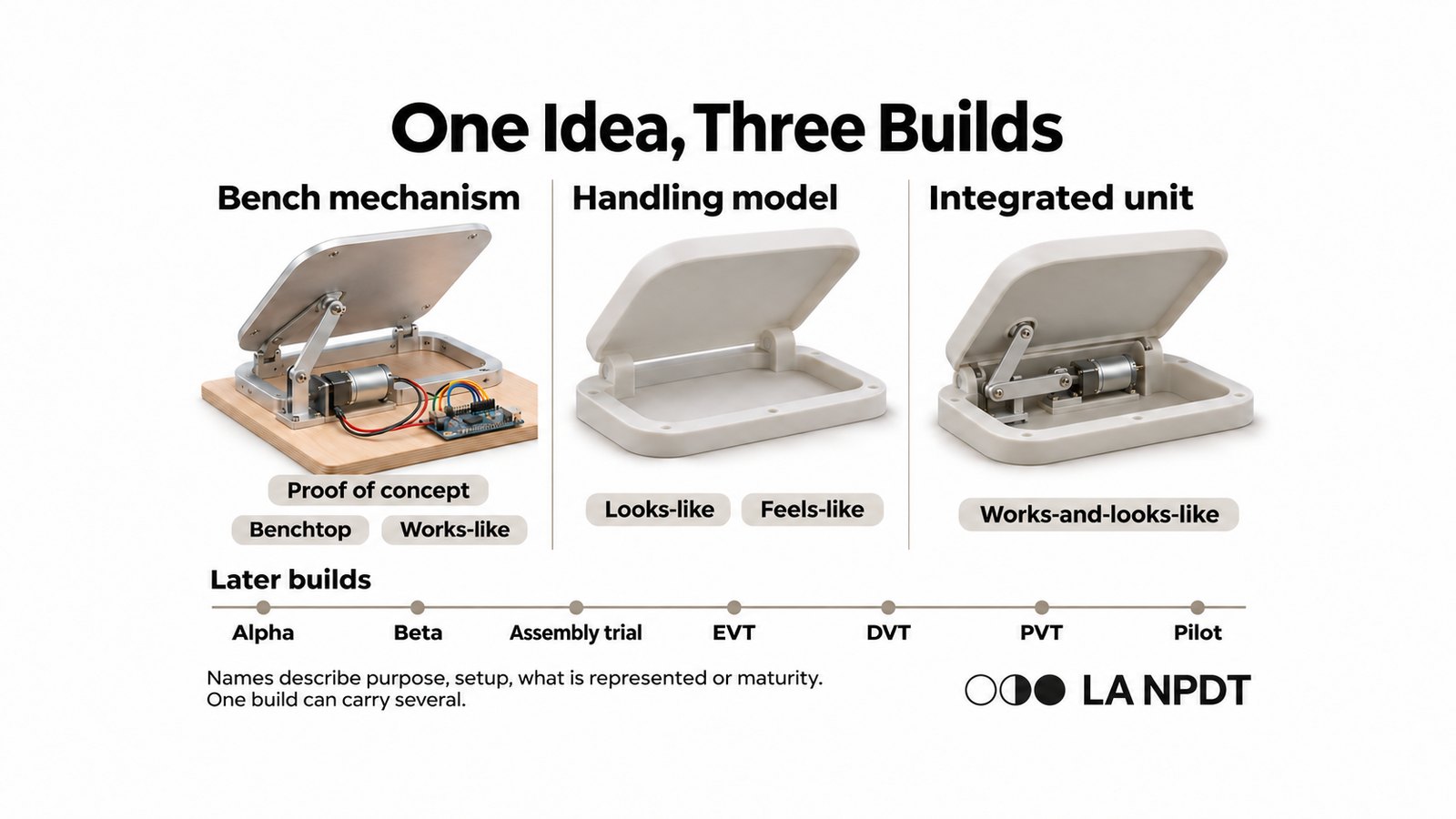
Proof of concept describes a purpose. Benchtop describes a setup. Works-like and looks-like describe what is represented. Alpha and beta describe maturity under a team's chosen convention. A benchtop PoC can also be a works-like prototype.
Prototype | Typical stage | Question it answers | Where AI tools can help in 2026 |
|---|---|---|---|
Proof of concept (often a benchtop or breadboard build) | Early | Can the critical function work? | Firmware on development boards; log analysis |
Works-like | After the PoC | Do the main functions work together? | AI CAD, simulation setup |
Looks-like and feels-like | In parallel with works-like | Are shape, size, handling and finish right? | Renderings; photo-to-CAD starter models |
Works-and-looks-like | When integration is the question | Does the function fit the intended form? | PCB layout; CAD cleanup |
Alpha | Testing and refinement | Does the design work as intended and meet key needs? | Review of generated files; physical tests decide |
Beta | Later testing | How do performance and reliability hold up, including with customers? | Data analysis; real use still takes real time |
Assembly trial (design for manufacturing, DFM) | Before tooling commitments | Can it be assembled, inspected and tested well? | Document review; only a build shows assembly |
EVT, DVT, PVT (validation builds, defined below), pilot | Validation gates | Do architecture, full design and production process hold up? | Data analysis; these are physical builds |
For examples of each, see Types of Prototypes Explained.
Proof of concept vs prototype
A prototype represents selected aspects of a product for evaluation. A proof of concept is a purpose: testing whether a critical idea works, by analysis, experiment or a focused prototype. The first benchtop build is often the PoC, but a benchtop rig can also come later, such as one that cycles a hinge a thousand times.
Works-like, looks-like and works-and-looks-like
Type | What it helps evaluate | What a successful test does not establish |
|---|---|---|
Works-like | A function, mechanism or interacting subsystem | Final appearance, complete functionality or production readiness |
Looks-like | Shape, proportions, layout and visual finish | Whether the mechanism or electronics work |
Feels-like | Weight, texture, grip and handling | Performance of the full working product |
Works-and-looks-like | Function inside a representative physical form | Manufacturing consistency, lifetime reliability or completed compliance work |
Stanford Biodesign also uses is-like, a more complete representation of the real product.
Stanford describes works-like prototypes as having "sufficient functionality, in at least one aspect of the design, to enable some manner of functional testing" and recommends building "only what is necessary to address one or two narrow questions at a time" (Stanford Biodesign, Prototyping: Build V1).
SparkFun describes the looks-like prototype as focused on "the look, feel, form and aesthetics of the product" (SparkFun).
For the lid, the bench mechanism tests movement, an appearance model tests handling, and an integrated version combines both once their interaction is the question. Costs and packages are on our prototype design page.
Alpha and beta prototypes
In Ulrich and Eppinger's Product Design and Development (5th ed., 2012, chapter 2), early (alpha) prototypes "are usually built with production-intent parts". These have production geometry and materials "but not necessarily fabricated with the actual processes to be used in production".
Later (beta) prototypes "are usually built with parts supplied by the intended production processes but may not be assembled using the intended final assembly process".
They are "typically tested by customers in their own use environment" (book page).
These names are not universal; document what your alpha or beta includes. Our hardware beta testing guide covers planning user trials.
Prototypes for testing assembly
Build trials expose problems a finished demo hides. Watch someone install the mechanism, route wires and close the housing, checking access, order and alignment. Design for manufacturing (DFM) addresses how parts will be made; assembly trials examine how they go together. A printed snap fit does not establish how a molded version will behave. See our guides to DFM review, snap fits, tolerance stack-up and test fixtures.
EVT, DVT, PVT and pilot builds
Build | Main purpose | Evidence to seek |
|---|---|---|
Engineering Validation Test (EVT) | Test the engineering architecture and integration | Key functions work together; major technical risks are understood |
Design Validation Test (DVT) | Test the complete design against requirements | Representative units meet performance, reliability and applicable compliance tests |
Production Validation Test (PVT) | Test the intended production process | Assembly and testing produce acceptable units consistently |
Pilot or pre-production run | Exercise production before a larger commitment | Process, quality and supply problems become visible |
Sources differ on early builds. Instrumental calls EVT "the first time you combine looks-like and works-like into one form factor", with intended materials and processes (Instrumental).
AJE Electronics says EVT units "may use rapid prototypes, development boards, temporary wiring, soft tooling, or manually assembled parts" (AJE Electronics).
Agree on entry and acceptance criteria with the manufacturer. See EVT, DVT and PVT in consumer electronics and the transition to pilot production.
Prototyping methods in 2026 and when to use them
Choose a process for the question: material behavior, dimensions, finish, quantity and ease of change.
Method | Useful for | Limit to keep in mind |
|---|---|---|
Filament 3D printing, often called fused deposition modeling (FDM) | Brackets, fixtures, quick shape or fit models | Printed behavior may differ from the production part |
Resin printing, including stereolithography (SLA) | Fine detail and smooth appearance models | Surface quality does not establish final material performance |
Powder printing, including selective laser sintering (SLS) and Multi Jet Fusion (MJF) | Functional polymer parts and small batches | Verify dimensions and material properties for the application |
Computer numerical control (CNC) machining | Precision interfaces, parts from chosen stock materials | Machining a shape does not establish its moldability |
Urethane casting in silicone molds | Repeated appearance or functional samples | Cast material may imitate a production plastic without matching it |
Sheet metal fabrication | Enclosures, frames, brackets | Check bends, joints and assembly access |
Prototype injection tooling, often aluminum | Trials in intended molding materials and processes | Tool changes cost time and money |
Development boards and modules | Early sensing, controls and firmware tests | Size and power use may differ from custom electronics |
Custom PCBs | Electronics integration and representative packaging | Each revision needs fabrication, assembly and testing |
Formlabs' printing comparison and casting guide explain the process differences. One product often uses several methods.
2026 printer announcements focus on speed and access (vendor claims):
- Formlabs Form Studio 1 (October 14, 2026): a resin printer from $699 that "prints most jobs in less than 2 hours" (Formlabs).
- Formlabs Fuse X1 (June 9, 2026): an industrial nylon printer Formlabs says can "deliver large prototypes next-day" (Formlabs).
- Bambu Lab H3C (November 3, 2026): Bambu says prints finish "on average more than 10% faster" than on its previous flagship (Bambu Lab).
- Prusa PLA High Speed (June 22, 2026): Prusa says the filament can save "up to 20-40% on print time" (Prusa).
Finishing, assembly and testing still take time. Explore 3D printing, rapid prototyping methods, silicone casting, soft and hard tooling and electronics prototyping. Electronics work also needs board bring-up, the first checks on a newly assembled board, and firmware testing.
For a 2027 project, plan around demonstrated capabilities: confirm tool access, keep editable files and budget for physical iterations. For products within the scope of the European Union (EU) Cyber Resilience Act, the European Commission gives December 11, 2027 for full applicability, with reporting obligations already applying from September 11, 2026 (European Commission). See our connected-hardware guide.
Where startups go wrong jumping from an AI concept to a build
These are patterns we see when founders, especially from software, go straight from an AI concept to an expensive build:
- Designing the enclosure before proving the function. A polished housing around an unproven mechanism postpones the important test.
- Treating a render or generated CAD as finished. It still needs wall thickness, tolerances and an assembly plan.
- Expecting software-speed iteration. A board revision or tooling change costs money and weeks; it is not a redeploy.
- Skipping pass or fail criteria. A demo video documents a run; a recorded measurement under defined conditions is evidence.
- Building the whole system at once, instead of one or two narrow questions per build, as Stanford recommends.
- Leaving compliance to the end, when FCC authorization and EU rules are easier to plan into early builds.
What investors look for. PitchBook wrote of the Q1 2026 robotics market: "Investors no longer judge robotics companies on whether the technology works.
They judge whether a company can manufacture at scale, win paying customers, and cut integration costs" (PitchBook). That is one report on one sector, not a universal rule.
Y Combinator's Winter 2027 Requests for Startups open with "AI's biggest bottlenecks are moving beyond the models", and Brad Flora's entry notes: "Software is cheap to start.
Robots, GPU clusters, and data centers aren't" (Y Combinator). Before funding another build, assemble the requirements, tested configuration, measured results, unresolved issues and proposed next test.
See Prototype vs Minimum Viable Product (MVP) and Pre-Seed vs Seed Funding for Hardware Startups.
Where to start with our team
If you have an idea, an AI rendering or a ChatGPT conversation and want to know what to build first, our Stage 1, Review/Analysis + Plan is designed to reduce your risk before engineering spend. It is a fixed $800 single payment and takes 1 to 2 weeks. With our team, Stage 1:
- defines the bare minimum your benchtop proof of concept must do, show and prove, and the quickest, least expensive path to build it;
- welcomes AI-generated materials, such as renderings, specs and ChatGPT notes, and checks them for technical feasibility and manufacturability;
- includes high-level prior art and market checks;
- gives you a plan for the next stages with timelines and pricing.
Optional add-ons: an extensive prior art search report (from $600), full market research (from $900) and a consumer survey (from $1,500 plus panel fees).
Typical ranges by product complexity class (A simplest to D most complex):
Class | Benchtop proof of concept | Full development program |
|---|---|---|
A | $1k-$5k | $11,300-$36,800 |
B | $2.5k-$10k | $28,300-$66,800 |
C | $5k-$15k | $49,300-$111,800 |
D | $20k-$35k | $86,800-$175,800 |
Ranges cover labor only, including equipment and machine time; materials, tooling, certification, patent fees and software are extra. All design, engineering and prototyping happen in-house in Ruston, Louisiana. To talk it through first, book a free 20-minute call.
Sources
Frequently asked questions
What is AI hardware prototyping?
AI hardware prototyping uses AI tools to assist the design, building and testing of physical product prototypes. In 2026 the work can include concept images, requirements, computer-aided design (CAD), firmware, printed circuit board (PCB) layout and simulation. The product itself does not need to contain AI. Engineers still define the test, review generated work and verify performance with physical measurements.
What is the difference between a proof of concept and a prototype?
A prototype represents selected aspects of a proposed product for evaluation. A proof of concept tests whether a critical idea or function is feasible, using analysis, experiments or a focused prototype. It often comes early but is not necessarily the only prototype. A benchtop proof of concept is a functional experiment run on a bench, and its results apply to the tested configuration, not automatically to the final product.
What is the difference between an alpha and a beta prototype?
In the convention described in Ulrich and Eppinger's Product Design and Development, alpha prototypes use production-intent geometry and materials without necessarily using final manufacturing processes, and test whether the design works as intended.
Beta prototypes usually use parts from the intended production processes, although final assembly may differ, and are often tested by customers. Teams use the labels differently, so specify what each build includes.
What do works-like, looks-like and works-and-looks-like mean?
A works-like prototype has enough functionality to test a mechanism or set of functions, even if it is incomplete or oversized. A looks-like prototype represents appearance and form, while a feels-like model emphasizes handling, weight or texture. A works-and-looks-like prototype combines representative form and function. These labels describe what the prototype reproduces, not reliability or production readiness.
Can I turn an AI-generated product image into a prototype?
Yes. Use the image to communicate the intended product, then define its function, dimensions, operating conditions and constraints. An engineer should review feasibility and manufacturability before choosing the first test.
Drawing-to-CAD or photo-to-CAD tools may help create starter geometry, but an image does not supply missing dimensions, internal mechanisms or verified material behavior. The first useful build is often a simple bench experiment that tests the biggest uncertainty.
What can AI not replace in hardware prototyping in 2026?
AI-generated files and predictions do not replace evidence that the physical product meets its requirements. Fit, heat, battery behavior, radio performance, durability, assembly and user interaction need physical validation.
AI can assist test preparation and data analysis, but someone must verify the setup, measurements and conclusions. OpenAI's November 2026 device example still needed several rounds of review for production limits, tolerances and assembly details.
What should a first hardware prototype show investors?
A useful first hardware prototype shows measured progress against the most consequential uncertainty: the requirement, the tested configuration, the result and any limits or failures. Add a credible next-build plan. A benchtop proof of concept can show technical feasibility.
It does not by itself establish customer demand, manufacturing economics or readiness to ship. PitchBook reported in 2026 that robotics investors increasingly judge whether a company can manufacture at scale.
Filed under:Education
Services related to this guide
- Best prototyping companiesDevelopment firms, instant-quote bureaus and local shops: who fits which job.
- Free prototype cost calculatorFive to eight questions, an instant cost range for a first prototype.
- Prototype development companiesWhich firms take a sketch to a working prototype, and which only fabricate parts.
- Rapid prototypingWorking prototypes in days, from 3D printing to vacuum casting.